

One ticket, five entrances, and the gate you pick decides how your whole day works. Here is how to choose — with real prices, the booking rules that trip people up, and the names the map apps get wrong.
Zhangjiajie National Forest Park was China's first national forest park, and it is the part of the Wulingyuan Scenic Area that Avatar was filmed in — the floating Hallelujah Mountains on Yuanjiajie plateau are the real thing the movie borrowed. Its quartz-sandstone pillars are the landform geologists named "Zhangjiajie landform" — a term now recognised worldwide, and the reason this park is on every serious China itinerary.
One ticket admits you to the whole park, and you can enter through five different ticket gates. They sit on three different sides of the same mountains. Pick the wrong one and you can lose two or three hours of the day to transit you did not need.
The following prices, hours and booking rules were checked against the Wulingyuan District tourism bureau, the Hunan provincial price bureau's published tariff, and the park's own reservation guidance in October 2026. Schedules shift with the season. The park's official channels on the day are the final word.
The short answer first
If you only have thirty seconds:
Staying in Wulingyuan town? → The East Gate (Wujiayu). Ten minutes from your hotel, the biggest and fastest gates.
Staying at the Forest Park Gate area, or in Zhangjiajie city? → The South Gate. The old main entrance, closest to Golden Whip Stream.
Want to skip the cable car money? → The North Gate (Tianzishan). The shuttle bus drives you straight up the mountain — but it is 52 km out and the last stretch is rough.
Coming back for a second visit? → The West Gate (Yangjiajie). About a third of the East Gate's footfall and the best photography in the park.
Everything below explains why, and covers the five things that go wrong for almost every first-timer.
What the park actually is
Zhangjiajie National Forest Park sits in Wulingyuan District, roughly 40 km northwest of Zhangjiajie city. It opened in 1982 as China's first national forest park, joined the UNESCO World Heritage list in 1992 as the heart of the Wulingyuan Scenic Area, became one of the world's first UNESCO Global Geoparks in 2004, and was China's first batch of 5A-rated attractions in 2007. Forest cover reaches 98%.
One clarification first, because it catches out nearly every foreign visitor:
Wulingyuan Scenic Area is the umbrella name. It covers four areas — Zhangjiajie National Forest Park, Tianzishan, Suoxixu and Yangjiajie — across 398 square kilometres.
Zhangjiajie National Forest Park is just one of those four. It is the one with the ticket, the five gates, the cable cars and the Bailong Elevator. The quartz-sandstone pillar forest that gave "Zhangjiajie landform" its name covers 264 square kilometres.
Your ticket admits you to the National Forest Park only. Tianmen Mountain and the Grand Canyon Glass Bridge are separate scenic areas with separate tickets, separate entrances and separate transport. Plan them as separate days.
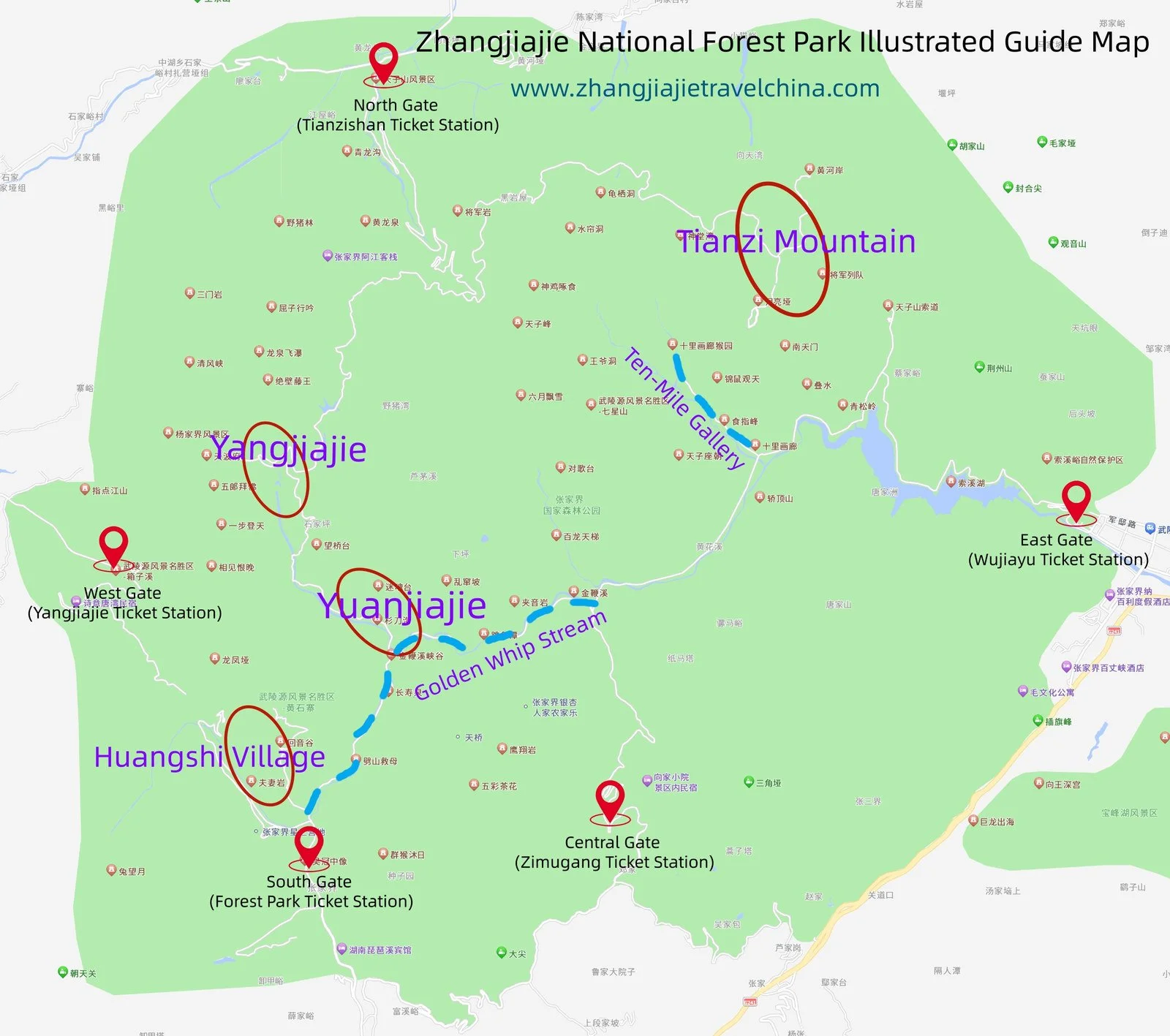
The five gates at a glance
There is one ticket, and it admits you through any of five gates. Which gate you pick decides which mountain you reach first — and therefore how the rest of the day falls.
East Gate (东门 / 吴家峪门票站) — Also called Wujiayu, Landmark Gate (标志门), or "Wulingyuan Southeast Gate". On the edge of Wulingyuan town, so hotels and restaurants are right outside. From the Central Coach Station in Zhangjiajie city: shuttle bus every 10 minutes, 35 km, about 50 minutes, ¥13. Taxi from the airport or rail station: ¥100–150, about 30 minutes. Remember it as: the one for a first visit, or if you only have one day.
South Gate (南门 / 森林公园门票站) — Also called the Forest Park Main Gate or Luoguta (锣鼓塔). Closest gate to Zhangjiajie city, on the south side of the park. From the Central Coach Station: shuttle bus every 10 minutes, 38 km, about 45 minutes, ¥12, and the bus stops right at the gate. Taxi: ¥80–120. Remember it as: the one for Golden Whip Stream, for staying in the city, and for a day trip.
North Gate (北门 / 天子山门票站) — Also called Tianzishan. On the northwest side, 52 km from the city. From the Central Coach Station: minibus toward Zhonghu or Tianzishan, roughly one per hour, 1.5–2 hours on the road. Remember it as: the one that saves you the cable car money.
Middle Gate (中门 / 梓木岗门票站) — Also called Shuiraosimen (水绕四门) or Longweiba (龙尾巴). Near Longweiba Village in Wulingyuan's Xiehe Township. From the Central Coach Station: shuttle bus every 10 minutes, 30 km, about 40 minutes, ¥10. Self-driving or a hired car gets you straight to the village. Remember it as: the one for off-peak entry, or a different route on your second day.
West Gate (西门 / 杨家界门票站) — Also called Yangjiajie. In Zhonghu Township, 14 km from the North Gate. From the Central Coach Station: minibus toward Zhonghu, roughly one per hour, 55 km, about 1.5 hours, then still 2 km on foot from the drop-off. Remember it as: the one for photography, hiking, and if you are happy to hire a car.
The one decision that matters most: match the gate to where you're sleeping. Staying in Wulingyuan and entering at the South Gate means an hour of cross-park transit before you see anything, plus a long walk back to your hotel that night. It is the single most common self-inflicted problem we see — and it is entirely avoidable.
The Google Maps naming trap
⚠️ Read this before you open a map app. The gate names are inconsistent across platforms, and getting it wrong sends you to a gate that is 30 km from the one you booked.
Specifically:
Google Maps labels the East Gate as "Wulingyuan (Southeast Gate)" — 武陵源(东南门). This is wrong. The gate actually called the Southeast Gate is the Middle Gate (Zimugang), a completely different place up on the mountain. You can book the East Gate and still end up pointed at the wrong entrance.
The correct label for the East Gate is 武陵源东门(吴家峪门票站), or simply 吴家峪门票站. Locals also call it 标志门, "Landmark Gate."
Some Chinese-language guides refer to the whole park informally as "阿凡达山" (Avatar Mountain). That is a nickname, not an official name. Search it and you will find blog posts, not a ticket office.
What actually works:
Search using the Chinese characters, not the English translation. Copy them straight into your app.
Show your driver the Chinese name on your phone. Every driver and hotel desk in Zhangjiajie recognises 吴家峪门票站, 森林公园门票站, 天子山门票站, 梓木岗门票站 and 杨家界门票站 immediately.
Save a screenshot of your gate name in Chinese before you lose signal.
Check your booking confirmation before you travel — it names the gate in Chinese, and the turnstile you need is the one matching that name.
Google Maps and Amap also disagree on pin positions for the same gate, because of coordinate offset differences in China. Trust the Chinese name over the pin. If in doubt, call the gate directly — the numbers are in the phone list below.
East Gate (Wujiayu)
The gate that works for most people.
It is the largest and the best organised. Security is fast, the signage is clear, and the internal layout is the easiest to navigate. Wulingyuan town is right there — restaurants, pharmacies, supermarkets, luggage shops.
Getting there: From Zhangjiajie city, the Central Coach Station (next to Zhangjiajie Railway Station) runs shuttle buses every 10 minutes — 35 km, about 50 minutes, ¥13 per person — arriving at the Wulingyuan coach station, roughly 2 km from the gate. Walkable, or take bus 1 or 2 for ¥2. From Hehua International Airport or Zhangjiajie West Station, a taxi or DiDi is ¥100–150 and takes about 30 minutes. If you're staying in Wulingyuan, you can walk it.
Hours: Opens 07:00, closes 17:00 (last entry 17:00). Public holidays open from 06:30. Off-season (1 December to 28 February) opens 07:30.
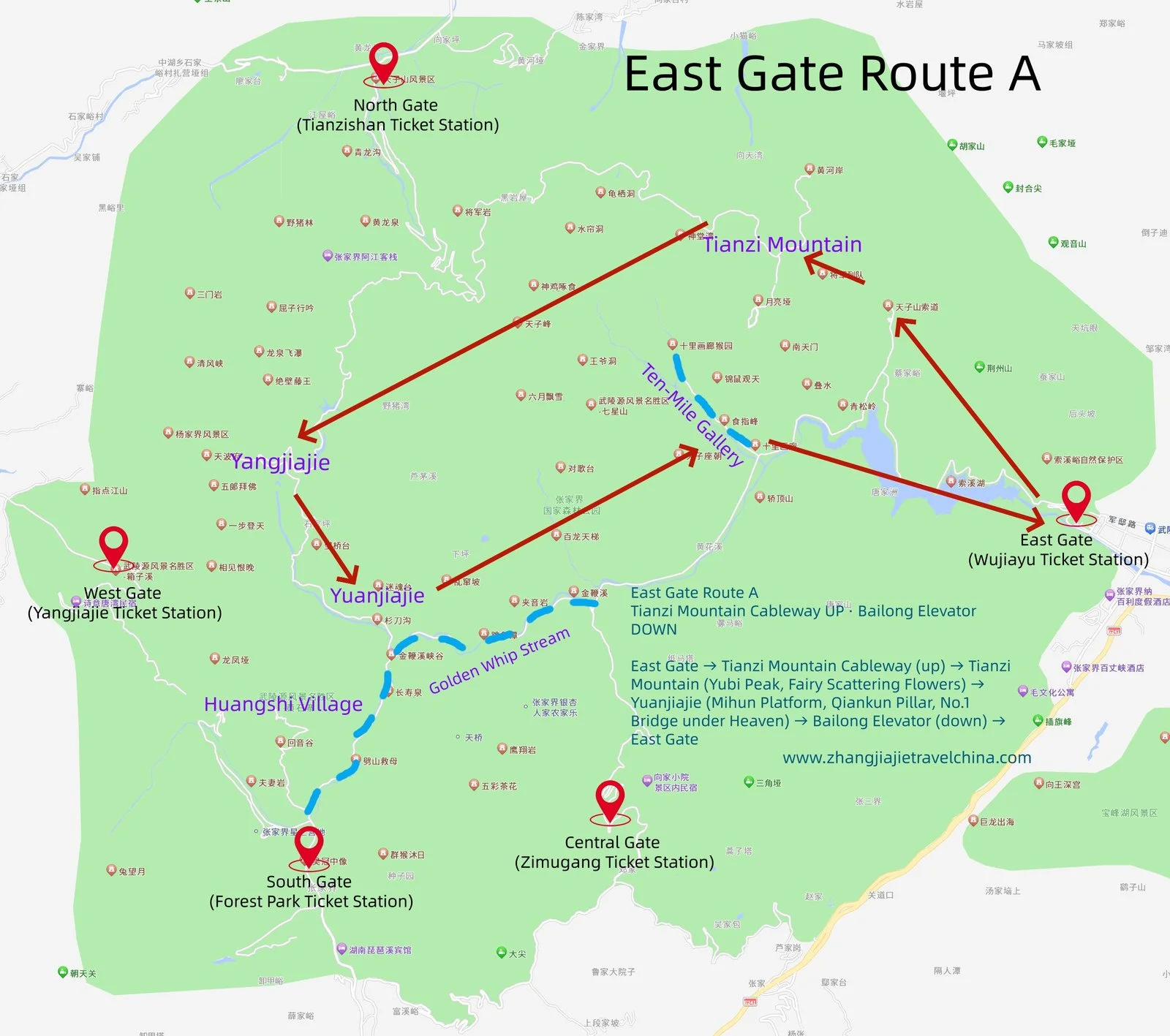
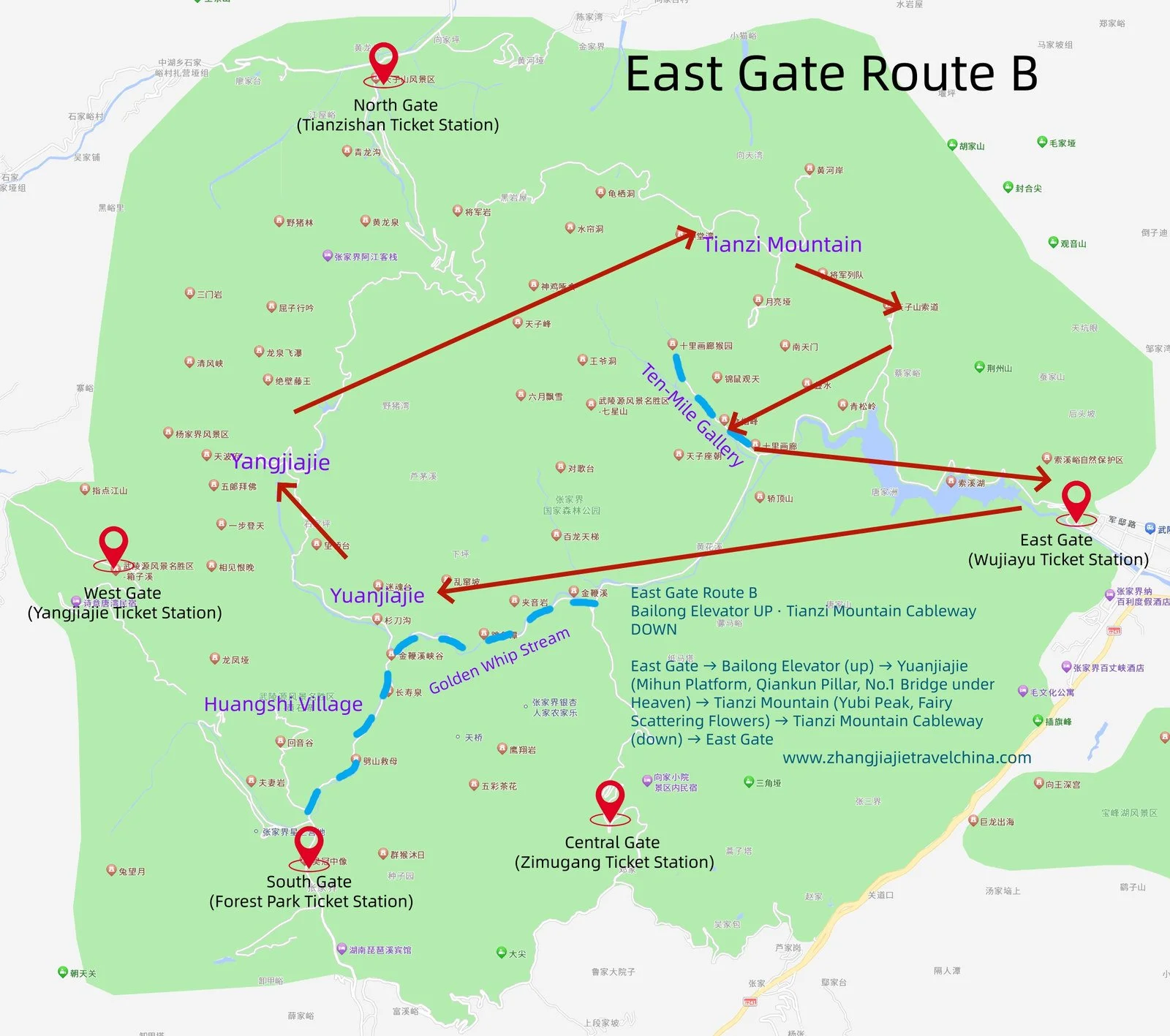
Lines A and B — this is the thing to get right. The East Gate splits incoming visitors by line, and the line is decided when you book, not when you arrive. Line A goes up via the Tianzishan Cable Car. Line B goes up via the Bailong Elevator, and covers Ten Mile Gallery and Shuiraosimen. If Tianzishan or Yuanjiajie is the centrepiece of your trip, check which line you were assigned before you travel. You can switch a booking free of charge through the official WeChat mini-programme, as long as there is availability on the slot you want — but at the gate on the day, changing is often not possible.
Crowds: The East Gate and Middle Gate together take roughly half of all park entries — around 57% by the park's own published figure. The gates are built for high volume and the queue does keep moving, but a queue nonetheless. To walk straight through, arrive between 06:30 and 07:30.
Who it's for: First-timers, anyone with only one day, anyone staying in Wulingyuan, anyone with a family group who wants to be near food and ATMs.
Phone: +86 744 562 8681 — lines, queues, luggage storage.
South Gate (Forest Park)
The old main gate, and the one that puts you in the heart of the park.
This is the entrance in almost every promotional photograph — the stone archway with two pillars and the horizontal signboard. It was the original entrance when the park opened in 1982, and Chinese visitors still call it 正门, "the front gate." The painter Wu Guanzhong came up through it in 1979 and wrote the line that made the park famous; his calligraphy tablets and a UNESCO World Heritage plaque stand a hundred metres inside.
Getting there: Direct shuttles from the Central Coach Station every 10 minutes — 38 km, about 45 minutes, ¥12, and the bus stops right at the gate. Taxi from the city: ¥80–120. If you're staying in Wulingyuan, buses leave the Wulingyuan coach station every 25 minutes from 06:30 to 17:30 — 20 km, 30 minutes, ¥8.
Hours: Opens 07:00, closes 17:00 (last entry 17:00). Off-season opens 07:30. Public holidays from 06:30.
What it's best for: The South Gate goes straight to the heart of the park. The official day route is: South Gate → Huangshizhai cable car station → Huangshizhai → Golden Whip Stream → Ten Mile Gallery → out the East Gate. Huangshizhai cable car return is ¥118; the Ten Mile Gallery train is ¥38 one way. Golden Whip Stream is 7.5 km of flat stone path, and walking it takes two to three hours — with a lot of photos.
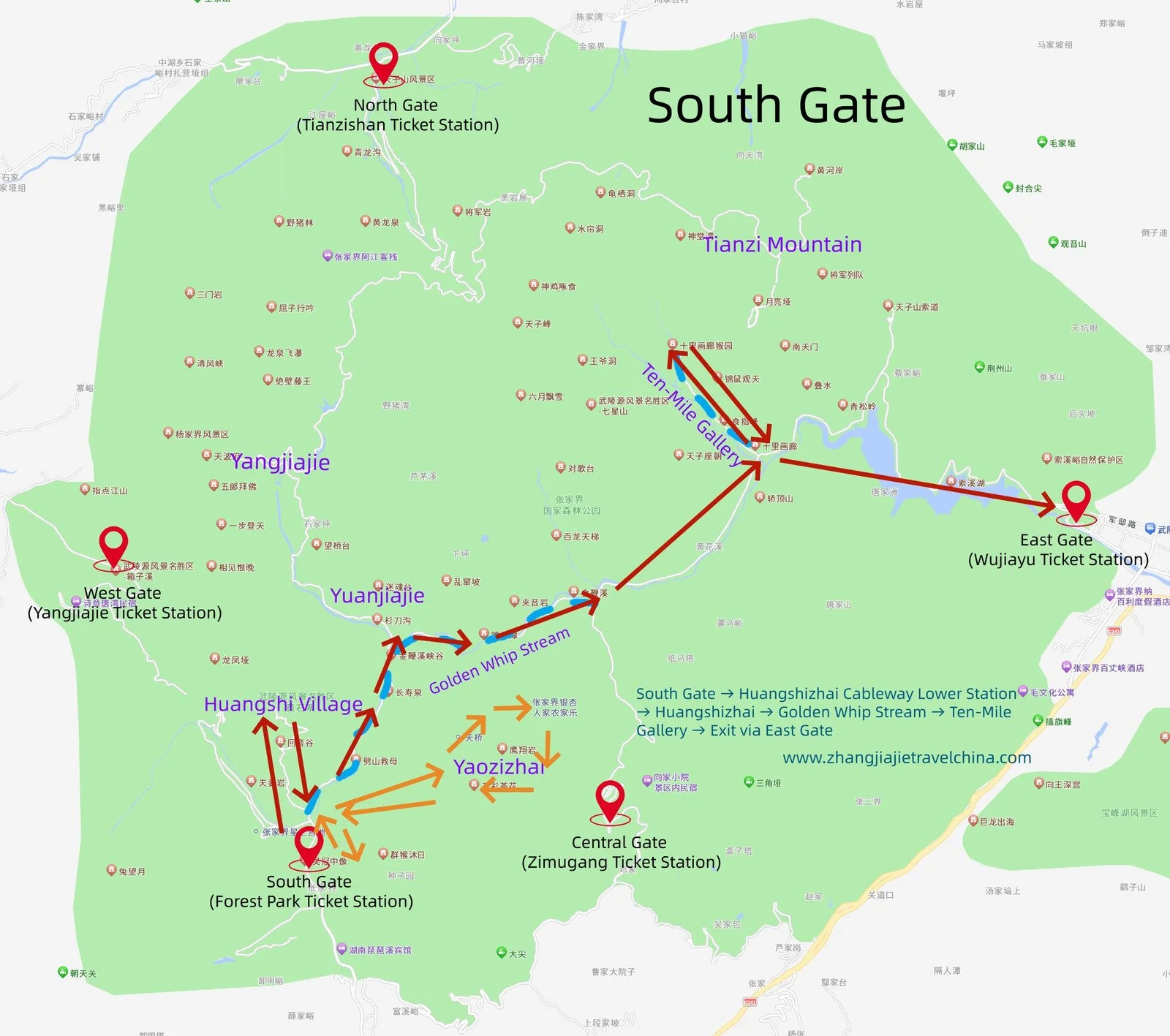
Hiking out from the South: Yaozi Zhai (Hawk's Nest Ridge) runs South Gate → Oxygen Bar Square → Yaozi Zhai → Oxygen Bar Square → back out the South Gate. The official route is a 5.3 km one-way climb from the square, 3–3.5 hours of pure walking, about 4 hours for the full visit. It reopened on 27 September 2025 after ten years of closure for ecosystem restoration, and there is no separate ticket — it is included in your park ticket. The trail from Golden Whip Stream up to Yuanjiajie takes 2–4 hours; the trailhead at Qianlihui is on your left if you enter from the South Gate and on your right if you come up from the East Gate direction. Check the park's notice on the day for whether that stretch is currently open.
Crowds: The South Gate and East Gate are the two busiest entrances, but thanks to timed reservations and on-site crowd-splitting, the actual queue at the South Gate is often shorter than at the East Gate. Our advice: go in with the first wave after opening.
Who it's for: Anyone walking Golden Whip Stream, anyone staying in Zhangjiajie city, anyone doing a day trip.
Phone: +86 744 571 2168 — lines, gate hours.
North Gate (Tianzishan)
The one gate that puts you on top of the mountain for free.
From the North Gate you are already up on Tianzishan. The Bailong Elevator and the Tianzishan Cable Car are both unnecessary — and you skip the queues at both.
Getting there: Minibuses from the Central Coach Station toward Zhonghu and Tianzishan, roughly one per hour. 55 km, 1.5–2 hours on the road. The last stretch is mountain road and genuinely bumpy — if you get carsick, prepare for it.
The luggage problem: This is the North Gate's real catch: are you sleeping up on the mountain tonight or down in the valley? Are you changing hotels tomorrow? Hauling large bags between the bus and the gate is miserable. Leave your luggage with a hotel in the city or in Wulingyuan and walk in light.
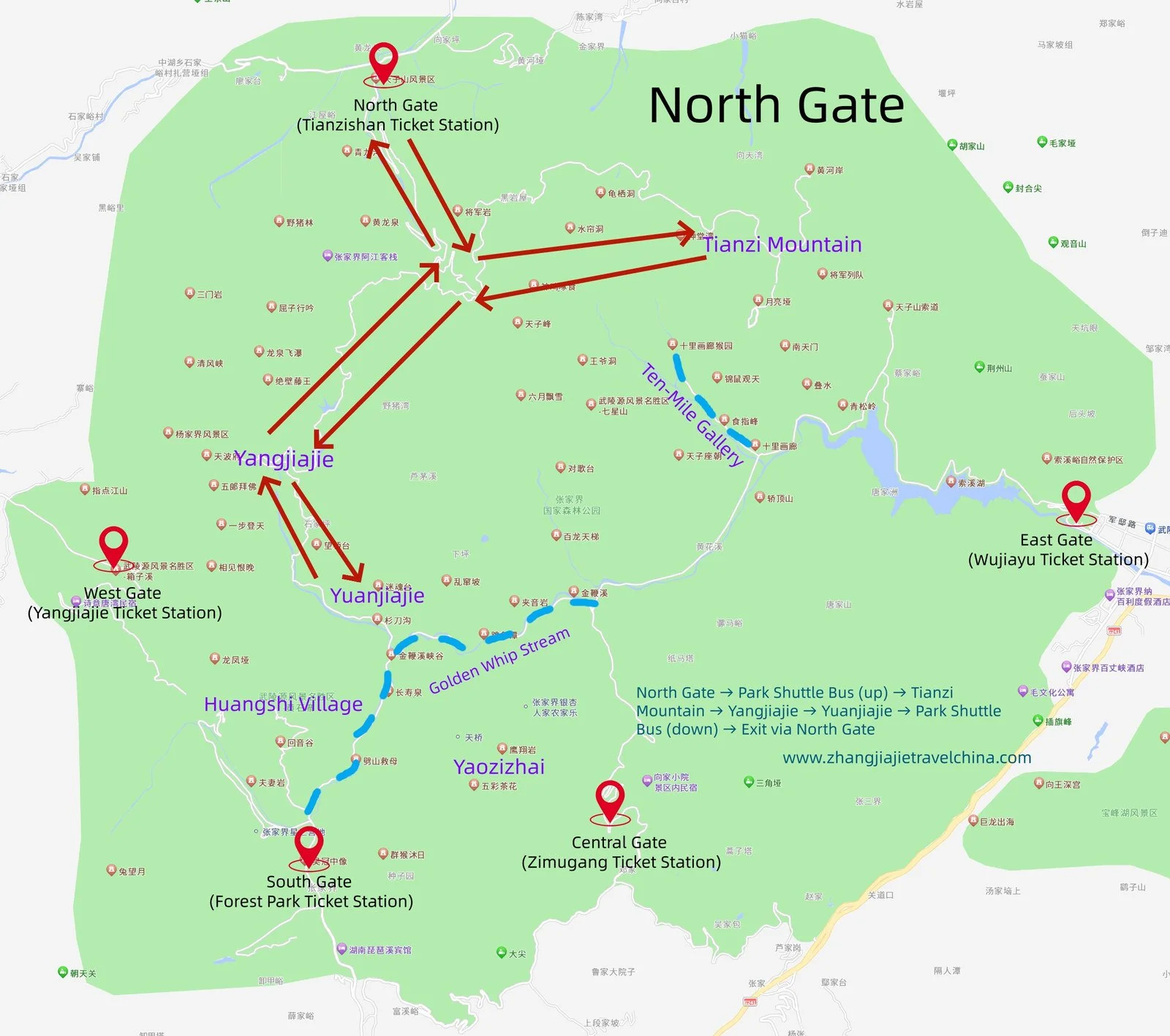
Official one-day route: North Gate → shuttle bus straight up → Tianzishan → Yangjiajie → Yuanjiajie → shuttle bus down → out the North Gate. Nothing extra to buy — the entrance ticket covers the shuttle bus, and you do not need to pay for a cable car or the elevator.
Two variations the park itself publishes:
North Gate → shuttle bus up → Tianzishan → Yangjiajie → Yuanjiajie → Bailong Elevator → Ten Mile Gallery → out the East Gate.
North Gate → shuttle bus up → Tianzishan → Yuanjiajie → Yangjiajie → Yangjiajie cable car down → out the West Gate.
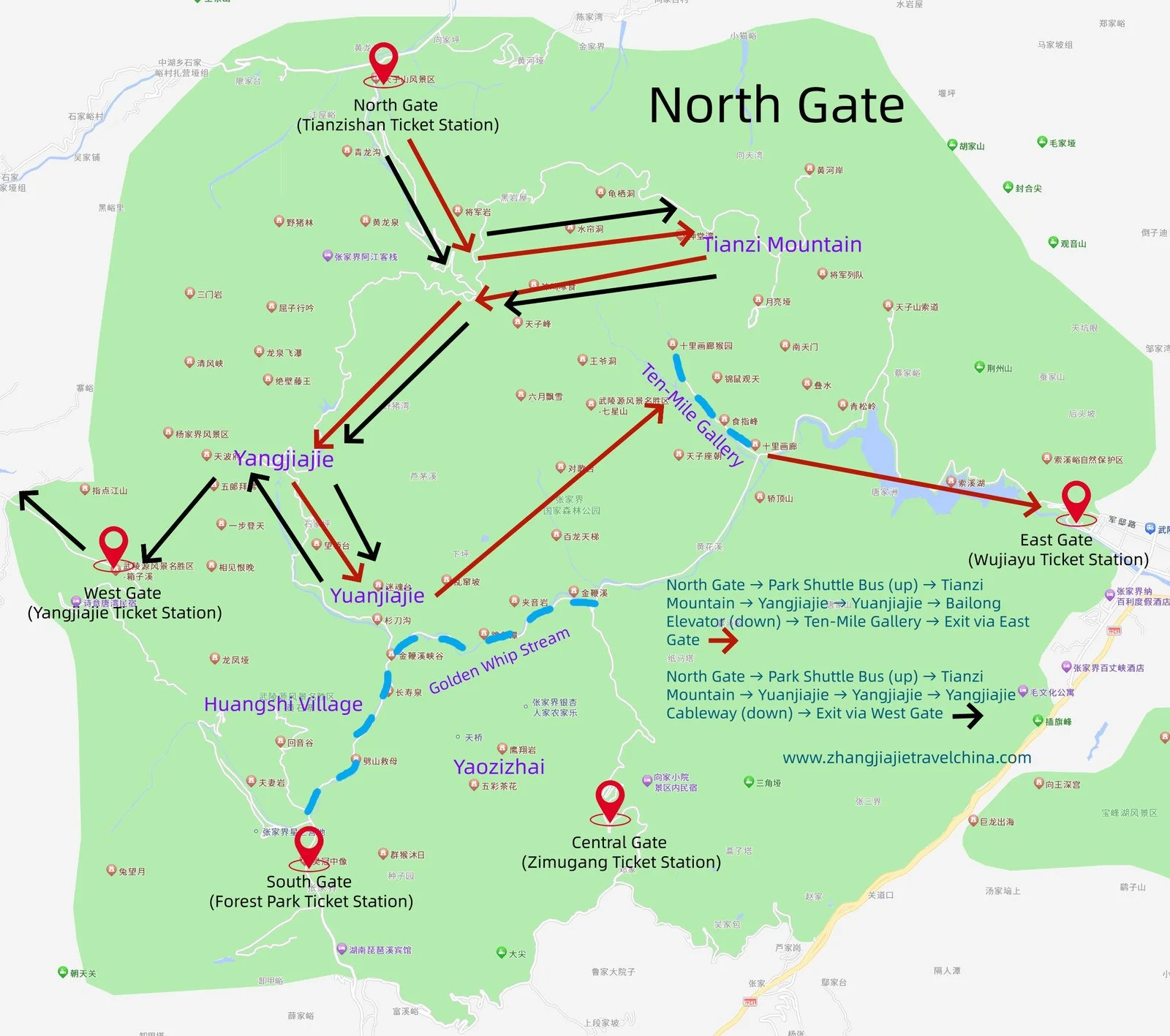
The off-peak value: On public holidays the park itself suggests the North Gate or West Gate. When the East Gate queue starts to make you question your life choices, these two are the answer.
Who it's for: Anyone who wants to skip the cable car spend, anyone stringing Yangjiajie into day two, anyone willing to put up with a bit of inconvenience.
Phone: +86 180 7441 9891 — routes, transfers.
Middle Gate (Zimugang)
The quietest of the five.
Names: Officially Zimugang ticket station (梓木岗门票站), also called the Shuiraosimen (水绕四门) gate. Some guides write it as "Southeast Gate"; on Google Maps it appears as Longweiba (龙尾巴).
Getting there: Shuttle bus from the Central Coach Station every 10 minutes — 30 km, about 40 minutes, ¥10, dropping you near Longweiba Village in Wulingyuan's Xiehe Township. Driving or hiring a car gets you straight to the village.
Position: The quietest gate of the five, with a cluster of high-end guesthouses around it. Its main job is to feed the Shuiraosimen and Bailong Elevator side of the park. When the East Gate is backed up in peak season, this is the "backup entrance."
Important: There is no cable car straight to the top from here. After entry you shuttle and transfer — then take the Bailong Elevator up, or walk Golden Whip Stream. Or simply use it as your second-day entrance to dodge the crowds.
Who it's for: Anyone staying in a boutique guesthouse, anyone avoiding crowds, anyone who wants a different route on day two.
Phone: +86 135 7446 6527 — routes, car hire.
West Gate (Yangjiajie)
Quiet is the entire point.
Yangjiajie has the smallest footfall of the major areas. Getting there from the city is awkward and it is not as famous as Yuanjiajie, which is exactly why the West Gate is quiet.
Getting there: In Zhonghu Township, 14 km from the North Gate, same minibus situation: roughly hourly from the Central Coach Station, about 55 km and 1.5 hours, then still 2 km on foot from the drop-off, or arrange a pickup. Plenty of people hire a car or a driver for this one.
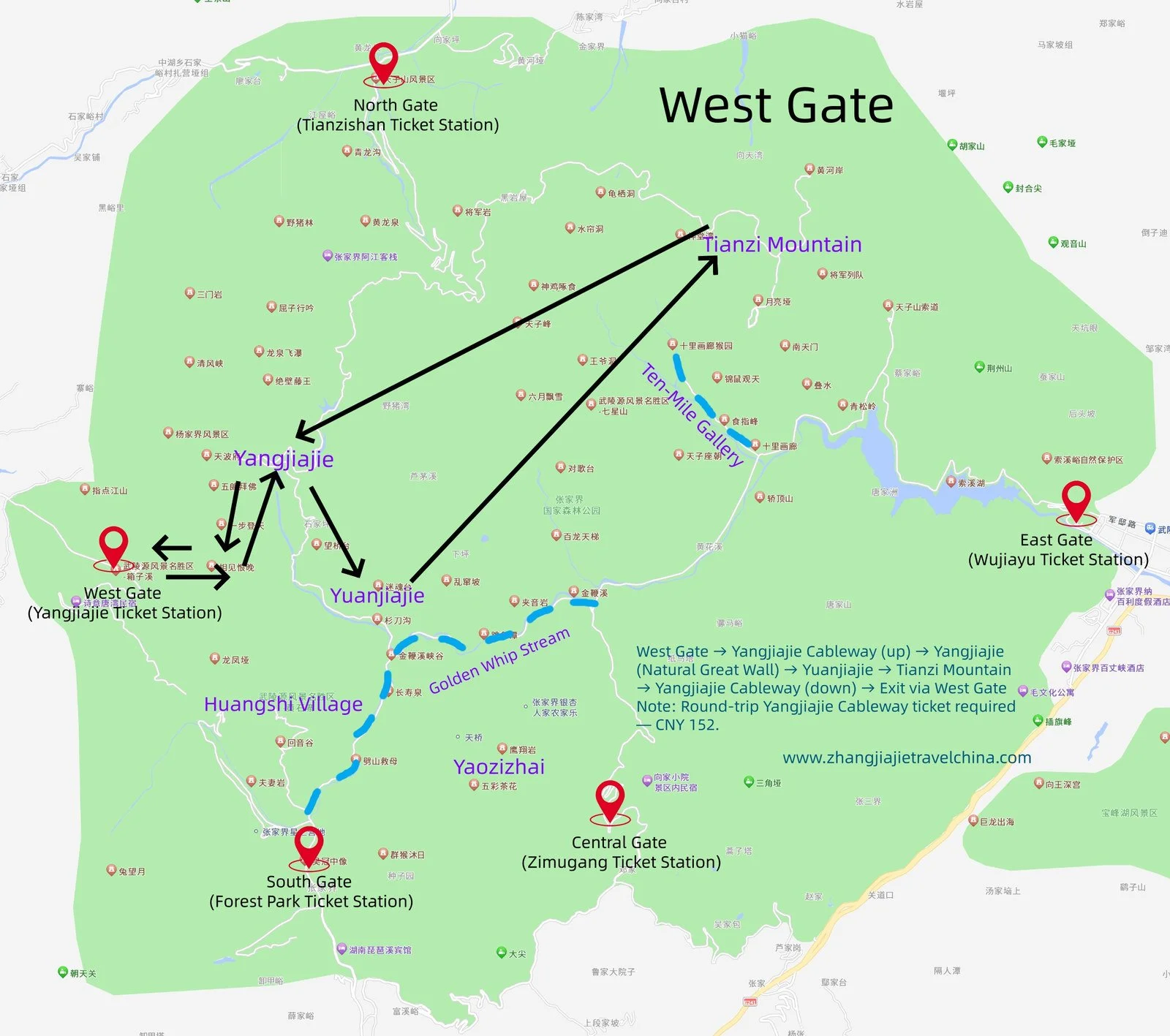
Route: West Gate → Yangjiajie cable car up → Yangjiajie (Natural Great Wall) → Yuanjiajie → Tianzishan → Yangjiajie cable car down → out the West Gate. Yangjiajie cable car return is ¥152.
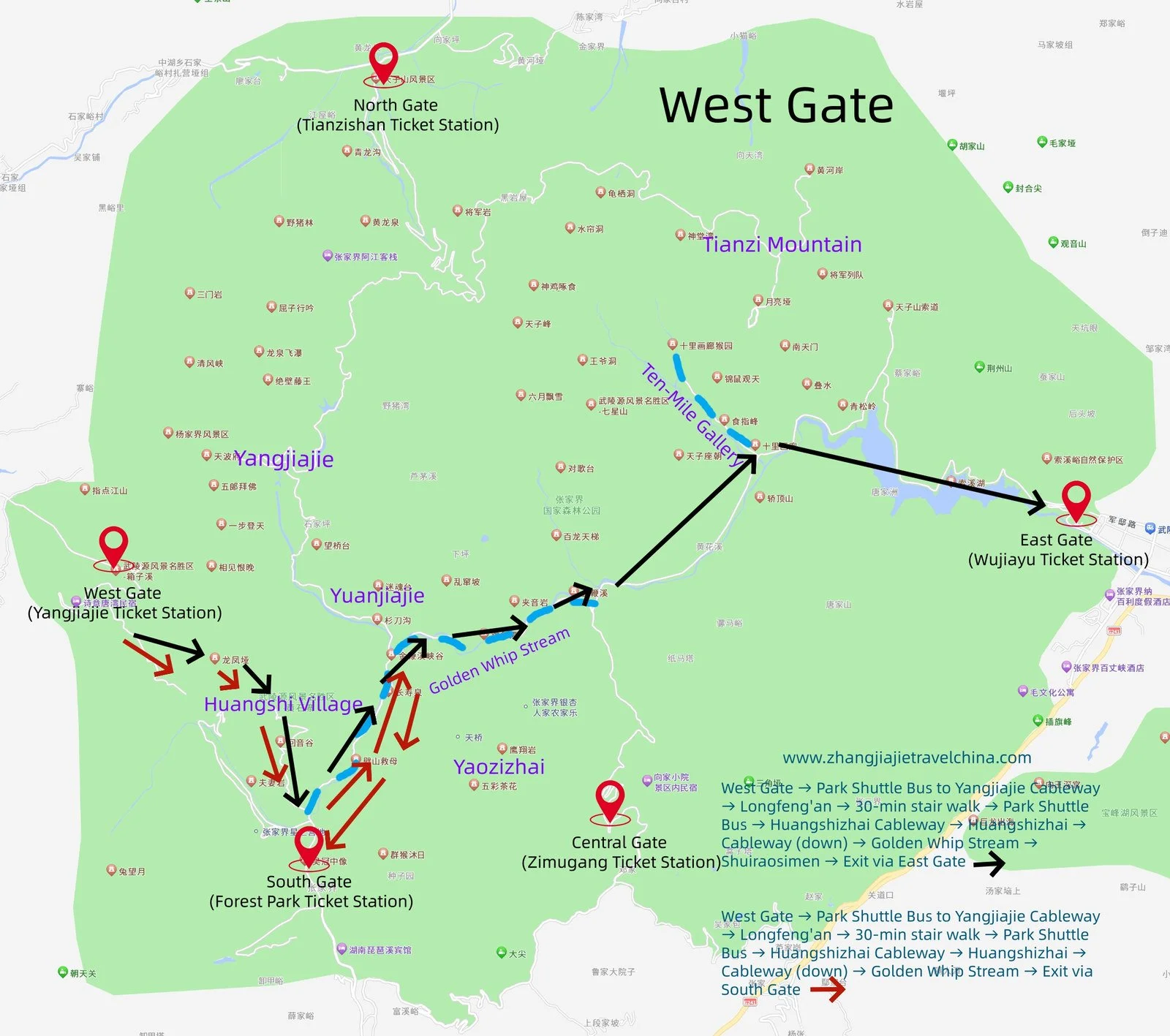
Two longer variations the park publishes:
West Gate → Yangjiajie cable car shuttle → Longfeng Nunnery → half an hour of steps → shuttle → Huangshizhai cable car → Huangshizhai → cable car down → Golden Whip Stream → Shuiraosimen → out the East Gate.
Same, but out the South Gate instead.
Crowds: The West Gate runs at roughly a third of the East Gate's volume. Arriving around 09:00 is comfortable, and the Yangjiajie cable car queue is usually under 10 minutes.
Note: Opens 07:00, closes 17:00 (last entry 17:00); summer and public holidays from around 06:30. Like the North Gate, choosing this gate basically means hiring a car to match your itinerary.
Who it's for: Photography, hiking, people who don't mind walking, and anyone happy to let everyone else have the crowds.
Phone: +86 744 566 8319 — routes, shuttle connections.
The official one-day route for each gate
The park publishes a sample one-day itinerary for the East, South, West and North Gates.
East Gate: East Gate → Tianzishan cable car up → Tianzishan → Yuanjiajie → Bailong Elevator down → Ten Mile Gallery → out the East Gate. Buy separately: Tianzishan cable car ¥72 one way, Bailong Elevator ¥65 one way, Ten Mile Gallery train ¥38 one way. The pace: 1 day, lots of steps, straight up to the ridge and back down to the valley floor.
South Gate: South Gate → Huangshizhai cable car station → Huangshizhai → Golden Whip Stream → Ten Mile Gallery → out the East Gate. Buy separately: Huangshizhai cable car return ¥118, Ten Mile Gallery train ¥38 one way. The pace: 1 day, 1.5–2 hours walking Golden Whip Stream.
West Gate: West Gate → Yangjiajie cable car up → Yangjiajie (Natural Great Wall) → Yuanjiajie → Tianzishan → Yangjiajie cable car down → out the West Gate. Buy separately: Yangjiajie cable car return ¥152. The pace: 1 day, the most walking of the four, the fewest people.
North Gate: North Gate → shuttle bus straight up → Tianzishan → Yangjiajie → Yuanjiajie → shuttle bus down → out the North Gate. Buy separately: nothing — the entrance ticket already includes the shuttle bus. The pace: 1 day, zero extra transport cost beyond the ticket.
Note that the Middle Gate has no official one-day route published. It is a route-changing entrance rather than a standalone day plan.
Pick your gate from your situation
Most people pick an entrance the wrong way round — choosing whichever gate sounds "best" and then bending their itinerary around it. The order that actually works is the reverse: how many hours do you have, where are you staying, how fit are you, do you care about photography — and only then the gate. This is the order we actually use when we book for clients.
First visit, one day only → East Gate. Most direct transport; the turnstiles are built for high volume; the park exit is right at the gate. Watch out for: arrive 30 minutes before opening and go in with the first group.
Staying in Wulingyuan, back to Wulingyuan at night → East Gate. Hotels, restaurants and pharmacies are right outside; entry and exit both painless. Watch out for: the queue is real. Go early, leave early.
Staying in the city, day trip or second night in Wulingyuan → South Gate. The shuttle from the city drops you at the gate in 45 minutes. Watch out for: entering at the South and exiting at the East means arranging the transfer in advance.
Want to skip the cable car and elevator costs → North Gate. The only gate where the shuttle bus takes you straight up to the summit after the ticket check. Watch out for: inconvenient transport, a rough final stretch, and luggage is the biggest problem.
Photography, happy to walk → West Gate. Around a third of the East Gate's footfall; 09:00 is the sweet spot for entry. Watch out for: you will basically need to hire a car to make it work.
Second day, don't want to queue for the Bailong Elevator again → Middle Gate. The most obscure gate; the better guesthouses cluster around it. Watch out for: external transport is poor — self-drive or a hired car is realistic.
Elderly parents or small children, worried about steps → East Gate or South Gate. Shortest distance from the ticket station to a cable car or shuttle stop. Watch out for: the visitor centre rents wheelchairs and has step-free routes.
Hate queues, not in a hurry → Off-season or the first slot of the day. Off-season (December to end February) opens at 07:30 with last entry 17:00 — confirm on the day's notice. Watch out for: the first slot of the day is reliably the quietest.
Arriving by high-speed rail from Changsha that morning → South Gate. The "Forest Park" shuttle from the station takes 45 minutes to the gate; you can leave bags at the entrance and get straight up to Huangshizhai. Watch out for: best if you only have 2 days in Zhangjiajie — the signature Avatar sights are ticked off on day one. Do not attempt it if you arrive after 15:00. South Gate in, South Gate out.
Coming from Fenghuang Ancient Town or Furong Town that day → South Gate. The "Forest Park" shuttle from the station takes 45 minutes to the gate; bags can be stored at the entrance and you are 3 minutes from the Golden Whip Stream entrance. Watch out for: also good for a 2-day Zhangjiajie trip — one ticket, four days, unlimited re-entry. South Gate in, South Gate out.
Tianmen Mountain in the morning, park in the afternoon → East Gate. Afternoon entry genuinely avoids the Bailong Elevator queue going up — though you cannot escape the queue coming down, whether by elevator or cable car. Watch out for: from November to March, do not start from the Tianmen Mountain cable car after 16:00 — it gets dark early, the park empties out and staff go off shift.
Grand Canyon in the morning, park in the afternoon → Middle Gate. The Grand Canyon only takes 2–4 hours, and at midday most tour groups are queuing at the East or South Gate — entering at the Middle Gate gets you to the Bailong Elevator fast. Watch out for: from November to March, do not enter after 16:00 for the same reason.
Tickets: what you actually pay
Entrance ticket (excludes shuttle bus) — ¥165. Valid 4 consecutive days.
Ticket + shuttle bus combo — ¥236. Valid 4 days, shuttle bus free between all park areas.
Concession ticket — ¥119. Chinese citizens only — foreign passport holders pay full price.
Annual pass — ¥310 / year. Includes the shuttle bus, unlimited entries.
Shuttle bus (bought separately) — ¥72. Valid 4 days from purchase — required if you only bought the ¥165 ticket.
Three-cable-one-elevator four-ride pass — ¥238. Any 4 single rides within 4 days (max 4 rides, non-refundable if unused).
Three-cable-one-elevator unlimited pass — ¥298. Unlimited rides on all four within 4 days.
Park-wide cable + shuttle pass — ¥530. 4-day ticket + shuttle bus + all four cable cars and the elevator, unlimited.
Bailong Elevator — ¥65 one way / ¥130 return. 335 m vertical rise, 1 min 28 sec.
Tianzishan Cable Car — ¥72 one way / ¥144 return. Straight up to Tianzishan.
Yangjiajie Cable Car — ¥76 one way / ¥152 return. The main lift for the West Gate.
Huangshizhai Cable Car — ¥65 one way / ¥118 return. The South Gate side.
Ten Mile Gallery train — ¥38 one way / ¥76 return. The full length of the gallery.
Travel insurance — ¥3. Voluntary.
The park also sells seasonal promotional tickets during the off-season and cultural tourism months. They often come with fixed-use windows and strict no-refund terms — check before you buy.
Why you see 239, 477 and 533 online
You will find at least three different prices for what looks like the same ticket. None of them is a mistake, and none of them is a scam — they are different products.
¥236 is the official ticket-plus-shuttle-bus combo from the park itself.
¥239 is what large booking platforms sell for the same bundle, with their own service fee folded in. Same contents, slightly higher price.
¥477 and ¥533 are platform packages combining the entrance ticket with the three-cable-one-elevator passes, again with markup.
How to tell whether you are being overcharged: read what is included. If a package gives you the entrance ticket, the shuttle bus and unlimited cable cars, the official park-wide pass is ¥530 and there is no reason to pay much more. If it gives you the ticket and shuttle bus only, ¥236 is the official price and ¥239 is fine.
The one that catches people: the shuttle bus is free only if you buy the ¥236 combo or the annual pass. If you buy the ¥165 entrance ticket on its own, the shuttle bus is a separate ¥72 ticket, valid for 4 days from purchase. Skip it and you will be trying to walk between the upper ridge and the valley floor — which on foot is 3 to 4 hours one way.
One more thing worth repeating: Zhangjiajie National Forest Park and Tianmen Mountain are different scenic areas. Their tickets do not work on each other, and neither do the Grand Canyon or Glass Bridge tickets.
Booking as a foreign passport holder
This is where most foreign visitors get stuck. Nine rules, and the third one surprises everybody.
First, it is real-name and face recognition. Chinese visitors scan their national ID card; foreign passport holders scan their passport. If you did not bring the physical document, you can do a self-service face scan at the gate, but it is much slower. Bring the passport you booked with.
Second, buying a ticket is not enough — you also need a timed slot. The whole year runs on timed, per-gate, real-name reservations. When you book you choose gate + date + time slot, and the turnstile you walk through is the one matching that gate.
Third, the gate you book is the gate you must use. If you want to change it, you rebook that gate's slot — you cannot simply walk across to a different entrance.
Fourth, four-day validity does not mean four unrestricted days. Your ticket is valid for four consecutive days, but each day's entry needs its own reservation. Re-entry is booked separately through the mini-programme, and the most recent reservation is the one that counts — earlier ones are voided automatically. If you book in advance, each order can hold up to three unused reservations at once, and no more than two per day (one before 11:00, one after).
Fifth, the East Gate has Line A and Line B. Line A goes up by the Tianzishan Cable Car; Line B goes up by the Bailong Elevator. You choose at purchase, and the turnstiles are different. If Yuanjiajie or Tianzishan is the point of your trip, check which line you were given before you travel — and if it is wrong, you can switch online for free, but changing at the gate usually means queueing all over again.
Sixth, foreign passport holders pay full price. Ticket and transport concessions are for Chinese citizens. You pay the adult rate: ¥236 for the ticket-and-shuttle combo, ¥238 for the four-ride pass, ¥298 for unlimited, ¥530 for the park-wide pass. The one exception that applies to everyone: children under 14 enter free on their own passport.
Seventh, a passport booking needs an extra step at the gate. After you pay online with your passport, do not join the queue straight away. You still need to go to a service window to have your face enrolled, and only then will the facial recognition let you through the turnstile.
Eighth, changing a reservation is free. If you booked the wrong gate or slot, you can change it under "reschedule / rebook" in the mini-programme, subject to remaining capacity, with no fee. If you have an overseas phone number, no phone number at all, or no smartphone, you can book manually at the ticket station window — do not get stuck trying to make the mini-programme work.
Ninth, there is a daily cap. Entry is capped at 53,000 people a day (counting first entries, re-entries, free and concession tickets together), but that ceiling is only reached on roughly ten days a year — Spring Festival, Labour Day, the summer holidays and National Day. Without a reservation you cannot get in, but outside those peaks you can usually book a quieter time slot or gate almost whenever you like. The 08:00–10:00 slots at the East and Middle Gates are the tightest; anything after 10:00 opens right up. Check remaining capacity on each slot in the mini-programme before you pay, rather than discovering at the gate that nothing is left.
Getting there
By air: Hehua International Airport (DYG) is about 5 km from the city centre, 45–55 minutes to Wulingyuan. Stay in Wulingyuan and use the East Gate; stay in the city and use the South Gate.
By high-speed rail: Zhangjiajie West Station is about 25 minutes from the city, about 45 minutes to Wulingyuan. Same rule: Wulingyuan means the East Gate, the city means the South Gate.
Via Changsha: Changsha South to Zhangjiajie West takes roughly 2.5 to 3.5 hours. Use the East Gate — but arriving the same afternoon and entering the park that day is usually not realistic. By the time you have checked in and dropped your bags, the last shuttle bus up has gone. See our China train guide for the booking details, and how to pay in China if you have not set up Alipay or WeChat Pay yet.
Self-driving: Parking works at the East Gate and the South Gate. The other three are not realistic in a normal car.
Where to stay
Three bases, and the trade-offs are clear.
Wulingyuan town: Right by the East Gate. Food is easy, and the hotels are ordinary, good hotels. If you are spending two or three days concentrated on the park itself, this is the best base.
Forest Park Gate area (Luoguta): At the South Gate. Quiet, close to Golden Whip Stream, and if you want to walk straight in at 07:00 without getting on a bus, this is the place.
Zhangjiajie city: Cheapest, and convenient for the airport and the night market. But every day costs an extra 40 to 50 minutes each way. Fine for one day, miserable for three.
Two practical notes for foreign visitors. Confirm your hotel will actually accept a foreign passport before you book — a few older properties in smaller towns still decline. And if you are booking a guesthouse near the West or North Gate, ask about luggage transfer in advance: many do it, but not all, and you need to know which one before you commit.
Our full district-by-district breakdown of where to stay covers the rest.
Luggage and how far you will actually walk
Every ticket station has luggage storage — the visitor centres charge around ¥15 a day, so you can leave the big bags at the entrance and walk in light.
The North and Middle Gates need the most care. The last stretch of the North Gate road is genuinely rough, and carrying bags between bus and gate is the single worst practical experience of this park. Leaving them with a hotel in the city or Wulingyuan is much more sensible.
The walking inside the park surprises people. Two stretches catch everyone out: the eco-bus stop below the Bailong Elevator top is about 1.1 km on foot from the elevator exit, and the stop below the Yangjiajie cable car is about 0.9 km from the station. Both are walkable, but only if you know they are there.
Rough distances: Golden Whip Stream 7.5 km end to end; Huangshizhai about 9 km return on foot; Yaozi Zhai 5.3 km one way. A full day across the main peaks comes to roughly 18 km of walking. It is doable, but it is not a casual stroll.
If your legs are not what they were, take the cable cars and the Bailong Elevator. You will still see everything worth seeing.
Money, apps and getting around
Paying: Ticket windows accept foreign currency cash, WeChat Pay, Alipay, UnionPay, and international cards including Visa and Mastercard. The park's own ticketing system supports passport bookings and passport-based facial recognition entry.
The catch is the WeChat mini-programme. Most of this park's ticketing lives inside WeChat, and WeChat generally wants a mainland mobile number for first-time setup and payment binding. If you have an overseas number, go straight to the ticket window (see rule eight above) or ask your hotel to book on your behalf — and make sure they use the official mini-programme rather than selling you a ticket from a third party.
Maps: Google Maps needs a VPN to work inside China, and Google and Amap disagree on pin positions for the same gate because of coordinate offset differences. Navigate by the Chinese place name and on-site signage, and screenshot the gate name in Chinese before you set out. Amap (高德) is what local drivers use and it is accurate here.
Getting around: DiDi and regular taxis cover the city and the main roads. For the West, North and Middle Gates — and honestly for the West Gate in general — you want a car with a local driver. See our DiDi versus taxi guide for the honest cost comparison.
Practicalities worth knowing before you land: Cash is still useful for small shops and rural restaurants. ATMs are common in the city and Wulingyuan, thinner in the villages. Bring a UK-to-China plug adapter. Mobile data — a local SIM or eSIM works, but check whether your phone is carrier-locked before you buy one at the airport.
The monkeys
⚠️ Golden Whip Stream and Ten Mile Gallery both have wild macaques, and they are not shy. They take things straight out of your hand — food, plastic bags, phones, cameras. They can carry rabies.
The rules: do not feed them, do not tease them, do not stare them down. Do not open your bag or a plastic bag in front of them — transparent bags are the worst. If a monkey approaches, do not run and do not wave your arms; back away slowly. If you are scratched or bitten, wash the wound and get to the park clinic straight away.
If you get separated: Agree on a meeting point before you enter — the gate exit or the cable car station plaza are both good. The park runs lost-person announcements and has police posts, so staff can help, but mountains eat signal and time. If someone is genuinely unreachable, call 110.
When to come
Foreign holidays and Chinese peak season do not line up, and that works in your favour.
Avoid July and August — Chinese school holidays make it the busiest stretch of the year — and National Day around 1 October, which is the single busiest week. October and November are the best time to be here: the pillar forest turns red, cloud seas are stable, the skies are clear, and the crowds are noticeably thinner than in summer. March and April are good too — more rain, but the green is fresh.
December to February is the low season. Fewer people, adjusted ticket policies, but some areas close. Check the park's notice for your dates.
Rain is not a problem. Ordinary rain and mist do not stop the cable cars or the Bailong Elevator — they only close if the park issues a specific notice. Plenty of guides get this wrong.
The one window to avoid is 16:00 to 18:30, when the queues to come down from Tianzishan and Yuanjiajie are at their worst. The Tianzishan cable car has less capacity than the Bailong Elevator, so its line is longer. If you cannot wait, come down by the Yangjiajie cable car instead.
Two ready-made itineraries
Two days, staying in Wulingyuan. Day 1: East Gate Line A → Tianzishan → Shen Tang Wan → San Cha Kou → paid electric cart (¥32) → Grand View Terrace → drop bags at the hotel → Old Farmhouse area (including the Sky Farmland). Day 2: hotel → San Cha Kou → Yangjiajie → Wulong Village → Yuanjiajie → Bailong Elevator → Ten Mile Gallery → out the East Gate. Or on day 2, take the Bailong Elevator down and walk the full 7.5 km of Golden Whip Stream to Huangshizhai, then out the South Gate. Line B works just as well for this route — it is simply a different way up.
Three days, changing hotels once. Day 1: South Gate → Golden Whip Stream → Huangshizhai → Longfeng Nunnery → Yangjiajie → Tianzishan → Yuanjiajie → Bailong Elevator → out the East Gate; sleep in Wulingyuan. Day 2: Grand Canyon Glass Bridge → return.
Two days, in and around Zhangjiajie with the Glass Bridge. Day 1: high-speed rail station or airport → Tianmen Mountain → 72 Strange Buildings → sleep in Wulingyuan. Day 2: East Gate Line B → Bailong Elevator → Yuanjiajie → Yangjiajie → Tianzishan → Ten Mile Gallery → out the East Gate. Day 3: Grand Canyon Glass Bridge → depart.
If the Glass Bridge is on day one, book your second night near the Tianmen Mountain cable car so you can reach the 72 Strange Buildings in the light. If the Tianmen Fox Fairy show matters to you, that pushes your first night into the city centre — and an early start the next morning. If you would rather not handle the transfer yourself, our Tianmen Mountain guide covers the logistics, or you can send us your passport details and we will handle the real-name booking.
Why you cannot do Tianmen Mountain on a 14:00 arrival. The airport and the high-speed rail station are only 3.6 km from the Tianmen Mountain cable car — 20 minutes — but you still have to sort luggage and collect tickets, and the park stops checking entry at 16:00. The Glass Bridge is 60 km from the airport or the station, about 1.5 hours, with the same 16:00 cut-off. There is no point rushing.
Linking in Furong Town and Fenghuang Ancient Town. Both towns are best seen at night. The daytime version of either is a shopping street and rather a letdown. A workable order: Tianmen Mountain or the Glass Bridge in the morning → Furong Town in the afternoon → Furong Town at night → Fenghuang Ancient Town at night, sleeping in Fenghuang. Furong Town is a stop rather than a base — there are few hotels and they are expensive — so it is better to stay in Fenghuang. You will need a car with a local driver: no high-speed rail or coach combination gets you through all three in a day, and the road between Furong and Fenghuang is long enough to put taxi prices out of reach. Our Furong Town guide and Fenghuang guide cover both in detail.
Emergency numbers
Police 110 · Ambulance 120 · Fire 119. Park Visitor Service Centre: +86 744 571 2345. Ticket Management Centre: +86 744 571 8833 — use these two for advance bookings (10+ days ahead), large groups and special requirements. If you are booking online more than 10 days ahead, contact the Ticket Management Centre directly.
East Gate (Wujiayu) — +86 744 562 8681. Lines, queues, luggage storage.
South Gate (Forest Park) — +86 744 571 2168. Lines, gate hours.
West Gate (Yangjiajie) — +86 744 566 8319. Lines, shuttle connections.
North Gate (Tianzishan) — +86 180 7441 9891. Lines, transfers.
Middle Gate (Zimugang) — +86 135 7446 6527. Lines, car hire.
Park Visitor Service Centre — +86 744 571 2345. Advance bookings, groups, special needs.
Zhangjiajie Central Coach Station — +86 744 830 5599. Shuttles from the city to every gate.
Booking channels: the WeChat mini-programme Zhangjiajie Tourism Assistant (张家界旅游小助手) — which has an English version — the official One-Trip Zhangjiajie (张家界一机游) shopping mini-programme, and the park's English service site at tourist.mpzjj.com, which handles booking, reservations, live queue information and park webcams.
Frequently asked questions
Can I enter at one gate and leave at another?
Yes, and for most routes you should. The park is a loop, the shuttle buses connect it, and the ticket is not tied to a single entrance. The exceptions are the gates that need a private transfer out — West, North and Middle — so plan the pickup before you commit.
Do I have to book a time slot, or can I just buy a ticket at the gate?
You need a reservation. Capacity is limited and the turnstiles check it. Use the official mini-programme with your passport details, or book at the ticket station window. Note that turning up at the gate on a peak day is a real risk.
Which gate is closest to the airport?
The South Gate — about 40 minutes via the city, assuming normal traffic.
Is the East Gate always queueing?
The East Gate has the most people but it is also the fastest. The genuinely painful stretch is 08:30 to 11:00 at the South Gate, because the East Gate has more lanes and more staff.
I only have one day — what should I do?
East Gate, first slot. Up the Bailong Elevator to Yuanjiajie, then across to Tianzishan. About 18 km of walking on the full loop. You can finish it, but it is not a leisurely day.
Can I drive right up to the gate?
East Gate and South Gate, yes. I would not plan on the other three.
Can I get into the park with just a passport and no visa-free eligibility?
Your passport is what matters for the ticket — entry into China is a separate question. If you are not sure about visa-free entry for your nationality, our visa-free guide lists the 50 countries currently covered and the 240-hour transit option.
Do I need a guide?
Not for the standard routes — the shuttle buses and the signage are clear, and the app does most of the work. But a driver for the West, North and Middle Gates is close to essential, and if you are combining Tianmen Mountain, the Glass Bridge and Fenghuang in one trip, a private car and driver removes most of the stress.
A note on sources
Prices, hours and booking rules here were checked in October 2026 against the Wulingyuan District tourism bureau's official ticket page, the Hunan provincial price bureau's tariff for Wulingyuan core area admission (湘发改价费规〔2024〕977号, effective 1 January 2025), the Zhangjiajie municipal price bureau's shuttle bus tariff notice (张发改价费〔2025〕33号, effective 1 January 2026), the park's official hiking route notes, and the park's own WeChat reservation guidance.
Two figures that circulate widely online and are wrong: the shuttle bus does not cost ¥40 or ¥71 — the official government tariff since 1 January 2026 is ¥72. And the ¥477 "cable car package" is a third-party platform price, not an official park product.
The park's official channels on the day are the final word on anything here.
Planning it with us
The gate you book depends on your arrival time, where you are staying, which line you get assigned and the mountain weather on the day — and those only come together once we know your dates.
Send us your dates and where you are staying, and we will tell you which gate to book, which line to choose and what time to be at the shuttle bus stop. No charge for that answer.
If you would rather have someone handle the whole thing, our Zhangjiajie private tours cover the park with your own guide and car, and we can re-plan around a closure at no extra charge.
You can also work through the practicalities first: 19 things every foreign traveller should know before coming to Zhangjiajie, how to pay in China, China train travel for foreigners, visa-free entry for 50 countries, and our complete Zhangjiajie National Forest Park guide for the sights rather than the gates.