
Xinjiang Tours — Silk Road, Kanas & Heavenly Lake
xinjiang
xinjiang
Filters

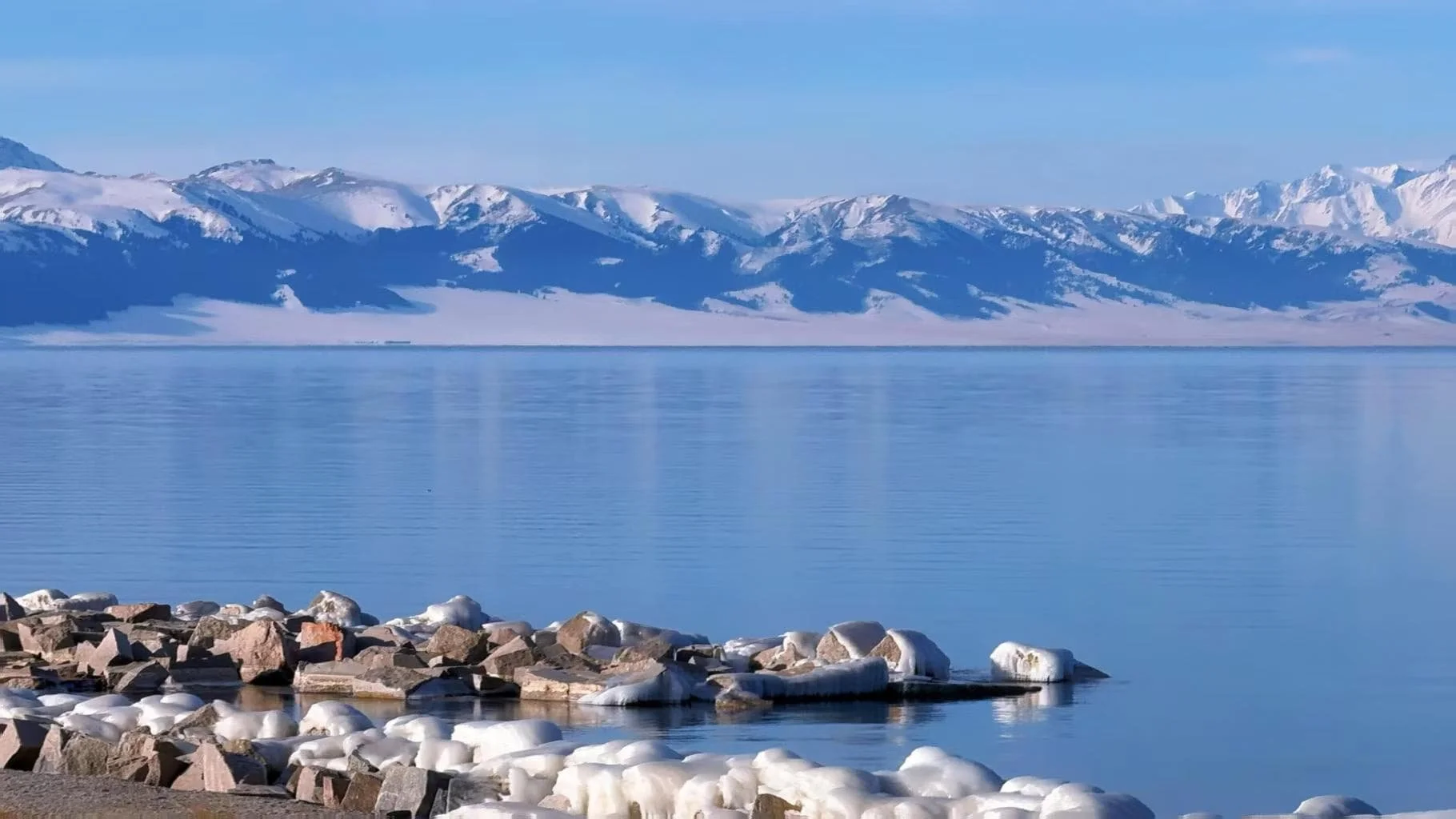
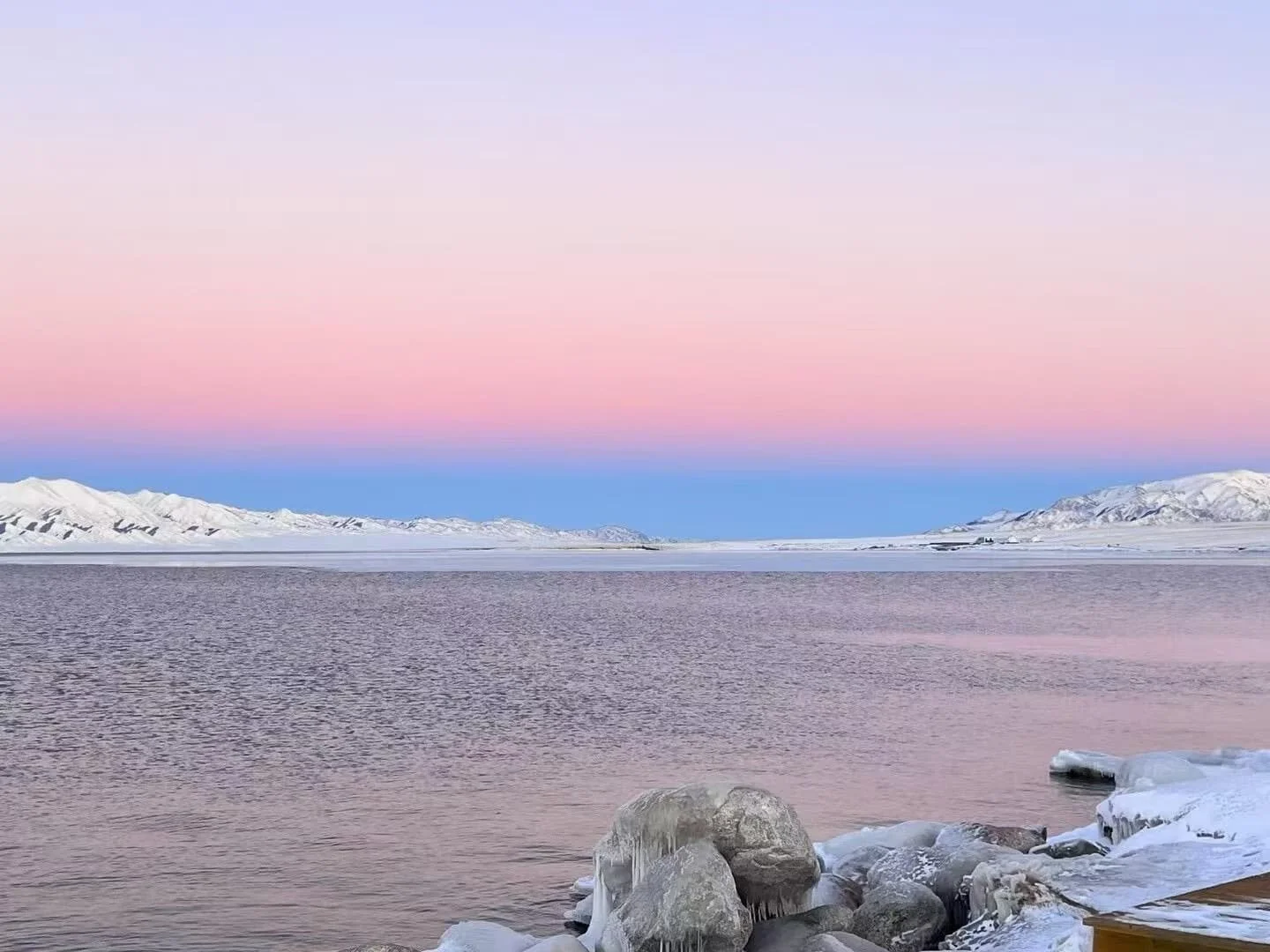
Discover Xinjiang in Just One Day — Four Unforgettable Options
Xinjiang (新疆) is China's largest province — a vast, mesmerizing land of snow-capped peaks, endless deserts, lush grasslands, and oasis cities that have connected East and West for over 2,000 years along the Silk Road. Starting from Urumqi (乌鲁木齐), the capital and one of the most inland cities on Earth, you can reach dramatically different landscapes within just 1–3 hours. That's the magic of this region: in a single day, you can stand on a glacier-fed alpine lake, walk through a 2,000-year-old oasis village, ride a horse across a Kazakh prairie, or browse the vibrant stalls of a Central Asian bazaar.
This private one-day tour gives you four carefully designed options, each showcasing a completely different face of Xinjiang. With a private guide and vehicle, you set the pace, ask all the questions you want, and experience the real Xinjiang — not the version in tourist brochures.
💡 Not sure which option to pick?
• Option 1 (Tianshan Heavenly Lake) — Love mountain scenery and alpine lakes? This is the #1 day trip from Urumqi.
• Option 2 (Turpan) — Fascinated by Silk Road history, extreme heat, and oasis culture? Turpan is otherworldly.
• Option 3 (Nanshan Pasture) — Want grasslands, Kazakh culture, and horseback riding? This is your escape to nature.
• Option 4 (Urumqi City Walk) — Prefer culture, food, and city life? Discover the soul of modern Xinjiang.
Option 1 Tianshan Heavenly Lake (天山天池)
Just 1.5 hours from Urumqi, Tianshan Heavenly Lake (天池) is one of Xinjiang's most iconic natural wonders — a crystal-clear alpine lake set at 1,980 meters above sea level, surrounded by snow-capped Tianshan peaks and dense spruce forests. The lake has inspired poets and painters for over 2,000 years; it's said to be the bathing place of the mythical Queen Mother of the West (西王母). Whether you see it under deep blue skies or wrapped in mist, it is unforgettable.
Early Morning — Depart Urumqi & Ascent to Heavenly Lake
Your guide picks you up from your Urumqi hotel at 7:30–8:00 AM. The drive takes you north into the Tianshan Mountains, along a winding mountain road that climbs steadily through dramatic gorges and past rushing mountain streams. As you ascend, the air turns crisp and cool — a refreshing break from Urumqi's dry heat.
Along the way, your guide will share legends of the Tianshan range, which stretches 2,500 km across Central Asia and forms the backbone of Xinjiang's geography. You'll also learn about the Queen Mother of the West mythology that surrounds Heavenly Lake — an ancient Chinese legend so powerful that the lake remains a place of pilgrimage for some visitors.
Mid-Morning — Arrive at Heavenly Lake & lakeside Walk
Arrive at the scenic area and take the shuttle bus (included) up the final winding road to the lake shore. Your first glimpse of the water — turquoise and mirror-still, framed by spruce-covered slopes and the jagged white peak of Bogda Peak (博格达峰, 5,445m) in the distance — will stop you in your tracks.
Walk along the lakeside boardwalk, which hugs the shoreline for about 2 km with minimal elevation gain. Your guide will point out the different tree species (spruce, Siberian fir, and hardy alpine wildflowers in summer), and explain how the lake was formed: a glacial moraine dam created this natural reservoir over 10,000 years ago.
Dinghai Shenzhen (定海神针 — "Stabilising the Sea Tree") — Look for the famous 19th-century cedar tree that appears to "stabilize" the lake. It's a beloved local landmark, and your guide will tell you the folklore behind its name. The tree is over 150 years old and still standing proud above the water's edge.
Midday — Qianlongyuan Hidden Dragon Abyss & Feilongtan Waterfall
Continue along the Qianlongyuan Hidden Dragon Abyss Trail — a scenic forest path that leads deeper into the spruce woods away from the main lakeside crowds. The trail is peaceful, with bird song and the scent of pine filling the air. In autumn (September–October), the forest turns golden — it's widely considered the most beautiful season at Heavenly Lake.
Along the trail, you'll reach Feilongtan (飞龙潭 — "Flying Dragon Pool") Waterfall — a seasonal waterfall that roars in spring (fed by snowmelt) and trickles gracefully by late summer. Even when the water is low, the setting — a clear pool surrounded by moss-covered rocks and hanging vines — is magical. Your guide will help you find the best photo spots along the trail.
Afternoon — Mayashan Cable Car & Panoramic View
For a truly spectacular perspective, take the Mayashan Cable Car (马牙山缆车) up the opposite side of the lake. The gondola climbs to approximately 2,700 meters, giving you a bird's-eye view of the entire lake below — a shimmering turquoise oval set amid dark spruce forest and ringed by snowy peaks. On clear days, you can see Bogda Peak reflected perfectly in the water from this vantage point.
The cable car ride itself is an experience: the gondolas are enclosed and safe, and the views unfold gradually as you ascend. At the top station, a short walk leads to a viewing platform with 360° panoramic views — you can see all the way back to the desert flats near Urumqi on exceptionally clear days.
After descending, board the shuttle bus back to the parking area and begin the return drive to Urumqi, arriving at your hotel around 5:30–6:00 PM.
Option 2 Turpan (吐鲁番) — The Hottest Place in China
Turpan (吐鲁番) is one of the most extraordinary places on Earth — a depresssion basin that sits 154 meters below sea level, where summer temperatures regularly exceed 45°C (113°F), and where some of the driest desert on the continent meets a 2,000-year-old irrigation system that turns sand into lush oasis. This is the heart of the northern Silk Road, where Uyghur culture, Buddhist history, and extreme geography converge. The 3-hour drive each way is long — but for travelers who love history, culture, and otherworldly landscapes, Turpan is an absolute must.
Morning — Drive to Turpan & Tuyugou Mazha Village (吐峪沟麻扎村)
Depart Urumqi at 7:00 AM for the 3-hour drive east to Turpan. The landscape transforms dramatically along the way: from Urumqi's semi-arid flats to the rocky, rust-colored hills that announce your arrival in the Turpan Depression. Your guide will explain the region's unique geography — a rain shadow desert where fewer than 20mm of rain falls per year, yet civilization has thrived here for over 2,000 years thanks to an ingenious underground water system.
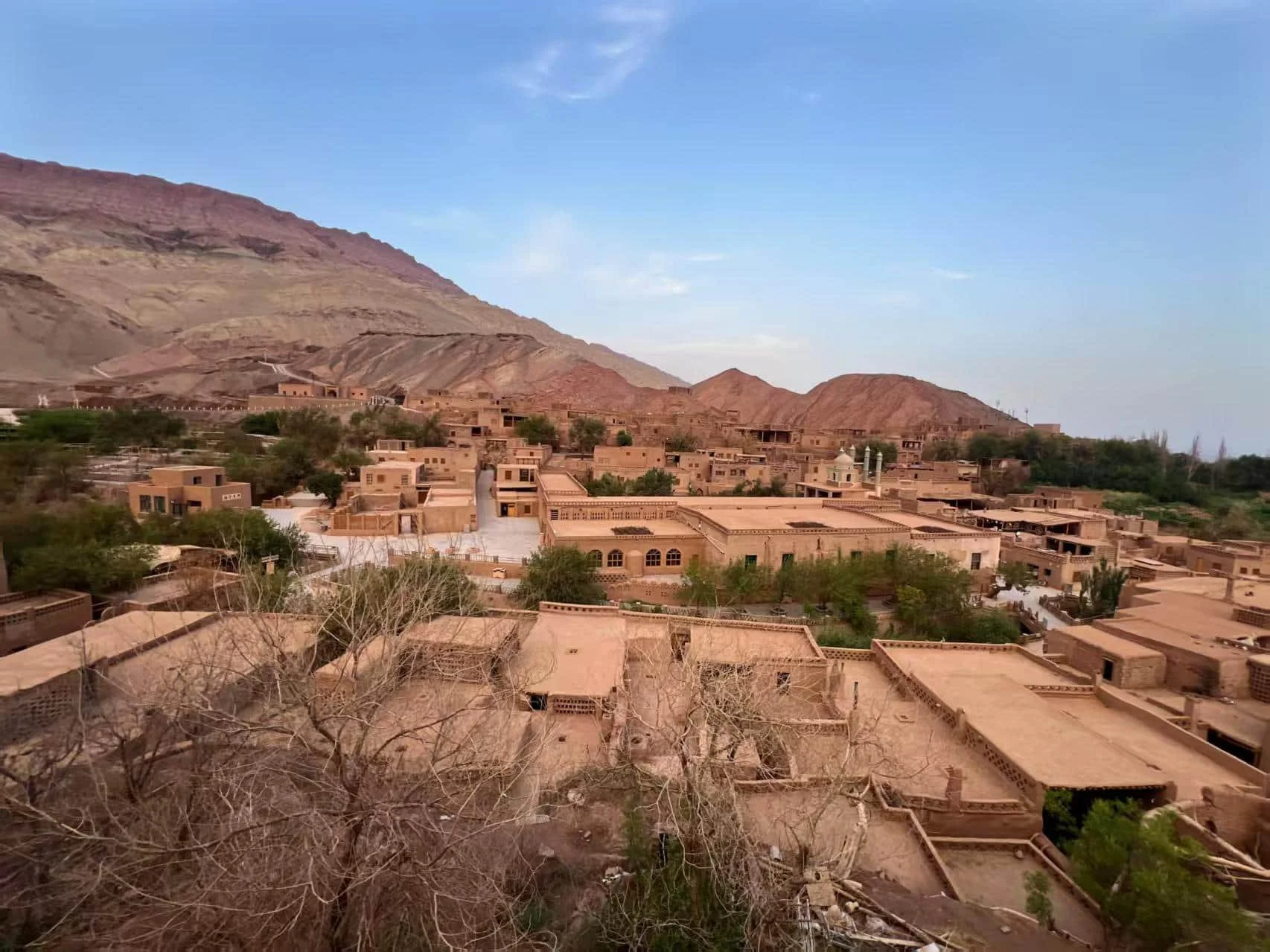
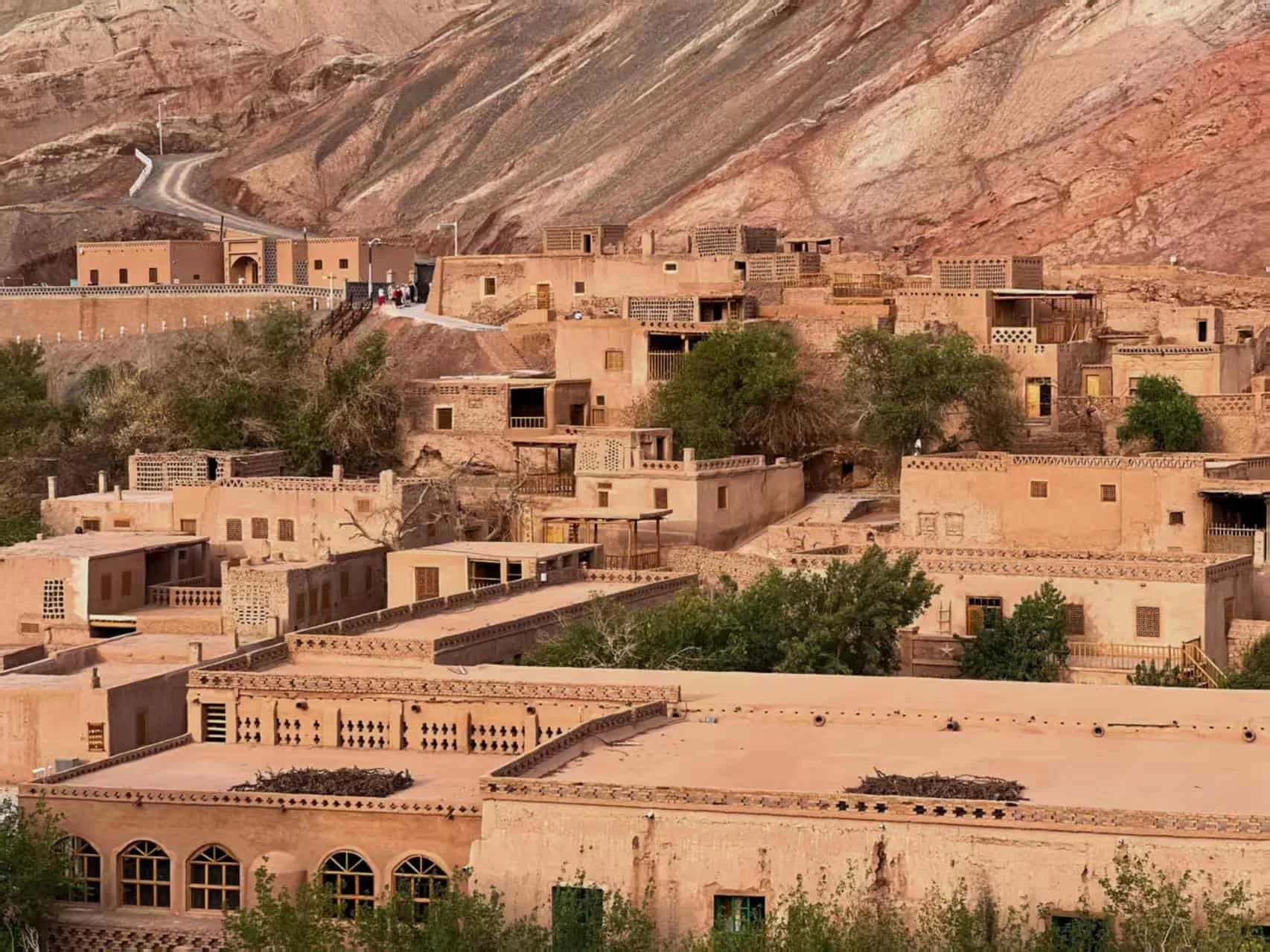
Arrive at Tuyugou Mazha Village (吐峪沟麻扎村) — one of the oldest continuously inhabited settlements in Xinjiang, with a history stretching back over 1,000 years. The village is built into the foothills of the Flaming Mountains, its mud-brick houses cascading down the slope in warm ochre and terracotta tones. This is a living Uyghur village — not a museum — where local families still live in the same courtyard homes their ancestors built centuries ago.
Walk through the village's narrow alleys, visit the Mazha (shrine) that gives the village its name (an important pilgrimage site for local Muslims), and learn about Uyghur architectural traditions: mud-brick construction, central courtyards, and flat roofs used for sleeping on hot summer nights. Your guide will introduce you to local villagers (with permission) and help you understand the deep cultural roots of this remarkable place.
Midday — Flaming Mountains (火焰山) & Desert Sunset
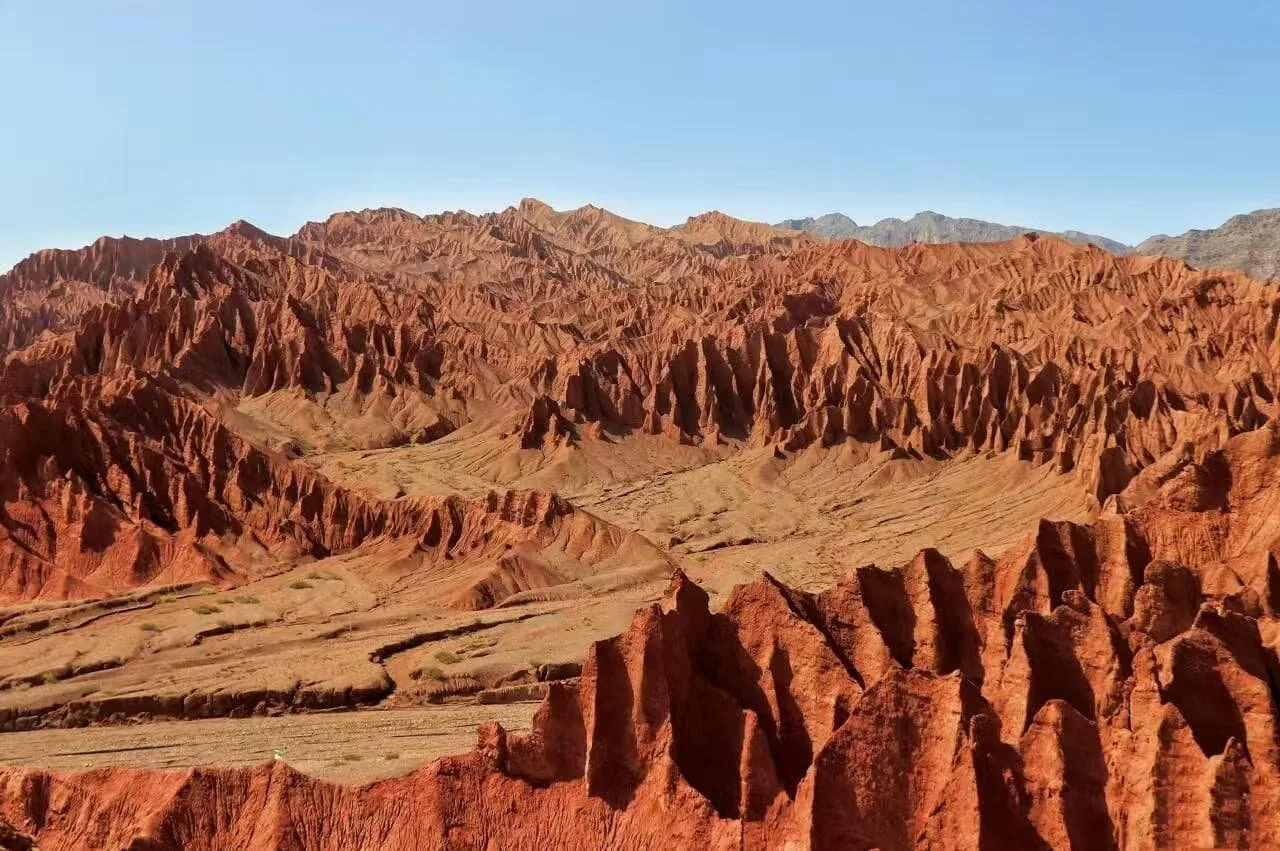
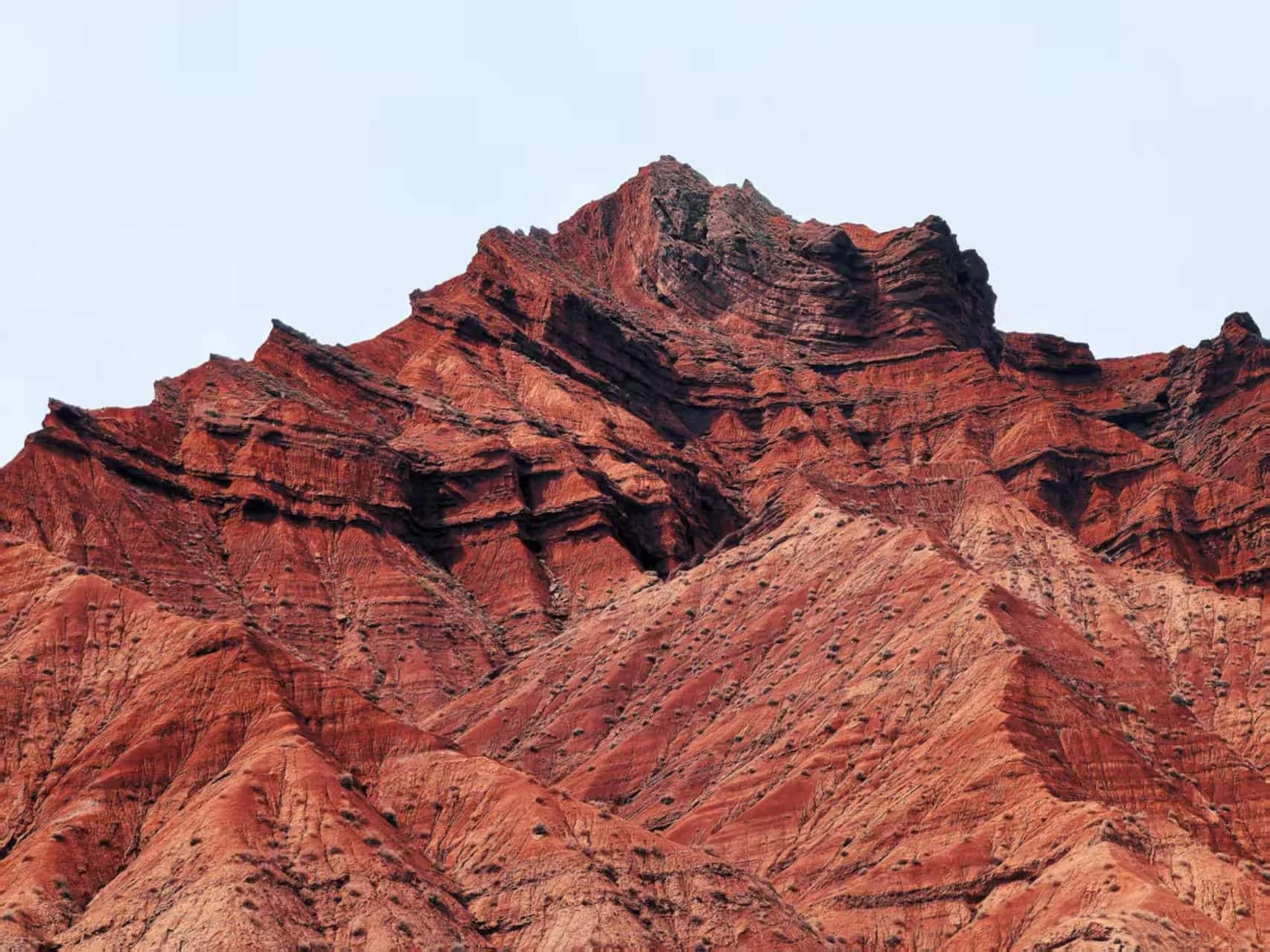
Next, visit the Flaming Mountains Scenic Area (火焰山景区) — a 100km-long ridge of red sandstone that glows an intense, flame-like orange-red under the sun. This is the landscape made famous by the classic Chinese novel Journey to the West (西游记), in which the Monkey King battles the demon king of the Flaming Mountains. The temperature here regularly hits 50°C (122°F) at ground level in July and August — hence the name!
Don't worry — we provide plenty of water and schedule this stop for the cooler morning or late afternoon hours. The scenic area has a giant thermometer monument (a popular photo spot) and informative displays about the region's extreme climate and its role in the Silk Road.
In the evening, witness the breathtaking desert sunset at Kumtag Desert (库木塔格沙漠) — one of the few deserts in the world that literally bumps up against a city (Shanshan County, on the edge of Turpan). As the sun drops, the dune colors shift from burnt orange to deep crimson to soft purple. It's a profoundly beautiful moment and a perfect end to your Turpan adventure.
Board your private vehicle for the 3-hour return drive to Urumqi, arriving at your hotel around 9:00–10:00 PM.
Option 3 Nanshan Pasture (南山牧场) — Kazakh Grasslands
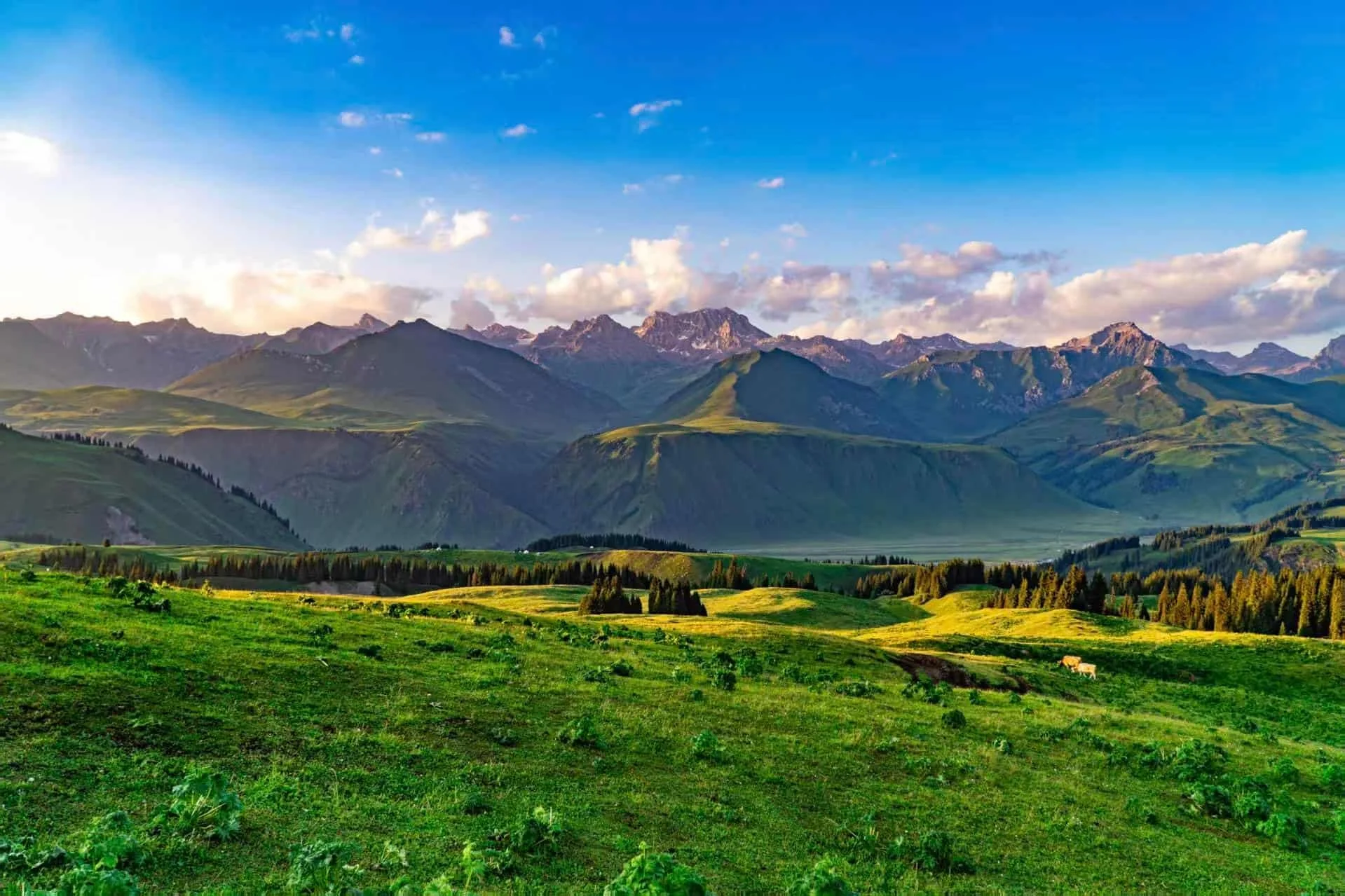
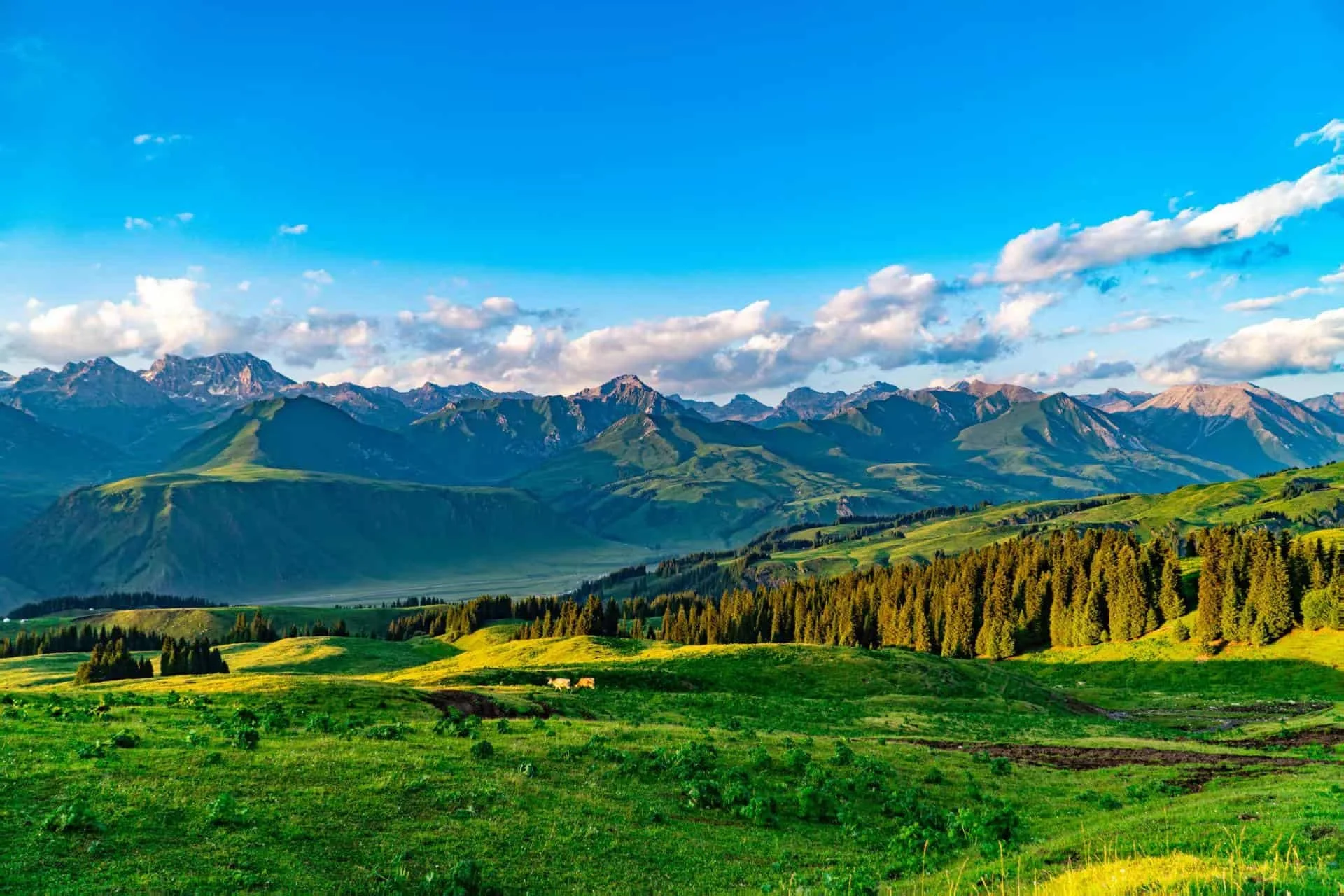
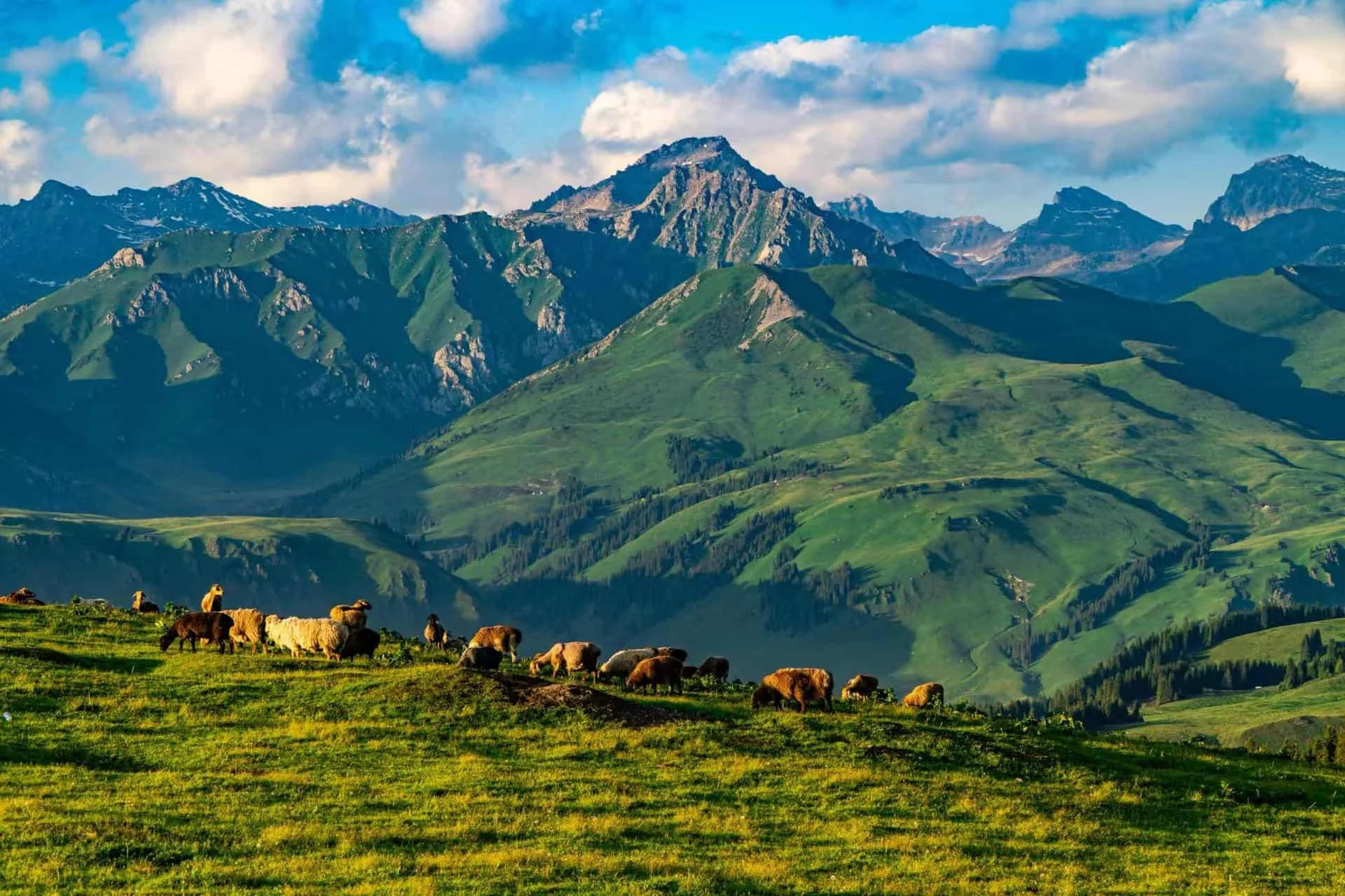
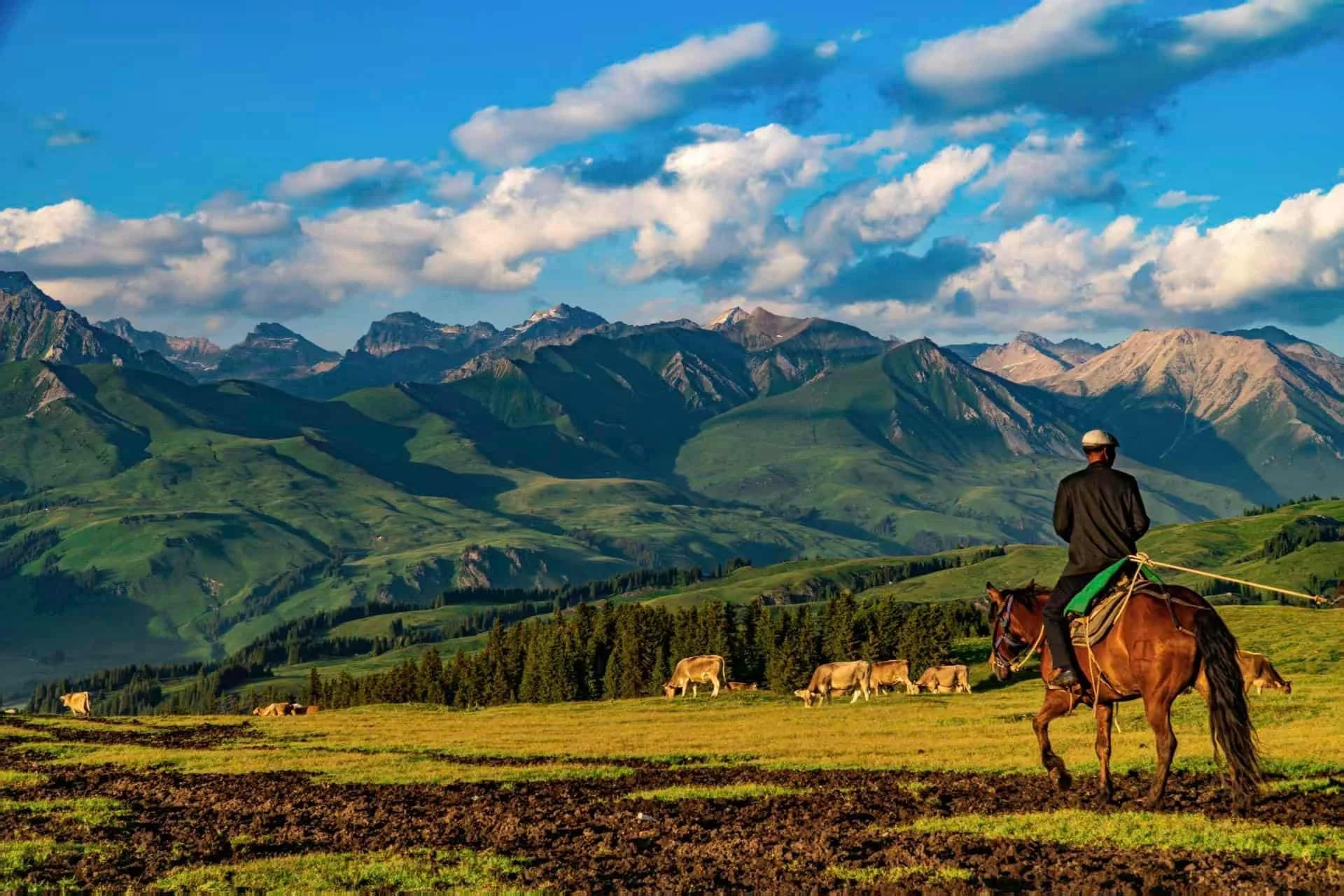
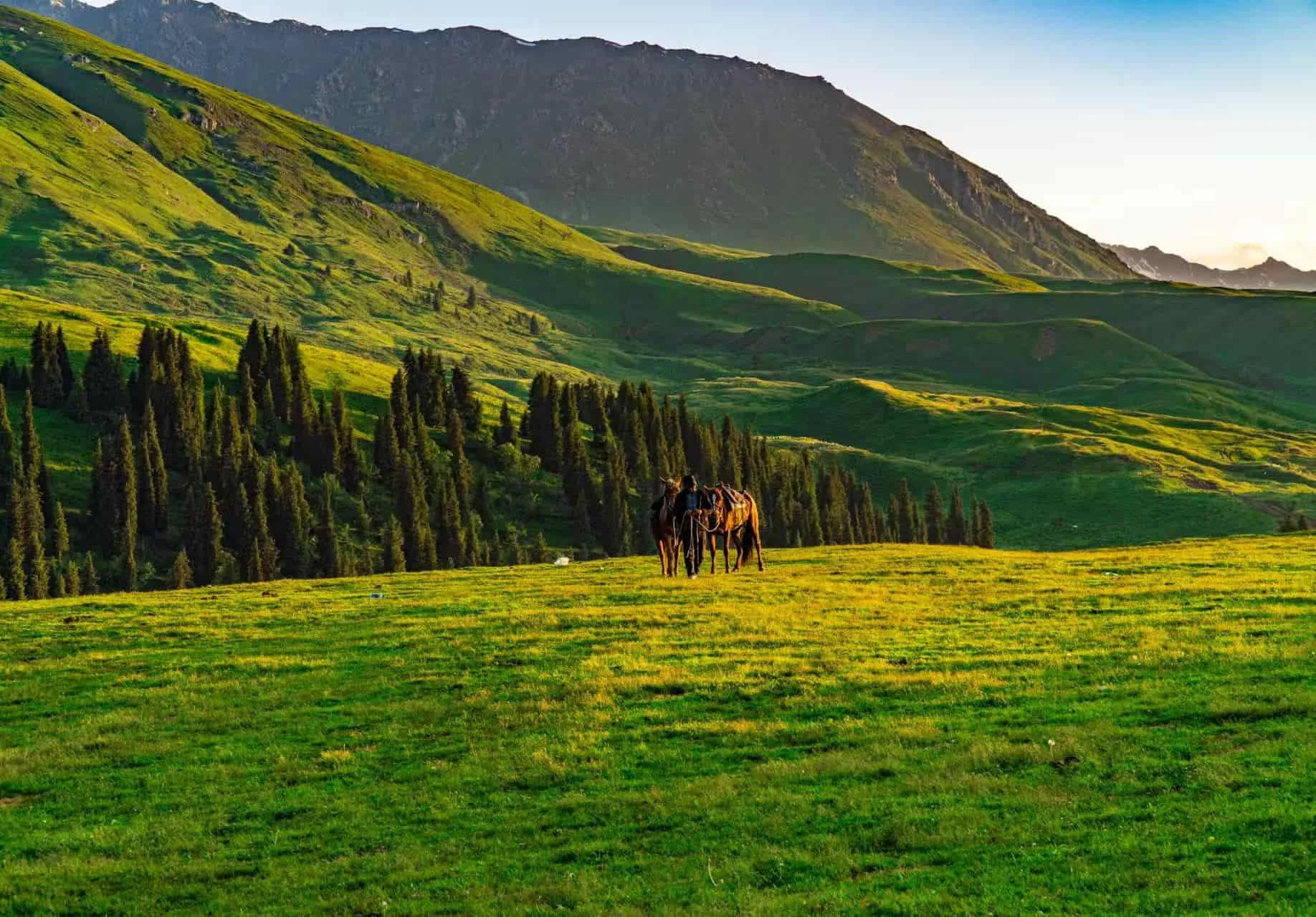
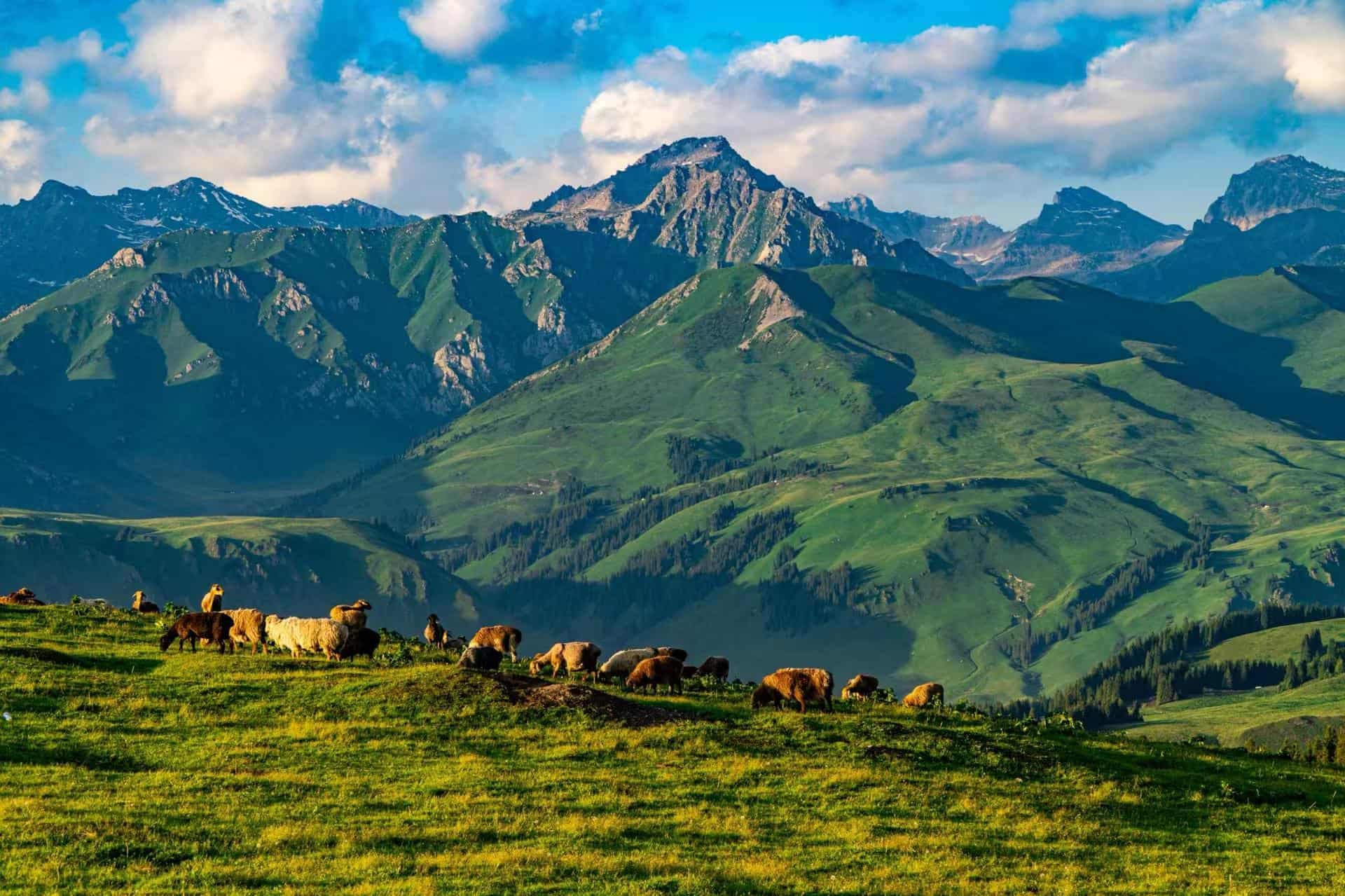
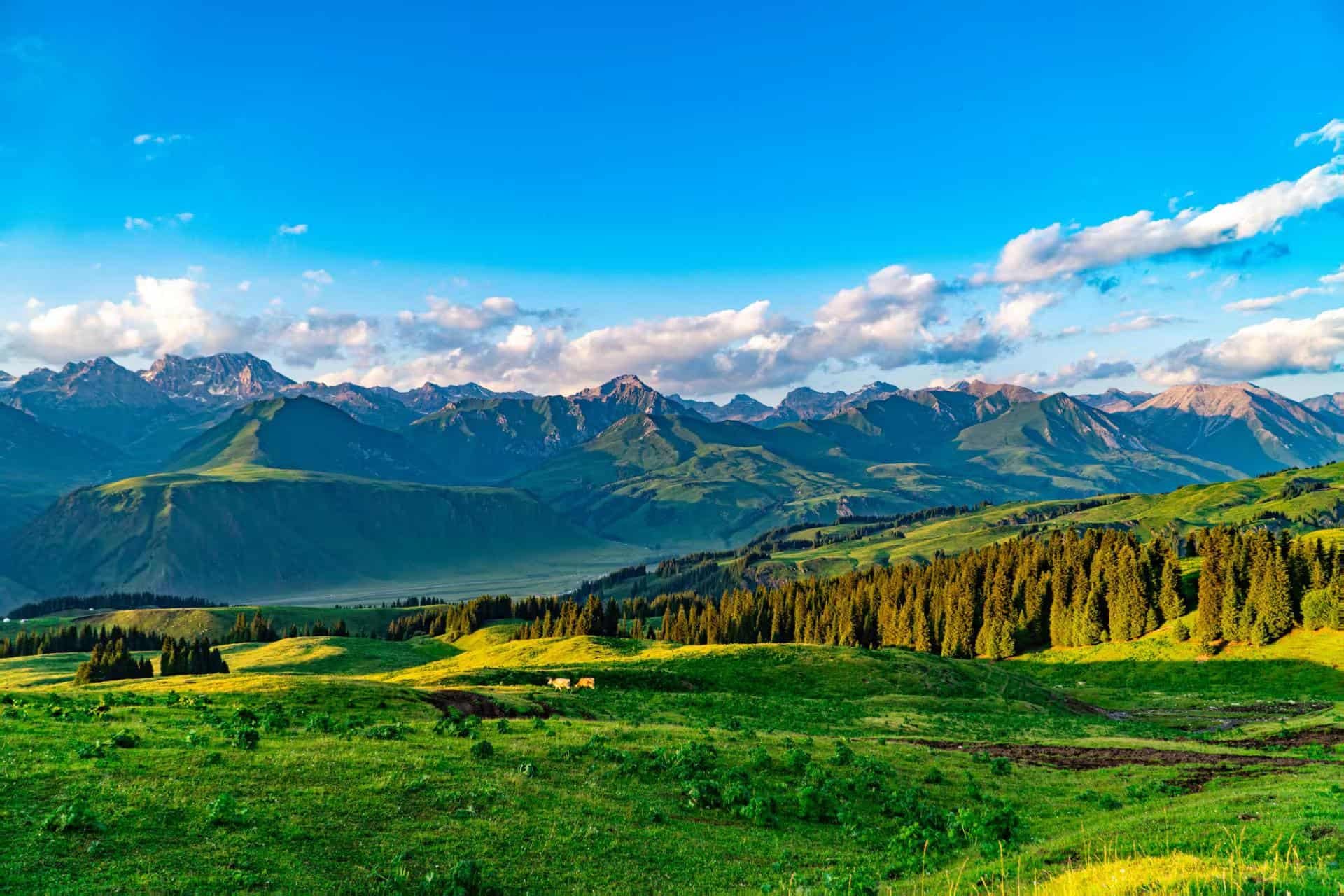
Just 1.5 hours south of Urumqi lies a completely different world: the Nanshan Pasture (南山牧场), a lush alpine grassland where Kazakh herders have grazed their sheep, horses, and cattle for generations. This is where the Tianshan Mountains meet the prairie — green rolling hills dotted with white yurts (gers), herds of horses galloping across the grass, and snow peaks glowing in the distance. It's also the filming location of the popular Chinese TV show "Dad, Where Are We Going?" (爸爸去哪儿) — and once you see it, you'll understand why they chose this location.
Morning — Sky Prairie (空中草原) & Kazakh Family Visit
Depart Urumqi at 8:30 AM and drive south into the Tianshan foothills. The road climbs steadily, and within an hour the city dust is replaced by fresh mountain air and the sight of grazing cattle. Arrive at the Sky Prairie (空中草原) — a high alpine meadow that lives up to its name, feeling as though it floats above the world.
Visit a traditional Kazakh family yurt — your guide will arrange for you to be welcomed with the traditional hospitality that Central Asian nomads have perfected over centuries. Step inside the round felt yurt, take a seat on the carpet-covered floor, and sip milky tea (奶茶) served in hand-painted bowls. The Kazakh host may also offer nan (flatbread), dried fruits, and homemade cheese. It's a cultural experience that feels authentic rather than staged — these families welcome visitors as part of their seasonal livelihood.
You'll also have the chance to try on traditional Kazakh costumes — beautifully embroidered robes, hats, and vests that reflect the nomadic heritage of the region. Your guide will help you capture photos that will make your friends back home very jelous.
Afternoon — Shenbulake Waterfall (神布拉克瀑布) & Horseback Riding
After lunch at a local guesthouse (serving hearty noodle dishes and fresh dairy products), head to Shenbulake Waterfall (神布拉克瀑布) — a scenic forest trail that leads to a cascading waterfall fed by snowmelt from the high Tianshan peaks. The hike takes about 1–1.5 hours round-trip on a well-maintained forest path with moderate inclines. In spring and early summer, wildflowers carpet the meadow slopes — it's one of the most beautiful hikes within day-trip distance of Urumqi.
Horseback Riding on the Grassland
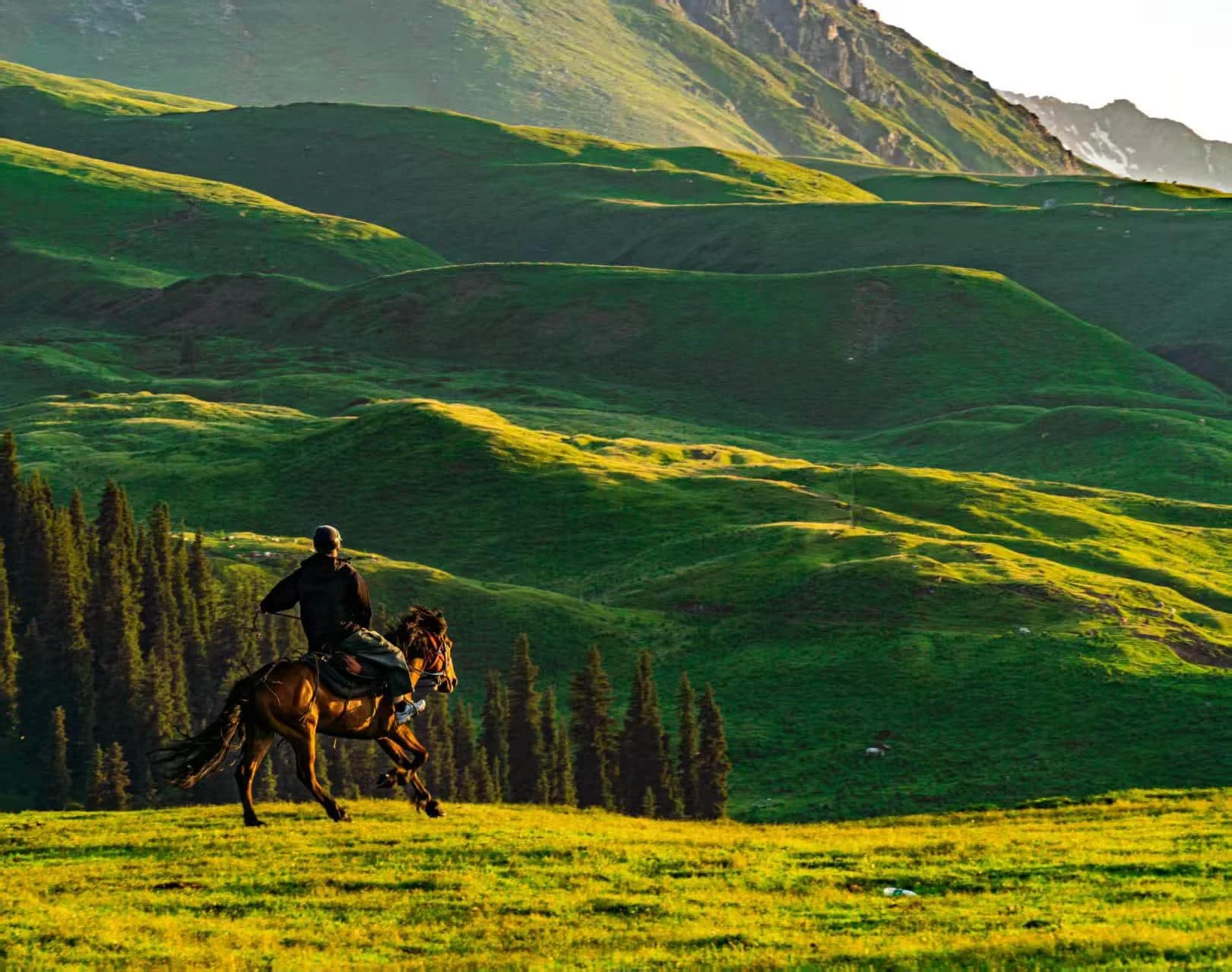
Here's the highlight for many visitors: riding a horse across the open prairie. Local Kazakh wranglers offer horseback rides at approximately ¥100 per hour (payable directly to the wrangler). Whether you're an experienced rider or a complete beginner, the wranglers will match you with a gentle, sure-footed horse and lead you on a safe ride across the grassland. There's something deeply freeing about cantering across an open alpine meadow with snow peaks on the horizon — it's a memory you'll carry for a long time.
Not into horseback riding? No problem — you can also simply walk along the grass, have a picnic by the stream, or relax at the yurt camp and chat with the family.
Return to Urumqi in the late afternoon, arriving at your hotel around 5:30–6:00 PM.
Option 4 Urumqi City Walk — Culture, History & Food
Prefer to stay in the city and discover Urumqi's rich cultural tapestry? This option is perfect for travelers who love museums, food, and local atmosphere. Urumqi may be a modern city, but it sits at the crossroads of the Silk Road — and its museums, bazaars, and food streets tell the story of thousands of years of cultural exchange between East and West.
Morning — Xinjiang Museum (新疆博物馆)
Start your day at the Xinjiang Museum (新疆博物馆) — the premier museum in the region, housing over 50,000 artifacts that tell the story of Xinjiang's 2,500-year history as a crossroads of civilizations. Entry is free with advance reservation (your guide will handle the booking for you).
Key exhibits not to miss:
• The Mummies of Xinjiang: Remarkably well-preserved 3,000-year-old mummies discovered in the Tarim Basin, with Caucasoid features and woven woolen clothing. They are evidence of the region's ancient diversity and continue to be the subject of intense archaeological debate.
• Silk Road Artifacts: Tang Dynasty silk paintings, Sogdian goldware, and Kushan-era coins — tangible proof of the trade networks that connected China to Persia, India, and Rome.
• Ethnic Minority Culture Hall: Traditional clothing, musical instruments, and household items from Xinjiang's 13 recognized ethnic minority groups, including Uyghur, Kazakh, Hui, Kyrgyz, and Tajik cultures.
Your guide will walk you through the exhibits, bringing the artifacts to life with stories of the Silk Road traders, monks, and soldiers who passed through this region.
Midday — Hetian Second Street (和田二街) or Lingguan Lane (灵官巷) Food Walk
By late morning, it's time to eat — and Urumqi is one of China's greatest food cities. Your guide will take you to either Hetian Second Street (和田二街) or Lingguan Lane (灵官巷) — two of the city's most beloved food streets, where the sizzle of grills and the scent of cumin fill the air.
Must-try dishes:
• Uyghur Laghman (拉面): Hand-pulled noodles stir-fried with bell peppers, onions, tomatoes, and your choice of lamb or beef. The noodles are chewy, the sauce is rich, and the portions are generous.
• Chuanr (串儿 — Uyghur-style kebabs): Cubes of marinated lamb grilled over charcoal and sprinkled with cumin and chili flakes. Eat them hot off the skewer, with a side of naan bread.
• Samsa (烤包子 — baked buns): Triangle-shaped pastries filled with spiced lamb and onion, baked in a tandoor-style oven until the crust is golden and flaky.
• Yogurt with Honey (蜂蜜酸奶): Thick, tangy Xinjiang yogurt drizzled with local wildflower honey. The perfect cooling finish to a spicy meal.
Your guide will order for you, explain each dish's cultural background, and make sure you don't miss the hidden gems that tour groups never find.
Afternoon — Xinjiang International Grand Bazaar (国际大巴扎)
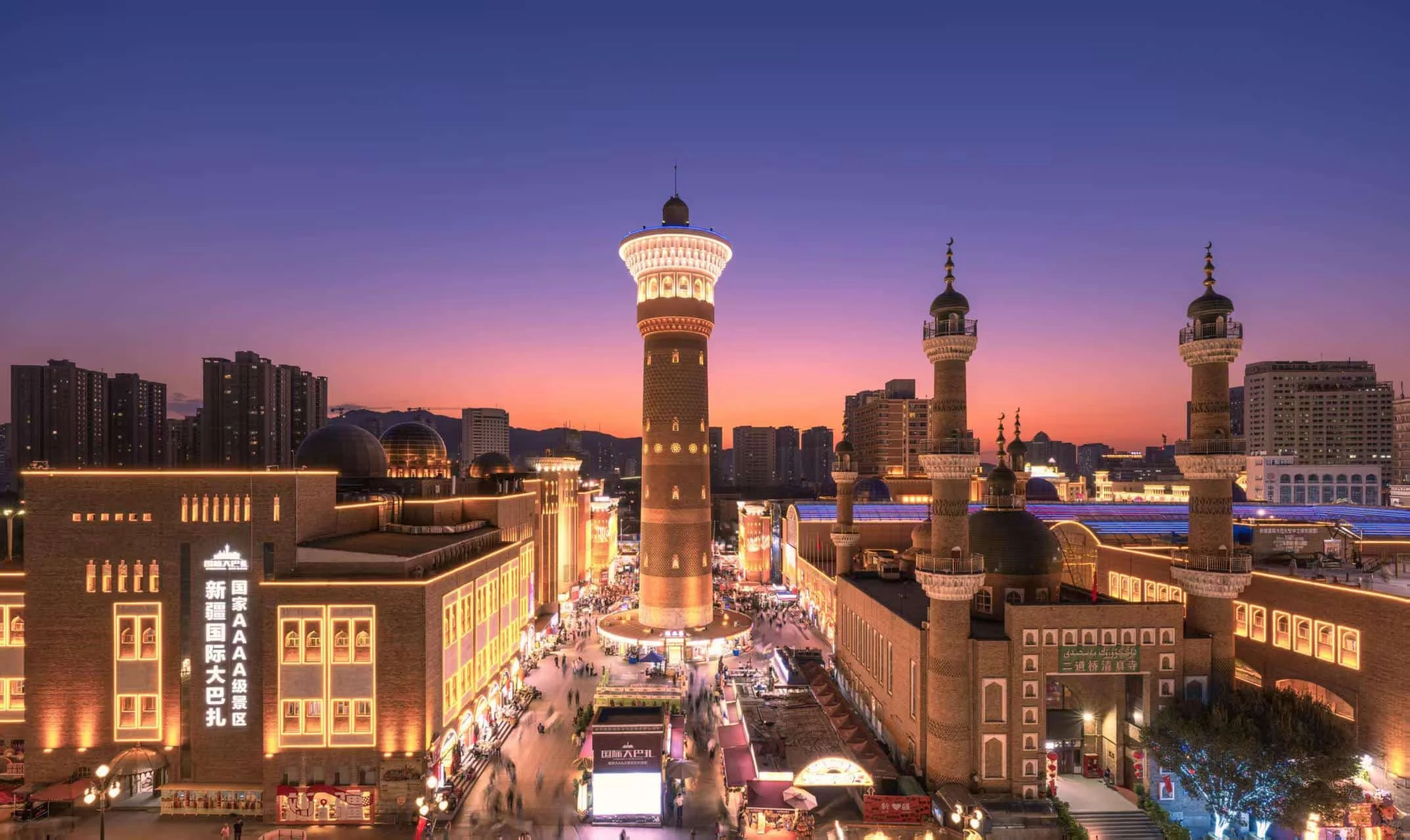
After lunch, head to the Xinjiang International Grand Bazaar (新疆国际大巴扎) — the largest bazaar in the world, covering over 40,000 square meters. Even if you're not planning to buy anything, the atmosphere alone is worth the visit: the call to prayer from the adjacent mosque, the riot of colors in the carpet stalls, the stacks of dried fruit and nuts, the clang of coppersmiths at work.
What to see and buy:
• Handwoven Carpets: Uyghur carpets are among the finest in Central Asia, with intricate patterns that can take months to weave. You can watch artisans at work in the on-site weaving workshop.
• Dried Fruits & Nuts: Xinjiang produces some of China's best figs, raisins, walnuts, and almonds. Sample liberally — the vendors expect it!
• Musical Instruments: Handcrafted dutar (two-stringed lutes), rawap (long-necked lutes), and frame drums. The sounds of these instruments drifting through the bazaar are part of its magic.
• Jade (Yushí): Xinjiang is famous for Hetian jade ( nephrite), one of the most prized stones in Chinese culture. The bazaar has a dedicated jade hall — your guide can help you distinguish genuine pieces from imitations.
Late Afternoon — Hongshan Park (红山公园) Sunset View
End your day at Hongshan Park (Red Mountain Park), a hilltop park in the center of Urumqi that offers the best panoramic view of the city. Climb the steps to the Hongshan Pagoda (红山塔) at the summit — built in 1788 during the Qing Dynasty and still standing strong. As the sun sets, the city lights begin to twinkle below, and you can see the outline of the Tianshan Mountains on the horizon to the south.
It's a peaceful, reflective end to a day spent discovering the many layers of Urumqi — from its ancient museum relics to its sizzling food stalls to its bustling bazaar. Your guide will drop you back at your hotel after sunset.
What's Included (All Options)
✔️ Private English-speaking guide (licensed, local expert)
✔️ Private air-conditioned vehicle with professional driver
✔️ All entrance fees:
Option 1: Heavenly Lake entrance + shuttle bus + Mayashan Cable Car
Option 2: Tuyugou Village + Flaming Mountains + Kumtag Desert entrance
Option 3: Nanshan Pasture entrance + waterfall trail + yurt visit
Option 4: Xinjiang Museum (free, reservation included) + Grand Bazaar
✔️ Bottled water and local snacks during the tour
✔️ Hotel pickup and drop-off in Urumqi city
✔️ Full itinerary flexibility — adjust pacing and focus as you wish
What's Not Included
✘ Meals (your guide will recommend the best local restaurants; budget approx. ¥60–120 per meal)
✘ Horseback riding (Option 3 only; approx. ¥100/hour, payable directly to wrangler)
✘ Travel insurance (highly recommended)
✘ Gratuities (optional, at your discretion)
Practical Information
🚶 Walking Level:
• Option 1: Moderate. Lake boardwalk is flat; cable car eliminates steep climbing. 2–3 hours total walking.
• Option 2: Easy–Moderate. Mostly flat walking at village and scenic areas. 3-hour drive each way.
• Option 3: Moderate. Forest trail to waterfall involves some incline. Horseback riding available as alternative.
• Option 4: Easy. Mostly flat city walking. Museum involves minimal walking.
👟 What to Wear:
• Option 1: Comfortable walking shoes. Jacket or fleece — lake is at 1,980m and can be 10°C cooler than Urumqi.
• Option 2: Sun hat, sunglasses, sunscreen (Turpan is extremely dry and sunny). Light, breathable clothing.
• Option 3: Sturdy walking shoes for the forest trail. Jacket for cooler mountain air. Long pants recommended for horseback riding.
• Option 4: Comfortable walking shoes. Modest clothing for museum and mosque vicinity (cover shoulders and knees).
📅 Best Time to Visit:
• Option 1: June–October for warm weather and accessible trails. Winter visits are possible but very cold.
• Option 2: March–May and September–November (avoid mid-summer extremes of 45°C+).
• Option 3: June–September for lush grassland. Spring (May–June) has the most wildflowers.
• Option 4: Year-round. The museum and bazaar are indoor/partially outdoor.
🎒 What to Bring:
• Sunscreen and lip balm (Xinjiang sun is intense at altitude)
• Reusable water bottle (stay hydrated, especially in Turpan)
• Cash (small bills) for bazaar shopping and horseback riding
• Passport (required for museum entry and some scenic areas)
👨👩👧👦 Family Friendly: All four options are suitable for families with children aged 6+. Option 3 (Nanshan) is especially popular with families for the yurt visit and horseback riding.
Xinjiang is a land of superlatives — the hottest, the coldest, the highest, the driest. Choose your adventure and discover it with us.
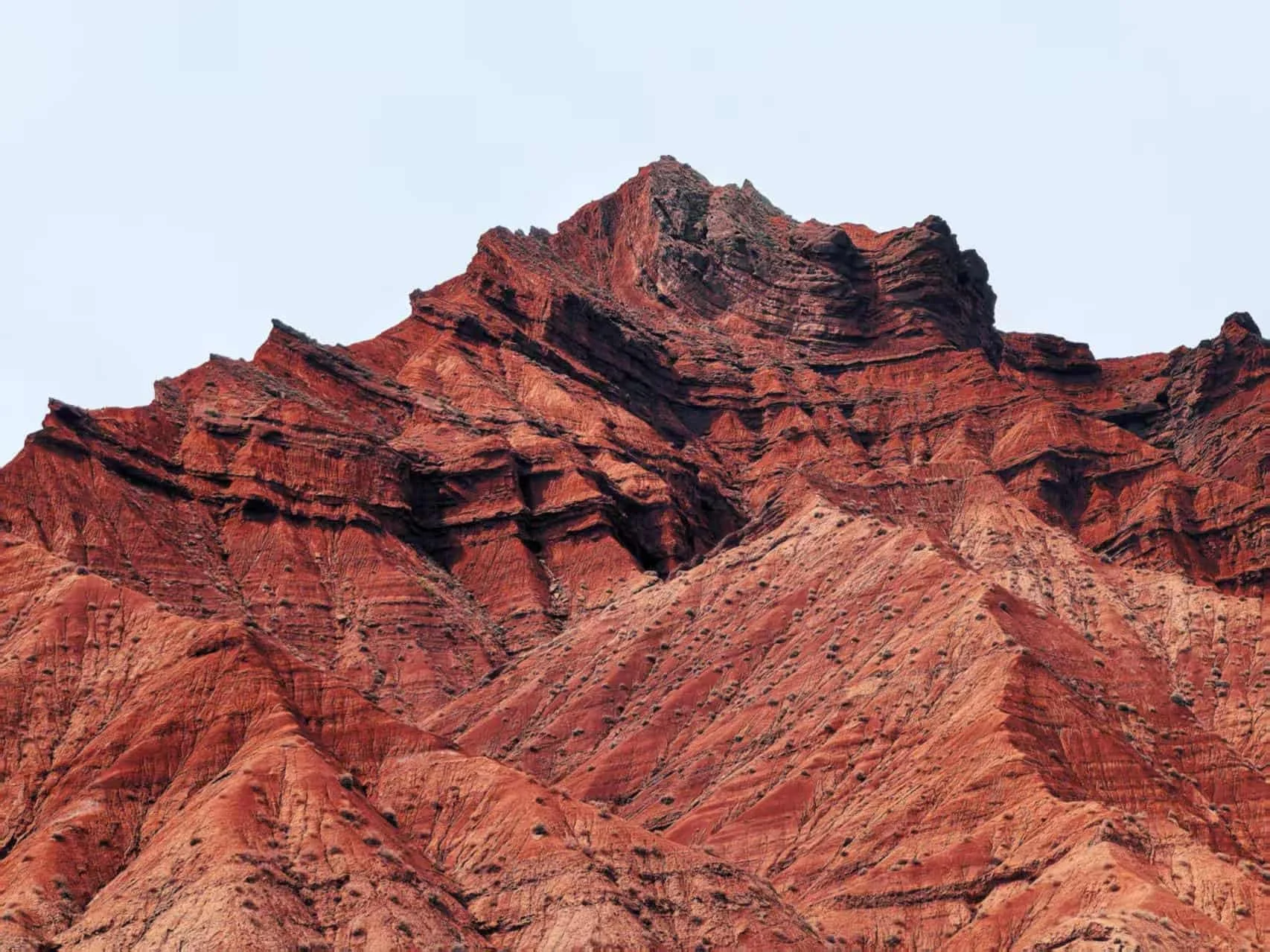
The Ultimate 10-Day Northern Xinjiang Adventure
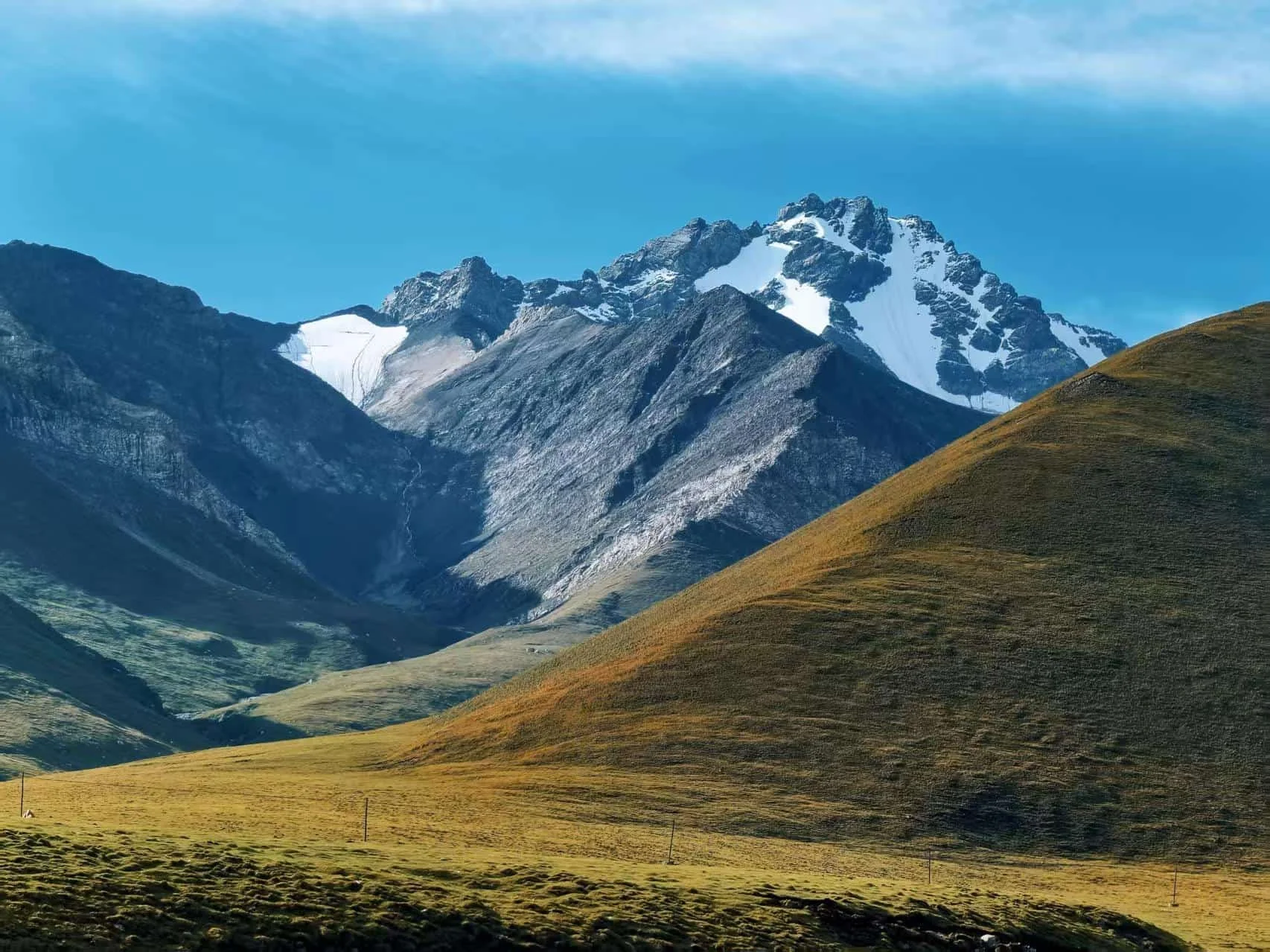
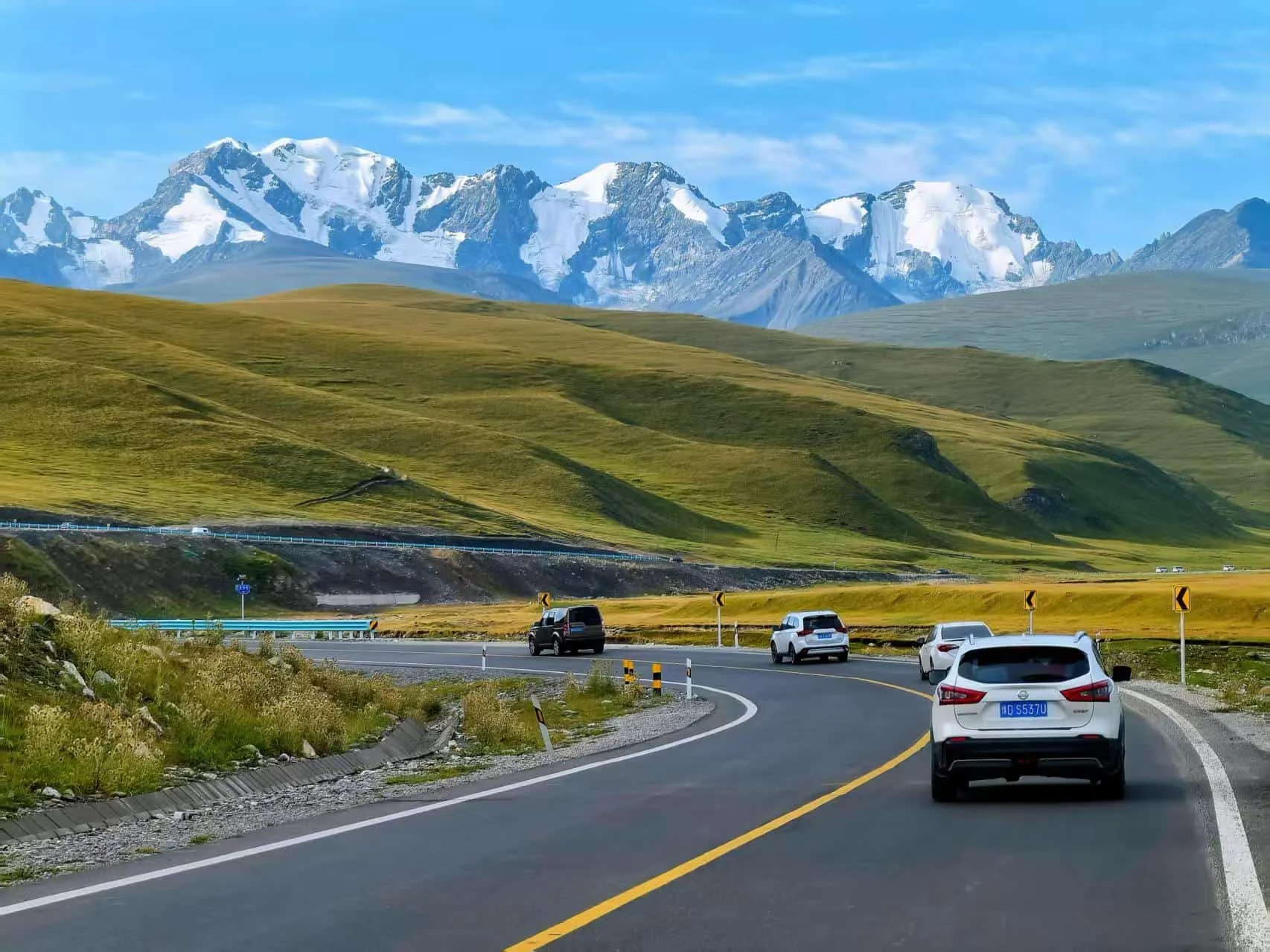
There are road trips — and then there is Northern Xinjiang. This 10-day private tour is widely considered the single best route in all of China for landscape diversity: in just 10 days, you'll witness glacier-fed alpine lakes, emerald pastures dotted with wildflowers, surreal desert highways, Kazakh yurts rising from endless grass, and the legendary Duku Highway — a road so spectacular it's called "the most beautiful highway in China."
Starting and ending in Urumqi, this carefully designed loop takes you through the Altay Prefecture (home to Kanas Lake — "China's Switzerland"), along the Ili Valley (Xinjiang's most fertile grassland region), and across the Tianshan Mountains via the Duku Highway. With a private guide and vehicle throughout, you set the pace — linger at a viewpoint as long as you like, stop for an impromptu photo, or add a short hike whenever the mood strikes.
🗺️ Route Overview (2,200 km total loop):
Day 1: Arrive Urumqi → hotel rest
Day 2: Urumqi → S21 Desert Highway → Ulungur Lake → Altay
Day 3: Altay → Ahe Highway → Hemu Bridge → Haden Platform → Hemu Village
Day 4: Hemu → Kanas Lake (Three Bays + Rainbow Beach) → Burqin
Day 5: Burqin → World Devil City → Kuytun / Dushanzi
Day 6: Kuytun → Sayram Lake (self-drive tour) → Guozigou → Yining
Day 7: Yining → Xiata Ancient Trail → Muzart Glacier → Tekes (Bagua City)
Day 8: Tekes → Nalati Sky Grassland (photography + BBQ) → Nalati Town
Day 9: Nalati → Tangbula Gallery → Duku Highway North Section → Urumqi
Day 10: Urumqi departure → airport transfer
💡 Why Choose This Tour:
This is the complete Northern Xinjiang experience — the route that serious travelers dream of. You'll cover all the iconic sights (Kanas, Hemu, Sayram Lake, Nalati, Duku Highway) and hidden gems most tour groups skip. The best months are June–September — with July–August for lush grasslands and September for golden autumn birch forests.
Day 1: Arrival in Urumqi — Welcome to Xinjiang!
Touch down in Urumqi (乌鲁木齐), the capital of Xinjiang and one of the most inland cities on Earth — over 2,500 km from the nearest ocean. Your private guide and driver will be waiting at the airport arrival hall, holding a sign with your name. Transfer to your five-star hotel in the city center for check-in and a well-earned rest.
If you arrive with daylight to spare, your guide will be happy to recommend a local dinner — try the Uyghur laghman (hand-pulled noodles) or a sizzling plate of chuanr (lamb kebabs) at a nearby food street. Tomorrow's adventure begins early, so an early night is recommended!
Hotel: Five-star hotel in Urumqi city center (included in tour package).
Day 2: Urumqi to Altay — S21 Desert Highway & Ulungur Lake
Morning — The Spectacular S21 Desert Highway
After breakfast at the hotel, depart Urumqi and head north on the S21 Desert Highway (S21 沙漠高速) — a spectacularly scenic expressway that slices through the Gurbantunggut Desert. Opened to traffic in 2021, this highway cut the driving time from Urumqi to Altay from 10 hours to just 5–6 hours. The views along the way are surreal: endless golden dunes on one side, distant snow peaks on the other, and the occasional desert shrub defiantly clinging to life in the sand.
Your guide will share stories of the highway's construction — an engineering feat that required bridging hundreds of kilometers of shifting sand — and point out the best photo stops along the way. There are designated viewing areas where you can step out onto the dunes and feel the vast silence of the desert.
Midday — Ulungur Lake (乌伦古湖)
About halfway to Altay, stop at Ulungur Lake (also called Fuhai Lake) — a massive, shimmering body of fresh water surrounded by desert steppe. In summer, the lake's surface turns a brilliant turquoise under the noon sun. This is also one of Xinjiang's most important fishing grounds — if you visit between June and August, you might catch local fishermen hauling in their nets.
Enjoy a lakeside lunch at a local fishing village restaurant — the Ulungur cold-water fish (especially the local species of carp and pike) is a regional delicacy you won't find in the cities. Your guide will help you order the freshest catch of the day.
Evening — Arrive in Altay
Arrive in Altay City (阿勒泰市) in the evening — a clean, tree-lined city nestled in the Altay Mountain range near the borders of Mongolia, Russia, and Kazakhstan. The air here is crisp and pine-scented, a refreshing change from the desert flats of the S21. Check into your comfort hotel and enjoy a restful night before tomorrow's journey deeper into the mountains.
Hotel: Comfort hotel in Altay (3–4 star standard).
Day 3: Altay to Hemu Village — The Most Beautiful Village in China
Morning — Ahe Highway (Altay–Hemu Scenic Road)
After breakfast, set out on the Ahe Highway (阿禾公路) — a spectacular mountain road that winds through spruce forests, past rushing mountain streams, and across high alpine meadows. This road only opened to regular traffic in recent years and remains one of the most scenic drives in all of Xinjiang. Keep your camera ready — the views change around every bend.
Stop at Hemu Bridge (禾木桥) for your first glimpse of the Hemu River — a crystal-clear mountain stream rushing over smooth river stones, framed by spruce-covered slopes. The bridge itself is a rustic wooden structure that sways gently underfoot, and it's one of the most photographed spots in the Altay region.
Midday — Haden Viewing Platform (哈登观景台)
Before entering the village, stop at the Haden Viewing Platform (哈登观景台) — the best panoramic viewpoint over Hemu Village. From here, you'll see the entire settlement spread out below: dozens of wooden Tuvan style log cabins with grass-roofed roofs, surrounded by a sea of birch and spruce forest, with snow peaks glowing in the distance. On autumn mornings (September), this view is so beautiful it's almost painful — the birch trees turn a brilliant gold, and the morning mist wraps the village in a soft white veil.
Your guide will explain the unique culture of the Tuvan people — a small ethnic minority group closely related to Mongolian nomads, who have lived in these valleys for generations and are known for their distinctive throat singing, wooden architecture, and deep connection to the forest.
Afternoon — Arrive in Hemu Village & Log Cabin Stay
Enter Hemu Village (禾木村) in the afternoon. This is consistently rated the most beautiful village in China — a place where time moves at the pace of the river, where smoke from woodstove chimneys curls into the crisp mountain air, and where the night sky reveals more stars than you knew existed.
Check into your traditional Tuvan-style log cabin — simple but cozy, with wooden walls, thick quilts, and often a woodstove to keep the mountain chill at bay. After dinner at a local guesthouse (serving hearty noodle soups and fresh dairy from the village's cattle), step outside for some of the best stargazing in China. With zero light pollution, the Milky Way arches directly overhead in a way that will take your breath away.
Accommodation: Traditional log cabin in Hemu Village (rustic charm, clean and comfortable).
Day 4: Hemu to Burqin — Kanas Lake & Rainbow Beach
Morning — Kanas Lake (喀纳斯湖): The Gem of Altay
After an early breakfast, depart Hemu and drive approximately 1 hour to Kanas Lake (喀纳斯湖) — the crown jewel of Xinjiang's Altay region and the centerpiece of Kanas Nature Reserve (a UNESCO Global Geopark). The lake is a staggering 1,900 meters above sea level, 24 km long, and fills a glacial valley with water so deeply turquoise it almost doesn't look real.
Visit the famous Three Bays (三湾) along the lakeshore — each with its own character:
• Wolong Bay (卧龙湾 — "Crouching Dragon Bay"): A wide, shallow section of the Kanas River where a heart-shaped island covered in spruce trees sits in the middle of the turquoise water. The view from the viewing platform is one of the most iconic images of Xinjiang.
• Moon Bay (月亮湾 — "Moon Bay"): A crescent-shaped river bend where the water glows an impossible jade-green. Two footprints etched into a rock on the riverbank are said (in local legend) to be the imprints left by a deity who stepped here while crossing the mountains.
• Fairy Bay (神仙湾 — "Immortal Bay"): A misty, shallow stretch of river where countless small islets create a labyrinth of glowing water. In the early morning, when the mist still hugs the surface, it truly looks like a place where immortals might walk.
Your guide will lead you along the wooden boardwalks that hug the shoreline — the paths are well-maintained with minimal elevation gain, and every few steps reveals another postcard-perfect view. In autumn (mid-September), the birch forests along the shore turn a blinding gold — this is widely considered the most beautiful season at Kanas.
Afternoon — Rainbow Beach (五彩滩)
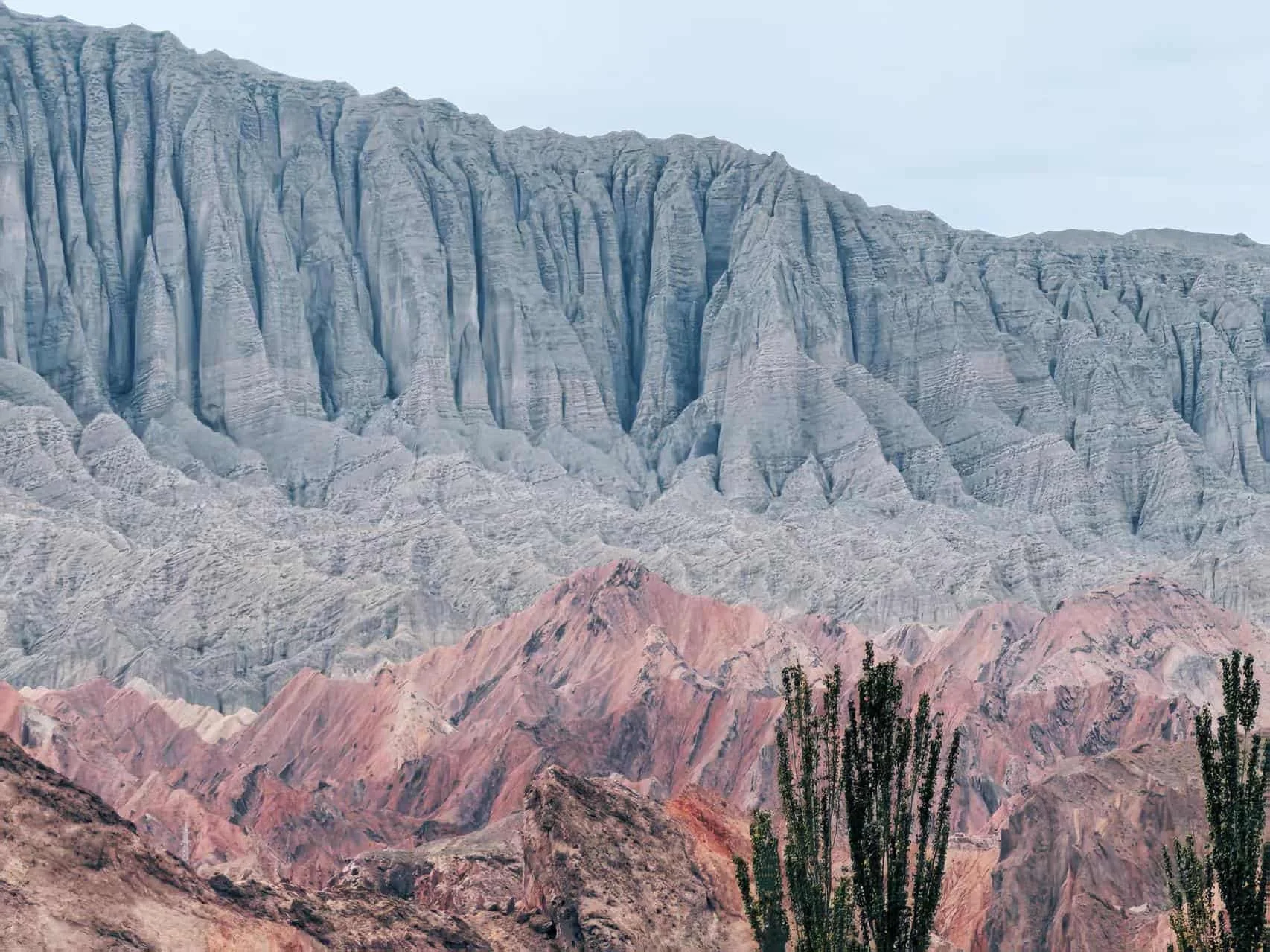
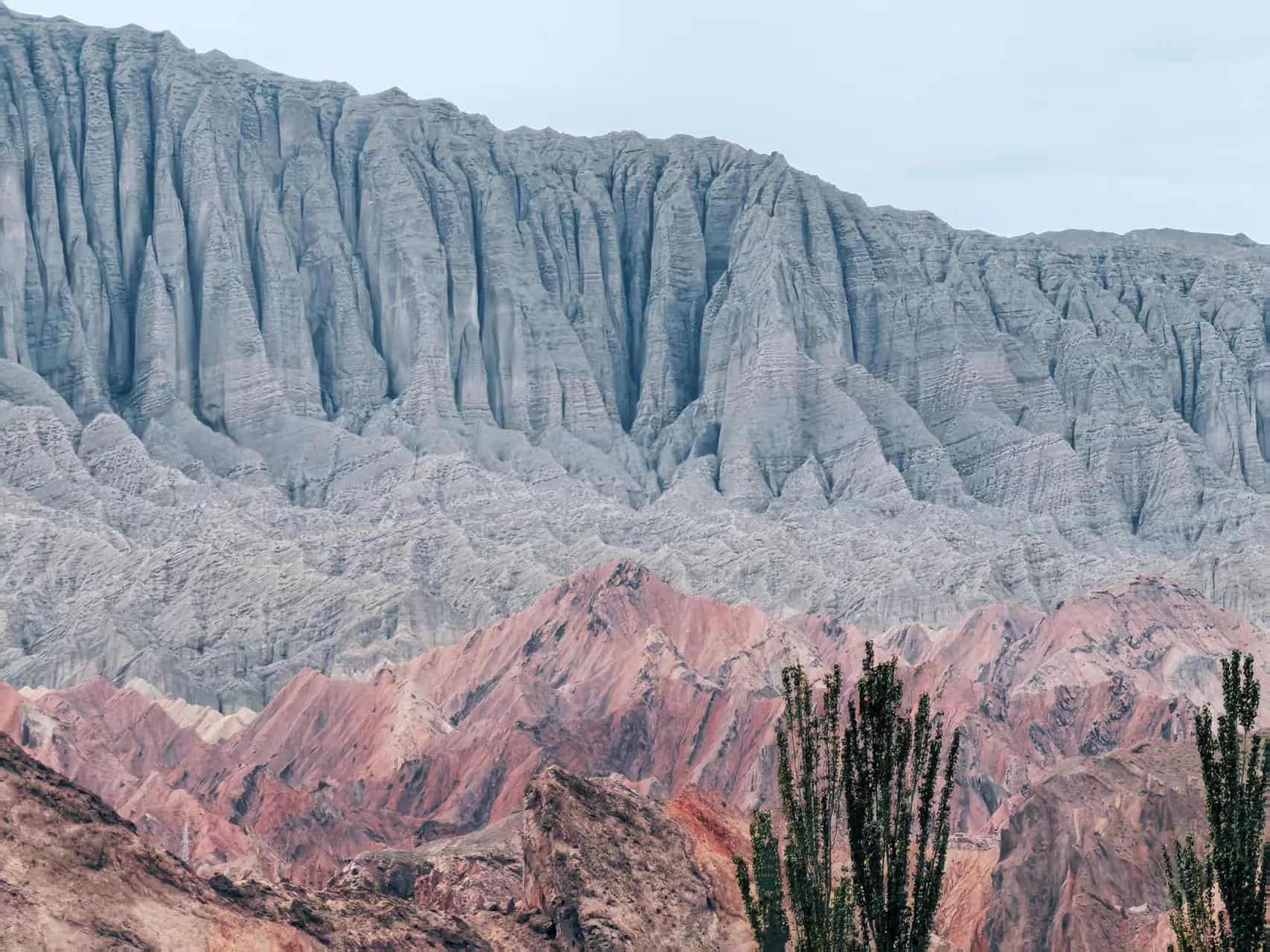
After exploring Kanas, drive approximately 2 hours to Rainbow Beach (五彩滩) near the town of Burqin. This is one of the most surreal landscapes in Xinjiang — a vast expanse of colorful eroded badlands on the north bank of the Irtysh River, where wind and water have sculpted the soft rock into bizarre pillars, caves, and ridges in shades of red, orange, yellow, and purple.
The best time to visit is sunset — as the sun drops, the colorful rocks glow intensly, while the Irtysh River on the opposite bank reflects the colors in its calm surface. The contrast between the rugged, colorful badlands on one side and the lush green poplar forest on the other is striking — it's like two different planets separated by a single river.
Evening — Arrive in Burqin
After sunset, drive 20 minutes to Burqin (布尔津) — a cheerful riverside town famous for its colorful, fairytale-style architecture and its night food market. Check into your comfort hotel and then head straight to the Burqin Night Market (布尔津夜市) — a row of sizzling grills and steaming pots lining the riverfront. The must-try dish here is grilled cold-water fish (烤冷水鱼) — freshly caught from the Irtysh River and grilled over charcoal with cumin and chili. It's so good that many travelers say the Burqin night market alone is worth the entire trip to Altay.
Hotel: Comfort hotel in Burqin (3–4 star standard).
Day 5: Burqin to Kuytun/Dushanzi — World Devil City
Morning & Afternoon — World Devil City (世界魔鬼城)
After breakfast, depart Burqin and drive south toward the Junggar Basin (准噶尔盆地). The landscape gradually transforms from mountain forest to arid desert steppe, and around midday you'll arrive at one of Xinjiang's most otherworldly landscapes: the World Devil City (世界魔鬼城), also known as Wind City (风城).
This is a massive yardang (wind-eroded) landscape — thousands of sandstone pillars, some as tall as 20 meters, sculpted over millions of years by the relentless Gobi wind. The wind howls through the narrow passages between the pillars, creating eery, wailing sounds that gave the place its name: at night, it's said to sound like screaming spirits. By day, it looks like the set of a sci-fi film about an abandoned alien city.
Take the scenic area shuttle bus (included) through the formations — there are designated stops where you can step out and walk among the stone pillars. Your guide will point out formations that resemble animals, castles, and human faces — the Chinese tradition of "finding the picture in the stone." The golden light of late afternoon is the best time for photography here, as it brings out the rich red and orange tones of the rock.
The Devil City is also famous as a filming location for the Chinese road movie Cars (cars racing in the desert) and numerous other films. You might recognize the landscape even if you've never been here before.
Evening — Arrive in Kuytun or Dushanzi
Continue driving south and arrive in either Kuytun (奎屯) or Dushanzi (独山子) in the evening — both are industrial cities at the northern foot of the Tianshan Mountains, and both serve as gateways to the spectacular scenery that awaits tomorrow. Check into your comfort hotel and rest well — tomorrow you'll reach Sayram Lake, one of the most beautiful alpine lakes in the world.
Hotel: Comfort hotel in Kuytun or Dushanzi (3–4 star standard).
Day 6: Kuytun to Yining — Sayram Lake & Guozigou Valley
Morning — Sayram Lake (赛里木湖): The Last Tear of the Atlantic
An early departure today for one of Xinjiang's absolute highlights. Drive southwest from Kuytun toward the Tianshan Mountains, climbing steadily until you reach the Guozigou (果子沟 — "Fruit Valley") — a spectacular mountain pass with a highway that spirals through deep gorges and past rushing waterfalls. The views from the Guozigou Bridge (a stunning piece of engineering that spans a 200-meter-deep canyon) are breathtaking — on clear days, you can see all the way to Sayram Lake in the distance.
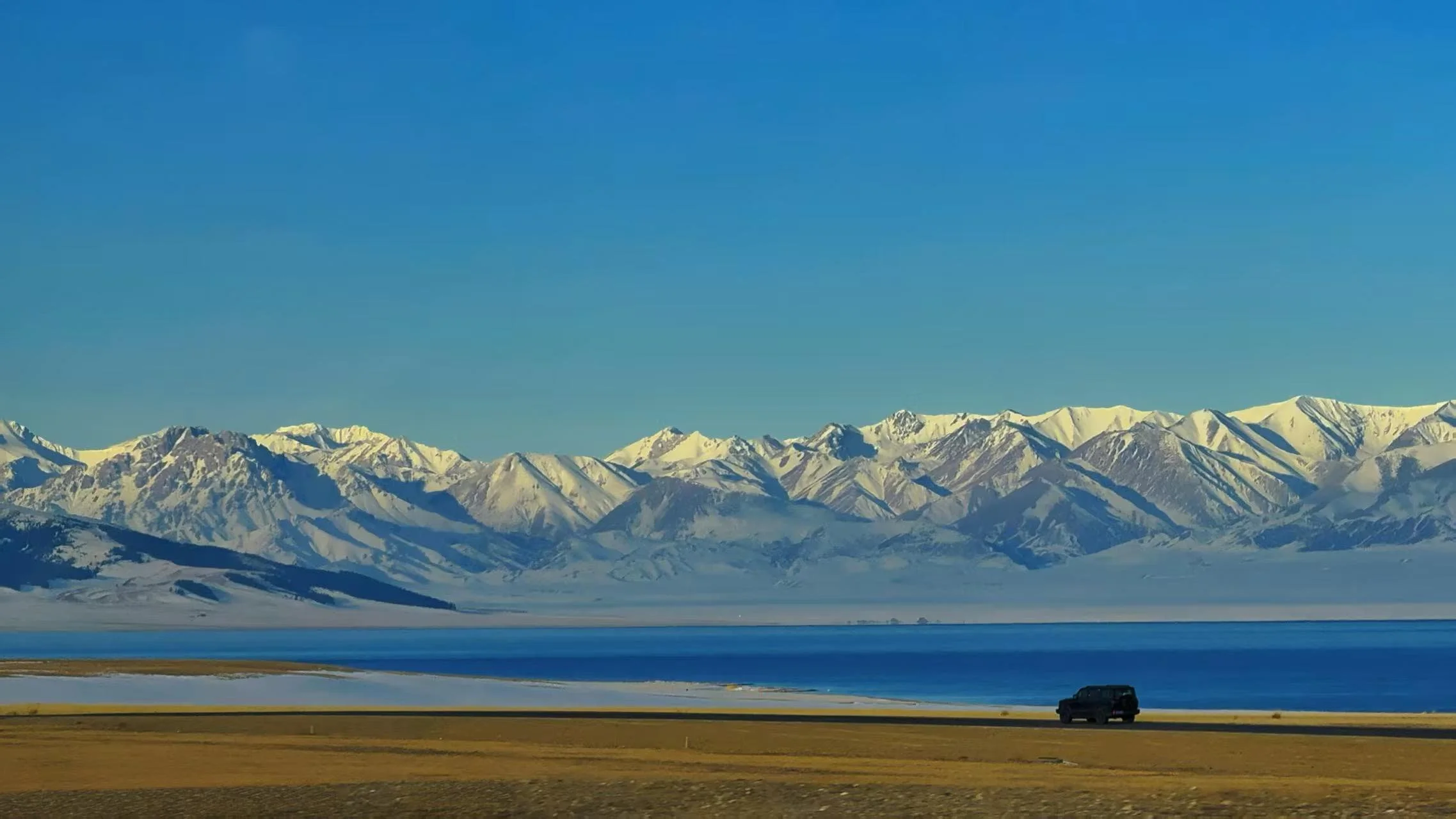
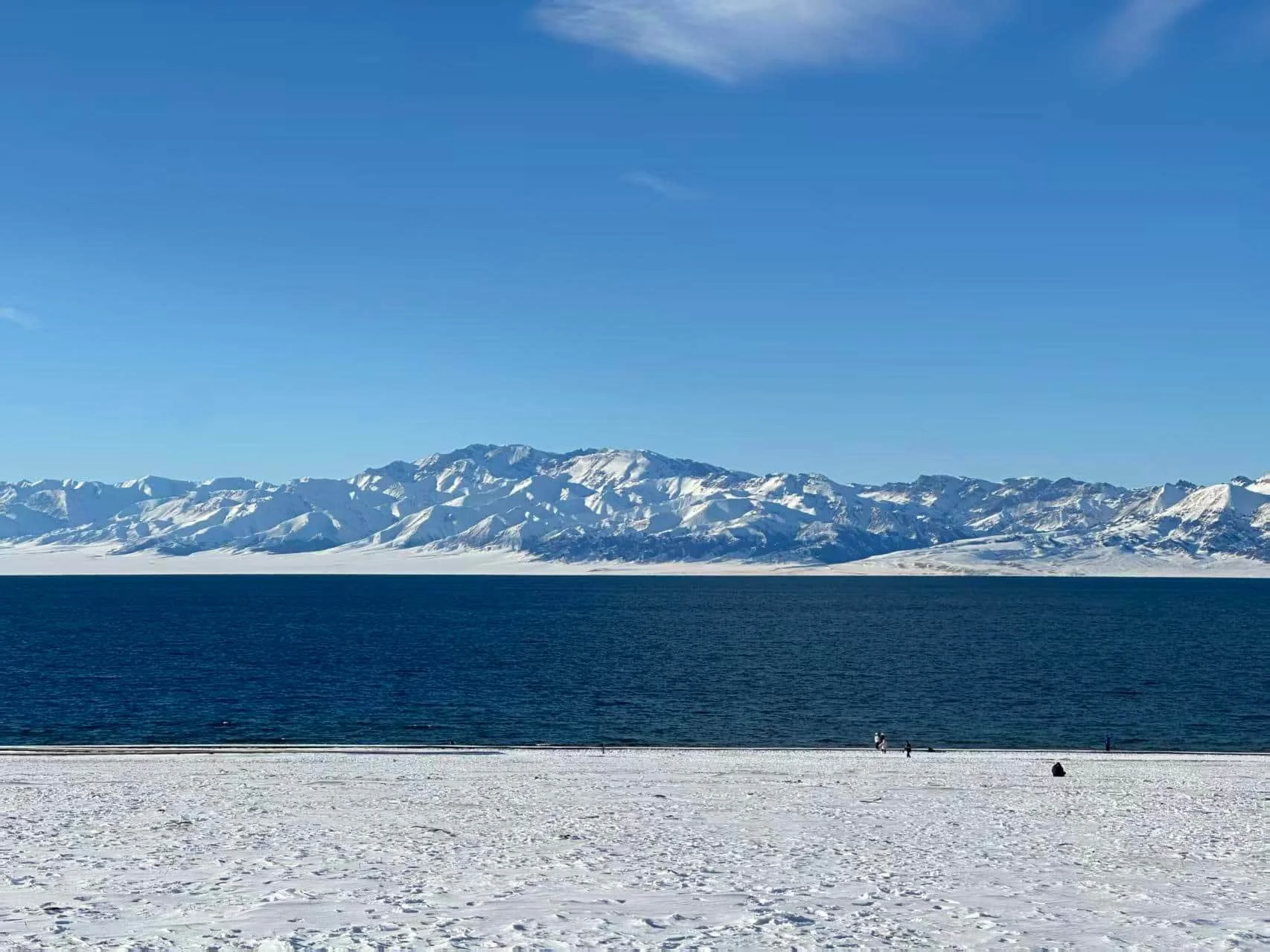
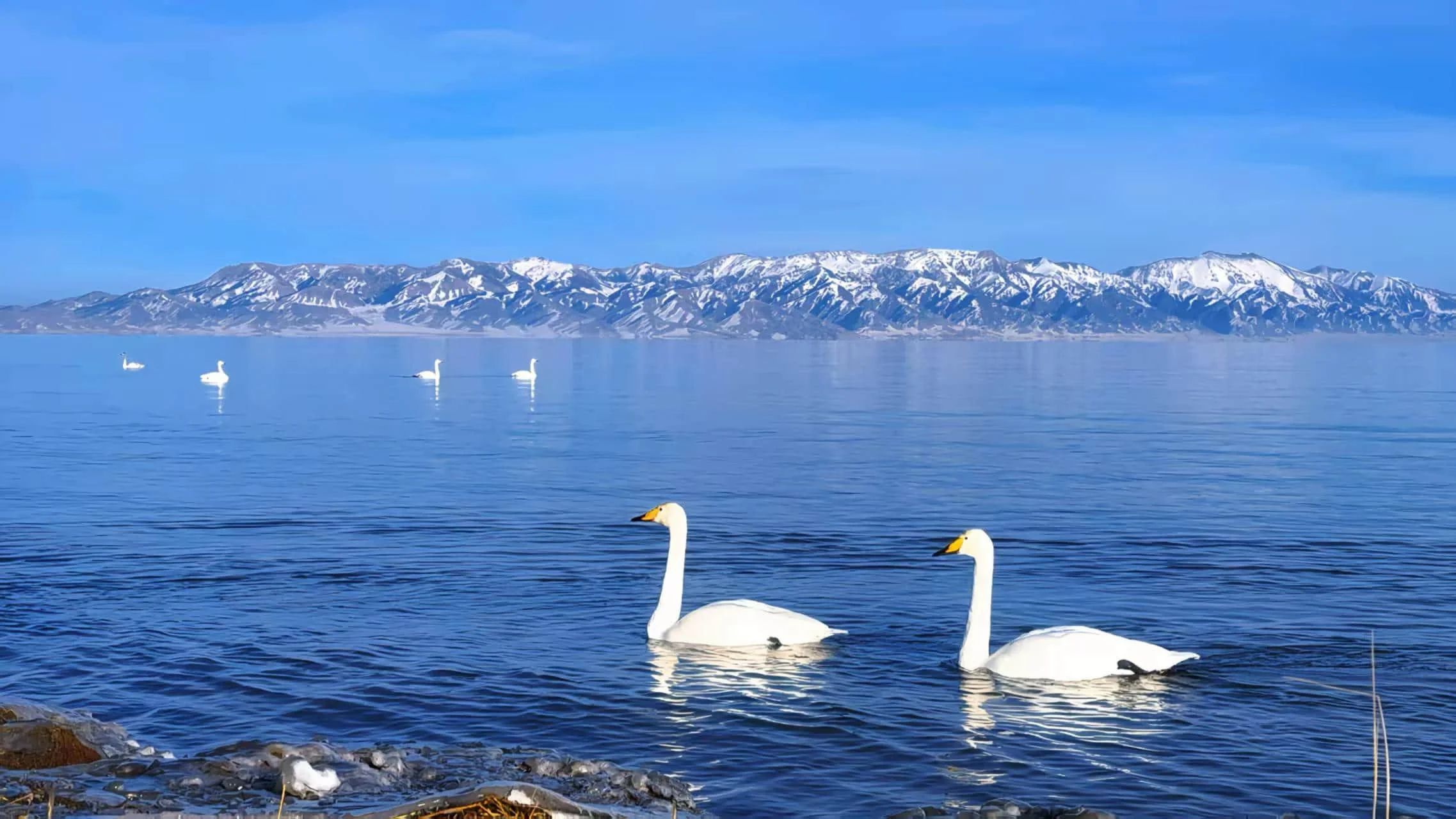
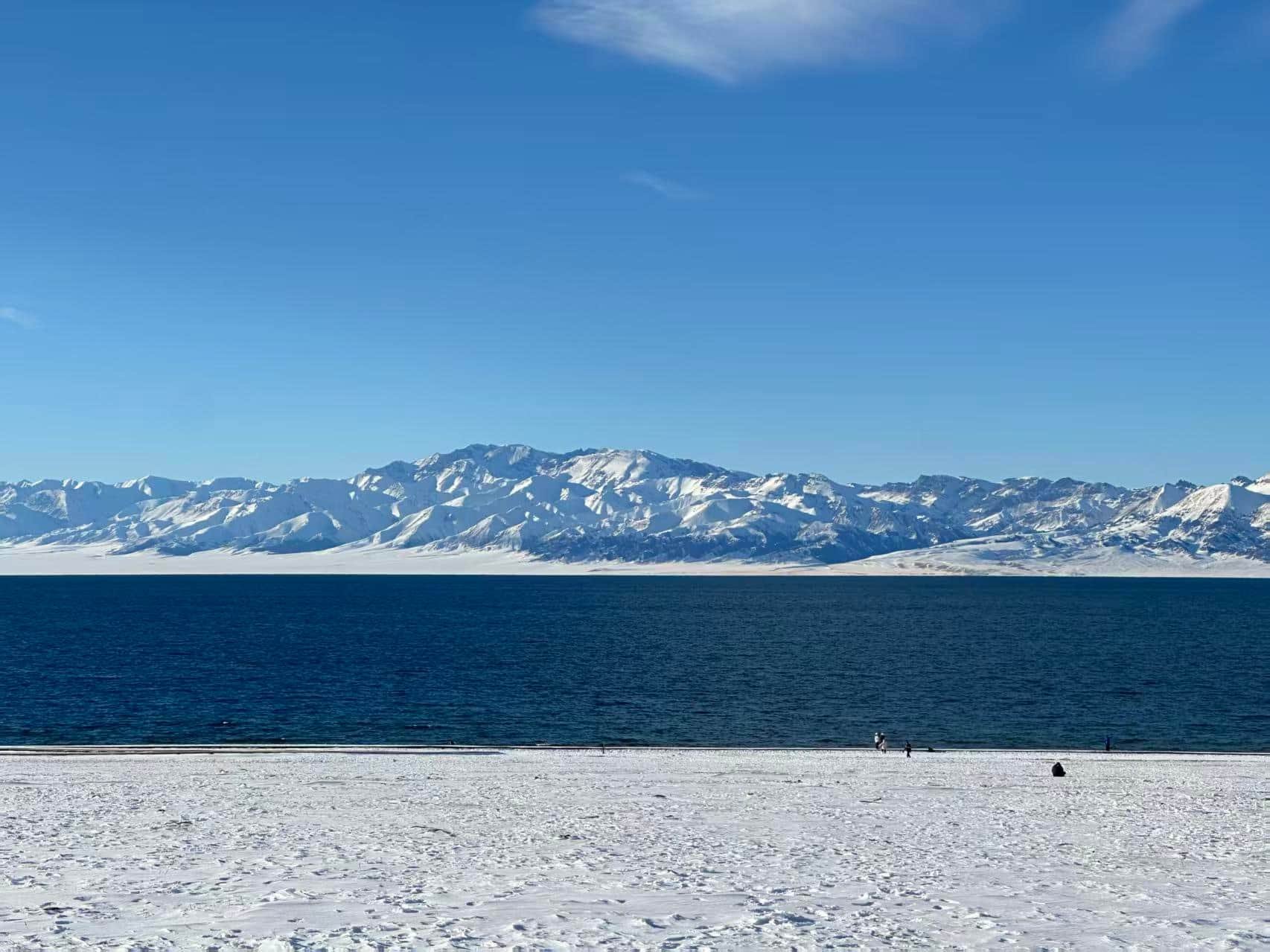
Arrive at Sayram Lake (赛里木湖) — known as "the last tear of the Atlantic Ocean" because it is the easternmost point reached by Atlantic Ocean moisture-carrying air currents. At 2,073 meters above sea level and covering 453 square kilometers, this is the largest alpine lake in Xinjiang. The water is an impossible, electric blue — so clear you can see pebbles on the lake floor 10 meters down — and it's framed by snow-capped Tianshan peaks that reflect perfectly in the still surface.
Enjoy a self-drive tour around the lake (your private vehicle follows the scenic lakeside road, with frequent stops for photos). In late May and June, the lakeside meadows burst into bloom with wild lilies, primroses, and forget-me-nots — a carpet of color against the blue water and white snow peaks. In summer, the local Mongol and Kazakh herders bring their sheep and horses to graze on the lakeside grassland, and you might see white yurts dotting the shore.
Afternoon — Guozigou & Arrival in Yining
After circling the lake, cross the Guozigou Bridge — one of China's most spectacular highway bridges, spanning a deep green valley at 200 meters above the canyon floor. The views from the bridge are so good that there's a dedicated viewing area where you can pull over and walk onto a glass-bottomed observation platform.
Continue to Yining (伊宁), the capital of the Ili Kazakh Autonomous Prefecture and the cultural heart of Xinjiang's Kazakh community. In the evening, take a stroll along Liuxing Street (六星街 — "Six-Star Street") — a historic neighborhood built in a unique radiating-street pattern, filled with Kazakh music venues, Islamic-style architecture, and some of the best food in Xinjiang. Try the ice cream (伊犁冰淇淋) from a local shop — it's made with local cream and honey and is legendarily good.
Hotel: Comfort hotel in Yining (3–4 star standard).
Day 7: Yining to Tekes — Xiata Ancient Trail, Muzart Glacier & Bagua City
Morning — Xiata Ancient Trail (夏塔古道) & Muzart Glacier
After breakfast, drive south from Yining into the Tekes River Valley, heading toward the foot of the Tianshan's highest peak. The destination is the Xiata Ancient Trail (夏塔古道) — an ancient Silk Road pass that connected the Ili Valley to the Tarim Basin, and one of the most spectacular hiking areas in Xinjiang.
Even if you don't do the full multi-day trek (which requires permits and serious fitness), the day-visit area along the Xiata River is spectacular. A scenic shuttle bus takes you deep into the valley, and from there you can walk along a flat riverside path with the Muzart Glacier (木扎尔特冰川) looming dramatically at the valley's end. On clear days, you can see the glacier's blue-white surface glowing against the dark rock of the mountain — it's one of the most accessible glacier viewpoints in all of China.
Your guide will explain the history of the Xiata Trail — how it was used for over 1,000 years by Silk Road traders, Buddhist monks, and military expeditions. The Tang Dynasty monk Xuanzang (the real-life inspiration for Journey to the West) is believed to have passed this way on his return from India with Buddhist scriptures.
Afternoon — Tekes (Bagua City) & Lijie Street
After Xiata, continue to Tekes (特克斯) — famously known as Bagua City (八卦城 — "Eight Trigrams City") because its entire layout is designed in the shape of the Bagua (Eight Trigrams) from the I Ching (Book of Changes). The city has no traffic lights — because the circular, trigram-based street layout makes them unnecessary. It's a completely unique urban design that you won't find anywhere else in the world.
Explore Lijie Street (离街) — the city's cultural and food street, where you can see traditional Kazakh and Kyrgyz handicrafts, try local dairy products (the kurt — dried yogurt balls — are an acquired taste but fascinating), and browse textiles and felt rugs made by local ethnic minority artisans.
Check into your characteristic homestay in Tekes — many of these are built in the traditional Kazakh style with intricate wood carvings and courtyards filled with flowers. It's a mucher more atmospheric stay than a standard hotel, and your hosts will often serve homemade jam and milk tea for breakfast.
Accommodation: Characteristic homestay in Tekes (Kazakh-style courtyard house).
Day 8: Tekes to Nalati Town — Nalati Sky Grassland
Morning & Afternoon — Nalati Sky Grassland (那拉提空中草原)
After breakfast, depart Tekes and drive east into the Nalati Grassland (那拉提草原) — one of the four largest alpine grasslands in the world and the crown jewel of Xinjiang's Ili Valley. The name "Nalati" means "place where the sun first appears" in the local language, and it's easy to see why: the grassland faces east, catching the first golden light of dawn, and stretches endlessly across rolling green hills at an elevation of 1,800–2,200 meters.
Nalati is divided into several scenic areas, and your private guide will tailor the visit to your interests:
• Sky Grassland (空中草原): The most famous section — a vast, flat alpine meadow where wildflowers bloom from May to July in every color of the spectrum. Kazakh herders graze their horses and sheep here, and the sight of a lone horseman galloping across the grass with snow peaks behind him is one of the most iconic images of Xinjiang.
• Ethnic Costume Travel Photography (民族服饰旅拍): This is one of the most popular activities at Nalati — dress in traditional Kazakh or Mongol costume (your guide can arrange rental) and have a professional-style photoshoot with the grassland and snow peaks as your backdrop. The photos are stunning and make for unforgettable souvenirs.
• Afternoon Tea on the Grassland: Your guide can arrange for a traditional Kazakh-style dastarhan (spread of food) to be laid out on a picnic blanket on the grass — homemade bread, fresh cheese, nuts, dried fruit, and milk tea. Sitting on the grassland with a hot cup of milk tea in your hand, looking out at the endless green hills — this is the essence of Central Asian travel.
• Traditional Barbecue (草原烧烤): In the late afternoon, enjoy a traditional Kazakh barbecue on the grassland — fresh lamb skewers grilled over an open fire, flatbread baked on a metal griddle, and perhaps even a whole roasted lamb if your group is large enough. Eating beneath the open sky with the Tianshan peaks watching over you is an experience you'll remember for the rest of your life.
Evening — Arrive in Nalati Town
After a full day on the grassland, drive to Nalati Town (那拉提镇) for the night. Check into your characteristic homestay — many of these are run by local Kazakh families and offer a genuine cultural experience. After dinner, you might have the chance to listen to traditional dombra (two-stringed lute) music performed by the host — the haunting, melodic sound of the dombra under the stars is something you won't soon forget.
Accommodation: Characteristic homestay in Nalati Town (Kazakh-style guesthouse).
Day 9: Nalati to Urumqi via Duku Highway — The Most Beautiful Road in China
Morning — Tangbula Hundred-Mile Gallery (唐布拉百里画廊)
After breakfast, depart Nalati and drive north along the beginning of the Duku Highway (独库公路). The first highlight is the Tangbula Hundred-Mile Gallery (唐布拉百里画廊) — a spectacular stretch of the Duku route where the road winds along the Tangbula River, past jagged limestone peaks, lush green meadows, and cascading waterfalls. The name "Hundred-Mile Gallery" is no exaggeration — every kilometer reveals a new composition of mountain, water, forest, and grassland that looks like a traditional Chinese landscape painting brought to life.
There are numerous scenic pull-offs along this section — your guide will stop at the best ones for photos. In June and July, the wildflower meadows are at their peak, and you might see Kazakh herders moving their flocks along the roadside (a reminder that this is still very much a working landscape, not just a scenic highway).
Midday & Afternoon — Duku Highway North Section (独库公路北段)
Continue along the Northern Section of the Duku Highway — widely considered the most spectacular stretch of this legendary road. The Duku Highway (G217) is a 561-km road that crosses the Tianshan Mountains from north to south, connecting Kuytun/Dushanzi to Kuqa in the south. It's only open from approximately June to September each year (the rest of the time it's closed due to snow), and driving it is considered a pilgrimage for Chinese road trippers.
The Northern Section in particular is breathtaking: the road climbs to over 3,400 meters at Hashilegen Daban (哈希勒根达坂) — a high mountain pass where there's snow on the ground even in midsummer, and where you can sometimes see marmots popping out of their burrows by the roadside. The views from the pass are panoramic — snow peaks in every direction, deep green valleys plunging below, and the road snaking impossibly along the mountain flank.
Your guide will share the incredible history of this road: it was built by the Chinese army over a period of 10 years (1974–1984) using mostly manual labor, and more than 100 soldiers lost their lives during its construction. There's a memorial monument at one of the passes where you can stop to pay respects.
Late Afternoon — Arrive in Urumqi
After descending from the Tianshan passes, the landscape gradually transitions back to the semi-arid flats around Urumqi. Arrive back in the city in the late afternoon or early evening, and check into your four-star hotel. Tonight, celebrate the completion of your epic Northern Xinjiang loop with a special farewell dinner — your guide will recommend the best place for a final Xinjiang feast.
Hotel: Four-star hotel in Urumqi city center.
⚠️ Duku Highway Advisory: The Duku Highway is subject to weather-related closures and traffic control. If the road is closed on the day of your traverse (due to snow, landslides, or heavy rain), we will use the alternative route: Nalati Town → Gongnaisi Daban → National Highway G218 → Tianshan Victory Tunnel → Urumqi. This alternative is also scenic and will get you back to Urumqi safely. Your guide will monitor road conditions and make the decision in your best interest.
Day 10: Departure from Urumqi — Until Next Time, Xinjiang!
After breakfast at the hotel, check out and transfer to Urumqi Diwopu International Airport (URC) according to your flight schedule. Your guide and driver will see you off with warm farewells — and, if you're like most travelers who complete this route, a promise to yourself that you'll be back.
Xinjiang is not a place you visit once. It's a place that gets under your skin — the vastness of the landscapes, the warmth of the Uyghur and Kazakh hospitality, the flavors of the food, the silence of the deserts and the roar of the mountain rivers. This 10-day tour covers the very best of the north — but the south (Kashgar, Taxkorgan, the Karakoram Highway) is waiting for your next trip...
What's Included
✔️ Private English-speaking guide (licensed, local expert, 5+ years experience)
✔️ Private air-conditioned vehicle with professional driver (comfortable SUV or minivan)
✔️ All entrance fees: Kanas Nature Reserve, Hemu Village, Rainbow Beach, World Devil City, Sayram Lake, Xiata Ancient Trail, Nalati Grassland, and all scenic area shuttle buses
✔️ Accommodation for 9 nights:
Night 1: Five-star hotel in Urumqi
Night 2: Comfort hotel in Altay (3–4 star)
Night 3: Traditional log cabin in Hemu Village (rustic charm)
Night 4: Comfort hotel in Burqin (3–4 star)
Night 5: Comfort hotel in Kuytun/Dushanzi (3–4 star)
Night 6: Comfort hotel in Yining (3–4 star)
Night 7: Characteristic homestay in Tekes
Night 8: Characteristic homestay in Nalati Town
Night 9: Four-star hotel in Urumqi
✔️ Daily breakfast at all hotels/homestays
✔️ Bottled water and local snacks during tours
✔️ Hotel pickup and drop-off throughout
What's Not Included
✘ Lunch and dinner (your guide will recommend the best local restaurants; budget approx. ¥60–120 per meal)
✘ Domestic flights to/from Urumqi (we can help you book — just ask!)
✘ Travel insurance (highly recommended)
✘ Gratuities (optional, at your discretion)
✘ Personal expenses (souvenirs, horseback riding, etc.)
Practical Information
🚶 Walking Level: Moderate. This tour involves some walking at scenic areas (Kanas Three Bays boardwalk: ~2–3 hours total; Xiata Ancient Trail: flat riverside walk, 1–2 hours; Nalati Grassland: minimal walking, mostly scenic driving with short walks). The tour is suitable for travelers with a moderate fitness level. Not suitable for travelers with severe mobility issues.
👟 What to Wear: Sturdy walking shoes with good grip. Layered clothing is essential — Xinjiang's temperature range is extreme: it can be 30°C in the desert and 5°C on a mountain pass on the same day. Bring a warm fleece or light down jacket even in summer. Sun hat, sunglasses, and sunscreen are mandatory (the UV at altitude is intense).
📅 Best Time to Visit: June–September. June–July: Grasslands are lush and wildflowers are in bloom. August: Warmest month, best for high mountain areas. September: Autumn colors (golden birch forests at Kanas and Hemu) — widely considered the most beautiful month, but book well in advance. October–May: Duku Highway is closed; Kanas area is very cold but spectacular in snow.
🎒 What to Bring: Passport (required for hotel check-in and some scenic area entries); reusable water bottle; personal medications; power bank (long driving days); camera with extra batteries; cash (small bills) for rural areas; lip balm and moisturizer (Xinjiang is extremely dry).
🚗 About the Driving: This is a road trip with significant driving time — approximately 2,200 km total. The longest driving day is Day 2 (Urumqi to Altay, ~6 hours) and Day 9 (Nalati to Urumqi via Duku, ~7–8 hours including stops). All driving is in a private vehicle with a professional driver, so you can relax, sleep, or enjoy the scenery. Frequent photo and rest stops are included.
👨👩👧👦 Family Friendly: This tour is suitable for families with children aged 8+. The driving days are long but broken up with spectacular scenery. Children especially love the horses and yurts at Nalati, the "dinosaur" landscape of Devil City, and the stargazing at Hemu Village.
📌 Important Notes:
1. Duku Highway Season: The Duku Highway is typically open from June 1 to September 30 each year (weather permitting). If your tour falls outside this window, we will adjust the itinerary to use the alternative route (G218 via Gongnaisi and Tianshan Victory Tunnel). The adjustment does not reduce the quality of the experience.
2. Altitude: Sayram Lake (2,073m) and Duku Highway passes (up to 3,400m) involve moderate altitude. Most travelers experience no issues, but those with heart or respiratory conditions should consult their doctor before traveling.
3. Weather Variability: Xinjiang's weather can change rapidly, especially in the mountains. Always carry a warm layer, even in summer. Your guide monitors weather and road conditions daily and will adjust the itinerary if necessary for safety.
4. Accommodation in Hemu: The log cabins in Hemu Village are rustic — they have clean bedding, private bathrooms (in most), and woodstove heating, but do not expect big-city hotel luxury. The experience of staying in the village is the point — and most travelers say it's their favorite night of the trip.
Why Travel with Us?
At LynxTravel, we believe that the best travel experiences come from freedom, flexibility, and local expertise. This isn't a bus tour with 40 strangers and a fixed schedule. It's your journey, guided by someone who knows every bend in the Duku Highway, every hidden photo spot at Kanas, and the best family-run restaurant in Burqin. We handle the logistics — permits, hotel bookings, route planning, daily timing — so you can focus on the landscapes, the people, and the moments that will stay with you long after you've returned home.
From the golden birch forests of Hemu to the glacial blue of Sayram Lake, from the otherworldly pillars of Devil City to the flower-filled meadows of Nalati — Northern Xinjiang will change the way you think about China. Book your 10-day adventure today.
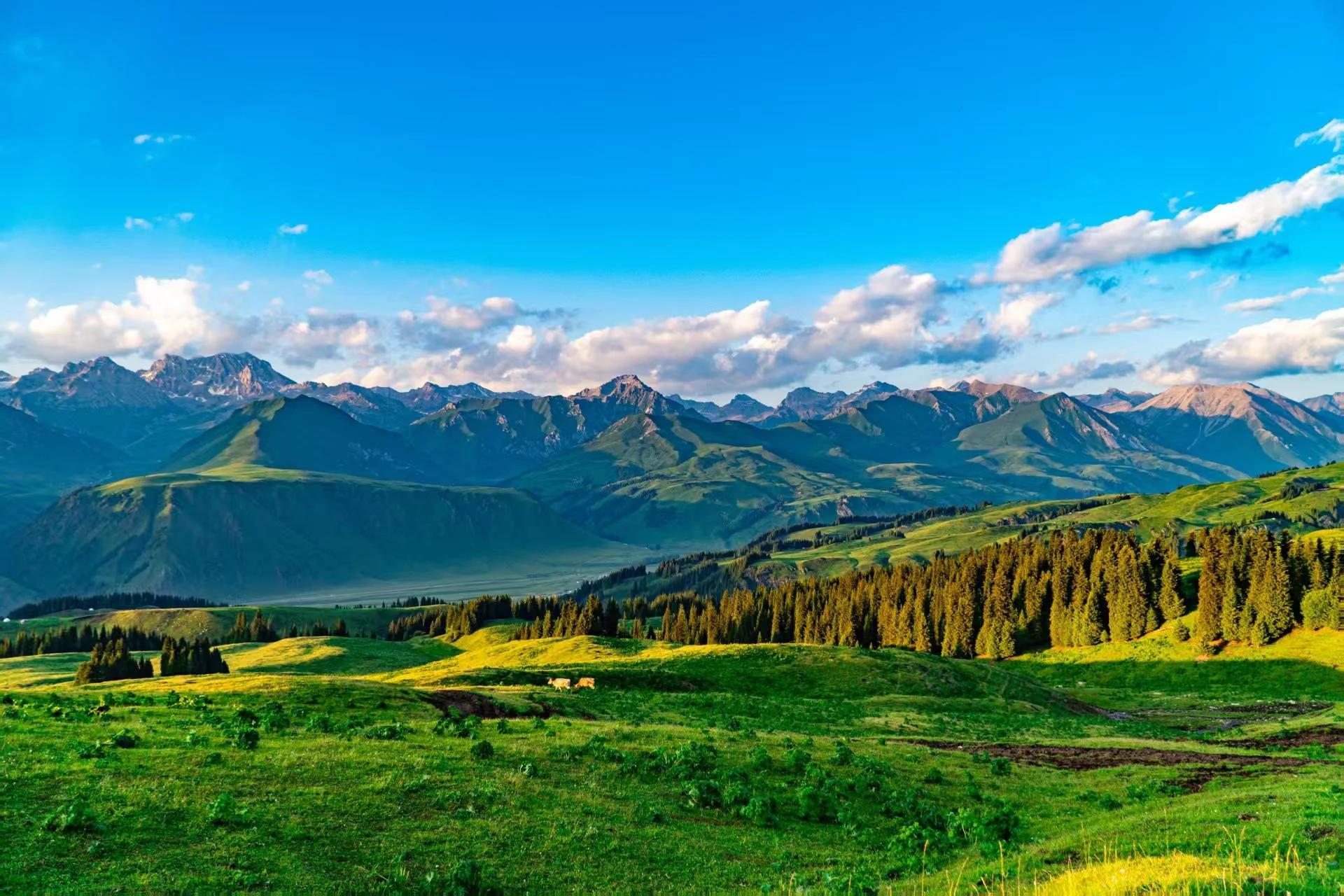
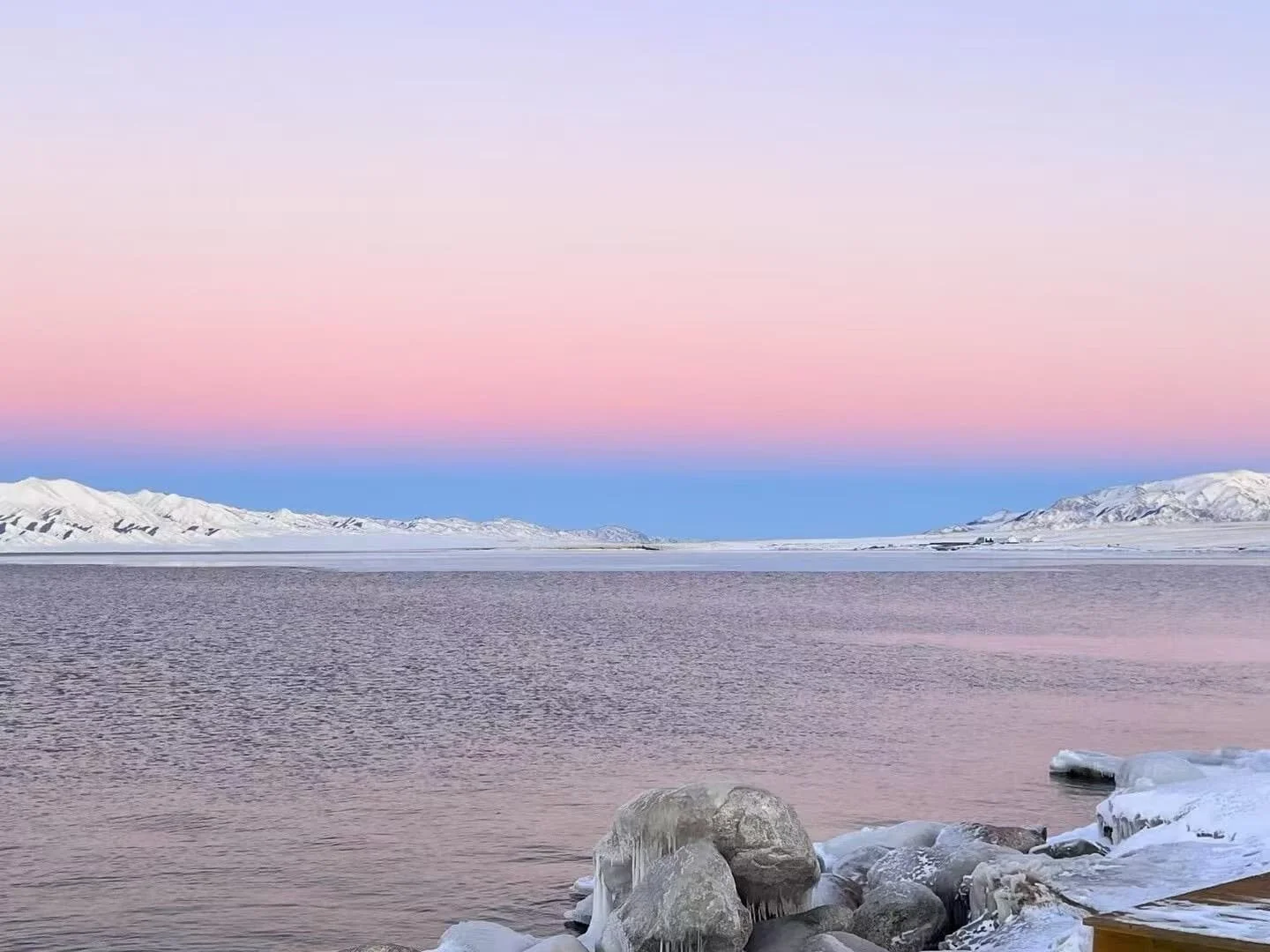
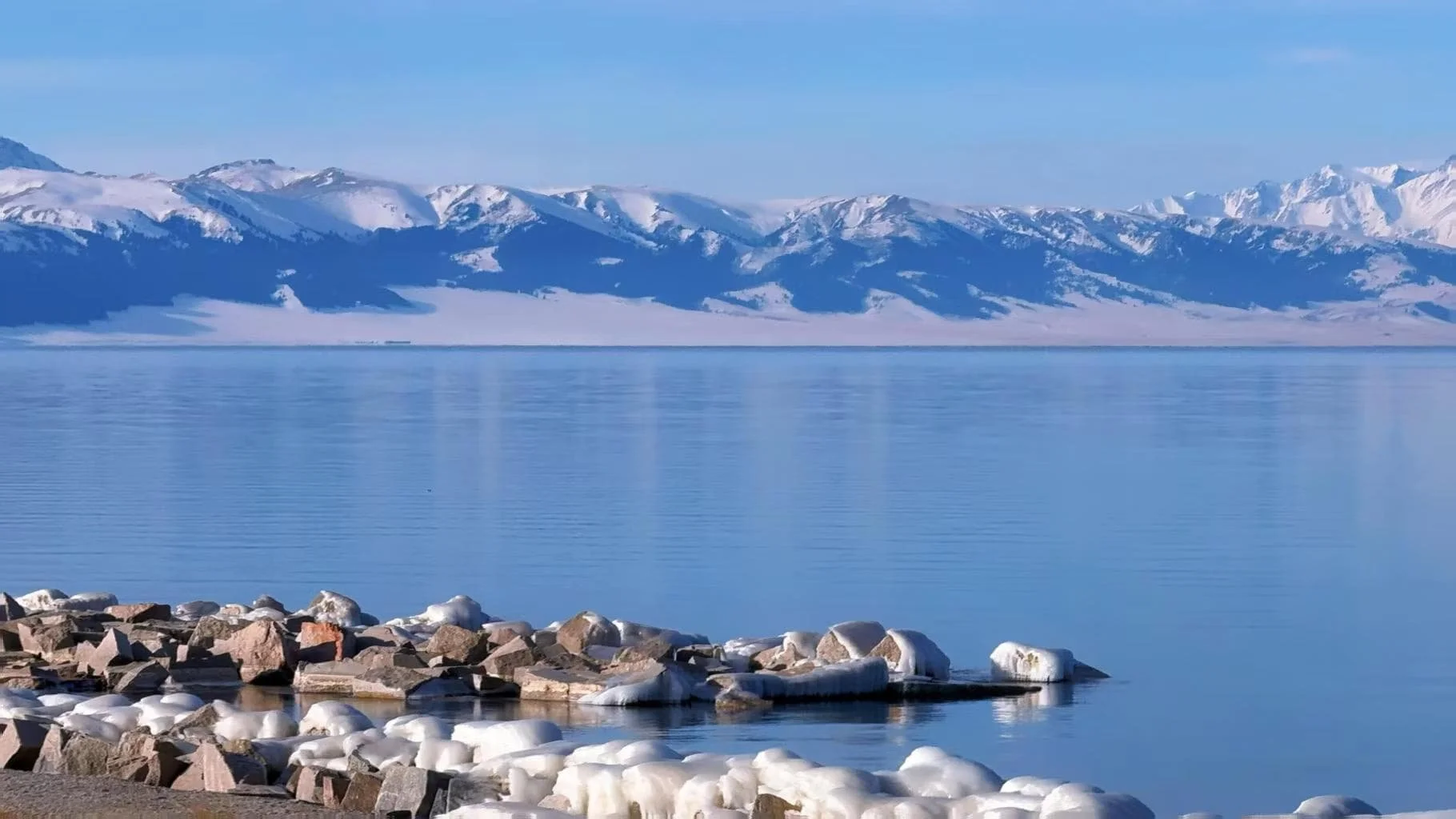
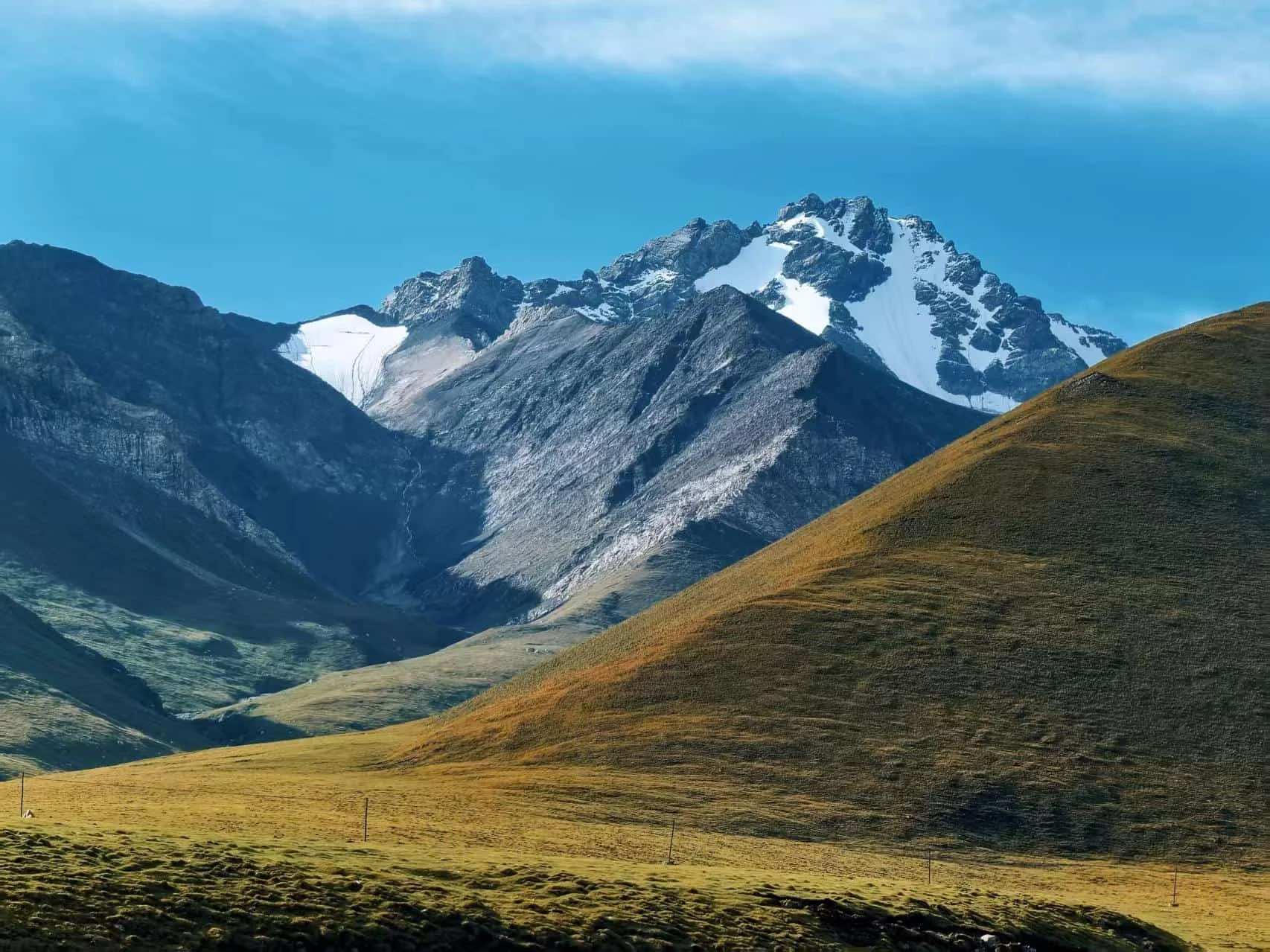
10 Days of Adventure Across Northern Xinjiang — Deserts, Lakes & the Duku Highway
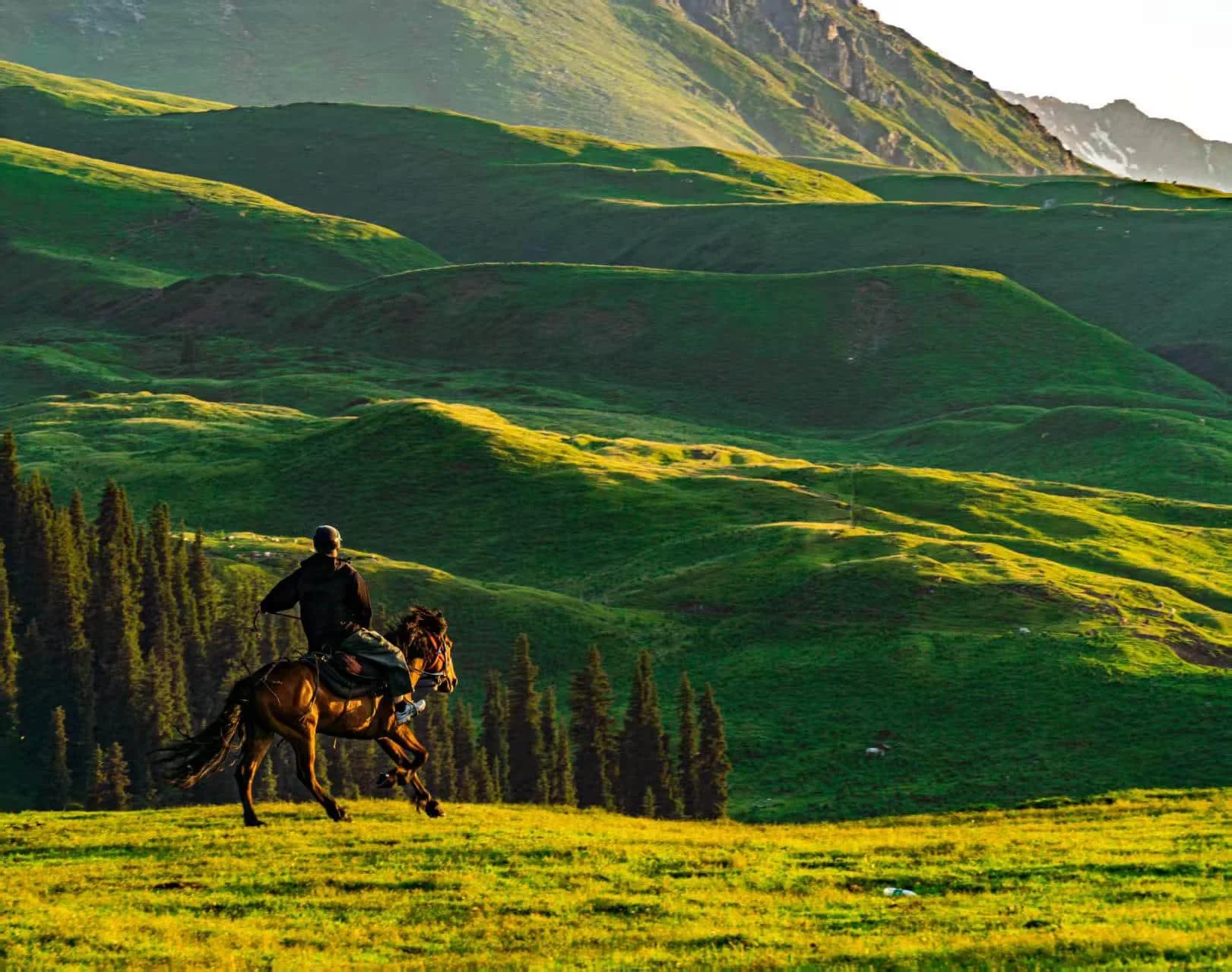
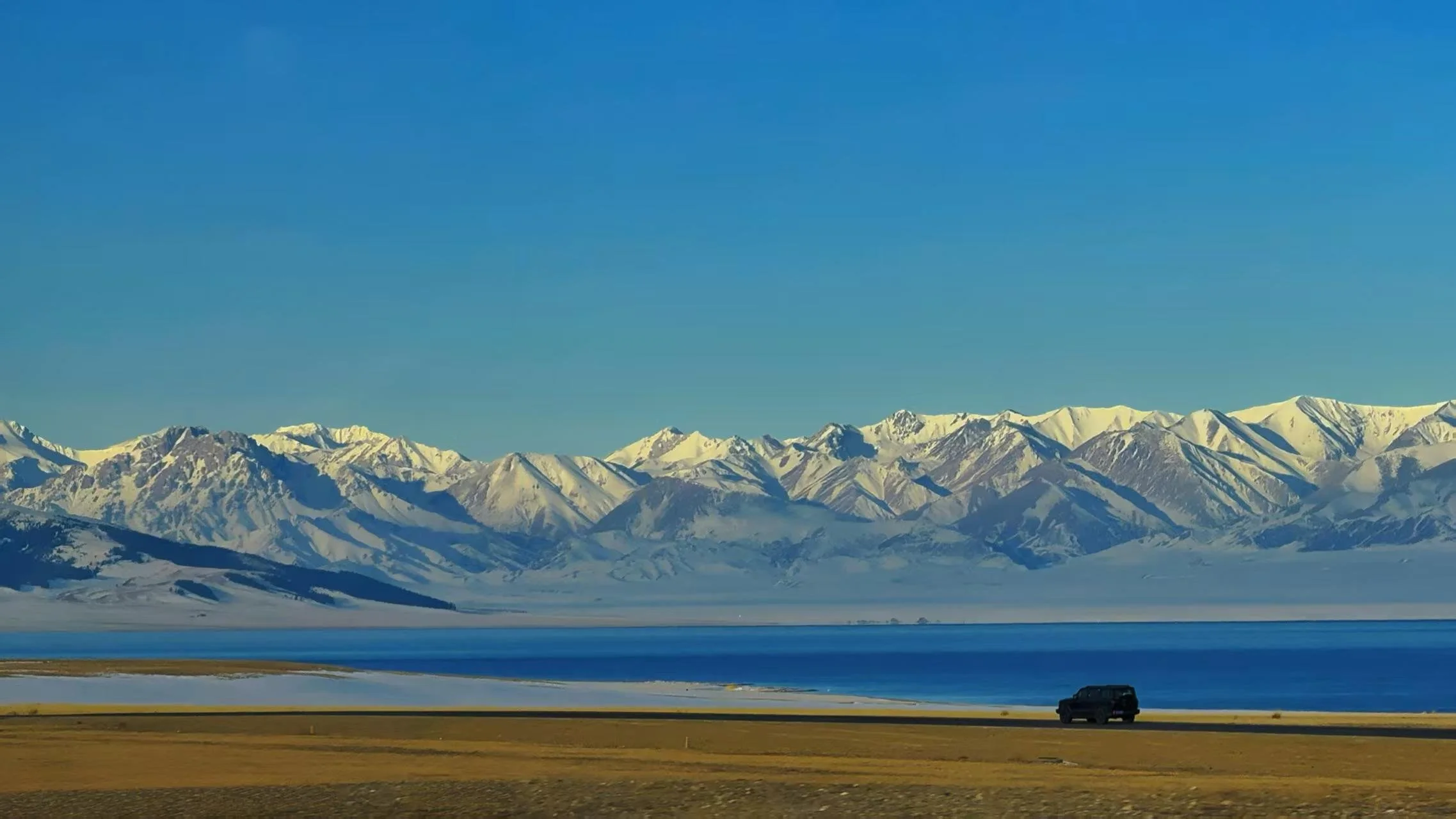
Northern Xinjiang isn't just a destination — it's a full-sensory immersion into landscapes that most people only see in documentaries. This 10-day scenic adventure tour takes you from the golden dunes of the Gurbantunggut Desert to the sapphire expanse of Sayram Lake, from the fairy-tale wooden village of Hemu to the vertiginous cliffs of the Duku Highway. Along the way, you'll ride desert buggies across sand waves, steer your own car around one of China's most beautiful alpine lakes, don traditional Kazakh garments for a prairie photoshoot, and share a BBQ under the stars with nomadic herders.
This is not your average sightseeing tour. Every day has an element of active engagement — whether it's hiking the Three Bays trail at Kanas Lake, ziplining across a desert canyon, or navigating the hairpin turns of China's most celebrated mountain highway. Your private guide handles all the logistics, while you focus on the experience.
What Makes This Tour Different: Unlike standard Northern Xinjiang itineraries, this adventure-focused route includes desert off-road activities at Karamay Desert Park, a self-drive experience around Sayram Lake, and a Kazakh cultural immersion at Nalati (ethnic costume photography + afternoon tea + prairie BBQ) — three experiences that turn passive sightseeing into active, unforgettable memories.
🏜️ Day 1: Arrival in Urumqi — Gateway to the Silk Road
Your adventure begins in Urumqi (乌鲁木齐), the capital of Xinjiang and the city farthest from any ocean on Earth. Despite its remote location, Urumqi is a vibrant, modern city where Uyghur, Kazakh, Han, and Hui cultures converge. Your private guide and driver will meet you at the airport and transfer you to a 5-star hotel in the city center.
If you arrive early, take an evening stroll through the International Grand Bazaar — the largest bazaar in China, with stunning Islamic architecture, towering minarets, and stalls overflowing with dried fruits, carpets, jade, and spices. It's a feast for the senses and a perfect introduction to the cultural melting pot of Xinjiang.
Tip: Xinjiang operates on Beijing Time officially, but local life runs about 2 hours later. Sunset in summer can be after 10 PM — you'll have plenty of daylight!
🐪 Day 2: S21 Desert Highway — Desert Safari & Altay
Morning — S21 Desert Highway & Yardang Landforms
Hit the road early and head north on the S21 Desert Highway, a 340km engineering marvel that cuts straight through the Gurbantunggut Desert (古尔班通古特沙漠) — China's second-largest desert. Unlike the shifting dunes of the Taklamakan, this is a fixed desert covered with scrubby saxaul bushes and dramatic Yardang landforms — wind-sculpted ridges carved over tens of thousands of years into bizarre, otherworldly shapes.
Your guide will stop at viewpoints along the highway where you can step out and feel the vastness of the desert. The silence is profound; the horizon stretches unbroken in every direction.
Midday — Karamay Desert Park (沙漠冒险!)
🔥 Adventure Highlight: This is where the tour earns its "Adventure" name. At Karamay Desert Park, choose from optional activities that take you off the observation platform and into the landscape:
Desert Surfing Vehicles (沙漠越野): Buckle into a purpose-built off-road buggy and tear across the dunes at thrilling speed — climbing sand walls, sliding down slip faces, and catching air over crests. Think of it as a roller coaster where you chart the course.
High-Altitude Zipline (高空滑索): Soar above the desert canyon on a zipline that spans hundreds of meters. The view from mid-air — golden sand below, blue sky above, wind rushing past — is pure adrenaline.
Not into extreme activities? The park also has gentle walking trails, photography platforms, and a desert museum explaining the Yardang formation process.
If the park is closed for seasonal maintenance, an alternative desert attraction will be arranged — your guide will ensure you still get that desert experience.
Afternoon — Ulungur Lake & Drive to Altay
Continue north past Ulungur Lake (乌伦古湖) — a vast freshwater lake known locally as the "Great Sea," with its neighbor Jili Lake called the "Small Sea." This is Xinjiang's second-largest fishing base, and the lakeshore scenery is a surprising contrast to the desert you just left: wetlands, reed beds, and flocks of migratory birds.
Arrive in Altay (阿勒泰) by evening and check into your hotel. Altay is the gateway to the Kanas region and the homeland of the Tuva people — a small ethnic group of Mongolian descent who have maintained their traditional lifestyle for centuries.
🏡 Day 3: Ahe Highway — Hemu Village & Starlit Log Cabin
Morning — Ahe Highway (阿禾公路)
Take the scenic Ahe Highway from Altay to Hemu — a road that winds through alpine meadows, birch forests, and river valleys with snow-capped peaks as a constant backdrop. (If traffic control restricts the Ahe Highway, you'll take the main highway route instead — equally scenic.)
Afternoon — Hemu Village (禾木村) Exploration
Hemu Village is one of the last remaining Tuva settlements in China, and it feels like stepping into a storybook. Traditional wooden cabins with peaked roofs are scattered across a valley floor where the Hemu River (禾木河) winds through birch forests and open grasslands. Cattle and sheep graze freely; smoke curls from cabin chimneys; the pace of life is measured in seasons, not hours.
Walk at your own pace along riverside boardwalks, cross the iconic Hemu Bridge (禾木桥), and climb to the Haden Observation Deck (哈登观景台) for a panoramic view of the entire village framed by mountains. This is the spot for travel photography — the light in late afternoon turns the wooden rooftops golden and the birch leaves translucent.
Optional activities: Horse riding along mountain trails (a Tuva tradition for centuries), or hiking deeper into the surrounding forests.
Evening — Log Cabin Under the Stars
Tonight's accommodation is a traditional log cabin (木屋) in Hemu Village. These rustic wooden lodges are the authentic Hemu experience — simple but comfortable, with thick quilts and wood-burning stoves. Step outside after dinner and look up: the village's remote location and zero light pollution mean you'll see the Milky Way stretching across the sky in breathtaking clarity. Bring your camera for astrophotography — the cabin rooftops against a star-filled sky make for an iconic shot.
Note: Log cabins are rustic by design. Hot water and Wi-Fi are available but may be slower than city hotels. The trade-off is an experience you simply cannot get anywhere else.
🌊 Day 4: Kanas Lake — Three Bays Hike & Rainbow Beach Sunset
Morning — Kanas Lake (喀纳斯湖) & the Lake Monster
Take the shuttle bus into the Kanas Nature Reserve (喀纳斯景区) — a pristine wilderness of alpine lakes, dense forests, and jagged peaks within the Altai Mountains. The centerpiece is Kanas Lake, a deep glacial lake whose waters shift between emerald green and sapphire blue depending on the season and light.
Kanas Lake is also home to one of China's most enduring mysteries: the "Kanas Lake Monster" (喀纳斯水怪). Locals and scientists have reported enormous creatures surfacing in the lake for decades. Some believe they're giant Hucho taimen (a species of salmon that can grow over 2 meters); others swear they've seen something far larger. Whether you believe the legend or not, standing on the lakeshore with the mist rolling across the water, it's easy to imagine something ancient lurking below.
Walk the lakeside boardwalks, visit the scenic viewpoints, and enjoy free time to explore at your own pace.
Afternoon — The Three Bays Hike (三湾徒步)
Hike along the trail that connects Fairy Bay (神仙湾), Moon Bay (月亮湾), and Wolong Bay (卧龙湾) — three stretches of the Kanas River where the water is so clear you can see every pebble on the riverbed, and the surrounding forests create a frame of impossibly vivid green. Each bay has its own character:
Fairy Bay: Morning mist hovers over the water like a veil — it's the most ethereal of the three, especially at dawn.
Moon Bay: The river curves in a perfect crescent shape, with two "footprint" sandbars in the center. Local legend says these are the footprints of the Moon Goddess.
Wolong Bay: A sandbar in the shape of a coiled dragon gives this bay its name. The calm, deep pool is perfect for contemplation.
The full Three Bays trail is approximately 5km of mostly flat, well-maintained boardwalk — a gentle and deeply rewarding hike.
Evening — Rainbow Beach (五彩滩) & Burqin Night Market
Head to Rainbow Beach (五彩滩) in the late afternoon — a geological wonder where wind and water have carved the riverbank into a surreal palette of red, yellow, purple, and white layered rock formations. The contrast between the colorful cliffs and the green Irtysh River flowing below is one of the most photographed scenes in Xinjiang. Arrive before sunset — the golden light amplifies the colors dramatically.
Continue to Burqin (布尔津), a charming border town with Russian-style architecture and tree-lined streets. Visit the famous "Internet Celebrity Bridge" (网红桥) — a pedestrian bridge lit with colorful lights that reflects in the river below — and explore the night market, where you can sample cold-water fish from the Irtysh River, grilled lamb skewers, and locally brewed kvass (a sweet fermented bread drink).
👹 Day 5: World Devil City — 10 Million Years of Wind Sculpture
Morning — World Devil City (世界魔鬼城)
Drive south to the World Devil City (Wuerhe Wind City) — a vast Yadan landform park where relentless winds have sculpted the rock into a city of "buildings," "castles," and "monsters" over millions of years. The name comes from the eerie howling sounds the wind makes as it whips through the rock formations — locals say it sounds like a thousand devils wailing.
Ride the shuttle bus through the park with an audio guide pointing out formations shaped like eagles, a dog gazing at the moon, and even the Titanic. The scale is staggering — these rock towers rise 10-30 meters high, stretching for kilometers across the barren plain.
🔥 Pro Tip: The best light for photography is late afternoon, when the low sun casts long shadows and turns the rocks deep amber. If your schedule allows, your guide can time the visit for the golden hour.
Afternoon — Karamay Oilfield & Drive to Kuitun/Dushanzi
Continue south past the Karamay Hundred-Mile Oilfield (克拉玛依百里油区) — one of China's largest oil fields. The landscape is surreal: thousands of "nodding donkey" pumps (磕头机) bobbing rhythmically across the flat plain, with drilling rigs and flares dotting the horizon. Against the blue sky and golden earth, it's an unexpectedly photogenic industrial landscape — a stark contrast to the natural wonders of the previous days.
Arrive in Kuitun (奎屯) or Dushanzi (独山子) by evening — the gateway town to the Duku Highway.
🚗 Day 6: Sayram Lake Self-Drive — "The Last Tear of the Atlantic"
Morning — Drive to Sayram Lake
Depart for Sayram Lake (赛里木湖) — the highest and largest alpine lake in Xinjiang, sitting at 2,073 meters above sea level. Known poetically as "the Last Tear of the Atlantic" (大西洋最后一滴眼泪), it's the furthest point reached by warm, moist Atlantic air currents before they're blocked by the Tianshan Mountains. The result is a lake of extraordinary purity — the water is a shade of blue that seems almost impossible.
Midday — Self-Drive Around Sayram Lake (自驾环湖!)
🔥 Adventure Highlight: This is one of the most thrilling experiences on the tour — driving your own vehicle around the 90km ring road that circles Sayram Lake. The road is well-paved, traffic is light, and the scenery changes with every bend: from rocky shorelines to wildflower meadows, from snow-capped peaks reflected in mirror-still water to crashing waves whipped up by mountain winds. Stop whenever you want — for photos, for a picnic, or simply to stand in silence and absorb the vastness.
Don't want to drive? No problem — your private driver will handle the wheel while you enjoy the views from the passenger seat.
Seasonal highlights:
Spring (April–May): The famous ice push phenomenon (推冰) — massive ice blocks pushed by wind and currents pile along the shoreline, glowing turquoise in the sunlight like a glacier landscape.
Summer (June–July): Wildflowers carpet the lakeshore meadows in waves of purple, yellow, and white.
Autumn (September): Golden grasslands and crystal-clear air with maximum visibility.
Afternoon — Guozigou Bridge & Six-Star Street, Yining
After lunch by the lake, drive through the spectacular Guozigou (果子沟) — a deep, forested canyon that serves as the natural gateway between the Sayram Lake basin and the Ili River Valley. Stop at the Guozigou Bridge viewpoint to photograph the double-tower cable-stayed bridge spanning the canyon — one of the most photographed engineering structures in Xinjiang.
Arrive in Yining (伊宁) and explore Six-Star Street (六星街) — a unique hexagonal street layout dating from the 1930s Soviet influence, now a charming neighborhood of European-style buildings painted in vivid blues, greens, and yellows. Wander the lanes, peek into artisan workshops, and taste Kazakh handmade ice cream — rich, creamy, and flavored with local herbs and fruits. The street is also the inspiration behind the beloved Xinjiang song "Apple Fragrance" (苹果香).
🥾 Day 7: Xiata Ancient Trail — Footsteps on the Silk Road
Morning — Xiata Ancient Trail (夏塔古道)
Take the shuttle bus into Xiata Ancient Trail National Forest Park (夏塔古道国家森林公园) — one of the most historically significant and scenically dramatic routes in all of Xinjiang. This trail was once a critical branch of the Silk Road, used by merchants, monks, and armies for over 2,000 years. The Tang Dynasty monk Xuanzang (玄奘) — the real-life inspiration for Journey to the West — is believed to have passed through this very valley on his pilgrimage to India.
Walk through a landscape of primeval forests, natural hot springs, and Wusun ancient tombs — the Wusun were a nomadic people who allied with the Han Dynasty against the Xiongnu. The trail leads toward the Muzart Glacier (木扎尔特冰川), visible in the distance — a massive ice field that has been the route's greatest obstacle and most magnificent sight since antiquity.
Walking level: The main trail is a gentle boardwalk; more adventurous hikers can push further toward the glacier base (allow 3-4 hours round trip).
Afternoon — Zhaosu Flower Fields & Tekes Bagua City (特克斯八卦城)
Continue by shuttle through Zhaosu (昭苏), where — in summer — endless fields of rapeseed flowers and sunflowers create a golden carpet against the backdrop of snow-covered Tianshan peaks. Even outside flower season, the agricultural landscape is stunning.
Arrive in Tekes (特克斯) — the world's only complete Bagua (Eight Trigrams) city layout, designed in 1937 based on the ancient Chinese divination system from the I Ching. The city radiates outward from a central Tai Chi altar along eight main streets, forming a perfect octagonal pattern visible from above. Explore Lijie Street (离街), where Kazakh and Uyghur cultures blend in a vibrant corridor of food stalls, craft shops, and traditional architecture. This is where to buy handmade felt products, dried fruits, and local dairy specialties.
🐎 Day 8: Nalati Sky Prairie — Kazakh Cultural Immersion
Morning — Nalati Sky Prairie (那拉提空中草原)
Enter Nalati Sky Prairie (那拉提空中草原) — one of the world's four great alpine grasslands and arguably the most beautiful in China. "Sky Prairie" gets its name from the fact that the grassland sits at an elevation where clouds seem to drift below you, creating the sensation of floating above the world. Snow-capped peaks ring the horizon; pine forests climb the slopes; wildflowers (May–July) paint the meadows in shifting colors.
Ride the shuttle bus across the prairie, passing herds of Ili horses (伊犁马) — a breed renowned for speed and endurance since the Han Dynasty, when they were known as "Heavenly Horses (天马)." Listen for the sound of dombra (冬不拉) — the two-stringed lute that is the soul instrument of Kazakh culture — drifting from a distant yurt.
Afternoon — Ethnic Costume Photography + Afternoon Tea + Prairie BBQ (民族服饰旅拍+下午茶+草原烧烤!)
🔥 Adventure & Culture Highlight: This afternoon is dedicated to immersive Kazakh cultural experiences:
1. Ethnic Costume Travel Photography (民族服饰旅拍): Don traditional Kazakh clothing — ornate embroidered velvet dresses for women, fur-trimmed coats and boots for men — and pose against the spectacular prairie backdrop. A professional photographer captures the moment. The resulting images are works of art: you, in centuries-old regalia, standing on an endless grassland with snow peaks behind you.
2. Afternoon Tea in a Yurt: Step inside a traditional Kazakh yurt (毡房) and sit on richly patterned felt carpets. Your hostess will pour milk tea (奶茶) — salty, rich, and warming — and serve baursak (包尔萨克), deep-fried dough puffs that are the Kazakh equivalent of bread. This is how nomadic families have welcomed guests for millennia.
3. Prairie BBQ under the Sky: As the sun lowers, gather for a traditional grassland barbecue — skewers of marinated lamb, roasted over open flames, served with flatbread and fresh salad. The experience of eating lamb grilled over wood fire, with the prairie stretching endlessly around you and the Tianshan peaks glowing pink in the sunset, is one that no restaurant can replicate.
🛣️ Day 9: Duku Highway — China's Most Beautiful Road
Morning — Tangbula Hundred-Mile Gallery (唐布拉百里画廊)
Depart Nalati and enter the Tangbula Hundred-Mile Gallery (唐布拉百里画廊) — a 100-kilometer stretch of road that winds through a landscape so beautiful it earned the name "Gallery." Lush green valleys, rushing rivers, wildflower meadows, and snow-capped peaks parade past your window in an ever-changing panorama. Every bend reveals a new composition that looks painted rather than real.
Midday — Baluntai Yellow Temple (巴伦台黄庙) — "Little Potala Palace"
Stop at the Baluntai Yellow Temple (巴伦台黄庙) — a grand Lamaist Buddhist monastery nestled in Old Baluntai Valley at 1,450 meters altitude. Known as the "Little Potala Palace," this is the largest Gelug (Yellow Sect) monastery in the region and a sacred site for Mongol Buddhist followers. The complex consists of 27 temples extending across 2.5 kilometers of valley floor, with vivid red and gold architecture set against the green mountain backdrop. The main hall houses a towering Maitreya Buddha statue, and the air is thick with the scent of butter lamps and incense.
Even if you're not Buddhist, the combination of stunning architecture, mountain setting, and spiritual atmosphere makes this a deeply moving stop — and one that most tour groups skip entirely.
Afternoon — Northern Section of Duku Highway (独库公路北段)
🔥 Adventure Highlight: The Duku Highway (独库公路) — 561km of mountain road connecting northern and southern Xinjiang through the heart of the Tianshan Mountains. Open only June to October due to snow, this is widely considered the most beautiful highway in China. The northern section you'll travel today traverses alpine meadows, crosses mountain passes above 3,400 meters, and passes through glacier-carved valleys where waterfalls cascade directly onto the road.
The highway was built by the Chinese military over 9 years (1974–1983), with 168 soldiers losing their lives to avalanches and landslides during construction. A memorial at the southern end honors their sacrifice. Driving this road is not just a scenic experience — it's a tribute to extraordinary human determination.
⚠️ Duku Highway Closure Policy: The Duku Highway is subject to sudden closures due to weather, landslides, or traffic control. If the highway is closed on your travel day, your guide will take Alternative Route: Nalati → Gongnaisi Daban → National Highway G218 → Tianshan Victory Tunnel (天山胜利隧道) — the world's longest expressway tunnel at 22.1km — → Urumqi. This alternative route is also spectacular and includes the tunnel as an engineering marvel in its own right.
Evening — Arrive Back in Urumqi
Arrive in Urumqi by evening, check into your hotel, and enjoy a farewell dinner. Your guide can recommend the best restaurant in town for a final Xinjiang feast — perhaps da pan ji (大盘鸡), the iconic "big plate chicken" that originated right here in Xinjiang.
✈️ Day 10: Departure from Urumqi
Enjoy a leisurely breakfast and free time before your departure. Your private driver will transfer you to Urumqi Diwopu International Airport according to your flight schedule. Depart with a camera full of extraordinary photos, a heart full of adventure, and a deep appreciation for the staggering diversity of China's northwest frontier.
Want to extend your trip? Ask us about adding Kashgar, Turpan, or a Silk Road extension — we can customize any itinerary.
✅ What's Included
✔️ Private English-speaking guide throughout (licensed, expert in Xinjiang geography & culture)
✔️ Private air-conditioned vehicle with professional driver
✔️ Self-drive experience at Sayram Lake (vehicle provided)
✔️ All entrance fees: Kanas Nature Reserve, World Devil City, Sayram Lake, Xiata Ancient Trail, Nalati Sky Prairie, Baluntai Yellow Temple
✔️ All shuttle bus / cable car fares within scenic areas
✔️ Ethnic costume travel photography session at Nalati (includes costume rental + professional photographer)
✔️ Afternoon tea + prairie BBQ at Nalati
✔️ 9 nights accommodation (5-star in Urumqi, 4-star comfort hotels, log cabin in Hemu, characteristic homestays in Tekes & Nalati)
✔️ Daily breakfast
✔️ Bottled water throughout
❌ What's Not Included
✘ Flights to/from Urumqi
✘ Lunch and dinner (budget ¥60-150 per meal; your guide will recommend the best local restaurants)
✘ Optional activities: desert surfing vehicles (~¥200), zipline (~¥150), horse riding (~¥100/hr) at Hemu
✘ Travel insurance (highly recommended — Xinjiang involves mountain roads and outdoor activities)
✘ Gratuities (optional, at your discretion)
📌 Practical Information
🚶 Activity Level: Moderate to Active. This tour includes hiking (Three Bays trail ~5km), optional horse riding, and the self-drive experience. Suitable for travelers with average fitness. Not recommended for those with severe mobility issues or young children under 6.
🌡️ Seasonal Considerations: The Duku Highway is open only June–October. June–July offers wildflower season at Sayram Lake and Nalati. September brings golden autumn foliage. Book early — this is peak season and accommodations fill fast.
🎒 What to Pack: Layers are essential — temperatures range from 5°C at mountain passes to 35°C in the desert. Bring: hiking shoes, sun protection (UV is intense at altitude), light rain jacket, warm jacket for evenings, and a camera with extra battery and memory cards.
🚗 Self-Drive Note: You must hold a valid driver's license (international driving permit accepted). The Sayram Lake ring road is well-paved and suitable for any experience level. If you prefer not to drive, your private driver will take the wheel.
📱 Connectivity: Cell coverage is available in cities and most scenic areas, but expect gaps in remote mountain sections. Download offline maps before departure.
🍽️ Dietary Notes: Xinjiang cuisine is heavily meat-based (lamb, beef). Vegetarian options exist but are limited in rural areas. Please inform us of dietary restrictions in advance so we can prepare alternatives.
🗺️ Route Map
Urumqi → S21 Desert Highway → Karamay Desert Park → Ulungur Lake → Altay → Ahe Highway → Hemu Village (log cabin) → Kanas Lake → Three Bays → Rainbow Beach → Burqin → World Devil City → Karamay Oilfield → Kuitun/Dushanzi → Sayram Lake (self-drive) → Guozigou Bridge → Yining → Xiata Ancient Trail → Muzart Glacier → Tekes (Bagua City) → Nalati Sky Prairie (costume photos + BBQ) → Tangbula Gallery → Baluntai Yellow Temple → Duku Highway → Urumqi
Ready for the adventure of a lifetime in Northern Xinjiang? Book your 10-day scenic adventure tour today — the Duku Highway is only open for a few months each year, and spaces fill quickly.

7 Days Along the Ancient Silk Road — From Turpan's Desert Cities to Kashgar's Living Bazaars
South Xinjiang is where the Silk Road still breathes. While northern Xinjiang captivates with alpine lakes and forested mountains, the south tells a different story — one of camel caravans and desert outposts, of blue-tiled mosques and labyrinthine old towns, of Uyghur bread baking in tandoor ovens and the call to prayer echoing across ancient mud-brick walls. This 7-day classic tour follows the legendary trade route from Urumqi through the Turpan Depression (the second-lowest point on Earth) to Kashgar — the fabled city at the crossroads of empires, where China, Central Asia, and the Indian subcontinent have met for over two millennia.
With a private guide, you won't just see these places — you'll understand them. Your guide is a local expert who knows which alley in Kashgar Old City leads to the best naan bakery, which stall at the livestock market sells the finest lambskin, and how to read the centuries of history written into the crumbling walls of Jiaohe Ancient City. This is cultural immersion, not sightseeing.
Why This Tour: The most comprehensive 7-day South Xinjiang itinerary available — covering Turpan's UNESCO desert cities, Tianshan Heavenly Lake, Kashgar's living Silk Road culture, AND the Karakoram Highway to Karakul Lake at 3,600m beneath the snow peaks of Muztagh Ata (7,546m). No other 7-day route covers this much diversity.
✈️ Day 1: Arrival in Urumqi — Where East Meets West
Your guide and driver will meet you at Urumqi Diwopu International Airport and transfer you to your hotel. After check-in, take the rest of the day to acclimatize and explore at your leisure.
Recommended evening activity: Visit the International Grand Bazaar (国际大巴扎) — the largest bazaar in China and a microcosm of Silk Road commerce. Wander through the Islamic-style archways past stalls piled with dried apricots from Turpan, jade from Hotan, carpets from Kashgar, and spices from across Central Asia. The minaret-topped mosque at the center of the complex is stunning at dusk, when golden lights illuminate the tilework. Grab a plate of polo (手抓饭) — Uyghur pilaf with lamb, carrots, and raisins — at one of the food courts. This is your first taste of the culture that will surround you for the next week.
Important: Xinjiang uses Beijing Time officially, but daily life runs about 2 hours later than the coast. Don't be surprised if restaurants are still serving dinner at 10 PM — this is completely normal.
🏜️ Day 2: Urumqi → Turpan — Windmills, Ancient Villages & Buddhist Caves
Morning — Da Ban Cheng Wind Farm (达坂城风力发电站)
Drive southeast from Urumqi toward Turpan, passing through the Da Ban Cheng Wind Farm — hundreds of towering white wind turbines standing in rows across the Gobi Desert, their blades turning slowly against a backdrop of snow-capped Bogda Peak. It's one of the largest wind farms in Asia and a photographer's dream: the contrast between the futuristic turbines and the ancient desert landscape is striking. Stop for photos at the designated viewpoint — the best angle captures the turbines receding into the distance with the mountains behind.
Midday — Tuyuk Village (吐峪沟麻扎村)
Visit Tuyuk Village — one of the oldest continuously inhabited villages in Xinjiang, with a history stretching back over 1,000 years. This is not a reconstructed tourist village — people still live here in traditional mud-brick homes with carved wooden doors and courtyards filled with grape vines. The village sits at the mouth of the Tuyuk Gorge (吐峪沟大峡谷), where Buddhist monks once carved meditation caves into the cliffsides. A short walk into the gorge reveals rock-cut cave dwellings and the remains of a Buddhist monastery — a poignant reminder that this region was Buddhist long before it became Muslim.
💬 Cultural Insight: Tuyuk is also home to the Tuyuk Mazar (麻扎) — a shrine believed to be the tomb of the first Uyghur convert to Islam. It's one of the most sacred Muslim sites in Xinjiang and a pilgrimage destination. While the shrine itself is reserved for Muslim visitors, the village surrounding it offers a rare, unfiltered glimpse into traditional Uyghur rural life.
Afternoon — Bezeklik Thousand Buddha Caves (柏孜克里克千佛洞)
Continue to the Bezeklik Thousand Buddha Caves — a complex of 83 rock-cut cave temples carved into the cliff face of the Mutou Valley, dating from the 5th to the 14th century. Once adorned with vibrant murals depicting Buddhist paradise scenes, celestial musicians, and donor portraits in multicultural dress (Sogdian, Chinese, Uyghur, and Indian), many of the finest murals were removed by German archaeologist Albert von Le Coq in the early 20th century and are now in Berlin's Museum of Asian Art.
Despite the losses, the remaining murals are extraordinary — especially the large-scale preaching scenes where the Buddha sits surrounded by worshippers in distinctly different ethnic costumes, a visual record of the Silk Road's multicultural traffic. Your guide will explain the artistic techniques, the stories depicted, and the complex history of cultural exchange (and looting) that shaped what you see today.
Late Afternoon — Astana-Karakhoja Ancient Tombs (阿斯塔那古墓群)
End the day at the Astana-Karakhoja Tombs — an underground cemetery dating from the 3rd to the 8th century that served the ancient city of Gaochang. Often called the "Underground Museum of Turpan," these tombs have preserved an astonishing array of artifacts thanks to the extremely dry desert climate: silk garments, paper documents, painted figurines, and even food — including dumplings and mooncakes that look freshly made despite being 1,300 years old.
One of the most fascinating finds is a pair of paper shoes made from repurposed official documents — a thrifty recycling practice that inadvertently preserved dozens of Tang Dynasty administrative records. Your guide will bring these stories to life as you descend into the excavated tomb chambers.
🏛️ Day 3: Turpan's UNESCO Treasures — Minarets, Ancient Cities & Underground Water
Morning — Emin Minaret (苏公塔)
Start at the Emin Minaret (苏公塔) — the tallest minaret in China at 44 meters, built in 1778 by Turpan's Uyghur ruler Emin Khoja to honor his loyalty to the Qing Dynasty. The minaret is an architectural marvel: constructed entirely of sun-dried bricks in 15 different geometric patterns — diamonds, waves, flowers — without a single steel bar or concrete column. The tapered cylinder rises from a 10-meter base to a delicate point, each pattern creating a subtle texture that shifts with the light. The adjacent mosque, with its timber-columned prayer hall and painted ceiling, is still active.
Midday — Jiaohe Ancient City (交河故城) — UNESCO World Heritage Site
Visit Jiaohe Ancient City — one of the best-preserved ancient cities on the Silk Road and a UNESCO World Heritage Site. Unlike most ancient cities built by stacking materials upward, Jiaohe was carved downward into a loess plateau — entire streets, houses, temples, and government buildings were excavated from the living earth, leaving a city that is simultaneously architecture and geology.
Standing on the central avenue, you walk between walls that are actually the excavated earth between rooms — a construction method unique to this site. The city was founded around the 2nd century BC as the capital of the Jushi Kingdom, later became a Tang Dynasty garrison town, and was finally abandoned after destruction by fire in the 14th century. At its peak, 7,000 people lived here.
Key highlights: the Buddhist temple complex with its 101 smaller stupas surrounding a central Great Stupa, the underground temple with surviving wall paintings, and the residential quarter where you can still see the layout of individual homes — living room, storage, well — carved into the ground. Your guide will explain how the city's strategic location on a cliff between two rivers made it both defensible and devastatingly isolated.
Afternoon — Karez Well System (坎儿井) & Turpan Museum
Explore the Karez Well System (坎儿井) — one of the three great ancient engineering projects of China (alongside the Great Wall and the Grand Canal). This underground irrigation network consists of over 1,100 wells connected by 5,000+ km of underground channels that tap into snowmelt from the Tianshan Mountains and deliver it to the Turpan basin entirely by gravity — no pumps, no energy, just brilliant hydrology developed over 2,000 years ago.
Visit a preserved karez section where you can walk inside the tunnel and see the construction technique: vertical shafts dug every 20-30 meters for ventilation and maintenance, connected by gently sloping underground channels that keep the water cool and prevent evaporation in the extreme desert heat. The system is so efficient that some karez are still in use today.
End the afternoon at the Turpan Museum, which houses the region's finest archaeological finds — including remarkably preserved mummies from the Astana tombs, ancient textiles, and the world's earliest known written contract (a rental agreement for a vineyard, naturally — this is Turpan).
🏔️ Day 4: Heavenly Lake of Tianshan → Flight to Kashgar
Morning — Heavenly Lake (天池)
Drive into the Bogda Peak (博格达峰) area of the Tianshan Mountains to visit Heavenly Lake (Tianchi) — a crescent-shaped alpine lake at 1,910 meters elevation, fed by glaciers from the 5,445-meter Bogda Peak. The contrast with the Turpan desert is dramatic: where yesterday you stood at the second-lowest point on Earth, today you're surrounded by snow-capped peaks, pine forests, and crystal-clear water reflecting the sky.
Walk the lakeside boardwalk, visit the West Queen Mother Temple (西王母庙) — a Taoist temple perched above the lake, dedicated to the mythical goddess who, according to legend, held court here and offered the Peaches of Immortality to visiting emperors — and take in the views of Bogda Peak's three glaciers. Your guide will share the rich mythology surrounding this lake, which has been considered a sacred site for over 3,000 years.
Afternoon — Fly to Kashgar (喀什)
Transfer to Urumqi Airport for the flight to Kashgar (喀什) — the legendary Silk Road city that has been a trading hub for over 2,000 years. At the westernmost edge of China, closer to Baghdad than Beijing, Kashgar is where Central Asian, South Asian, and Chinese civilizations have collided, mingled, and coexisted for millennia.
Your guide will meet you at Kashgar Airport and transfer you to your hotel. Step outside in the evening and feel the difference: the air is thicker, the streets are narrower, the sounds are more layered — the call to prayer, the clatter of copper hammering, the sizzle of lamb on grills. You're no longer in the China you know. You're on the Silk Road.
🕌 Day 5: Kashgar — The Living Heart of the Silk Road
Morning — Kashgar Old Town (喀什老城)
Enter Kashgar Old Town — one of the best-preserved Islamic cities in Central Asia and a living museum of Uyghur architecture and daily life. This is not a theme park reconstruction — people have lived in these maze-like streets for centuries, and they still do. Mud-brick houses with carved wooden balconies, painted doors in brilliant blues and greens, and rooftop terraces overflowing with pomegranate trees and climbing roses line the narrow lanes.
Your guide will lead you through the labyrinth — without a guide, it's genuinely easy to get lost, which is part of the charm. Visit the Hundred-Year-Old Tea House (百年老茶馆), where Uyghur men gather on cushioned platforms to drink tea, eat naan, and listen to impromptu music performances. Order a pot of saffron tea with rose petals and a plate of naan (馕) — the Uyghur flatbread that is the staple of every meal — and absorb the atmosphere as the sunlight filters through the lattice windows.
Midday — Livestock Market & Handcraft Street
Visit the famous Livestock Market (牲畜巴扎) — a weekly gathering where herders from the surrounding countryside bring sheep, cattle, horses, and donkeys to trade. The scene is chaotic, colorful, and completely authentic: men in traditional doppas (embroidered caps) haggle over lambs, horses are test-ridden in an open field, and the air is thick with dust and the smell of animals. This market has operated in some form for over a thousand years — it's the Silk Road in action.
Continue to Handcraft Street (手工艺街), where artisans practice trades that have barely changed in centuries. Watch a coppersmith hammer a tea kettle from a single sheet of brass, observe a woodworker carve intricate patterns on a baby's cradle, and see how Uyghur musical instruments — the rawap, the dutar, the dombra — are assembled by hand. Each workshop is a masterclass in traditional craftsmanship.
Afternoon — Grand Eid-Kah Mosque (艾提尕尔清真寺) & Apak Khoja Tomb
Visit the Id Kah Mosque (艾提尕尔清真寺) — the largest mosque in China, with a capacity of 20,000 worshippers. Built in 1442 and expanded over the centuries, the mosque's iconic yellow-tiled facade and twin minarets dominate the central square of Kashgar. The courtyard is peaceful, with poplar trees providing shade and a central pool for ablution. Non-Muslim visitors are welcome outside prayer times.
Continue to the Apak Khoja Tomb (阿帕克霍加麻扎) — a stunning Islamic mausoleum complex known as the "Fragrant Concubine's Tomb" (香妃墓). The legend says this is the burial place of Xiangfei, a Uyghur woman who became a concubine of the Qianlong Emperor and was said to naturally emit a captivating fragrance. Whether the legend is true or not, the architecture is magnificent: a green-tiled dome, minarets with intricate geometric patterns, and a complex of prayer halls and meditation rooms — all set within peaceful gardens. The tilework is among the finest Islamic art in China.
🏔️ Day 6: Karakoram Highway — Karakul Lake Beneath Muztagh Ata
Morning — Drive the Karakoram Highway (喀喇昆仑公路)
Set out on one of the world's most spectacular drives: the Karakoram Highway (KKH), also known as the China-Pakistan Friendship Highway. This engineering marvel climbs from Kashgar at 1,300m through increasingly dramatic mountain scenery toward the Pakistan border at 4,700m. You'll travel the first 200km of this legendary road.
Stop at Upal Village (乌帕尔乡) — a small Uyghur settlement where the road begins its climb into the mountains. Sample fresh naan from a village bakery and observe the transition from lowland desert to mountain terrain.
Midday — Red Mountain & White Sand Mountain (白沙山)
As the road climbs, the geology becomes increasingly dramatic. Stop at the Oytag Red Mountain (红山) — a vividly colored geological formation where layers of red sandstone and conglomerate are exposed in dramatic folds, and the White Sand Mountain (白沙山) at Bulungkol (布伦口) — a surreal landscape of gleaming white sand dunes reflected in the still waters of Bulunkol Reservoir. The contrast between the white sand, the turquoise water, and the grey-brown mountains behind is otherworldly.
Afternoon — Karakul Lake (卡拉库里湖) & Muztagh Ata (慕士塔格峰)
Arrive at Karakul Lake (卡拉库里湖) at 3,600 meters — a high-altitude glacial lake sitting at the foot of the majestic Muztagh Ata (慕士塔格峰, 7,546m), known as the "Father of Ice Mountains." On a clear day, Muztagh Ata's snow-dome summit is reflected perfectly in the lake's mirror-still surface — one of the most iconic mountain views in all of Central Asia. To the southeast, the jagged peak of Kongur Tagh (公格尔峰, 7,719m) adds to the panorama.
Walk along the lakeshore, visit the small Kyrgyz yurt settlement where herders offer bowls of hot milk tea and fresh yogurt, and simply sit and absorb the scale of the landscape. At this altitude, the air is thin and crystalline — you'll notice the sky is a deeper blue than you've ever seen. Take it slow; your guide will monitor your comfort level for altitude.
🏔️ Altitude Note: Karakul Lake sits at 3,600m. Most travelers experience mild effects (slight breathlessness, mild headache). Your guide will carry oxygen and ensure you take it easy. If you have a history of altitude sickness, consult your doctor before the trip.
Evening — Return to Kashgar
Drive back down the Karakoram Highway to Kashgar, arriving in the early evening. For your final night, ask your guide to recommend the best Zhuafan (手抓饭) restaurant in the old city — Uyghur pilaf served with your hands, washed down with cold kvas (格瓦斯), the fermented bread drink that's Kashgar's favorite refreshment.
✈️ Day 7: Departure from Kashgar
Enjoy breakfast at your hotel and spend your final moments in Kashgar however you wish — last-minute shopping for dried fruits and spices at the bazaar, a quiet cup of tea at the Old Tea House, or a morning walk through the Old Town when the light is soft and golden.
Your driver will transfer you to Kashgar Airport according to your flight schedule. Depart carrying the scents of cumin and rose, the sound of the rawap, and the memory of Muztagh Ata reflected in a glacial lake — the Silk Road, alive inside you.
Want to extend? We can add a day trip to Shache (莎车) for its magnificent Uyghur palace and the Twelve Muqam performance — the UNESCO-listed musical tradition of Xinjiang. Just ask.
✅ What's Included
✔️ Private English-speaking guide throughout (licensed, expert in Silk Road history & Uyghur culture)
✔️ Private air-conditioned vehicle with professional driver
✔️ Domestic flight: Urumqi → Kashgar (Day 4)
✔️ All entrance fees: Tuyuk Village, Bezeklik Caves, Astana Tombs, Emin Minaret, Jiaohe Ancient City, Karez Wells, Heavenly Lake, Id Kah Mosque, Apak Khoja Tomb, Karakul Lake
✔️ 6 nights accommodation (comfort hotels, breakfast included)
✔️ Bottled water throughout
✔️ Airport pickup (Urumqi) and drop-off (Kashgar)
❌ What's Not Included
✘ International flights to/from China
✘ Lunch and dinner (budget ¥60-120 per meal; your guide will recommend the best local restaurants)
✘ Travel insurance (highly recommended)
✘ Gratuities (optional, at your discretion)
✘ Personal purchases at the bazaar (hard to resist!)
📌 Practical Information
🚶 Walking Level: Moderate. Jiaohe Ancient City involves ~2 hours of walking on uneven ground. Kashgar Old Town involves 3-4 hours of walking on cobblestones. Comfortable shoes essential.
🌡️ Climate: Turpan is one of the hottest places on Earth — summer temperatures regularly exceed 45°C. Bring sun protection (hat, sunscreen, UV-blocking sunglasses). Kashgar is milder but still hot in summer. Mornings and evenings are pleasant year-round.
🏔️ Altitude: Karakul Lake is at 3,600m. Most travelers adjust fine for a day visit, but those with heart or lung conditions should consult a doctor. Your guide carries supplemental oxygen.
📷 Photography: Kashgar Old Town and the Livestock Market are incredibly photogenic. Always ask permission before photographing people — Uyghur culture values politeness, and most people are happy to pose if asked respectfully.
🕌 Cultural Sensitivity: Kashgar is a Muslim-majority city. Dress modestly when visiting mosques (long sleeves, covered knees). Remove shoes before entering prayer areas. The Id Kah Mosque welcomes non-Muslim visitors outside prayer times.
🍽️ Food Highlights: Don't miss: polo (Uyghur pilaf), laghman (hand-pulled noodles with stir-fry), samsa (baked meat pastries), and kawap (grilled lamb skewers with cumin and chili — Xinjiang's signature street food).
📅 Best Time to Visit: April–June and September–November offer the most comfortable temperatures. The Livestock Market is busiest on Sundays — plan accordingly if you want to experience it at full scale.
🗺️ Route Map
Urumqi → Da Ban Cheng Wind Farm → Tuyuk Village → Bezeklik Caves → Astana Tombs → Turpan → Emin Minaret → Jiaohe Ancient City → Karez Wells → Heavenly Lake → ✈️ → Kashgar → Old Town & Tea House → Livestock Market → Handcraft Street → Id Kah Mosque → Apak Khoja Tomb → Karakoram Highway → Karakul Lake (Muztagh Ata 7,546m) → Kashgar → ✈️
Follow the ancient camel caravans along the Silk Road. Book your 7-day South Xinjiang Classic Tour today — spaces are limited during peak season.
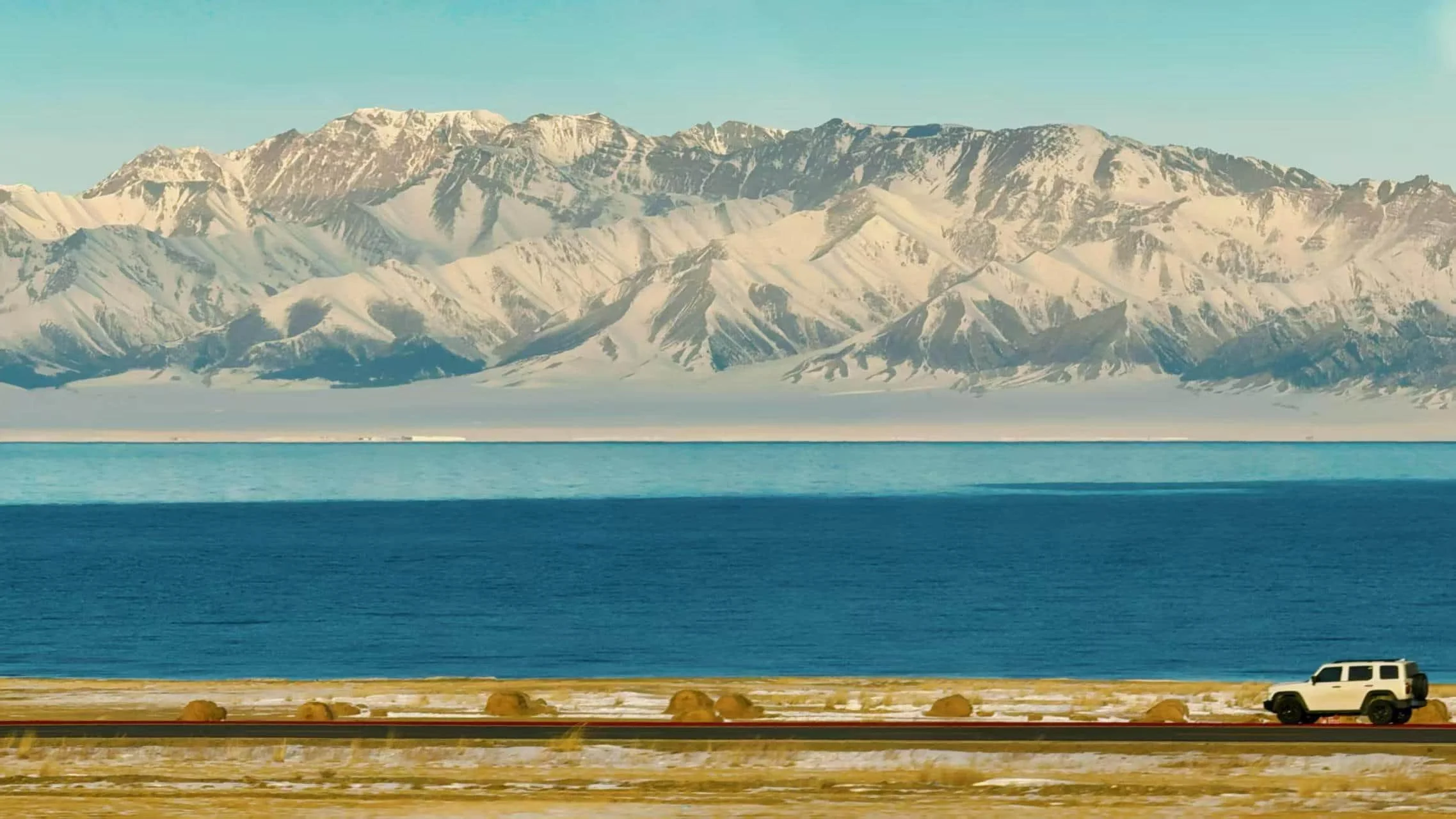
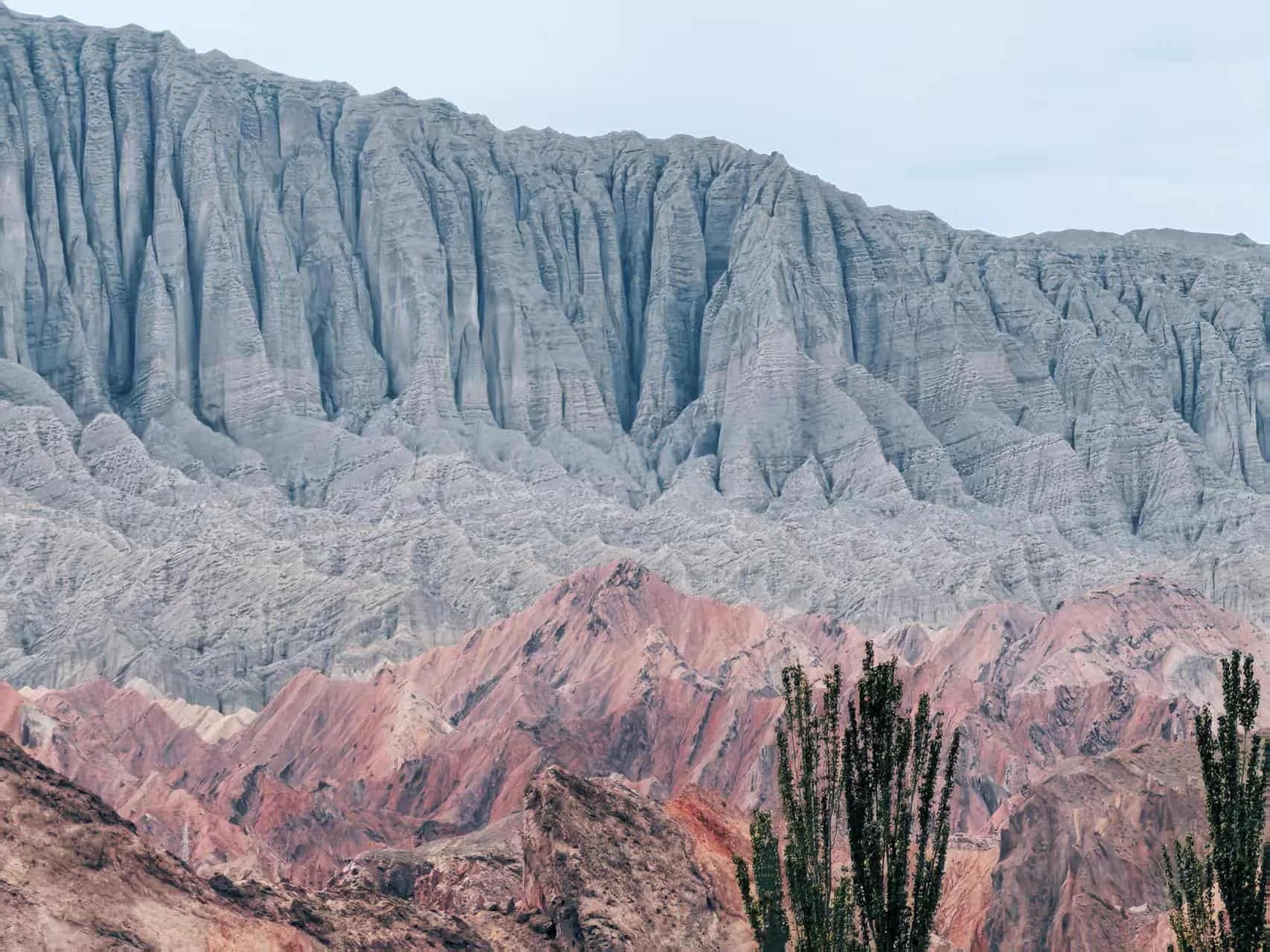
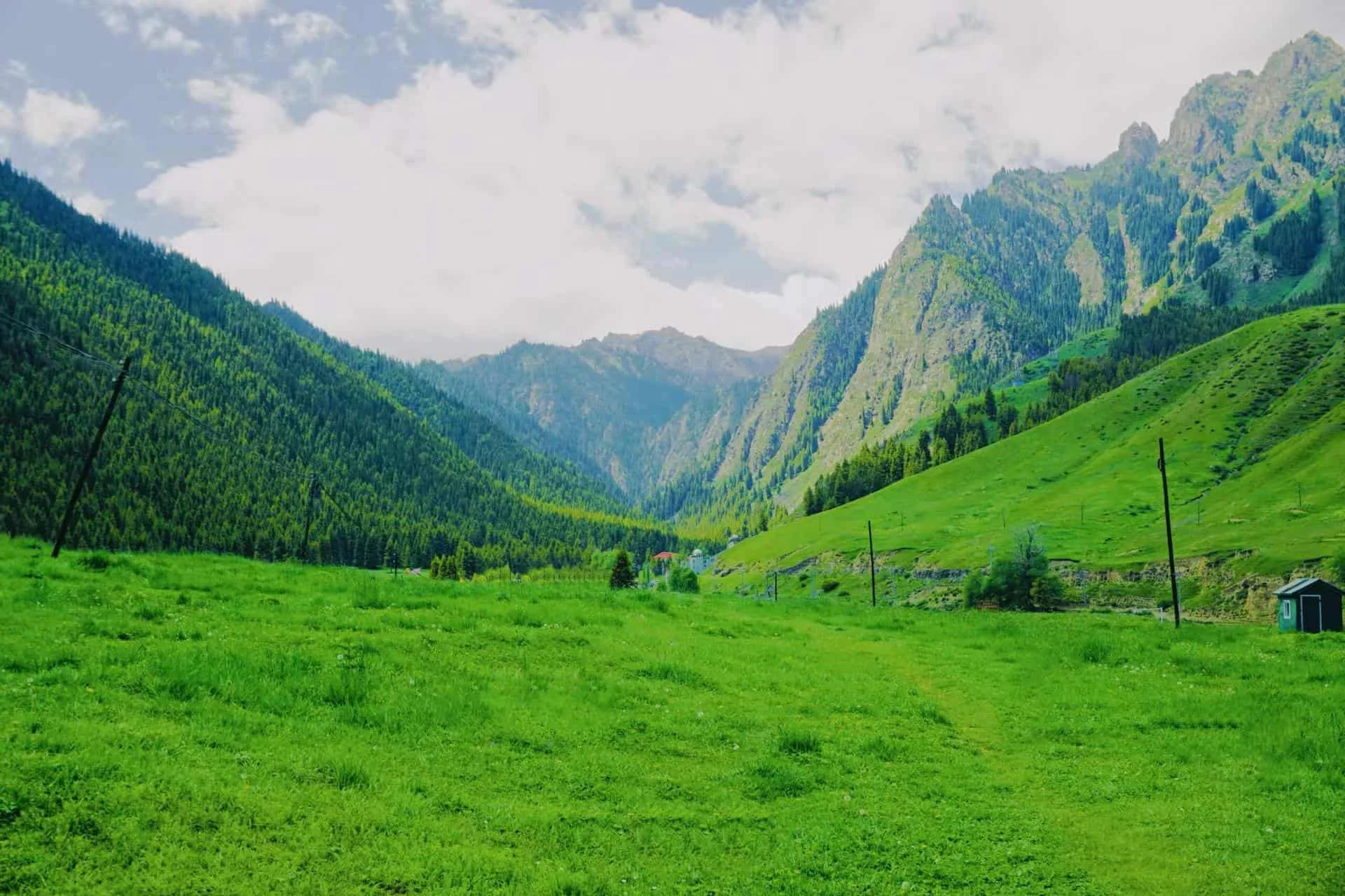
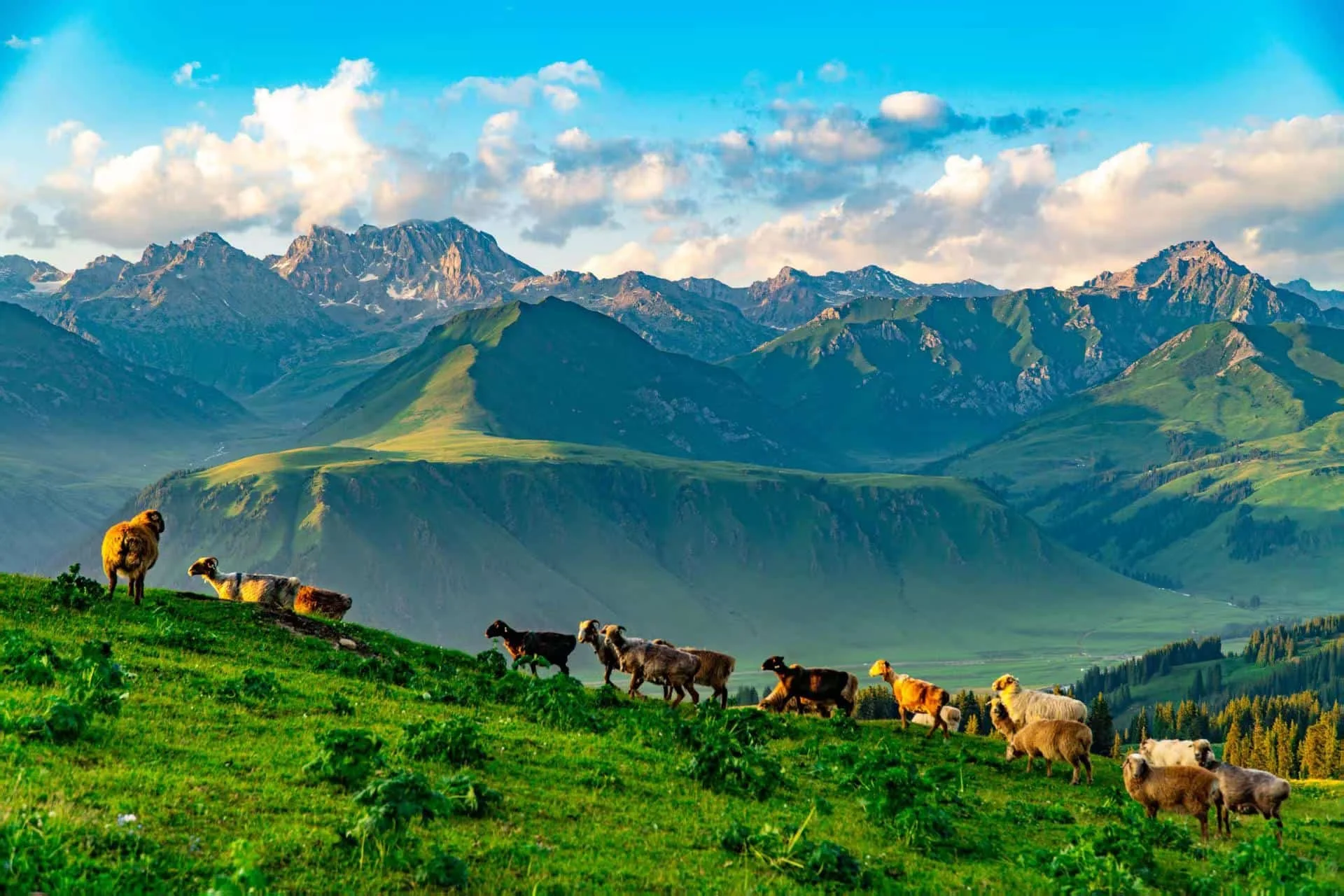
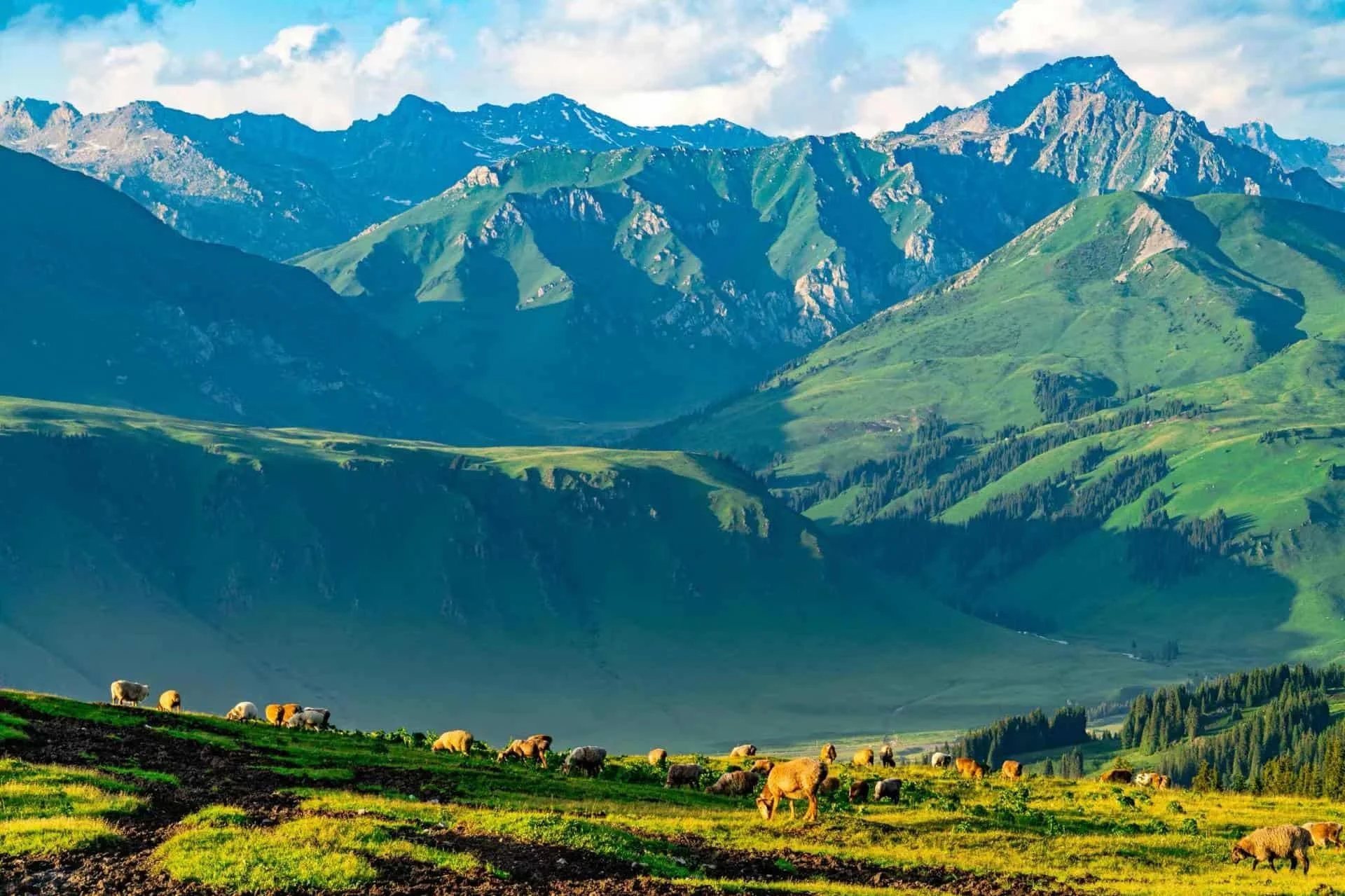
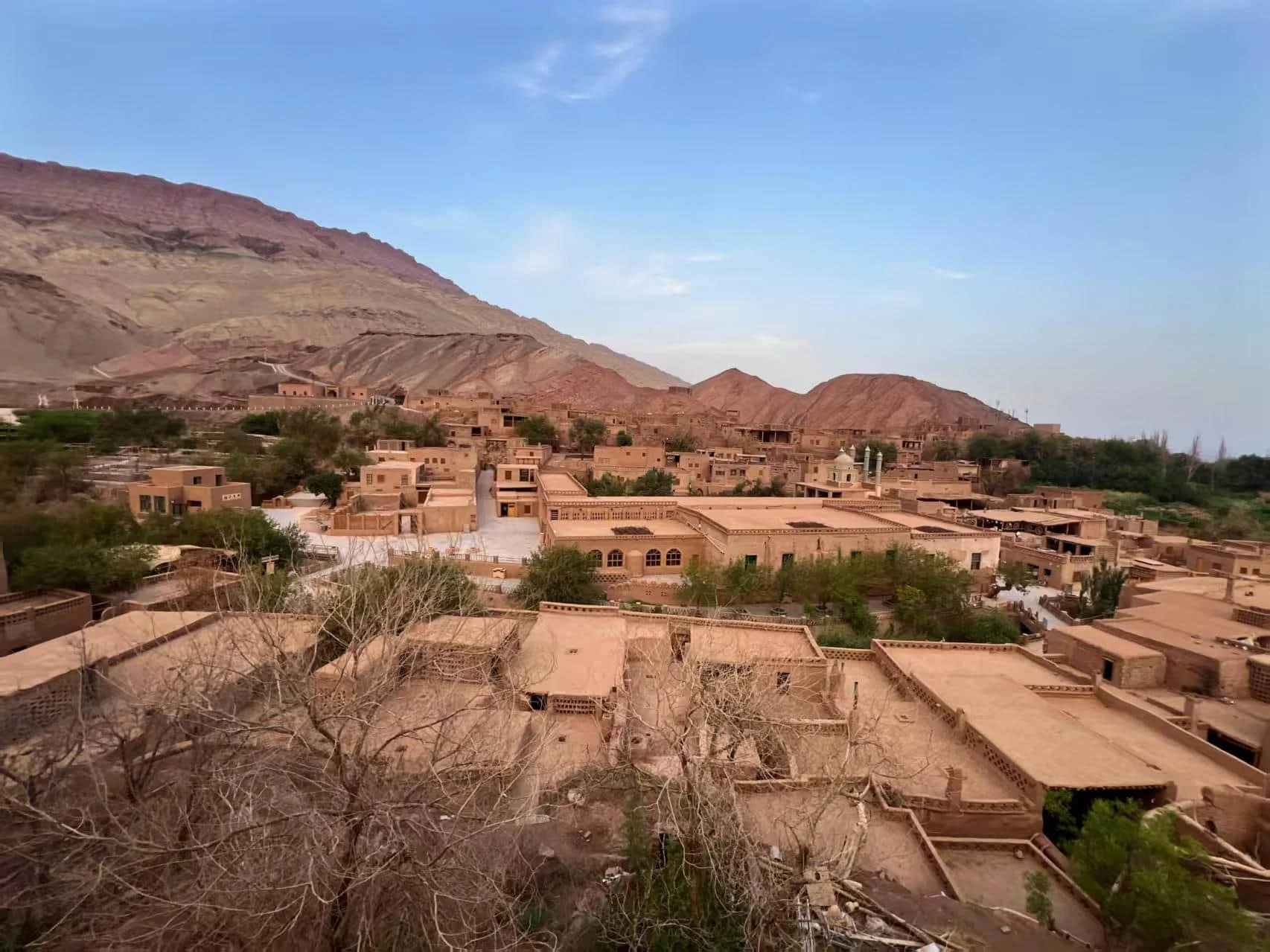
6 Days in Northern Xinjiang — Desert, Mountains & the Heart of Kanas
Short on time but refuse to miss Northern Xinjiang's greatest hits? This 6-day private tour distills the region's most extraordinary landscapes into one efficient, deeply rewarding itinerary: cross the Gurbantunggut Desert on the S21 Highway, experience the Tuva culture of Hemu Village, stand before the legendary waters of Kanas Lake, and gaze across the vast expanse of Ulungur Lake — all with a private guide who ensures every moment is meaningful, not rushed.
This is the ideal tour for travelers who want the core Northern Xinjiang experience without the longer commitment of a 10-day circuit. You'll see the desert, the mountains, the forest, and the lake — the four faces of the Altay — and return home with a complete picture of this extraordinary corner of China.
Why This Tour: The most efficient way to experience Northern Xinjiang's top highlights — S21 Desert Highway, Kelameili Desert Park, Hemu Village (log cabin stay), and Kanas Lake — in just 6 days. Perfect as an add-on to a China round-trip or a standalone adventure.
✈️ Day 1: Arrival in Urumqi
Your private guide and driver will meet you at Urumqi Diwopu International Airport and transfer you to your hotel. Take the rest of the day to rest and acclimatize.
If you arrive early, explore the International Grand Bazaar — a vibrant introduction to Xinjiang's cultural crossroads, with Islamic architecture, Uyghur street food, and stalls overflowing with dried fruits, nuts, and spices. Try your first bowl of daqanji (大盘鸡) — Xinjiang's famous "big plate chicken" — or a plate of lamian (拉面), hand-pulled noodles stir-fried with lamb and vegetables.
Tip: Xinjiang operates on Beijing Time officially, but daily life runs about 2 hours later. Sunset in summer can be after 10 PM — you'll have plenty of evening daylight.
🏜️ Day 2: S21 Desert Highway — Through the Heart of the Desert
Morning — Depart Urumqi via S21 Desert Highway
Leave Urumqi and head north on the S21 Desert Highway (阿乌高速) — a 340km engineering marvel that cuts directly through the Gurbantunggut Desert (古尔班通古特沙漠), China's second-largest desert. Unlike the shifting dunes of the Taklamakan to the south, this is a semi-fixed desert — the sand is held in place by vast stretches of saxaul bushes and desert vegetation, creating a landscape of gentle undulating dunes dotted with hardy green scrub.
The S21 is one of China's newest desert highways (opened 2021), and the drive is mesmerizing: an endless ribbon of asphalt stretching to the horizon, with the desert stretching endlessly on both sides. Stop at viewpoints to step out and experience the profound silence and vastness of the landscape. On clear days, the snow-capped peaks of the Altai Mountains are visible on the northern horizon — your destination.
Midday — Kelameili Desert Park (卡拉麦里荒漠公园)
Visit Kelameili Desert Park — a protected area within the Gurbantunggut Desert that showcases the desert's surprising biodiversity. The park is home to the Przewalski's horse (普氏野马) — the last truly wild horse species on Earth, once extinct in the wild and successfully reintroduced here. With luck, you may spot a small herd grazing on the desert scrub. Other wildlife includes goitered gazelles, wild asses (kulans), and desert foxes.
The park also features dramatic Yardang landforms (雅丹地貌) — wind-carved rock formations sculpted over millennia into ridges, towers, and surreal shapes. Walk among these formations and feel the power of the wind that shaped them — and continues to reshape them, grain by grain, year by year.
If the park is closed for seasonal maintenance, your guide will arrange an alternative desert experience.
Afternoon — Continue to Altay
Continue the drive north, watching the desert gradually give way to grassland and then to the foothills of the Altai Mountains. Pass by Ulungur Lake (乌伦古湖) — a vast freshwater lake known as the "Great Sea" of the north — visible from the highway as a shimmering blue expanse in the arid landscape.
Arrive in Altay City (阿勒泰) by evening, check into your hotel, and rest. Tomorrow, you head into the mountains.
🏡 Day 3: Altay → Hemu — Into the Tuva Homeland
Morning — Scenic Drive to Hemu
Depart Altay and drive toward Hemu Scenic Area (禾木景区) along a road that climbs steadily into the Altai Mountains. The landscape transforms with every kilometer: rolling grasslands give way to birch forests, then to dense coniferous woods, and finally to the valley where Hemu sits — a pocket of civilization in a wilderness of peaks and forests.
Afternoon — Hemu Village (禾木村) at Your Own Pace
Hemu Village is one of only three remaining settlements of the Tuva people (图瓦人) — a small ethnic minority of approximately 3,000 people who are ethnically distinct from both Mongolians and Kazakhs, with their own language, customs, and shamanistic traditions. The village feels impossibly remote and impossibly beautiful: traditional wooden cabins with steeply pitched roofs are scattered across a valley floor bisected by the clear waters of the Hemu River (禾木河), all surrounded by mountains cloaked in birch and pine.
Cross the iconic Hemu Bridge (禾木桥) — a simple wooden span over the river that has become one of the most photographed structures in Xinjiang — and climb to the Haden Observation Deck (哈登观景台) for the classic panoramic view: the entire village spread below you, smoke rising from cabin chimneys, cattle grazing in the meadows, and mountains ringing the horizon.
Spend the rest of the afternoon exploring at your own pace. Wander the village paths, visit a Tuva family home (your guide can arrange this), or simply sit by the river and listen to the water and the wind in the birches.
Optional: Horse riding through the mountain trails — a Tuva tradition for centuries. Your guide can arrange horses and a local guide for a 1-2 hour ride.
Evening — Log Cabin Under the Stars
Tonight, stay in a traditional log cabin (木屋) in Hemu Village. These rustic wooden lodges are the authentic local experience — simple but comfortable, with thick quilts and a warm stove. After dinner, step outside and look up: the village's remote location and near-zero light pollution make this one of the best places in China for stargazing. The Milky Way arches overhead in breathtaking clarity, and shooting stars are common.
Log cabin note: Accommodations are rustic by design. Hot water and Wi-Fi are available but may be slower than city hotels. The trade-off is an irreplaceable experience — falling asleep in a wooden cabin in one of the most remote villages in China, with nothing but the sound of the river and the wind in the trees.
🌊 Day 4: Kanas Lake — Three Bays & Lake Monster Legends
Morning — Enter Kanas Nature Reserve (喀纳斯景区)
Take the shuttle bus from Hemu into the Kanas Nature Reserve — a UNESCO-caliber wilderness of alpine lakes, primeval forests, and jagged peaks within the Altai Mountains. The shuttle ride itself is scenic, winding through birch forests and along river valleys before arriving at Kanas Lake (喀纳斯湖).
Kanas Lake is a deep glacial lake whose waters shift between emerald green and sapphire blue depending on the season and the angle of sunlight. The lake is also home to one of China's most famous unsolved mysteries: the "Kanas Lake Monster" (喀纳斯水怪). For decades, locals and scientists have reported enormous creatures surfacing in the lake. Some believe they're giant Hucho taimen (a species of salmon that can grow over 2 meters long); others insist they've seen something far larger. Stand on the lakeshore with the mist rolling across the water, and you'll understand why legends thrive here.
Walk the lakeside boardwalks, visit scenic viewpoints, and explore at your own pace.
Afternoon — The Three Bays Trail (三湾徒步)
Hike the trail connecting the three most beautiful stretches of the Kanas River — each with its own character and legends:
Fairy Bay (神仙湾): Morning mist hovers over the water like a celestial veil — the most ethereal of the three, especially magical at dawn when the mist catches the first light.
Moon Bay (月亮湾): The river curves in a perfect crescent, with two small sandbars in the center shaped like footprints. Local legend says these are the footprints of the Moon Goddess, who descended to bathe in the river.
Wolong Bay (卧龙湾): A sandbar shaped like a coiled dragon lies in the calm pool, giving this bay its name. The surrounding forest reflects in the still water, creating a perfect mirror image on calm days.
The full trail is approximately 5km of well-maintained boardwalk — a gentle, deeply rewarding walk through one of China's most beautiful forest landscapes.
Evening — Drive to Beitun (北屯)
After a full day in Kanas, drive to Beitun for overnight accommodation. Beitun is a small garrison town on the Irtysh River — the only river in China that flows into the Arctic Ocean. Relax this evening; tomorrow you begin the journey back.
🌅 Day 5: Beitun → Ulungur Lake → Return to Urumqi
Morning — Ulungur Lake (乌伦古湖)
Depart Beitun and drive south, stopping at Ulungur Lake (乌伦古湖) — known as the "Great Sea" (布伦托海), with its smaller neighbor Jili Lake called the "Small Sea." This is Xinjiang's second-largest fishing base, and the lakeshore scenery is a striking contrast to the mountains you've left behind: vast open water, reed beds teeming with waterbirds, and a shoreline that stretches to the horizon.
Depending on the season, you may see flocks of migratory birds — pelicans, swans, and cormorants — that use Ulungur as a stopover on the Central Asian flyway. The lake is also famous for its cold-water fish, particularly the Altay whitefish — try it grilled at a lakeside restaurant for lunch.
Afternoon — S21 Desert Highway Return
Drive back to Urumqi via the S21 Desert Highway, experiencing the desert landscape from the opposite direction — the light is different in the afternoon, casting long shadows from the Yardang formations and painting the sand in warm amber tones. It's a meditative drive and a perfect time to reflect on the extraordinary diversity of landscapes you've seen in just six days: desert, mountain, forest, lake, and grassland — the full spectrum of Northern Xinjiang.
Arrive in Urumqi by evening and check into your hotel.
✈️ Day 6: Departure from Urumqi
Enjoy breakfast at your hotel and spend your final morning at leisure. Your private driver will transfer you to Urumqi Diwopu International Airport according to your flight schedule.
Want to extend? We can add a day trip to Turpan (UNESCO desert cities) or Heavenly Lake in the Tianshan Mountains — both are within easy reach of Urumqi. Just ask!
✅ What's Included
✔️ Private English-speaking guide throughout (licensed, expert in Altay region & Tuva culture)
✔️ Private air-conditioned vehicle with professional driver
✔️ All entrance fees: Kelameili Desert Park, Hemu Scenic Area, Kanas Nature Reserve
✔️ All shuttle bus fares within scenic areas
✔️ 5 nights accommodation (Urumqi 5-star, Altay & Beitun comfort hotels, Hemu log cabin)
✔️ Daily breakfast
✔️ Bottled water throughout
✔️ Airport pickup and drop-off in Urumqi
❌ What's Not Included
✘ Flights to/from Urumqi
✘ Lunch and dinner (budget ¥60-120 per meal; your guide will recommend the best local restaurants)
✘ Optional horse riding in Hemu (~¥100/hour)
✘ Travel insurance (highly recommended)
✘ Gratuities (optional, at your discretion)
📌 Practical Information
🚶 Walking Level: Moderate. The Three Bays trail is ~5km of flat boardwalk. Hemu village walking is easy. Suitable for most fitness levels.
🌡️ Seasonal Considerations: Best time is June–September. June offers wildflowers; September brings stunning golden autumn foliage (the birch forests turn brilliant yellow). Book early for September — it's peak season.
🎒 What to Pack: Layers are essential — mountain temperatures can drop to 5°C at night even in summer. Bring: comfortable walking shoes, sun protection (UV is strong), light rain jacket, and a camera with extra battery (cold drains batteries faster).
📱 Connectivity: Cell coverage is available in cities and most scenic areas but expect gaps in remote mountain sections. Download offline maps before departure.
🍽️ Food Highlights: Try Altay cold-water fish (grilled whitefish from Ulungur Lake), Tuva milk tea and cheese in Hemu, and Kazakh hand-pulled noodles in Burqin.
👨👩👧👦 Family Friendly: This tour is suitable for children aged 8+ who are comfortable with walking. The log cabin experience is a hit with kids (but note: stairs may be steep).
🗺️ Route Map
Urumqi → S21 Desert Highway → Kelameili Desert Park → Altay → Hemu Village (log cabin) → Kanas Lake → Three Bays → Beitun → Ulungur Lake → S21 Return → Urumqi
Experience the best of Northern Xinjiang in just 6 days. Book your private tour today — September golden season fills up fast!

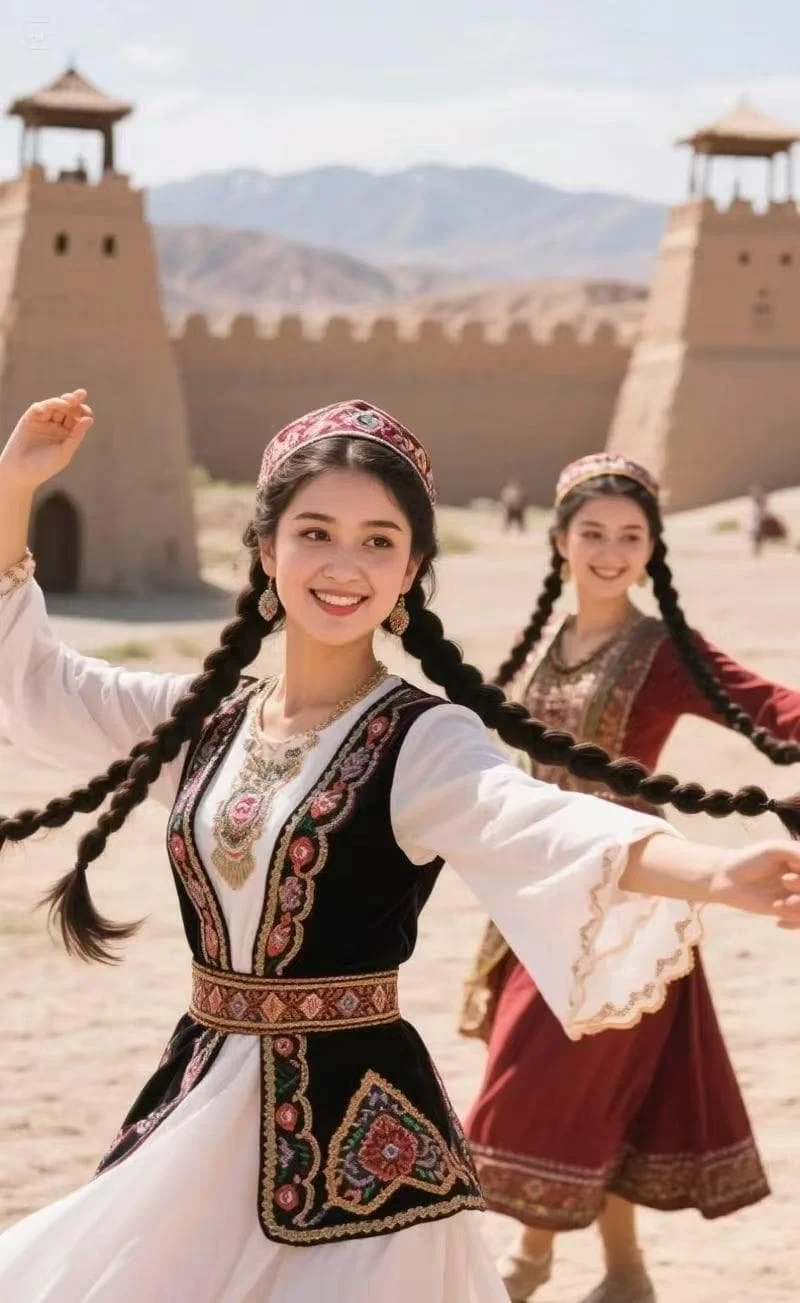
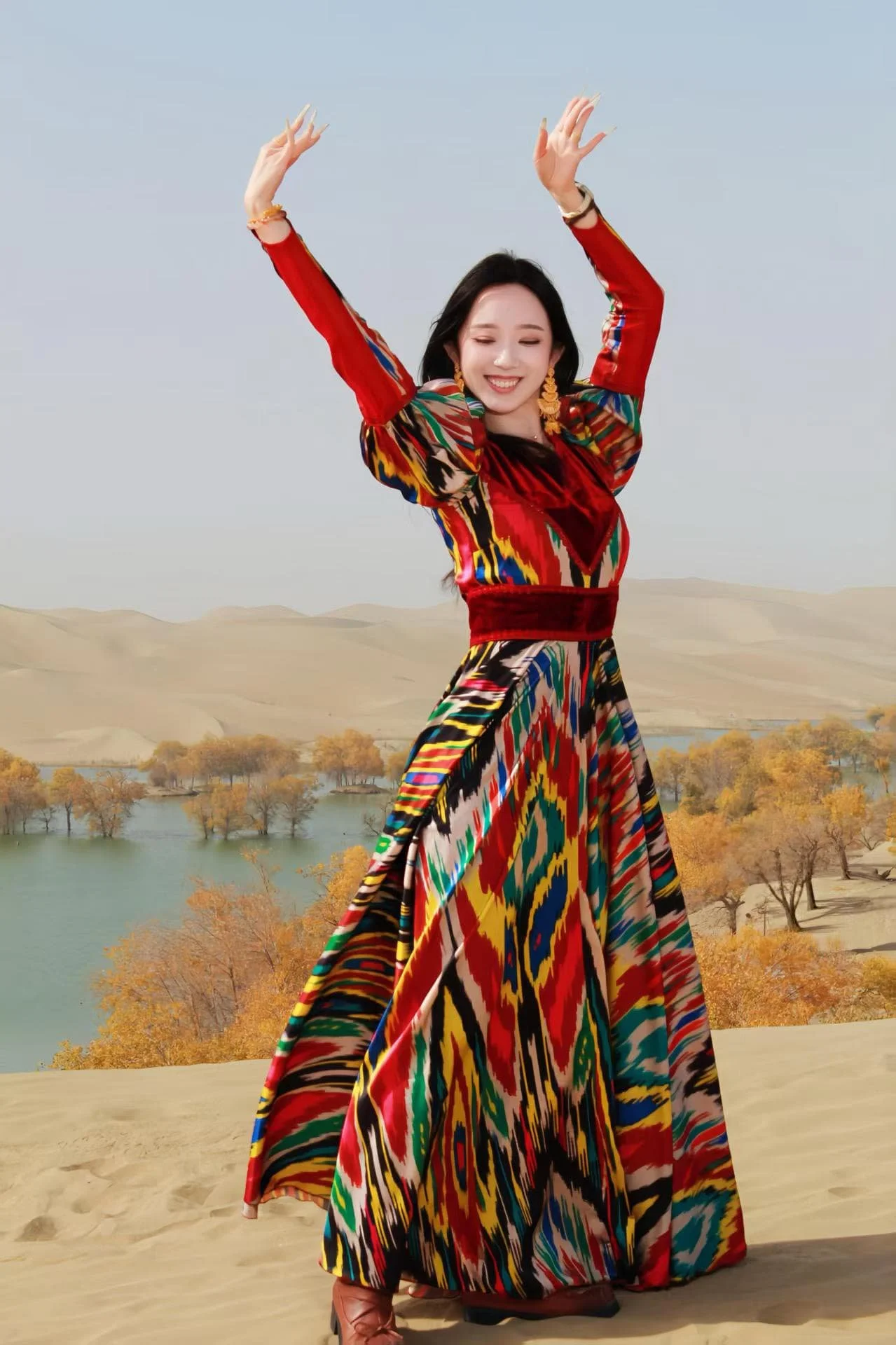
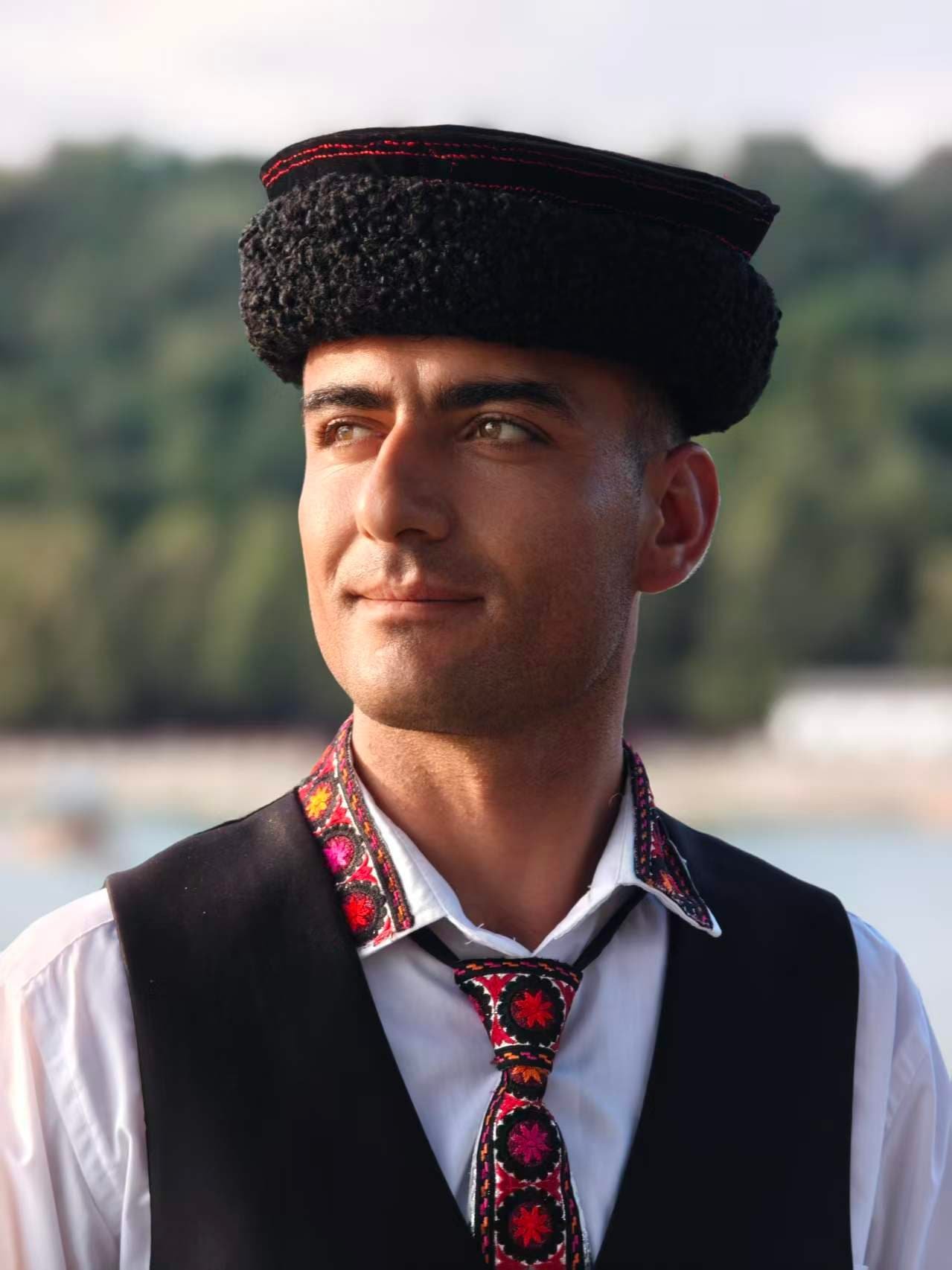
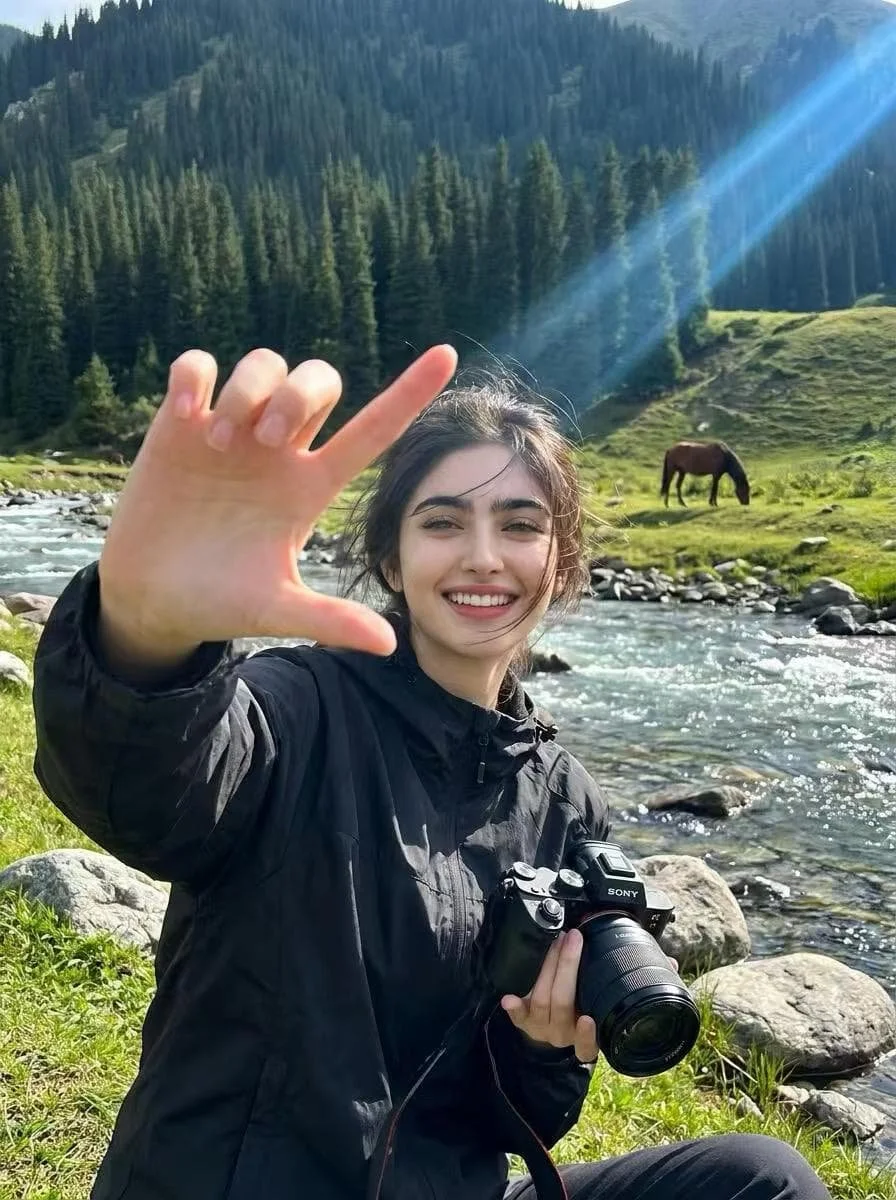


Why You Need a Professional Guide in Xinjiang
Xinjiang is not like other travel destinations. Covering one-sixth of China's total land area — larger than France, Germany, and Spain combined — this is a land of staggering scale where the nearest town might be 400 kilometers away, where Mandarin gives way to Uyghur, Kazakh, and Kyrgyz on the street signs, and where a wrong turn on a mountain road can mean hours of backtracking through some of the most remote terrain on Earth.
A professional local guide isn't a luxury in Xinjiang — it's the difference between a trip that clicks and one that falls apart. Our guides are licensed professionals who've spent years navigating these vast distances, decoding the cultural nuances, and building relationships with local communities. They know which mountain passes are open, which roadside restaurants serve the real laghman (not the tourist version), and how to read the weather patterns that can close the Duku Highway without warning.
What Makes Our Guides Different: Zero shopping stops. Zero hidden commissions. Every minute of your day is spent on your experience — not on steering you toward silk carpet showrooms or jade shops. This is pure, immersive travel, guided by someone who genuinely loves sharing their homeland.
Who Are Our Guides?
🎓 Licensed & Verified Professionals
Every guide in our team holds a valid national tour guide license, verifiable on China's official tourism supervision platform. Xinjiang has implemented a rigorous three-year competency upgrading initiative — our guides participate in annual skills contests and continuing education programs that keep their knowledge sharp and their service standards at the highest level.
🗣️ Language Capabilities
Mandarin-speaking guides: Local residents with deep, lifelong familiarity with northern, southern, and eastern Xinjiang routes. They know the back roads, the family-run guesthouses, and the hidden viewpoints that don't appear in any guidebook.
English-speaking guides: Bilingual professionals with fluent English and cross-cultural interpretation skills. They don't just translate — they explain the why behind cultural practices, historical events, and local traditions in a way that makes Xinjiang's complexity accessible and fascinating.
Other languages available: Russian, Kazakh, Uyghur, Korean, and Japanese. These niche-language guides are especially popular with travelers from Central Asian and East Asian countries.
📸 Beyond Guiding — Your Photographer & Problem-Solver
Many of our guides carry professional photography equipment and drones — because you didn't travel 3,000 kilometers to take mediocre phone photos of Kanas Lake. They'll capture the shots you can't: drone panoramas of the grasslands, golden-hour portraits at Sayram Lake, and candid moments you'd miss while fumbling with camera settings.
They also carry high-altitude emergency supplies — Rhodiola supplements, portable oxygen cylinders, and first-aid kits — because safety in Xinjiang's remote regions isn't optional, it's essential.
What Our Guide Service Includes
✅ Standard Service (8–10 hours/day)
✔️ Licensed professional guide for full-day tour (typically 9:00 AM – 6:00/7:00 PM Beijing Time)
✔️ Expert narration and cultural interpretation at every site
✔️ Itinerary customization — tell us your interests, we design your perfect day
✔️ Pre-booking of attraction tickets (critical during peak season — many sites sell out)
✔️ Wireless audio receiver (for groups, so everyone hears clearly without crowding)
✔️ Guide's entrance tickets and in-park shuttle fares (when accompanying you into scenic areas)
✔️ Guide's working meals covered
✔️ Hotel pickup and drop-off (downtown areas, prearranged schedule)
✅ All-Inclusive Package Add-Ons
✔️ Private air-conditioned vehicle with professional driver (fuel + tolls included)
✔️ All scenic spot admission tickets for travelers
✔️ Standard twin/double room accommodation
✔️ Selected daily meals (breakfast + lunch or dinner)
✔️ Domestic tourist accident insurance
✔️ High-altitude emergency supplies (oxygen + Rhodiola)
✔️ Performance ticket booking (Back to the Western Regions, Silk Road · Millennium Impression)
❌ Not Included
✘ Personal expenses: souvenirs, snacks, beverages
✘ Visitor dining (unless specified in all-inclusive package)
✘ Attraction tickets for guide-only bookings
✘ Overtime fees beyond 8–10 hours (Mandarin: ¥50–100/hour; English/foreign: ¥100–200/hour)
✘ Voluntary gratuities (non-compulsory, at your discretion)
✘ Guide's off-city overnight accommodation (¥200–300/night for remote locations)
✘ Driver's meals and accommodation (¥30–50/meal; ¥200–300/night) — unless included in package
Service Coverage — All of Xinjiang
RegionKey DestinationsNorthern XinjiangUrumqi, Ili Valley, Kanas, Altay, Sayram Lake, Narat Grassland, Hemu Village, Duku HighwaySouthern XinjiangKashgar Old Town, Kuqa Grand Canyon, Hotan Jade Market, Taxkorgan (Pamir Plateau), Karakul LakeEastern XinjiangTurpan (Flaming Mountain, Jiaohe Ruins, Karez), Hami, Kumtag Desert
Note on cross-region trips: Northern and southern Xinjiang are separated by the Tianshan Mountains. Long-distance journeys spanning both regions incur additional intercity transport and multi-night lodging costs due to the expansive terrain. We'll advise you honestly on whether a combined route makes sense or if focusing on one region is better for your time frame.
Core Attractions & Recommended Duration
AttractionWhy It MattersTime NeededHeavenly Lake (Tianshan)Alpine lake beneath Bogda Peak; sacred Taoist site with mirror-still reflectionsHalf day – 1 dayKanas Lake"Pure Land on Earth" — morning mist over the Three Bays, lake monster folklore1–2 daysHemu VillageTraditional Tuvan hamlet with log cabins, golden autumn forests, sunrise fog1–2 daysSayram Lake"The Last Tear of the Atlantic Ocean" — sapphire waters you can drive aroundHalf day – 1 dayNarat GrasslandOne of the world's four great river-valley grasslands — alpine meets lowland pasture1 dayDuku HighwayTrans-Tianshan scenic route, open ~4 months/year — "four seasons in one day"1–2 daysBayanbulak GrasslandSwan Lake + the legendary Nine Twists & Eighteen Turns sunset1 dayKashgar Old TownMillennia-old Silk Road labyrinth — Uyghur culture at its most authentic1–2 daysFlaming Mountain (Turpan)Journey to the West filming site; summer surface temps hit 70°CHalf dayKarez Irrigation SystemOne of China's three ancient engineering marvels (alongside the Great Wall & Grand Canal)1–2 hoursInternational Grand BazaarUrumqi landmark — concentrated Xinjiang specialties, but avoid shopping-trap group tours2–3 hoursHemu/Kanas StargazingZero light pollution — Milky Way visible to the naked eyeEveningUrho Ghost CityYardang wind-eroded landform — otherworldly photography destination2–3 hoursKoktokayCanyon, river, granite landscapes — inspiration behind the folk song "Shepherd of Koktokay"1 dayPamir PlateauMuztagh Ata Peak, Karakul Lake, White Sand Lake — border permit required2–3 days
Optional Add-On Services
🎫 Advance Ticket Reservation
Critical during peak season (June–October). Many attractions — Heavenly Lake, Kanas, Sayram Lake — require real-name pre-booking and sell out days ahead. We handle all reservations for you.
🚗 Off-Road & MPV Charter
Professional drivers who know every cross-country route in Xinjiang. This isn't optional — it's essential. The distance from Urumqi to Kashgar is 1,500 km; the road to Kanas winds through mountain passes. You need someone who's driven it a hundred times.
🏨 Hotel Reservation
We book budget-aligned accommodation — downtown or in-resort. Inside Kanas National Park, lodging is extremely scarce and must be reserved well in advance. We handle this so you don't have to worry.
🛂 Border Permit Guidance
Destinations like Baihaba, Taxkorgan (Tashkurgan), and Khorgos require frontier passes. We provide step-by-step assistance with the application process so there are no surprises at checkpoints.
✈️ Airport & Railway Transfers
Pickup/drop-off at Urumqi Diwopu International Airport, Urumqi Railway Station, Kashgar Airport, and all major transit hubs.
🗺️ Fully Bespoke Multi-Day Routes
A full Xinjiang round trip can take up to one month. Most travelers split it into focused itineraries — northern, southern, or eastern Xinjiang. Tell us your available days, group size, and interests, and we'll design a route that makes every day count. No cookie-cutter packages.
Multi-Day Tour Cost Clarification
For multi-night itineraries, please confirm financial responsibility for these items in advance to avoid on-site disputes:
ExpenseWho PaysReference CostGuide's downtown accommodationGuide (returns to own residence)No extra chargeGuide's lodging at remote/scenic locationsClient¥200–300/nightDriver's accommodation (with chartered vehicle)Client¥200–300/nightDriver's daily mealsClient¥30–50/mealGuide's casual working mealsClient¥30–50/meal
💡 Recommended: Book a formal all-inclusive contract with written provisions covering guide and driver's board and lodging. This eliminates all on-site disputes and lets you focus on the experience.
Group Size Rules
Private tour: 1 guide for 1–10 guests
Small-group tour: Maximum 15 travelers per group
Booking Guidelines
📅 When to Book: Peak season is June–October. Book at least 7–14 days in advance; for top-rated popular guides, book 20+ days ahead. Summer booking volume surges 40%+ year-over-year — Xinjiang is now one of China's most sought-after long-haul destinations.
🛂 Valid Documents: All visitors must carry original ID card, passport, or Mainland Travel Permit. Border permits are compulsory for Baihaba, Taxkorgan, and Khorgos. We'll advise you on exact requirements for your itinerary.
🕐 Time Zone Note: Xinjiang officially follows Beijing Time, but local daily routines run roughly 2 hours behind — sunrise and sunset are later. All flight and train schedules use Beijing Time. Your guide will help you adjust.
Why Travelers Choose Our Guides
Here's what sets a genuinely professional Xinjiang guide apart from the rest:
They're locals. Not guides flown in from Beijing who memorized a script. Our Mandarin-speaking guides were born and raised here. They know which Uyghur grandmother makes the best samsa, where the wild walnuts grow along the Ili River, and how to spot a snow leopard print on the trail to Koktokay.
They're problem-solvers. When the Duku Highway closes due to a rockslide (it happens), your guide already has a Plan B route mapped out. When you feel altitude sickness at Karakul Lake (3,600m), they have oxygen ready. When the Kanas ticket system crashes during Golden Week, they know the backup booking channels.
They're storytellers. The Silk Road isn't just a historical footnote here — it's alive in the faces of the Kashgar craftsmen, the calligraphy on the Id Kah Mosque, and the caravanserai foundations beneath modern Turpan. Our guides don't recite Wikipedia; they make you feel the history.
They respect your autonomy. Want to skip a site and spend two hours photographing yaks on the Narat Grassland? Done. Want to add a spontaneous stop at a local market? They'll make it happen. This is your journey.
Ready to explore Xinjiang with a guide who makes every day extraordinary? Book your private guide today and discover the real Xinjiang — the one you can't find on your own.
No results found
No results match your search. Try removing a few filters.
Frequently Asked Questions
-
May-October for pleasant weather; July-September for fruit season.
-
Yes, Xinjiang is very safe for travelers. All attractions have security checks.
-
No permit needed for most areas. We handle all logistics.
-
Absolutely —we offer extended Silk Road itineraries including Turpan & Dunhuang.
-
Xinjiang is famous for lamb skewers, hand-pulled rice (pulao), and naan bread.
Ready to Explore Xinjiang?
Tell us your travel dates, group size, and interests —we'll reply within 2 hours with a custom itinerary, completely free.
What Our Guests Say
Share Your Experience
Thank you!
Your review has been submitted and will appear after a quick check.