

Dehang Grand Canyon — The In-Depth Guide 2026
Contents
1. First Things First: What Is Dehang, Really?
2. Tickets: How to Actually Buy Them (2026 Official Prices)
3. The Shows: Two Night Performances, Back Next April
4. Dehang's Core Highlights, One by One
5. Getting There
6. Planning Your Route (5 Itineraries by Fitness and Transport)
7. Where to Stay
8. What to Eat
9. Budget (Per Person, 2026 Reference)
10. Before You Go
11. When to Come
12. Cultural Etiquette — Essential Reading for International Visitors
13. FAQ
14. Final Thoughts
15. Appendix A: Photography Shot List for Content Creators
16. Appendix B: Sources and Verification Notes
Eight out of ten people heading to Zhangjiajie treat Dehang as "just an exit on the way" — slow down, glance, snap a photo, and keep driving to Fenghuang. That is the most expensive miss in all of Xiangxi. This guide covers every pitfall, every show worth watching, and exactly which ticket to buy — all in one place.
1. First Things First: What Is Dehang, Really?
Dehang is not a check-in spot for influencers — it is a massively underrated, complete scenic area: the world's longest-span steel-truss suspension bridge across a canyon, a 216-meter hanging waterfall, roughly 1.5 km of cliffside glass walkway, a thousand-year-old Miao village where about a hundred families still live, plus two very different night shows — and the core ticket costs just 80 RMB, with more to see than many 300-RMB attractions.
"Dehang" comes from the Miao language (written deut hangd in Miao script), meaning "beautiful canyon."
Location: Aizhai Town, Jishou City, Xiangxi Tujia and Miao Autonomous Prefecture. The Aizhai Bridge zone is about 19 km from downtown Jishou; Dehang Miao Village is about 24 km. The area holds China's top 5A rating (full name: Aizhai–Shibadong–Dehang Grand Canyon Scenic Area, awarded in June 2021). The protected area covers about 90 sq km, with a core visiting zone of 8.1 sq km.
The official "Aizhai Wonders" tourism area consists of three scenic zones:
Aizhai Bridge Zone — the bridge suspended over the canyon, an under-bridge viewing corridor, cliff walkways, and high-altitude extreme activities
Dehang Canyon Zone — Dehang Miao Village on the valley floor, Liusha Waterfall on Jiulong Stream, and Tianwen Terrace along Yuquan Stream
Jidou Miao Village Zone — a cliffside Miao village "riding on an eagle's back," close to Tianwen Terrace
The real star of Dehang is the canyon, not the houses. The right way to visit is not "enter village — take photos — leave village," but to descend from the cliff tops to the valley floor, then walk from the valley into the two canyons. The village is just your gateway and lodging base.
Dehang, Fenghuang, or Furong Town — Which One?
Fenghuang (Phoenix Ancient Town) — Riverside clusters of stilted houses, night lights, lived-in atmosphere. Best for: staying 1–2 nights, exploring slowly, not minding crowds. Reviews: "Beautiful, but crowded and commercial."
Furong Town — A town draped over a waterfall; the night view is the whole show. Best for: passing through; one specific picture. Reviews: "Very commercial, but gorgeous at night."
Dehang — Miao village + canyon landscape; the least touristified. Best for: wanting a "more authentic" alternative; enjoy walking. Reviews: the one seasoned travelers recommend.
How to choose:
One day only, coming from Zhangjiajie: pick Fenghuang. It packs more sights per hour and transport is easier.
One day only and want to skip the crowds: pick Dehang — but follow the "canyon + village" plan.
Two days: one night in Fenghuang + one night in Dehang. That is the right way to do Xiangxi.
Want the "town hanging on a waterfall"? That is Furong Town, not Dehang.
Dehang is not "a cheaper Fenghuang," nor a substitute for it. Dehang sells valleys, waterfalls, cliffs and a bridge; Fenghuang sells riverside nights and old-town atmosphere. The two are not playing in the same league.
2. Tickets: How to Actually Buy Them (2026 Official Prices)
Unlike Furong Town or Fenghuang, Dehang is not one ticket — it is several, sold separately.
Official list prices
Dehang Grand Canyon — ¥80 — Yuquan Stream canyon, Jiulong Stream canyon, Tianwen Terrace, Jidou Miao Village, daytime folk performances.
Aizhai Bridge — ¥95 — Bridge viewing platform, sightseeing elevator and escalators.
Aizhai Cliff Glass Walkway — ¥78 — The cliff glass walkway.
All-zone 3-day ticket — ¥120 — Everything above, valid 3 days.
All-zone 3-day transport pass — ¥60 — All shuttle buses, valid 3 days.
Shuttle / cart prices
Tourist shuttle — ¥25 (round trip) — Main Visitor Center — Aizhai Bridge — Dehang Canyon.
Aizhai Bridge electric cart — ¥10 (round trip) — Aizhai Bridge Visitor Center — west side of the bridge.
Yuquan Stream canyon cart — ¥12 (round trip) — Yuquan Stream mouth — Yuquan Gate.
Jiulong Stream canyon cart — ¥18 (round trip) — Jiulong Stream mouth — Hailuo Peak.
Sightseeing elevator / escalator — ¥30 (round trip) — Up to the bridge's main viewing platform.
Buy the 120 + 60 combo, not just the 120
From July 1, 2026, the Aizhai Wonders tourism area launched the "Three-Day Slow Tour Pass" (running until July 1, 2027):
The 120 RMB is admission: unlimited entry for 3 days from purchase across 5 core sights — Aizhai Bridge, Dehang Canyon, the cliff walkway, Jidou Miao Village and Tianwen Terrace. Real-name registration; for the named holder only.
The 60 RMB is transport: it covers the scenic shuttles, the bridge sightseeing elevator and escalators, the bridge carts, and the Yuquan / Jiulong Stream carts.
Note: the bridge elevator, canyon carts and scenic shuttles are all inside the 60 RMB. Buy only the 120 and you will be buying transport tickets again at the elevator or cart stops — buying piecemeal on site is usually pricier and more hassle.
Two people, two days, bridge + canyon + walkway + Tianwen Terrace: 120×2 + 60×2 = 360 RMB — far cheaper than buying each sight separately.
In 2026 the Dehang Grand Canyon ticket is 80 RMB, and that single ticket already covers Tianwen Terrace, Jidou Miao Village, both canyons and the daytime shows. Visitors who buy the 80 and then head to Aizhai Bridge get turned away — the bridge charges separately.
How to buy
Official ticket platform (Chinese interface): Aizhai Smart Scenic Area at w.dehang.cn — book up to 10 days ahead, or same-day until 24:00.
Real-name booking: one ticket per person; entry requires the original ID card or passport — photos will not work.
Buying with a passport: after booking online with your passport, the confirmation page shows a QR code — screenshot it and scan at the gate; no need to dig out your passport.
Validity: the 120 RMB is a promotional 3-day pass; single tickets are same-day only. Do not mix them up.
Optional paid activities
Via ferrata (beginner) — List ¥198, typically about ¥99 online.
Via ferrata (advanced) — List ¥298, typically about ¥149 online.
Cloud Walk — List ¥288, typically about ¥50–140 online.
High Bridge Matrix Line A — List ¥280, typically about ¥88 online.
High Bridge Matrix Line B — List ¥400, typically about ¥180 online.
Aizhai Bridge bungee — List ¥2,680, typically about ¥1,314–1,399 online.
Canyon starlit rafting — ¥68 (no typical online price listed).
Infinity heated pool — ¥48.
Sky Mirror — ¥10.
Kids' playground — ¥38.
Via ferrata and Cloud Walk have weight and age limits; the bungee does not operate in rain or wind. Do not get impulsive with kids in tow.
3. The Shows: Two Night Performances, Back Next April
Dehang's shows split into daytime (free) and night (ticketed) — something most travelers never realize.
Free daytime shows (included in the 80 RMB ticket)
Miao drum song & dance / Miao wedding folk performance — from 10:00.
Miao costume showcase / intangible-heritage performance — from 15:00.
Actual times can drift by about 30 minutes; follow the scenic area's daily notice. The summer lineup also includes "Village Gate Welcome," Miao language classes and fire-pit concerts.
Entering the village you will meet the "gate-blocking wine" ritual — Miao young women and men block the village gate, sing antiphonal songs, then offer you rice wine. It is the highest welcome the Miao people offer; do not shy away. If you would rather not drink, decline politely — or just touch the rim to your lips.
"Dehang Illusion" — Immersive 5D "Show + Feast + Drama" Theater
Dehang's flagship show — the only product in China that fuses performance, banquet and drama into one.
Season — Mid-April to end of October each year; closed November–March.
Status for 2026 — Season over. The final three shows originally set for October 16–18 have been suspended (per the "Zhangshang Xiangxi" / 掌上湘西 notice of 2026-10-16). Wait for 2027.
Reference schedule (past years) — Apr–Jun: Fri/Sat/Sun; Jul–Aug: Tue–Sun (dark Mondays); Sep–Oct: Fri/Sat/Sun.
Ticket price — Full price 228 RMB; "Dehang Illusion (with Dehang ticket)" bundles from about 99 RMB (check platforms for same-day pricing).
Duration — About 60 minutes.
Booking — Buy via the WeChat mini-program "Aizhai Dehang Illusion" and reserve seats at least 1 day ahead — no reservation, no entry.
What the show actually is:
A basalt cliff face millions of years old as the natural screen; real Miao village buildings as the stage
Eight "drawer-style" indoor mini-theaters chained with one outdoor grand theater, "Water-Moon Illusion"
Set against the 1938 war of resistance in Xiangxi: the life-and-death pact between the Miao youth "Shitou" and "Aya"
Take your seat and you are in the play — the audience are guests at this Miao wedding banquet, not bystanders
The story runs from betrothal and fetching the bride, through the tears of the wedding and the ceremony, to sending the groom off to war
Eat as you watch: smoked pork, artemisia-rice cakes, pickled radish and corn liquor crowd the long table — raise your glass with the actors
Naked-eye 3D projection washes over the basalt cliff as an 8-meter "moon in the water" slowly rises from center stage — sky, water and real scene: three moons at once
"Dehang Illusion" runs only April to October — nothing after November. The 2026 season has ended; 2027 is expected to open mid-April (subject to official notice). Slot this show into your Xiangxi itinerary next spring or summer. Between now and next April, evenings in the village are for stargazing and fireside chats.
"Mountain Wind, Drum Rhyme" — Large-Scale Eco Landscape Performance
Dehang's long-running show — more enjoyable than "Dehang Illusion."
Showtime — 19:00 start, about 80 minutes; bonfire parties mostly Wed/Fri/Sat evenings (winter schedule per weekly notice).
Ticket price — List 120 RMB/person; show combo tickets about 180 RMB.
Four chapters: Mountain Ghost, Song of Wind, Drum King, Miao Rhyme. The plot tells the haunting love story between Chiyou, the war god of the Miao frontier who guards Tianwen Terrace, and Shan'gu, the forest goddess. It stages the legend of the "Drum Town under Heaven" with its ox-ritual drum ceremony, and includes the Wu-Nuo shaman stunts of climbing knife ladders and walking through fire. Xiangxi folklore — corpse-driving, "cave haunting" and Chenzhou talismans — all make an appearance.
Dehang is known as the "Drum Town under Heaven." Miao drums split into "celebrating the year" and "honoring the spirits" — the gate-blocking welcome plays year drums, rituals play spirit drums. The area has produced five generations of Drum Kings and two generations of Monkey Drum Kings. The fourth-generation Drum King, Long Juxian, is a Dehang Miao woman; the first-generation Drum King, Long Yingtang, was once received by Premier Zhou Enlai.
How the two shows compare
Nature — Dehang Illusion: modern immersive theater + banquet. Mountain Wind, Drum Rhyme: eco landscape live performance.
Highlights — Dehang Illusion: story, the banquet, 5D light show. Mountain Wind, Drum Rhyme: Miao drums, stunts, the folklore itself.
Season — Dehang Illusion: April–October. Mountain Wind, Drum Rhyme: year-round (winter times TBA).
Schedule — Dehang Illusion: Fri/Sat/Sun (Tue onward in peak summer). Mountain Wind, Drum Rhyme: 19:00, about 80 minutes.
Best for — Dehang Illusion: culture immersion, photos, first-timers. Mountain Wind, Drum Rhyme: photography, pure performance, stunt lovers.
The two shows are completely different in kind — it is not a ranking. If time allows, split them across two days.
4. Dehang's Core Highlights, One by One
Above the canyon: engineering miracles. Below it: Miao village life. Here is each highlight in "bridge first, village second" order, with the best time to visit noted.
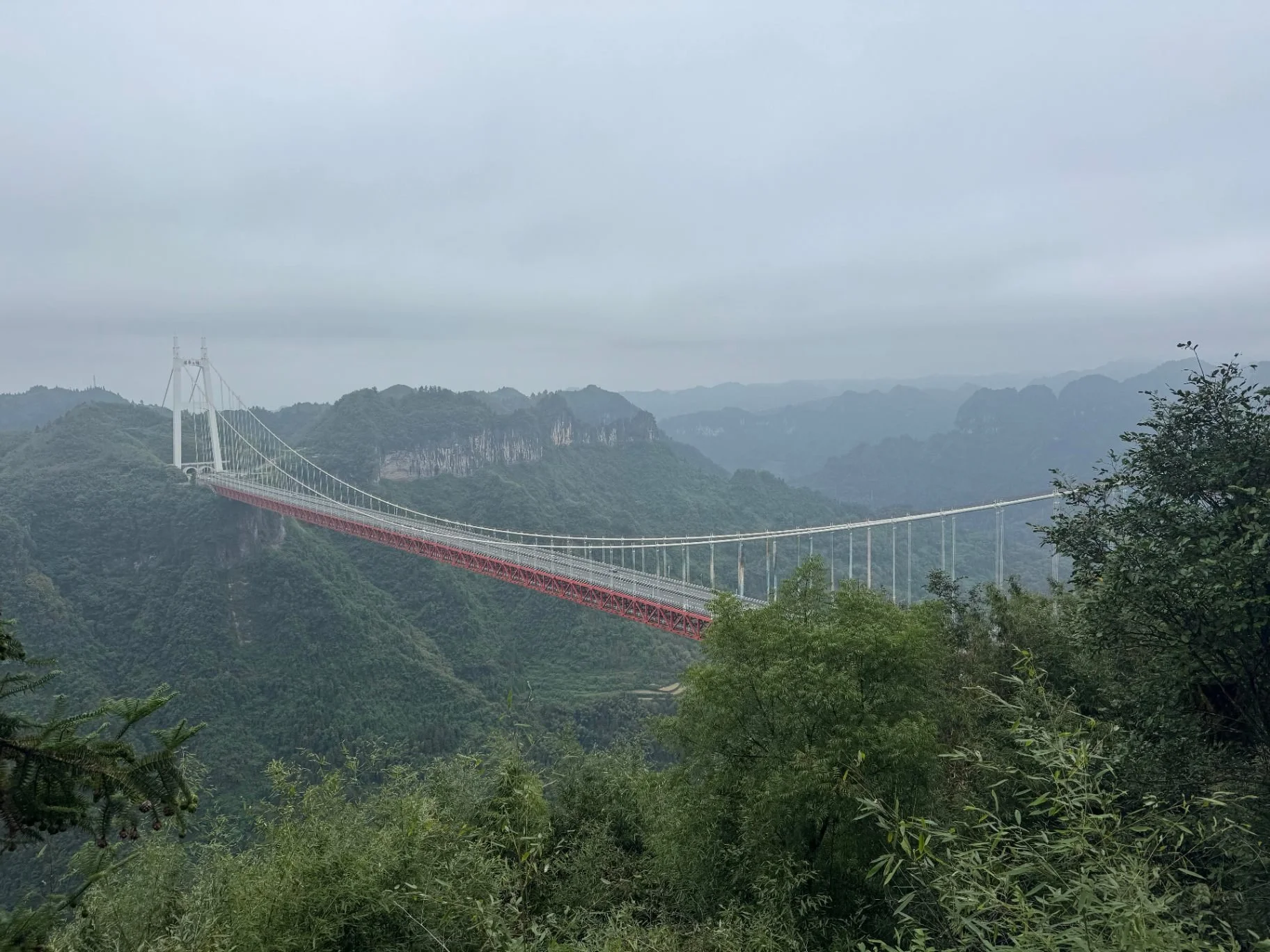
Aizhai Bridge — An Engineering Miracle Over Dehang Canyon
Aizhai Bridge is not a footbridge — it is a working road bridge with two decks: traffic on top, pedestrian viewing corridors on both sides below.
Structure — Steel truss stiffening girder, single-span suspension bridge.
Main span — 1,176 m.
Deck width — 24.5 m.
Deck height above canyon floor — 355 m.
Construction — Started October 2007; opened to traffic March 31, 2012; total cost 1.5 billion RMB.
Status — The world's longest-span steel-truss suspension bridge across a canyon; set four world firsts at completion.
What international media said:
2013: NBC's website picked "10 new world landmarks you must see" — Aizhai Bridge was China's only entry.
2017: the UK's Daily Mail covered the 1,100-foot-high bridge as "driving above the clouds," calling it one of the world's most beautiful bridges.
How to visit: pedestrians cannot walk the deck. The real experience is in the under-bridge corridor and the cliff walkway — not craning your neck from the ground. Ground-level photos take 30 minutes and count as "you did not really come." Take the elevator / escalator (30 RMB) up to the main viewing platform: standing at a 355-meter drop, watching fog roll up from the canyon — that is what the extra 40 RMB buys. Go early morning or late afternoon; midday sun flattens the shot. It is windy on the bridge and colder than the valley floor — bring a jacket. High wind, thunderstorms or heavy fog can close the walkway or elevator without notice.
Aizhai Highway — The Great Artery of China's War of Resistance
Directly below the bridge, the old highway hugs the cliff face as it spirals upward — 13 hairpin turns of 180 degrees climbing hundreds of meters in almost no distance.
Built — 1936; the most treacherous section of the Hunan–Sichuan (Xiang-Chuan) Highway.
Length — About 6 km.
Terrain — Less than 100 m of horizontal depth against 440 m of vertical rise, on a 70–90° slope.
Bends — 13 sharp turns forming 26 overlapping road segments.
Status — Birthplace of China's first highway overpass (a stone arch bridge).
History — The only trunk highway to the southwest during the war; over 2,000 laborers worked 7 months, more than 200 died — the "Xiang-Chuan Highway Fallen Workers Monument" stands roadside.
The Aizhai Highway was the throat of the Xiang-Chuan Highway and its hardest section to build. Barely 6 km long, it had to spiral up a cliff with under 100 m of horizontal run, 440 m of vertical rise and a 70–90° grade — 13 sharp bends and 26 overlapping road segments, like "a compressed spring." On terrain that forbidding, everything was done by hand. Building those 6 kilometers took more than 2,000 workers nearly a year; 232 died on the job, and the injured were beyond counting — a truly "blood-paved road." Today the "Xiang-Chuan Highway Fallen Workers Memorial Tower" and the "Trailblazer" bronze statue on the hill keep that history alive. The highway's strategic value became obvious once the war erupted in full: as the key node of the Xiang-Chuan Highway, it was a lifeline for the entire war effort.
Aizhai Cliff Glass Walkway — the "Sky Corridor"
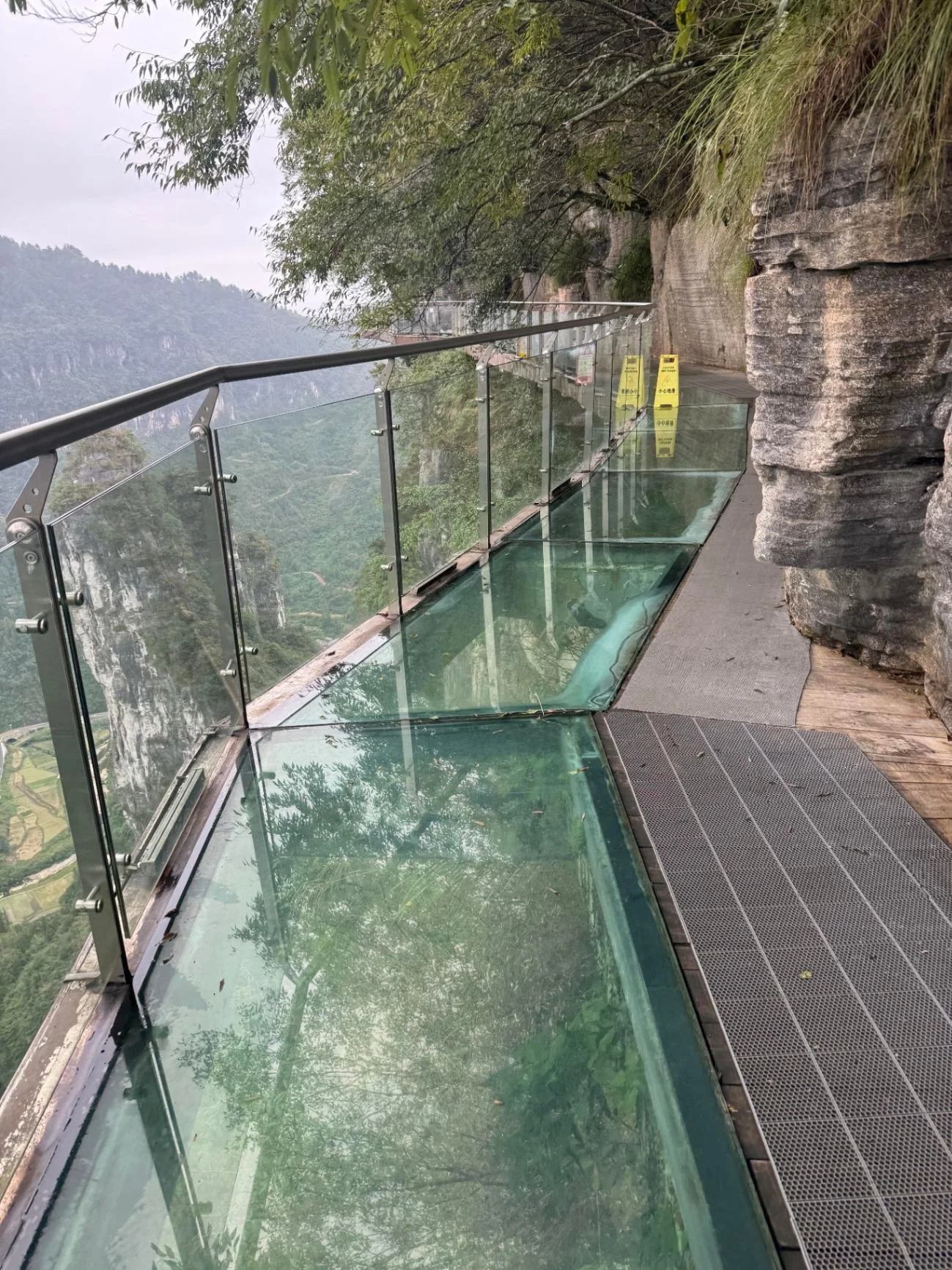
Length — About 1.5 km (government and CCTV sources say 1.5 km; 2026 Party-media platforms say 1.6 km — both figures circulate).
Glass section — 100 m.
Location — On the cliffs of Dehang Grand Canyon, 300–400 m above the canyon floor.
Connects — Archway parking lot ↔ Aizhai Bridge.
Design — Draws on Miao "butterfly" and "flowing ribbon" motifs.
The real thrill is the glass section in the middle — a suspended glass path with a 300-plus-meter drop straight down. Your legs will wobble the first time; that is normal. Afraid of heights? Detour around the glass; most of the walkway is non-slip wood.
Best time: dusk. The glass turns gold in the setting sun — the single best photo in all of Dehang.
Officially, this walkway joins the bridge and Tianwen Terrace as the three great aerial sights: "Sky Corridor, Sky Bridge, Sky Terrace."
Liusha Waterfall — A 216-Meter Drop
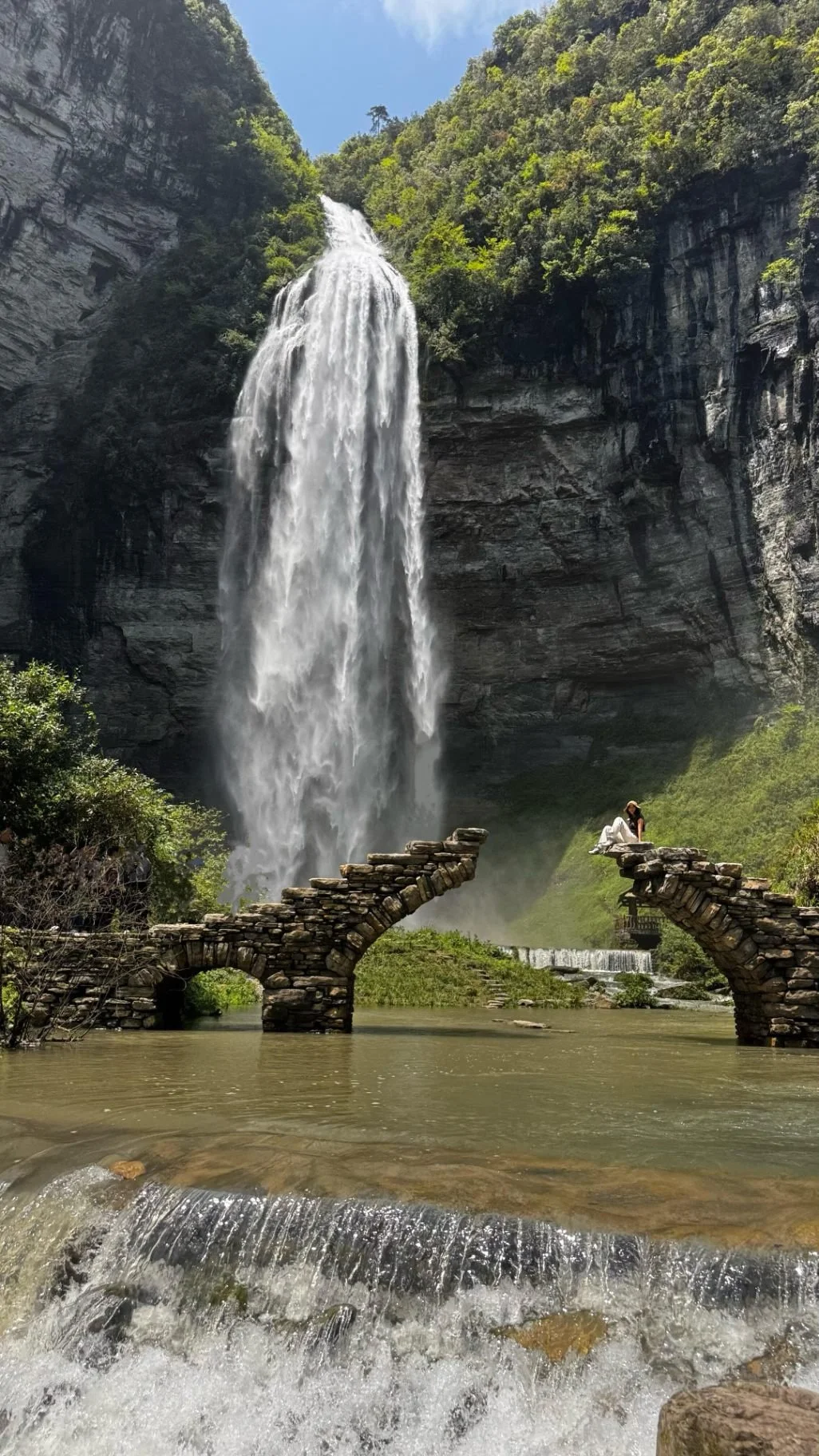
One of Dehang Canyon's signature sights. Its uniqueness: with a 216-meter drop it shows a "hard-and-soft" beauty that shifts with the seasons. It sits at the source of Jiulong Stream inside the Dehang scenic area, water hurling off a sheer cliff. From April to June in the rainy season, torrents thunder into the deep pool, shaking the valley with mist everywhere — truly spectacular. In the dry season it falls like a light veil, 10–15 m wide. It is one of China's tallest waterfalls (216 m) — and the most-liked, most-played Dehang video across social media is the waterfall behind the Broken Stone Bridge: this very Liusha Waterfall.
From Dehang Miao Village / the ticket office, follow the Jiulong Stream trail to the waterfall: about 30–60 minutes one way depending on your starting point and photo stops; some visitors amble in from the village center and log 2 hours. By scenic cart: the Jiulong line runs about 18 RMB round trip, 3 km by cart, then about 1 km on foot to the falls — included if you bought the 60 RMB transport pass. The route is mostly gentle, but stone steps are slippery and mossy. Best flow: April–June, or 1–2 days after heavy rain. July–August brings high water but thunderstorms and slicker trails. November–March is the dry season and the fall can thin to a thread — though this super-El Niño year has kept Dehang rainy, so even now you can hear the waterfall roar. Do not wade in after a storm; valleys flood fast and cloudy water is your warning. Do not climb the railing to shoot from directly under the falls. Bring non-slip shoes and a rain jacket.
Tianwen Terrace (Terrace of Heavenly Questions)
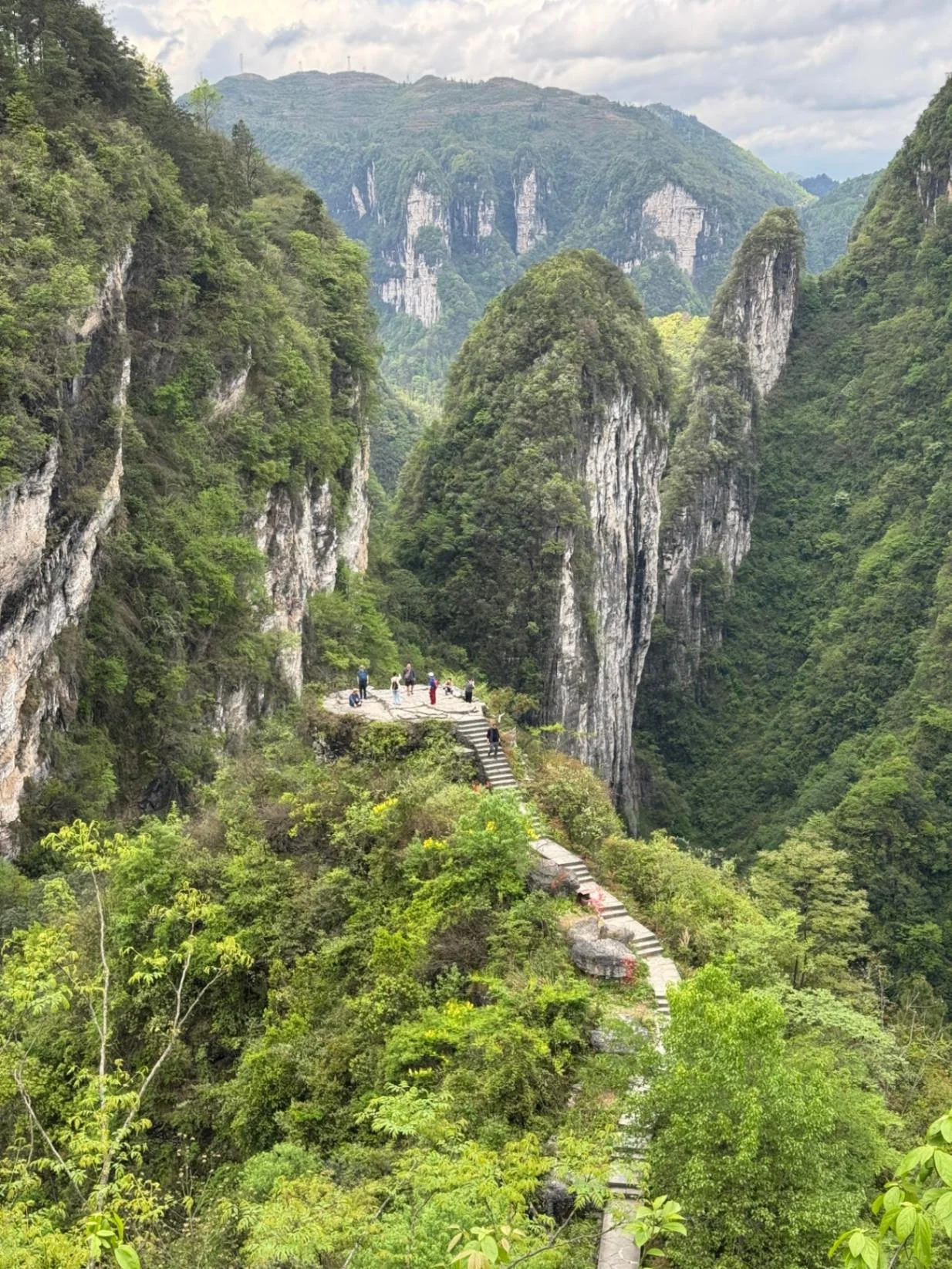
A natural stone platform atop a standalone peak inside the Yuquan Stream canyon, open on three sides, about 150 m above the cliffs below, with a platform roughly 6 m across. Legend says the poet Qu Yuan, exiled to Xiangxi around 268 BC, once climbed this very terrace to question the heavens — the questions he later organized into "Tianwen" (Heavenly Questions). The site is also a "golden spike" section in international geology — worth a visit if you are into the subject. More than 20 Chinese films and TV dramas have shot here (including "Border Town" and "Blood Drum"); the roughly 4-second opening shot of misty valleys in 2017's "Wonder Woman" was filmed here too. From Dehang Miao Village, the climb up Yuquan Stream runs about 2 km — 399 bluestone steps, roughly 1.5 hours. Coming from the west entrance (Jidou Miao Village side) it is all downhill: 20–30 minutes to the terrace, much easier on the legs. The platform is tiny and you will queue for photos in high season; anyone afraid of heights will feel their knees go at the edge. If you are a content creator, get here before 9 AM to shoot — drones are allowed (it is not a no-fly zone) and this is where your great Dehang footage comes from; after 10 AM the sea of cloud rises from the canyon and swallows the platform whole. Tianwen Terrace offers one of Dehang's most photogenic views. Bad knees, traveling with elders or kids, or only 4 hours to spare? Skip it — the 399 steps up and down will eat most of your day.
Jidou Miao Village — The Cliffside Village
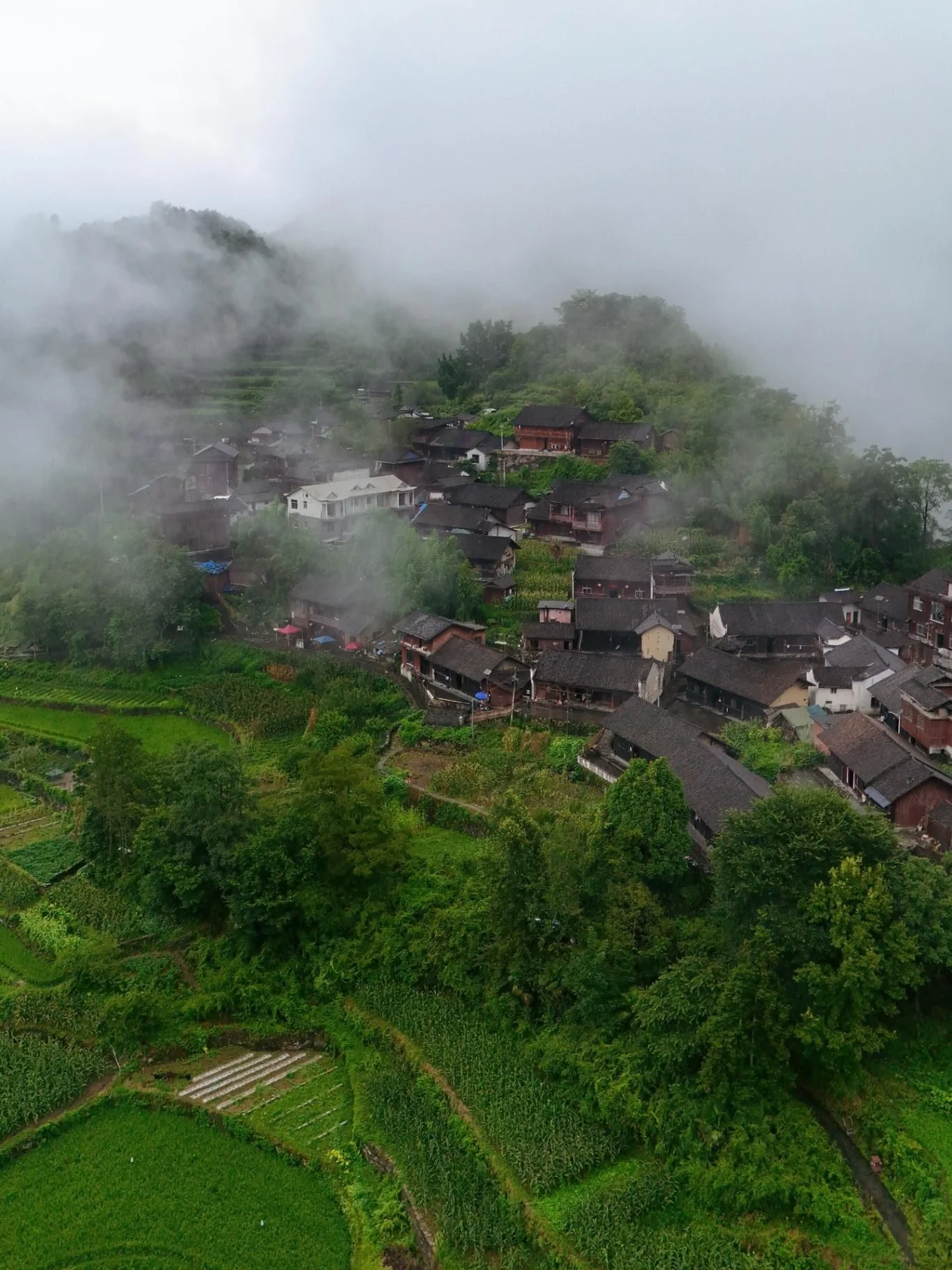
"Jidou" means "the village riding an eagle's back" in Miao. Seen from below, the ridge really does look like a stone eagle with spread wings, and Jidou sits right on its back. The village clings to a sheer cliff — three sides overhanging, a deep valley below, hidden in cloud. Terraced fields stack in front; when peach and plum blossoms open it is nicknamed the "Peach Blossom Village." Inside: 47 households, 170-plus people, every one surnamed Long. It has served as a location for dramas like "Pacifying Bandits in Xiangxi," "Wulong Mountain" and "Bloody Xiangxi." The houses follow "five pillars, eight rafters" and "four-rank row" styles, planks painted glossy, window lattices carved with dragons and phoenixes. It is much smaller and quieter than Dehang Miao Village — 20–30 minutes covers the village itself. Its value is the cliff perspective and the lived-in feeling of a place where people still actually live. Enter from the west gate: Jidou first, then downhill to Tianwen Terrace, then down Yuquan Stream to Dehang Miao Village — the least tiring order. Climbing up from the valley floor just to come back down is not worth it.
Dehang Miao Village — The Real Core
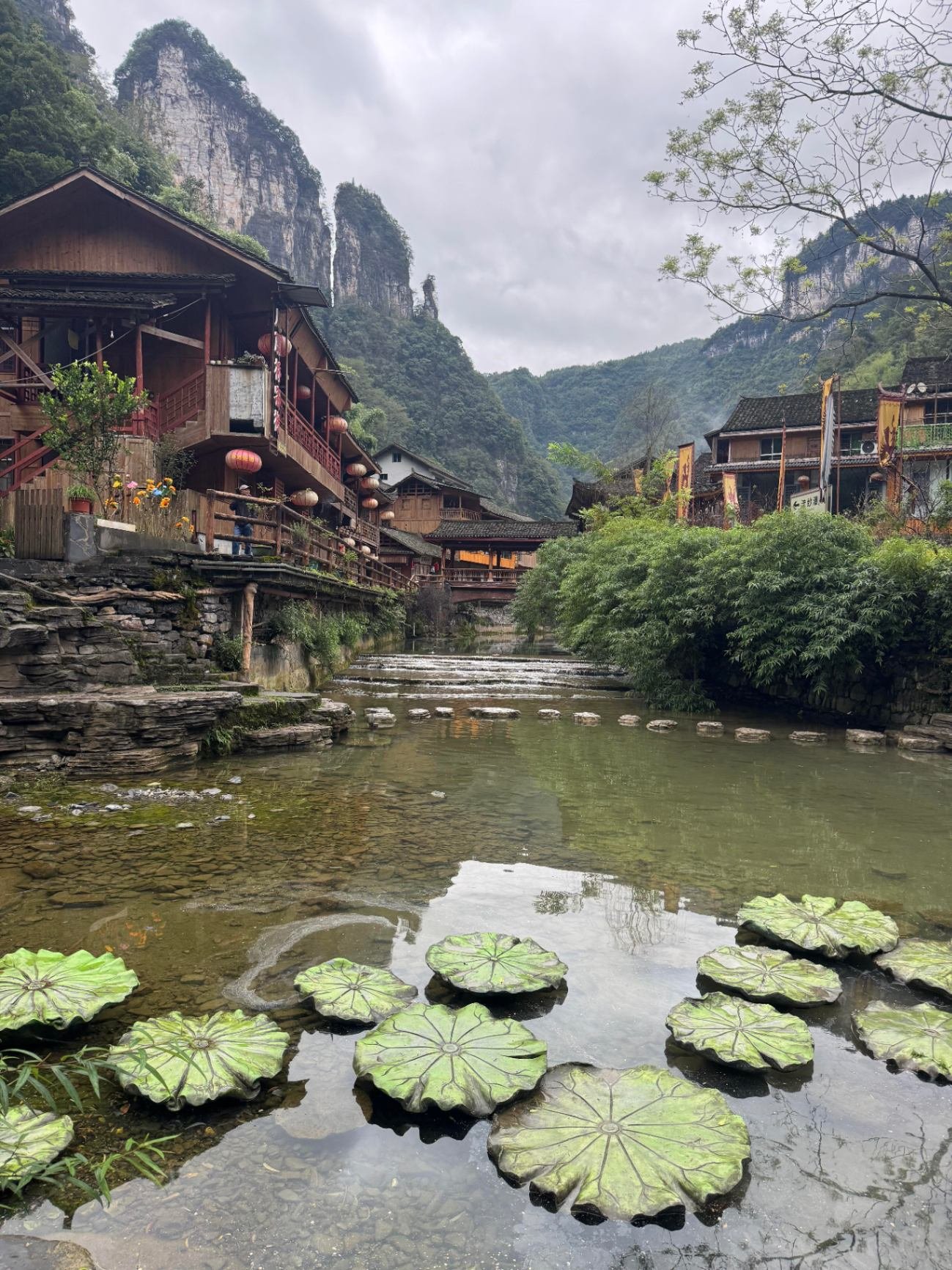
About a hundred households and some five hundred people live in Dehang Miao Village, in wooden houses under uniform gray tile scales, threaded by bluestone paths, stone yards, stone bridges and stone walls. The homes have upswept eaves, half-hidden by fire-blocking walls, stilted floors and carved windows, all built along the water. Dehang on a rainy day is the soul of the whole area: small bridges over flowing water, mist and drizzle, stepping-stone crossings — an ink-wash painting come to life. In China, besides Dehang, only Zhejiang's Guyan Huaxiang looks like this in the rain: both are the real-world version of the classic Chinese ink painting. Then there is the evening, when the setting sun pours into the canyon like a sword slanted down from the sky — a dreamscape to rival any Hollywood blockbuster. From the village center, more than 15,000 meters of bluestone paths lead to every sight, where the three streams — Hangxia, Jiulong and Yuquan — meet. Jielong Bridge ("Dragon-Linking Bridge") is the photo hotspot and the site of the Miao "dragon-linking" ceremony; rent a Miao outfit (30–50 RMB/hour) and shoot by the bridge. Drum King Plaza is the main stage for daytime drum and wedding performances. At the eco-farming culture park you can watch villagers press oil, make paper, weave cloth, brew liquor and mill rice right on the spot. Behind the village rises Pangu Peak at over 700 m elevation — its summit splits into two gourd-shaped peaks, and the climb rewards you with a view over all of Dehang Miao Village. The bluestone steps spiral through bamboo forest and get steep — not recommended with small children. Passing through? One hour covers a loop. Shows + meal + a stroll: 2–3 hours. Stay a night, and this becomes the quietest stop on the greater Xiangxi loop — the closest you will get to real Chinese village life: streams burbling at night, the raw smell of the countryside in the air, roosters and dogs at dawn. It is a living village earning money from tourism. It is not a museum, not an "untouched specimen." You will see concrete houses, smartphones, construction and touts — and you will see elders, the Miao language, drums and cooking smoke. Both are real.
How international visitors rate it:
An Italian reviewer (2025) gave it 3 points: "Cute little village, but nothing special — arrived not-too-late in the morning and there was almost nothing to do."
A US blogger who stayed 3 nights in 2022 asked Auntie Shi, a local, whether the Miao costume worn in performances was everyday wear. She pointed at her own trousers: "This is what we wear normally — you cannot wear skirts here, not practical." On tourists wearing Miao dress for photos, her take: "If they like it, why not?"
A note on village inns: conditions are basic. Old wooden buildings mean steep stairs, thin walls, heavy damp; many inns do not provide disposable toiletries — bring your own — and hot water can be unreliable. Rooms sell out in high season. Pack earplugs, slippers and a flashlight.
5. Getting There
High-speed rail is optimal, self-drive is freest, the bus is cheapest. Pick by where you are starting.
From Zhangjiajie (the best option)
This is the strongest reason to pair Dehang with Zhangjiajie.
Route — Zhangjiajie West → Jishou East (direct).
Distance — 142 km.
Journey time — 38–47 min (fastest 38; some trains 50+ min).
Frequency — About 20 trains a day.
Fare — Second class about 65–79 RMB (63/65/71/79 depending on train — check 12306).
First train — 07:05.
Advance booking — 15 days.
Common stops along the way: Zhangjiajie West → Furong Town → Jishou East → Fenghuang Ancient Town → Huaihua South. The value of this line: it strings together Zhangjiajie → Furong Town → Dehang → Fenghuang Ancient Town with no backtracking. If you would rather not haul luggage around and lose time to transit, Lynx Travel's car rental and private-driver service covers Zhangjiajie / Furong Town / Dehang / Fenghuang Ancient Town / Mount Fanjing and Guiyang — every car comes with a local driver, so you never drive yourself. Save the energy, skip the transit stress.
Jishou East Station → Dehang: about 24 km, three ways:
Scenic shuttle — 20 RMB/person, about 40 min — direct to the Dehang Visitor Center.
Taxi / ride-hail — About 35–45 RMB — quotes vary widely; confirm meter or fixed price before boarding.
Route 18 tourist bus — 5 RMB (to Dehang) / 10 RMB (to the bridge zone) — sectioned fares; longer ride, about 70 min–1.5 h.
⚠️ Around the high-speed rail and train stations you will find touts with unlicensed "black cabs" who hard-sell Miao costumes and show tickets. Do not get in.
Route 18 Tourist Bus in Detail (cheapest — and the one most people miss)
Route — Jishou East HSR Station — Qianzhou Ancient Town — Aizhai Wonders Tourism Area (Dehang Miao Village) — Aizhai Bridge Zone — Jidou Village Visitor Service Center / Tianwen Terrace.
Fare — Jishou East → Dehang 5 RMB; → Aizhai Bridge Zone 10 RMB; sectioned fares.
Departs Jishou East — 08:30 / 12:00 / 15:30.
Returns from the scenic area — 10:30 / 14:00 / 17:30 (from the Aizhai Wonders area, Jidou Village and Tianwen Terrace side).
Payment — No change given on board — have small cash or a transit QR code ready.
Important: few buses and an early last run are the big risks with this line. Have your inn owner confirm the day's schedule before you set out. The 17:30 return is the last bus — miss it and you are sleeping in the village or paying for a pricey ride.
Taxi / Private Driver / Self-Drive
Jishou downtown → Dehang — About 24 km, one-way taxi about 50 RMB, 20–40 min (not an official rate).
Jishou East → Dehang — About 40 min; quotes range from 35–45 RMB to 80–100 RMB — huge spread, confirm before boarding.
Private driver, full day — Priced by car type and route; agree up front on waiting time, tolls and the return leg.
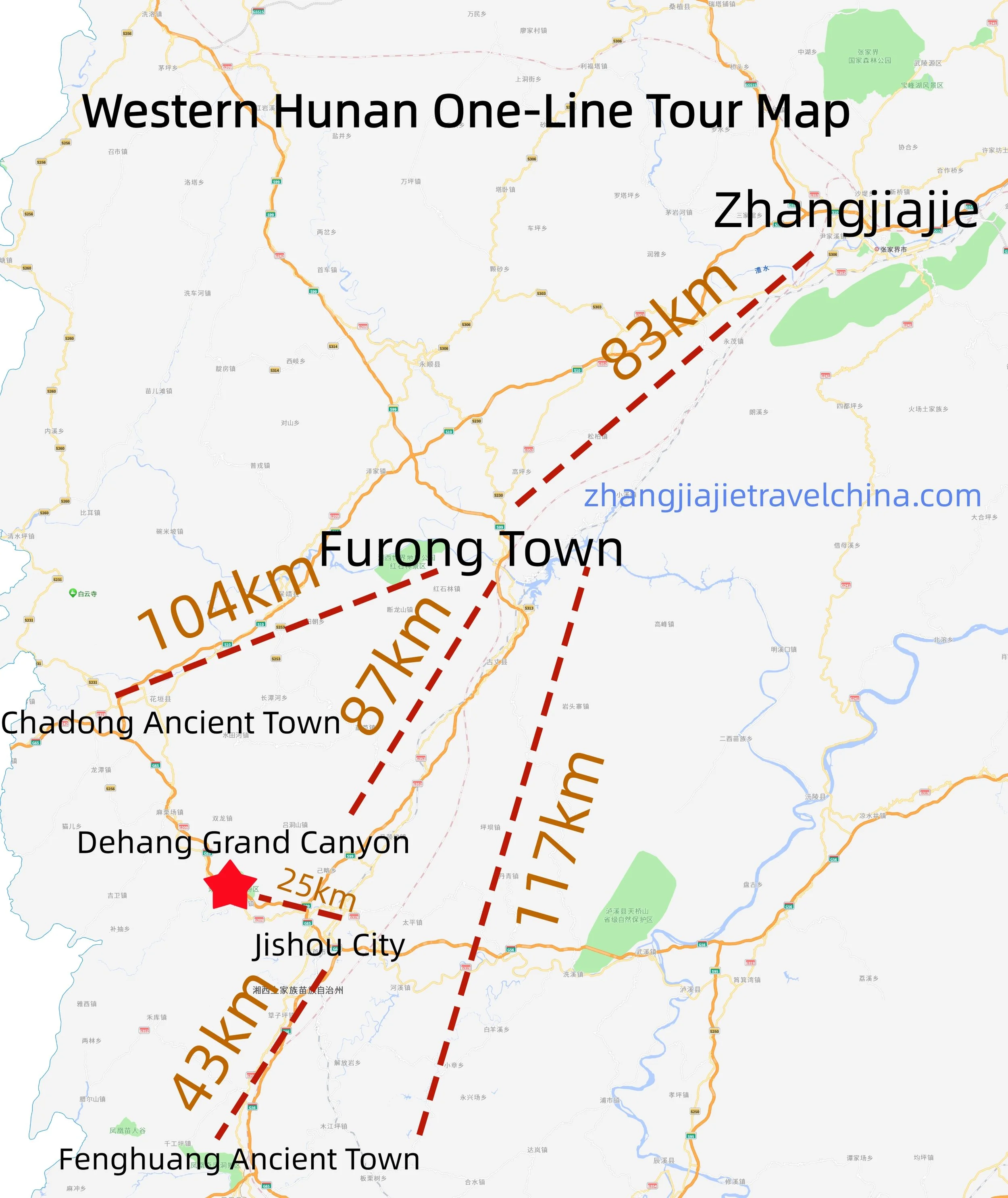
Self-drive — Exit the Baomao Expressway at Aizhai toll station, then about 13 km to the village; about 1.5 h from Zhangjiajie, about 66 km from the Fenghuang side, about 3.5 h from Changsha; tolls about 5 RMB. Village inns usually require parking outside with the owner picking you up; use official lots, not roadside private spaces.
Does Didi work? In downtown Jishou, yes. In Dehang village you cannot count on hailing a car — and at night, forget about getting back to Jishou from the village.
From Furong Town
Furong Town has its own high-speed rail station: take the train to Jishou East (just over 20 minutes), then transfer to the Route 18 bus for Dehang. Alternatively, take the coach from Furong Town to Jishou: buses run between Jishou West and North bus stations and Furong Town's station, 8:00–18:00, hourly, about 1.5 hours for 23 RMB. On arrival in Jishou, pick the bus to Dehang from whichever station you land at (see above).
Via Fenghuang
From Fenghuang: 13 minutes by high-speed rail to Jishou East, then Route 18 or a taxi. A half-day "Fenghuang — Dehang — Fenghuang" run is possible but rushed. More sensible: stay a night in Fenghuang, do Dehang the next morning, and head back to Fenghuang or on to Zhangjiajie in the afternoon. We do not recommend a same-day round trip from Fenghuang — the train is only 13 minutes, but with transfers at both ends you would burn 3–4 hours on the road.
Stringing the Xiangxi Loop (a group-travel favorite)
Dehang is never a standalone stop. The 5A scenic area's full name is "Aizhai–Shibadong–Dehang Grand Canyon," and two more worthwhile sights sit on the same route. Shibadong Village: free entry, the birthplace of China's "targeted poverty alleviation" campaign, about 36 minutes from Jishou — pairs naturally with Dehang for a single day. Chadong in Border Town (Huayuan County): the real-life setting of Shen Congwen's "Border Town" — across the Qingshui River lie Hong'an in Chongqing and Yajia in Guizhou, so one step spans three provinces; the rope ferry "laladu" costs 2 RMB per person per crossing.
Chinese Place-Name Card to Show Drivers
Screenshot this and show it when needed:
Please take me to: Dehang Miao Village (Dehang Grand Canyon Scenic Area) / Aizhai Bridge Zone / Aizhai Cliff Walkway / Tianwen Terrace / Jidou Miao Village / Liusha Waterfall / Jishou East Station / Aizhai Town. I would like to get off at the scenic area visitor center. What time is the last bus back to Jishou?
6. Planning Your Route (5 Itineraries by Fitness and Transport)
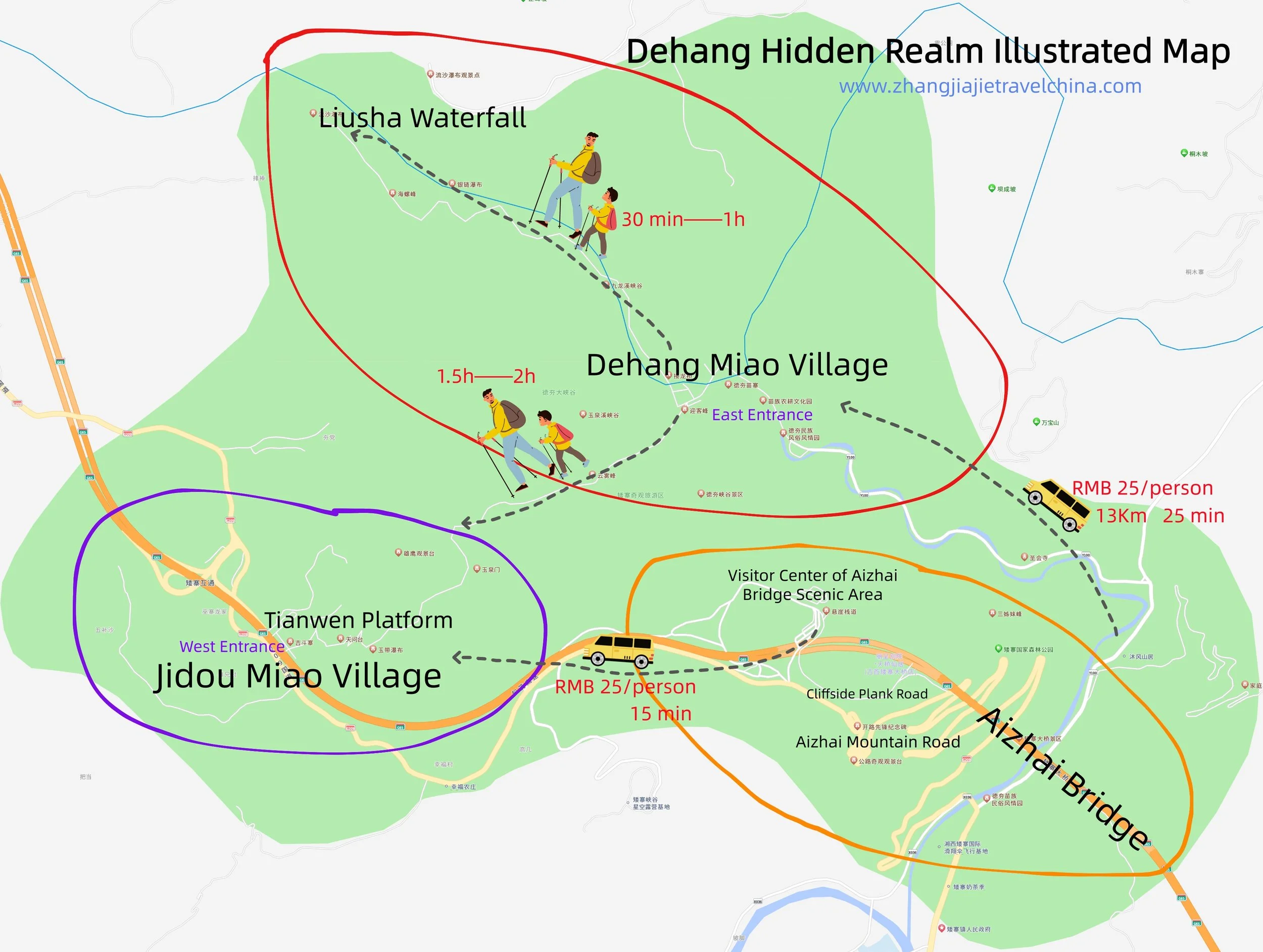
One core principle: the village zone and the bridge zone are 13 km apart — do not even think of walking; you would waste hours. Take the 25 RMB shuttle between them.
One Day, the Essentials (private driver / self-drive; enter west, exit east — most recommended)
For: reasonably fit travelers who want to see both canyon and village in one day.
07:30 — Depart downtown Jishou.
08:30 — Arrive at the west entrance by Jidou Miao Village / Tianwen Terrace (the area opens at 08:30 — do not come too early).
08:30–09:00 — Jidou Miao Village (clifftop; see the village first).
09:00–09:40 — Tianwen Terrace (downhill from the west side — easier).
09:40–11:40 — Descend Yuquan Stream to Dehang Miao Village (Yudai Waterfall, Yuquan Gate).
11:40–12:40 — Lunch in the village.
12:40–14:40 — Round trip to Liusha Waterfall via Jiulong Stream (take the cart to skip a leg).
14:40–15:40 — Dehang Miao Village + the 15:00 drum / wedding performance.
15:40–17:00 — Leave the village; if you still have legs, add Aizhai Bridge / the walkway (needs 2+ hours — better as day two).
17:30 — Head back.
Note: this route skips the glass walkway and Aizhai Bridge — Dehang's soul is in the village and the hidden valleys anyway. If Miao village and natural scenery are not your thing, swap for the itinerary below.
One Day, Bridge + Canyon (skip the Tianwen climb)
08:30 — Leave Jishou; straight to the Aizhai Bridge Zone.
09:00–11:30 — Cliff walkway + sightseeing elevator + under-bridge corridor.
11:30–12:30 — Lunch in the zone / transfer to Dehang.
12:30–15:00 — Dehang Miao Village + Liusha Waterfall via Jiulong Stream (cart saves time).
15:00–15:30 — Catch the drum / wedding performance.
15:45–17:30 — Head back.
For: acrophobes who still want the walkway, travelers with elders or kids, or anyone with a single day. Tianwen Terrace and Jidou can be dropped.
Two Days, One Night (the most comfortable)
Day 1: Bridge + Cliff Tops
Morning: Jishou East Station / downtown → Aizhai Bridge Zone
Noon: lunch in the bridge zone or Aizhai Town
Afternoon: cliff walkway, elevator, under-bridge corridor; if you are fit, add via ferrata or Cloud Walk
Dusk: check in at Dehang Miao Village, dinner in the village, a stroll
Evening: the 2026 show season is over — stargazing / fireside chats instead; from next April you can catch "Dehang Illusion" or "Mountain Wind, Drum Rhyme"
Day 2: Canyon + Village
Early morning: stroll the village, shoot stilted houses and morning mist
Morning: Jiulong Stream → Liusha Waterfall (2 hours round trip)
Noon: lunch in the village
Afternoon: Yuquan Stream → Tianwen Terrace → Jidou Miao Village, exiting at the west gate — or reverse it: enter west and walk down to the village
17:30: head back
This is Dehang's right rhythm. One day is a checklist; two days let you feel that "the mornings and evenings belong to the village."
One Day by Public Transport (no car, the cheapest)
08:30 — Catch Route 18 at Jishou East Station.
~10:00 — Arrive at Dehang Miao Village.
10:15–12:15 — Jiulong Stream → Liusha Waterfall round trip.
12:15–13:15 — Lunch.
13:15–14:45 — Stroll the village, tea, wait for the show.
15:00–15:30 — Drum / wedding performance.
15:30–16:45 — Rest in the village; head to the bus stop early.
17:30 — Route 18 back.
This route misses Tianwen Terrace and the bridge. With one day and no car, you must choose between the waterfall and Tianwen Terrace. The waterfall photographs better; Tianwen Terrace is the one that makes the trip.
The 4-Hour Blitz (only for passing through)
Dehang Miao Village 1 hour + Liusha Waterfall round trip 2 hours + a meal 1 hour; or Aizhai Bridge + walkway 2.5 hours + lunch 1 hour. Do not try to squeeze Tianwen Terrace into 4 hours — those 399 steps will teach you humility.
Walking Time Chart (varies by starting point — do not mix them up)
Village gate / ticket office → Liusha Waterfall — 30–60 min one way; gentle trail, longer with photo stops.
Village center → Liusha Waterfall — Visitors log 2 hours (the original does not specify one-way / round trip); slow walk + photos, while route tables budget 1 hour one way.
Village center → Tianwen Terrace — About 1.5 h uphill; 2 km, 399 steps.
West entrance → Tianwen Terrace — 20–30 min downhill; easiest option.
Tianwen Terrace → Jidou Miao Village — 20–30 min; cliff-top trail.
Jidou → village (down Yuquan Stream) — 1.5–2 h; all downhill.
Bridge zone loop — 2–3 h; elevator, walkway and corridor included.
Aizhai switchback road by vehicle — 30–60 min; many bends — motion sickness likely.
⚠️ Do not try to hit the waterfall, Tianwen Terrace and the whole glass walkway in one day. The waterfall round trip alone is two hours.
Our suggestion: if you are starting from Zhangjiajie and want to hit Furong Town / Dehang's hidden valleys / Fenghuang Ancient Town in one trip, contact Lynx Travel and rent a licensed car with a local driver. Leave your Zhangjiajie hotel at 8:00 AM, reach Dehang before 11:00, tour after lunch, then head to Furong Town around 5–6 PM for dinner and the night view, and drive on to Fenghuang Ancient Town afterward. One day, plenty of touring time, and no exhaustion — that efficiency is only possible with a private car. On public transport you can only pick one of the three.
7. Where to Stay
Strongly recommended: stay one night in the village. On a tighter budget, fall back to downtown Jishou or Fenghuang Ancient Town.
Three Bases, Three Experiences
Inside Dehang Miao Village — Pros: the village at dawn and dusk is at its best; trails start at your door; the owner can pick you up and buy tickets for you. Cons: need a scenic ticket; park outside; old wooden buildings are damp and thin-walled; no convenience stores at night. Best for: wanting village life, photography, a one-night stay.
Aizhai Town / Bridge Zone — Pros: bridge and canyon views; newer facilities; good for self-drivers. Cons: a distance from the village; few dining options. Best for: bridge lovers; those who want comfort.
Fenghuang Ancient Town — Pros: hotels galore, stable prices, easy food and transport. Cons: 2–3 hours of commuting each day; no village atmosphere. Best for: one-day visitors, elders and kids, catching a train.
Inns Inside the Village
Yangjie Inn — Village center, about 100 m from the Miao village; renovated 2025, only 8 rooms; owner pickup and home-cooked meals. Platforms from about HKD 258/night; 4.8/5, about 97 reviews.
Zuixiang Inn — About 100 m from the Miao village; opened 2025; mountain-view / projector rooms; free parking and pickup. Platforms from about TWD 1,419; 9.9/10, about 77 reviews.
Lingxi Yaju — About 80 m from the Miao village, beside Jiulong Stream; river-view / wooden family rooms; free parking, laundry and station pickup. Very few review samples — check the latest before booking.
Fengxi Inn — Streamside inside the scenic area; river-view rooms; the owner couple cook — their smoked pork and smoked pork hocks are well reviewed. Check live prices.
Shuangyue Villa — Heart of the village inn cluster, facing the stream; some activities reimburse tickets, breakfast included. Rooms run small; breakfast about 18 RMB/person.
Price ranges (2026 reference): off-season weekdays 120–220 RMB/night; peak season / weekends / holidays 260–450 RMB/night, and rooms fill fast. High-end: "Tianqiao Xianju" by Aizhai Bridge — 26 rooms, pricier, selling bridge views and an infinity pool. There is also the Aizhai Canyon Starlit Camping Base.
Questions You Must Ask When Booking a Village Inn
Hello, I would like to book a room for [month/day]. Could you tell me:
Does the rate include scenic-area admission?
Can you buy the 120 RMB 3-day pass for me?
Where do I park — will you pick me up from the lot?
Does the room have a private bathroom, A/C or heating, and hot water?
Any dehumidifier or electric blanket? How damp is the wooden building?
Is breakfast included? Can I eat dinner at your place? Roughly how much per person?
Is the room on the stream side or the road side? Is it noisy at night?
What is the easiest way to get there from Jishou East Station — can you help call a car?
Send these questions to the owner in Chinese on WeChat before you arrive — far better than arguing on site.
8. What to Eat
Dehang's flavor profile: sour, spicy, cured. The couplet at the village gate reads "Sour fish, sour meat, corn liquor — drunk are guests from eight directions," and locals say "skip the sour for a day and your walk goes astray."
Sour fish — Miao pickled fish (not sour-soup fish); 68–138 RMB/portion. Fermented, salty-sour; go easy if your stomach is delicate.
Sour pork — Pork belly with toasted rice flour and salt, jar-fermented 10+ days, stir-fried with chili and garlic sprouts; 48–68 RMB/portion. One portion feeds two; the fat melts on the tongue.
Miao smoked pork — Smoked over the fire pit, steamed with fiddlehead / fern cakes / sausage; 88–158 RMB/portion. Heavy smoke aroma, on the salty side.
Blood-cake duck — Duck blood and glutinous rice cakes soaked in spicy duck broth; 58–88 RMB. Spicy, great with rice.
Sour-soup fish — Local fish in a fermented tomato / fermented chili broth; small about 68, large about 98. A completely different dish from sour fish.
Peach-blossom insects — Many-legged stream insects, deep-fried or stir-fried with chili; old sources: 2 RMB/skewer, 4–5 RMB/plate. Spring only; for the adventurous.
Rice tofu — Rice-milk curd, served cold or hot; 12–18 RMB. Spicy — ask for less.
She-fan — Glutinous rice + wild greens + diced cured pork; about 10 RMB. Common in spring.
Glutinous rice wine — Home-brewed Miao liquor; sweet but strong; by the pot. Not a soft drink.
There is also the Miao King Feast: the "Dehang Miao King Feast" restaurant in the village, 48 RMB/person, popular with groups. In general, 40–80 RMB per person gets you a good meal; order the big dishes — sour-soup fish, smoked pork, blood-cake duck — and you will reach 100 RMB. The long-table feast runs about 80 RMB/person and covers sour-soup fish, smoked pork, blood-cake duck and rice wine in one sitting — good for groups. The village's farmhouse-style eateries and the old restaurants near the Wind-Rain Bridge are reliable; inn owners' home cooking is often recommended too — book ahead. Places with printed prices are more reassuring; at places without a menu, ask before you order. ⚠️ Eating inside the scenic area is pricey, and bargaining is expected — better yet, eat back in Jishou, 30 km away: cheaper and cleaner.
Vegetarian: you can order stir-fried fiddlehead, bamboo shoots, wild onion, tofu and greens — but many dishes are cooked in lard or cured pork, so say "no meat, no lard" when ordering.
Halal: there is no halal restaurant in Dehang; Jishou city has them. If you observe halal strictly, eat in the city.
Allergies: sour fish and sour pork are fermented; ask clearly about shrimp, crab and insect dishes.
Stomach care: Hunan food runs spicy — order "mild" or "no chili"; drink bottled water and go easy on raw and cold food.
9. Budget (Per Person, 2026 Reference)
Backpacker / budget — Tickets + transport 180 RMB; lodging 120–180 RMB/night; food 60–80 RMB/day; local transport 20–40 RMB/day; total about 380–480 RMB/day.
Standard — Tickets + transport 180 RMB; lodging 220–300 RMB/night; food 80–120 RMB/day; local transport 50–80 RMB/day; total about 530–680 RMB/day.
Comfort — Tickets + transport 180 RMB; lodging 350–500 RMB/night; food 120–200 RMB/day; local transport 80–150 RMB/day; total about 730–1,030 RMB/day.
Extra: "Dehang Illusion" 228 RMB/ticket (2026 season over — plan it for 2027); high-altitude activities about 100–400 RMB each; long-table feast about 80 RMB/person; Jishou–Changsha / Zhangjiajie / Fenghuang rail tickets separate.
Example — two people, two days, one night, standard tier: tickets + transport 180×2 = 360; one night's lodging 250; food 100×2×2 = 400 over 2 days; local transport / shared private-driver 150; total about 1,160 RMB for the two — 580 RMB per person, excluding long-distance travel and shows.
10. Before You Go
Work through four checklists — ID and money, clothing and gear, apps and info, final confirmations — and fill any gaps before departure.
ID and money
ID card / passport original + copy or photo
200–300 RMB cash (no ATM in the village; stalls may take cash only or WeChat only)
Alipay / WeChat linked to an international card (foreign visitors)
Screenshots of ticket and lodging bookings
Travel insurance (covering hiking / outdoor activities)
Clothing and gear
Non-slip hiking shoes (not runners, not flip-flops — the stone steps grow moss; this one is non-negotiable)
Rain jacket (beats an umbrella — canyon trails are narrow)
Quick-dry layers + light jacket or fleece (the canyon is cooler than the city)
Long trousers (insects and scratches)
Hat, sunscreen, mosquito repellent
Trekking poles / knee braces (if your knees are iffy)
Earplugs, eye mask (wooden buildings = thin walls)
Flashlight / headlamp
Power bank, plug adapter (foreign visitors)
Tissues, wet wipes, hand sanitizer
Basic meds: anti-diarrheal, cold, band-aids, motion-sickness
Apps and info
Offline translation app (Apple / Baidu / Microsoft)
Amap / Baidu Maps offline packs (more reliable than Google Maps in China)
WeChat for your inn owner / driver
The Chinese place-name card (see Chapter 5)
Scenic-area hotline 0743-8665 205 (info) / 0743-8665 350 (canyon zone)
Weather forecast / scenic-area official account
Final confirmations
Route 18 departure / return times (the current schedule dates from 2024)
Whether the area is open / the walkway closed
Whether the 120 RMB promo pass is still valid (runs to 2027-07-01)
Whether your inn includes tickets / pickup
Rain / flash-flood warnings
Whether "Dehang Illusion" is running (2026 season over — check again in April)
11. When to Come
Start with water and crowds by season, dodge the worst dates, and note three special situations for 2026.
Seasons at a glance
Mar–May — Water rising after spring rain; humid, cool mornings and evenings; light crowds. Best for fresh green and mist — bring rain gear.
Jun–Aug — Water at its highest; muggy outside, cool inside the canyon; summer peak, weekends packed. Best for waterfalls and escaping the heat — dodge thunderstorms.
Sep–Oct — Water still good; most comfortable weather; extremely crowded over National Day, fine on normal days. Best all-round.
Nov–Feb — Still viable; cold and damp; very few people. For quiet lovers and the cold-tolerant — shows and shops may close.
If you can pick one window: a weekday in October (late September to end of October). Water is still flowing, the air is not muggy, and crowds are lighter than summer. Coming just for the waterfall: April–June, or 1–2 days after heavy rain — but post-rain trails are at their slickest, so non-slip shoes.
Dates to avoid
National Day Golden Week (Oct 1–7 — queues for the bridge, walkway and shuttles); May Day and Spring Festival are the same; summer weekends are the family-travel peak.
Weather and gear
Xiangxi is rainy in spring, thunderstorm-prone in summer and cold-damp in winter. Do not enter the canyon on storm days: flash floods strike fast and the area may close without notice. On heavy-fog days you may not see the bridge at all. The canyon is cooler than the city — bring a light jacket. The village has no central heating and A/C heat is limited; in winter pack thermal underwear and a waterproof shell.
12. Cultural Etiquette — Essential Reading for International Visitors
Dehang Miao Village is home to roughly 500 residents. Most dress ordinarily, use smartphones, go to school and work away — do not leave disappointed because you did not see anyone "in full silver regalia." Traditional dress comes out for performances, festivals and photos; as locals themselves put it, Miao costume is impractical for daily work. On group visits or festival days, Miao young women often block the gate with rice wine (independent travelers may not encounter it). It is a welcome ritual, not forced spending. Take the cup with both hands; a sip or a lip-touch is fine. If you do not drink, a polite "no alcohol, thank you" works — or touch the rim to your lips. The wine is sweet but sneaky; do not down it on an empty stomach. Return the cup afterward and say "thank you." Daytime drum and wedding performances happen at Drum King Plaza, typically at 10:00 and 15:00 (seasonal). Visitors can go up and play the drums or join the wedding interactions; if you would rather not, sit toward the back. The performers are locals doing their job — do not mock the moves as "fake"; commercialization and real life coexist here. Applaud when the show ends; no tipping needed. In Miao culture the drum is more than an instrument: historically it carried messages and lifted morale before becoming festival performance. Do not touch the ancestral hall, ritual objects or the drum troupe's sacred drums — the drums set out for visitors to try are fine to play, and if unsure, ask. Foreign visitors call Dehang a "hidden gem" — meaning "few tourists," not "mysterious." Do not romanticize it into a place that does not exist. Dehang has concrete houses, construction, touts and loudspeakers — and it has the Miao language, drums, fire pits and cloud seas. It is a real village developing its tourism, not a specimen frozen in time. You may dislike the commercial side, but do not treat the locals as exhibits who "ought to stay primitive."
13. FAQ
Q1: Are Dehang and Aizhai Bridge the same place? They belong to the same 5A-rated "Aizhai–Shibadong–Dehang Grand Canyon Scenic Area," which contains three zones: Aizhai Bridge, Jidou Miao Village and Dehang Grand Canyon. Dehang Miao Village sits on the canyon floor; Aizhai Bridge spans above; the two are about 13 km apart, linked by a 25 RMB shuttle.
Q2: Do I need a border-area permit for Dehang? No. Dehang is in Xiangxi, Hunan — no border-control zone involved.
Q3: Is it cheaper to buy tickets online or on site? The official system prices online at roughly list (Dehang 80, bridge 95, walkway 78) — buying online saves the queue, not money. You will need your ID/passport number; entry is by original document or QR code.
Q4: Can I do a same-day round trip from Zhangjiajie? You can, but we do not recommend it. The train is 38–47 minutes each way, so on paper it is doable — but you may not catch the Dehang–Jishou buses back.
Q5: Is it suitable for elders and kids? The village, the bridge viewing platform and the main canyon trails are fine. The Liusha Waterfall round trip, Tianwen Terrace and the glass walkway involve real walking and steep stone steps — assess honestly and do not push it.
Q6: Is one day enough? Absolutely — though our advice is to focus on Dehang's soul, its hidden valleys, since transport here is not the most convenient.
Q7: Which show is better value, "Dehang Illusion" or "Mountain Wind, Drum Rhyme"? "Illusion" is immersive 5D theater plus a banquet, with a complete story — great for first-timers. "Mountain Wind, Drum Rhyme" is eco landscape performance with stunts — stronger on folklore itself, and better for photography. The two are different in kind, not rank.
Q8: Why do so many guides list tickets at 60 or 100 RMB? Outdated info. Official 2026 prices: Dehang Grand Canyon 80 RMB, Aizhai Bridge 95 RMB, cliff walkway 78 RMB, all-zone 3-day pass 120 RMB.
Q9: Are there ATMs on site? Yes, at the scenic-area ticket hall — but they may not accept foreign cards. Carry a little cash to be safe; mobile payment (WeChat / Alipay) covers most merchants.
Q10: Do I need to book ahead in high season? Yes. Village inns are few — book weekends and holidays well ahead. If you only have one day for Furong Town, Fenghuang and Dehang combined, base yourself in Fenghuang Ancient Town and see the best of Xiangxi at a comfortable pace.
Q11: Can foreign tourists visit? Yes. Entry registration accepts an original passport; payment is mostly mobile — carry a little cash. But English is essentially nonexistent here, so bring a translation app and the Chinese place-name card.
Q12: Why do some of the "Dehang" photos online look like Fenghuang? Overseas social media is flooded with Fenghuang photos mislabeled as Dehang; TripAdvisor even lists Dehang's address as Fenghuang County. Dehang is in Jishou, 70 km from Fenghuang, and there is no direct transport between the two — transfers required.
14.Final Thoughts
Dehang's value is not in any single sight — it is density. Inside 8.1 square kilometers you get a world-class bridge, a hanging waterfall, a glass walkway, a thousand-year-old Miao village and two major night shows — all on a core ticket of 80 RMB. Go to Fenghuang Ancient Town but skip Dehang, and you have seen only half of Xiangxi. Go to Dehang and only look at the bridge, and you have not been to Dehang at all.
About us: Lynx Travel runs no-shopping small groups, private custom tours, and car rental with drivers — Zhangjiajie, Dehang, Shibadong, Fenghuang and the whole Xiangxi loop covered end to end, all first-hand, nothing handed off to middlemen.
15.Appendix A: Photography Shot List for Content Creators
Bridge panorama + sea of cloud — Bridge's main viewing platform (elevator up); right at the 08:30 opening, or dusk.
The 355-meter drop, up close — Under-bridge viewing corridor; morning, when the fog rolls upward.
Golden glass walkway — Glass section mid-walkway; dusk light.
Tianwen Terrace sea of cloud — Tianwen Terrace; before 9 AM — after 10 the cloud seals the terrace.
Village life — Jielong Bridge, bluestone lanes; morning or evening light.
Waterfall + rainbow — Base of Liusha Waterfall; sunny afternoon.
The night show — "Dehang Illusion" — the 8-meter moon rising; final act (after the show returns next April).
16. Appendix B: Sources and Verification Notes
Prices for optional activities and village inns change frequently — please confirm with us before you travel, and we will tell you the actual rate on the day rather than the rate recorded when this guide was written.