
Fenghuang Ancient Town Guide 2026
Written for foreign passport holders planning a trip to China, or already in the country
Structure — 15 chapters, jump straight to the one you need
Core chapters — Tickets and discounts (4) · Photo spots and timing (5) · Practical setup (9) · Scams and traps (11) · Photo shoots and Miao village tours (12)
Written — 9 October 2026
Data — 2,074 TripAdvisor reviews · word frequency analysis across roughly 660,000 words · 20.8964 million visitors to Fenghuang County in 2025
Verification — every figure checked against official sources; all 17 links tested live, both on 10 October 2026
Contents
Chapter 1 · When to Go: The Best Times and the Worst
Chapter 2 · What Fenghuang Actually Is
Chapter 3 · History and Culture: Eight Misconceptions
Chapter 4 · Tickets and Discounts: What Is Free and What Costs Money
Chapter 5 · Photo Spots and When to Shoot Them
Chapter 6 · Where to Stay: Eight Zones Compared
Chapter 7 · Getting There: Three Options
Chapter 8 · Food and Where to Eat
Chapter 9 · Practical Setup: Payment, Connectivity, Health, Clothing
Chapter 10 · Itinerary and Luggage
Chapter 11 · Scams and Traps: Seven Things That Go Wrong
Chapter 12 · Photo Shoots and Miao Village Tours: The Two Costly Lessons
Chapter 13 · If Something Does Go Wrong: Who to Contact
Chapter 14 · FAQ: Twenty-Two Questions
Chapter 15 · One Last Thing
Last year a guide who had been leading inbound groups for seven or eight years told me something over dinner that I have not forgotten.
She said the biggest misconceptions foreigners hold about Fenghuang are these three: that Fenghuang and Zhangjiajie are the same place; that Fenghuang is not worth two days; and that the whole thing is a plastic construction put up for photographs.
But once they actually arrive, the thing foreigners ask about most is not commercialisation or the buildings. It is the crowds.
This guide is written for anyone holding a foreign passport who is planning a trip to China, or already in the country. Fifteen chapters, and you can jump straight to the one you need.
Chapter 1 · When to Go: The Best Times and the Worst
Fenghuang is not like Furong Town. Furong Town divides into flood season and dry season. Fenghuang looks much the same all year round, except for the few days in the summer flood season when parts of it are underwater. When you go still decides what the experience feels like.
Times to avoid
· 1–7 October (National Day golden week): this is the worst of the worst. Prices multiply, crowds multiply tenfold, and the riverside at night is so packed you cannot move.
· Spring Festival, May Day and other public holidays: same thing.
· July–August plus every weekend: the domestic family and school holiday peak. The air is thick and humid.
· Weekends carry one extra reason: on 30 May 2020, eight giant pandas arrived from the Sichuan China Conservation and Research Center for the Giant Panda at Phoenix Ancient Panda Park, 7 km from the old town. So weekends now bring large numbers of domestic visitors who came for the pandas rather than the town. Some of the weekend crush has nothing to do with Fenghuang itself.
Relatively good times
· 8 October to mid-November: after the golden week, footfall drops off a cliff. Autumn skies, high visibility. This guide was written on 9 October 2026.
· March–May: the most comfortable weather, with plenty of clear days before the rainy season.
· Weekdays in September–November: comfortable overall, and easy to arrange.
But do not expect an off season
A foreign visitor put it directly on TripAdvisor: "It's crowded all the time! I doubt this place has a off peak season at all." (Fenghuang is crowded whatever the season. I genuinely doubt it has an off-peak season at all.)
Fenghuang County recorded 20.8964 million visitors in 2025, ahead of Yangshuo, Pingyao and Wuzhen's West Scenic Zone. So the right way to approach Fenghuang is to avoid the crowds and get a relatively quiet version of it, while accepting that it will still be busier than the Jiangnan water towns. Fenghuang is now the most visited ancient town in Hunan after Zhangjiajie.
Chapter 2 · What Fenghuang Actually Is
Fenghuang is not an "ancient town". It is a scenic area.
That single distinction is the key to everything that follows. Many people treat Fenghuang as a "Little Lijiang". It is quieter than Lijiang, more lived-in than Wuzhen, and far less polished than Dali.
The walled town was first built in 1556, during the Ming dynasty, and was rebuilt in the Qing era in 1704. The Tuojiang river runs 4.4 km through it. The historic core covers 1.8 square kilometres. Fenghuang sits in Fenghuang County, Xiangxi Autonomous Prefecture of Tiao and Miao Ethnic Minorities, western Hunan, roughly 430 km from Changsha. It is on the Zhangjiajie–Jishou–Huaihua high-speed rail line, about one hour from Zhangjiajie West station (see Chapter 7). If you have not been to Hunan yet, most itineraries pair Phoenix with Zhangjiajie — our main Zhangjiajie guide covers the mountain parks, the glass bridge and the Tianmen Mountain route in full.
Chinese poets described it like this:
A green hill cradles the old town,
The Tuojiang curls around the walls,
A street of red stone slabs,
A row of small stilted houses,
A weather-beaten city wall,
A timeworn old castle,
A wondrous Qiliang Cave,
A magnificent old stone bridge,
And a people known the world over — Fenghuang Ancient Town!
That core area of roughly one square kilometre — the strip along the river that you will actually walk — carries within it every fantasy about ancient towns that Chinese literature has ever produced. It is also why China complains about the place while continuing to visit it.
Its beauty, for a Chinese visitor, depends on the hour and the weather. It is not a fixed thing.
Just after dawn, roughly 6:00–7:00
Miao women washing clothes at the river's edge through river mist. Chinese literati gave this image a name: huan sha (浣纱, "washing silks"). And Fenghuang on a rainy morning just after waking is something else entirely — water vapour drifting slowly down the river, the whole town seeming to float. This is the real-life version of the Penglai immortal mountain from Chinese myth.
And the town just after waking: people walking over stone, sandals making a small soft sound, carrying the nostalgia that belongs to every Chinese person who has ever left home.
The town lit up at night, roughly 19:30–22:00
"There is heaven above and Suzhou and Hangzhou below, but neither compares to the lights of Fenghuang." That is exactly what the lighting is like — unmatched among Chinese ancient towns.
Walk the bar street between Jinshuiqiao and North Gate pier and the current dance tracks pour out through the buildings and echo across both banks. Neon and wooden stilt houses fuse completely. With the alcohol running through everyone, Fenghuang tips fully into DJ mode.
If the noise bothers you, spend 88 yuan on the Nanhua Mountain National Forest Park ticket and walk up to the Phoenix Terrace and the cliffside walkway. From up there the view is the same as a drone shot — the whole town curled around you like a dragon of fire. Tip: go in the evening and you can catch the exact moment the lights come on.
The hours in between are just a shopping street
That is slightly unfair, but I would rather say it now than have you build expectations on it.
How visitors actually rate it
We pulled every English-language review left on TripAdvisor for Phoenix Ancient Town and ran a word frequency count on the result. It is the same method we use across our China travel guides. The method matters, so here it is: we took the full review set from the listing, stripped ratings and formatting, and were left with roughly 660,000 words. Everything below is a raw count. No sentiment model, no weighting.
The listing scores 4.3 out of 5, from 2,074 reviews. The distribution:
· 5 stars: 46.4%
· 4 stars: 39.8%
· 3 stars: 11.1%
· 2 stars: 1.8%
· 1 star: 0.7%
Four and five stars together account for 86.2%. One and two stars together are only 2.5%. That is a strong result, and it tells you plainly that foreign visitors rate Fenghuang as an excellent scenic area.
But 3 stars alone is 11.1%. For comparison, the three core Zhangjiajie attractions — National Forest Park, Grand Canyon and Tianmen Mountain — all sit at under 1.5% negative. Fenghuang's share of "decent but something is off" ratings is markedly higher.
So what is the "off" part?
Positive words: beautiful (156), lovely (24), stunning (23), gorgeous (17), picturesque (13), breathtaking (12), charming (11), romantic (10), magical (7)
Negative words: crowded (77), commercial (31), touristy (29), tourist trap (17), commercialized (14), noisy (13), fake (9), overrated (7)
The single most frequent negative word is crowded, at 77 — more than half of all the "commercial" words put together.
So the story on Chinese platforms is that commercialisation has destroyed Fenghuang. But what actually turns foreign visitors away is not the commercialisation. It is the sheer number of people.
Which is why you should treat Fenghuang as a scenic area rather than an ancient town. Almost every positive review comes with a "but" attached, and almost every negative review admits the place is beautiful. That is the real structure of Fenghuang.
Chapter 3 · History and Culture: Eight Misconceptions
Almost everything foreigners get wrong about Fenghuang concerns its cultural identity. And these are precisely the things you will never read on Chinese platforms.
"It's the 21st century. Why are people still wearing Qing dynasty clothes?"
What you are looking at is not Qing clothing. It is Miao dress.
Fenghuang County belongs to Xiangxi Autonomous Prefecture of Tiao and Miao Ethnic Minorities. Note that "Miao" and "Tiao" sit side by side in that name.
This is not "an ancient town" and it is not "a minority village". It is a living cross-section of Han, Miao and Tiao people who have coexisted here for 800 years. Around 15,000 Miao people still live along the Tuojiang today, and about 60% of the women washing clothes at the river in the early morning are Miao. But the "Miao performances" you see on Hong Bridge after 10am are 99% designed for tourists. It is not local life.
The clothes are called Miao dress, and the features are specific:
· Silver — headdresses, neck rings, earrings and bracelets. Much of it is white copper, not actual silver.
· Batik — indigo-dyed cloth, patterned with beeswax resist then dipped in a solution made from the crushed root of indigo plants. Every pattern carries a fixed meaning, and it is also, genuinely, beautiful.
· Miao embroidery — patterns worked into collars, cuffs and sashes.
· Five-colour silk — the most valued Miao textile work, symbolising longevity and peace.
A Spanish writer travelling here in August 2026 put it this way: "Hay más de mil comercios que ofrecen trajes tradicionales y servicios de fotografía..." (More than a thousand shops offer traditional dress and photography services, including lighting, makeup and retouching.)
More than a thousand. Everyone says Miao photo shoots are on every street. That is a slight exaggeration — several hundred would be accurate. But the clothes in those shops are not traditionally made Miao garments. They are machine-produced, and many are not Miao clothing at all. They are a product that photo-tourism invented: costume.
"Why do Chinese visitors love renting these commercialised costumes for photos?"
Because Miao dress is the most visually powerful costume system among China's ethnic minorities. In an era where attention is currency, it flatters the desire to look good. And the silver, the saturated colours, it genuinely flatters most faces.
Fenghuang's "ethnic flavour" is a heavily commercialised folk presentation. It is not anthropology in the field. The clothes themselves are not fake, but they have been staged.
So go in with that expectation and you will see beautiful things. Go in expecting to witness authentic minority village life and you will be disappointed.
Miao dress is not Qing clothing. The people wearing it include locals, and they also include you, on your first visit.
"The old town is free, so why do the attractions inside charge? How does a free scenic area make money?"
This is where most visitors doing their research get stuck, because it looks contradictory.
The old town is genuinely free. And it makes money in a way an ordinary scenic area does not.
First, confirming that "free" is real. The lanes, the Tuojiang river path, the North Gate stepping stones, the outside of Hong Bridge, Wanming Pagoda and Xue Bridge are all open at no charge, and none require a booking.
The history is worth knowing
· 10 April 2013: Fenghuang introduced a 148 yuan entry fee, the so-called "walled city fee". It caused enormous public backlash.
· 10 April 2016: abolished. The old town has been free to enter ever since.
So what does it earn from?
Not entry fees. It earns from everything the visitors spend once they are inside:
· Accommodation — guesthouses in the old town run 100–600 yuan a night; core hotels report occupancy above 86% in peak season.
· Food — several hundred restaurants along the river.
· Photo shoots — the single largest industry in Fenghuang, employing more than 10,000 people and turning over more than 500 million yuan a year.
· Silver and costume shops — over a thousand of them.
· Boats and shows — the Tuojiang boat rides and the immersive "Xiang Jian · Tuojiang" night cruise.
· The Nine Sights inside the walls — Shen Congwen's former residence, Xiong Xiling's former residence, Hong Bridge, the East Gate tower and others. This is the part you pay for after you have already entered.
So the logic is: the free core area brings people in, and the money comes from what they eat, sleep on, photograph, and boat through. The Nine Sights ticket is part of that, but it is not where the profit is.
"Fenghuang is so crowded, and there are armed police everywhere. In many countries that would be a warning sign."
China is one of the two most populous countries on earth, and its headline attractions are permanently packed. That is not unusual. And heavy visible policing is a safety measure, not a threat. It is standard crowd management.
Whatever happens, you can rely on the Chinese police. They will handle things you cannot.
Even though Fenghuang receives over 20.8964 million visitors a year, violent crime has effectively stayed at zero. So do not worry about personal safety. Worry about property risk: overcharging, bar host scams, counterfeit goods and shopping tours.
"Fenghuang is a World Heritage Site"
You will read "UNESCO World Heritage site" in English travel writing repeatedly. This is wrong.
Fenghuang is on China's Tentative List for World Heritage. It is not a World Heritage Site.
The name on the tentative list is also not "Fenghuang Ancient Town". It is "Phoenix Regional Defence System". The name matters, because it reveals something almost no Chinese guide mentions and that you will find genuinely interesting: the value of Fenghuang is not only the stilt houses along the river. It is a complete Ming and Qing military defence system.
The system comprises seven categories and 15 surviving installations: fortified towns, garrison towns, river forts, stockades, watchtowers, beacon posts and border walls. It includes Fenghuang Ancient Town itself, the Southern Great Wall of China and Huangsiqiao Old Town. It is one of the largest, best-preserved and most complete Ming-Qing military defence systems surviving anywhere in southern China.
· December 2006: "Fenghuang Ancient Town" was placed on the Tentative List for the first time — the first county in Hunan Province to make the list.
· 2011: the nomination subject was changed from "Fenghuang Ancient Town" to "Phoenix Regional Defence System".
· 17 November 2012: the Phoenix Regional Defence System was re-entered as a standalone project on the updated Tentative List.
· It remains on the Tentative List. It has not been inscribed.
· 6 February 2024: Phoenix Ancient Town Scenic Area — Fenghuang Ancient Town plus Nanhua Mountain (Shenfeng Culture) Scenic Area, 4.39 square kilometres in total — was rated a national 5A-grade tourist attraction.
So "5A" and "World Heritage" are two entirely different systems. 5A is a Chinese commercial rating. World Heritage is a UNESCO list.
"Fenghuang is the place from Border Town"
This one is a well-meant fabrication that has spread into English blogs that look authoritative.
The truth: Fenghuang is Shen Congwen's hometown. He was born there. That part is true. But Border Town (《边城》) is set in Chadong, in today's Biancheng town, Huayuan County.
The novel opens: "there was a small mountain town called Chadong." The name Chadong appears 34 times in the novel. Nowhere in Fenghuang County can you find it.
The old tourism slogan was "this town has been waiting a thousand years." To open the Chinese travel market, marketers borrowed the fame of Border Town, which had been nominated for the Nobel Prize in Literature. What they did was mention "Border Town" and never actually claim it was Fenghuang. The rest was people assuming it.
"Fenghuang does not welcome Japanese. Many places refuse them."
That part is true. A small number of guesthouses — Pozhan Lodge is the one that became publicly known — posted their own notices refusing entry to Japanese guests who had served in the invasion of China. That is one owner acting alone, not a town-wide rule. The overwhelming majority of restaurants, shops and hotels serve Japanese guests without any issue.
Fenghuang has been developing inbound tourism continuously. There is Japanese-language guiding, foreign currency exchange and multilingual signage, and visitors from every country including Japan come every year. Inbound arrivals keep rising.
Why the refusal of Japanese specifically? The reason is a thousand years deep.
In the Jiajing era of the Ming dynasty, Tiao soldiers from Yongshun and Baojing — mostly Tiao families — marched a thousand li to the southeast coast to fight the wokou raiders. The Battle of Wangjiangjing is counted among the finest victories on that front.
In 1945, the Battle of Western Hunan, the last major campaign of the Second Sino-Japanese War, was fought in the Xuefeng Mountains. The Japanese burned and killed on their way through, and thousands of people in Western Hunan died. Tiao and Miao families gave up their hunting rifles to carry stretchers and supply grain. Countless men from Western Hunan died in that fighting. Two months later, the Japanese surrendered at Zhijiang.
This ground was a battlefield, and it is also ground that witnessed a victory. What these families carry is a memory of watching their homes burn and their relatives die. They remember the crimes of the invader. They do not hate ordinary Japanese people today.
"Fenghuang is a bunch of plastic built for tourists to take photos in"
What most visitors are actually seeing is the Phoenix Ancient Town Historic and Cultural District conservation and improvement project in progress.
It covers roughly 80 protected historic buildings and 25 traditional lanes around Laoyingshao and Dongzheng Street, and the approach is "repair as old". Progress: 79% complete as of June 2026, 87% reported on 29 September 2026, with completion expected in October 2026.
The "plastic" visitors are seeing is construction hoarding and temporary site facilities.
Chapter 4 · Tickets and Discounts: What Is Free and What Costs Money
The single most common misunderstanding foreign visitors have about Fenghuang is that the town charges an entry fee.
It does not.
Since 10 April 2016 entry has been free — the old lanes, the Tuojiang river path, the North Gate stepping stones, the outside of Hong Bridge, Wanming Pagoda, Xue Bridge and the night view are all free and require no booking.
The history, briefly
· 10 April 2013: Fenghuang began charging 148 yuan, switching from "ticket for the sights" to "ticket for the scenic area" — the so-called walled city fee. It caused enormous backlash.
· 10 April 2016: abolished and replaced with "suspension of area-wide checkpointing, sights keep their own tickets". Entry has been free ever since.
What the 128 yuan Nine Sights ticket actually covers
The Nine Sights (凤凰九景) is the official bundle name you will see at the ticket window — worth knowing, because the individual tickets are sold under nine different names and it is easy to buy the wrong one.
The Nine Sights ticket is 128 yuan and includes the daytime Tuojiang boat ride. It is valid for three days. Sights open 08:00–17:30. The nine are:
· Shen Congwen's Former Residence
· Xiong Xiling's Former Residence
· Yang Family Ancestral Hall
· East Gate Tower
· Hong Bridge
· Wanshou Palace
· Chongde Hall
· Phoenix Ancient Town Museum
· Daytime Tuojiang boat
Buying online is cheaper than at the window.
What it does not cover
· Qiliang Cave: 98 yuan for foreign passport holders. This is the second most popular paid site in Fenghuang and it is not included in the Nine Sights ticket. It sits about 6 km from the old town, fifteen minutes by taxi for 35–50 yuan. The cave runs more than 6,200 metres, its largest hall is reputed to be 120 metres high, and it holds a steady 16°C. Allow two hours and bring a thin jacket. Open 08:30–17:30, last entry 17:00; on public holidays it opens from 08:00.
· Nanhua Mountain National Forest Park: 88 yuan (about 50 yuan online). This is the only reliable way to see the whole town from above, and it is not included in the Nine Sights ticket.
· Daytime Tuojiang boat on its own: 80–85 yuan.
· The "Xiang Jian · Tuojiang" immersive night cruise: 148–188 yuan depending on package.
· Every Miao costume photo shoot and every Miao village tour. None of these are in any ticket.
On discounts: as a foreign visitor you will almost certainly pay full price
The standard concessions are:
· Free: children under 1.4 m, visitors over 65, active-duty military personnel, disabled visitors
· Half price: visitors aged 60–64, full-time students
These run on Chinese-registered age and student status. A foreign passport holder qualifies for almost none of them, and will pay full price in nearly every case.
So do not plan to save money by flashing a senior card. If you want certainty, ask the booking platform before you travel.
How to buy tickets with a passport
Fenghuang uses real-name ticketing. One document, one ticket.
· Enter your passport number in place of a national ID number when booking.
· Carry the physical passport with you. A screenshot of it will not be accepted.
· Booking channels: the official Phoenix Ancient Town Scenic Area website, the official WeChat account and mini-program, or Trip.com, Meituan and Douyin.
· Buy one day ahead and keep the electronic confirmation.
· If the gate reader does not recognise a foreign passport, use the staffed lane. This is normal and it is not a problem.
Online is cheaper than the window. Whichever channel you use, the only name to look for is the complete "Nine Sights" ticket. Fenghuang has many ticket types — single sights, the Nine Sights pass, and combined passes with the boat — priced from 34 to 188 yuan. Read the name carefully or you will buy the wrong one.
What I would actually buy
If you have one night: buy nothing. Walk the free parts, see the night view, eat outside the walls. The Nine Sights are museums. The town itself is the attraction.
If you have two nights and care about Shen Congwen: buy the Nine Sights, and add Qiliang Cave the next morning. Skip the night cruise unless you specifically want it — the lit-up view from the riverbank is the same view.
If you want the panorama and do not care about museums: skip the Nine Sights entirely and buy only the Nanhua Mountain ticket. That is the better trade.---
Chapter 5 · Photo Spots and When to Shoot Them
Fenghuang is a two-shooting-window town.
Everything worth photographing happens in two windows a day, and both of them fall outside the hours most visitors spend here.
The two windows
06:30–07:30, morning mist. This is the window. River fog burns off around 08:30, and tour groups start arriving from that point on. By 09:00 the river reads as a market rather than a river. If you shoot one thing on this trip, shoot this.
18:30–19:30, blue hour into lighting-up. The lanterns come on between 19:00 and 19:30. Arrive thirty minutes early. Between 19:00 and 21:30 you also have the lit-up reflections on the water.
Do not shoot between 11:00 and 16:00. If you want someone to show you the good angles at the hours that actually work, a private guide is worth considering.. The light goes hard, faces darken against a blown-out background, and everything looks worse than it is.
The six spots worth your time
Beimen Treading Stones. The stepping stones across the river, and the most-photographed place in town. Be there by 06:30 for mist, wet stone and reflection. Rain makes the stones slippery, and this is the one spot in Fenghuang where that genuinely matters.
Hong Bridge. Shoot from the bridge looking down the river. Reflections of the covered bridge and the stilt houses are the shot. The ground level is free; the upper level costs money if you hold the Nine Sights ticket.
Wanming Pagoda and Xue Bridge. The pagoda reflected in the river is the best night shot in Fenghuang, and fewer people come here than to Hong Bridge. Xue Bridge is where you want to be after 21:00, once the crowd thins out.
South Gate viewpoint. Free, high up, and the only spot that gives you the whole S-curve of the river with the mountains behind it. Ten to twenty minutes uphill on foot from the south gate. Go before you fall in love with the old town, not after.
Huilong Pavilion stilt houses. Walk the river path. Not one viewpoint but a twenty-minute walk, and it is where the town still feels inhabited rather than staged.
North Gate pier. The pier, the covered bridge and the boats in one frame. Vintage-looking, especially with a boat in shot.
Three technical notes
For night shots bring a tripod. On a phone, use Night mode and drop exposure two or three stops — the reflections are brighter than they look to the naked eye.
Shooting reflections after 22:00 avoids most of the crowd on the bridge.
Wear shoes with grip. The whole town is wet limestone and it is genuinely slippery.
Chapter 6 · Where to Stay: Eight Zones Compared
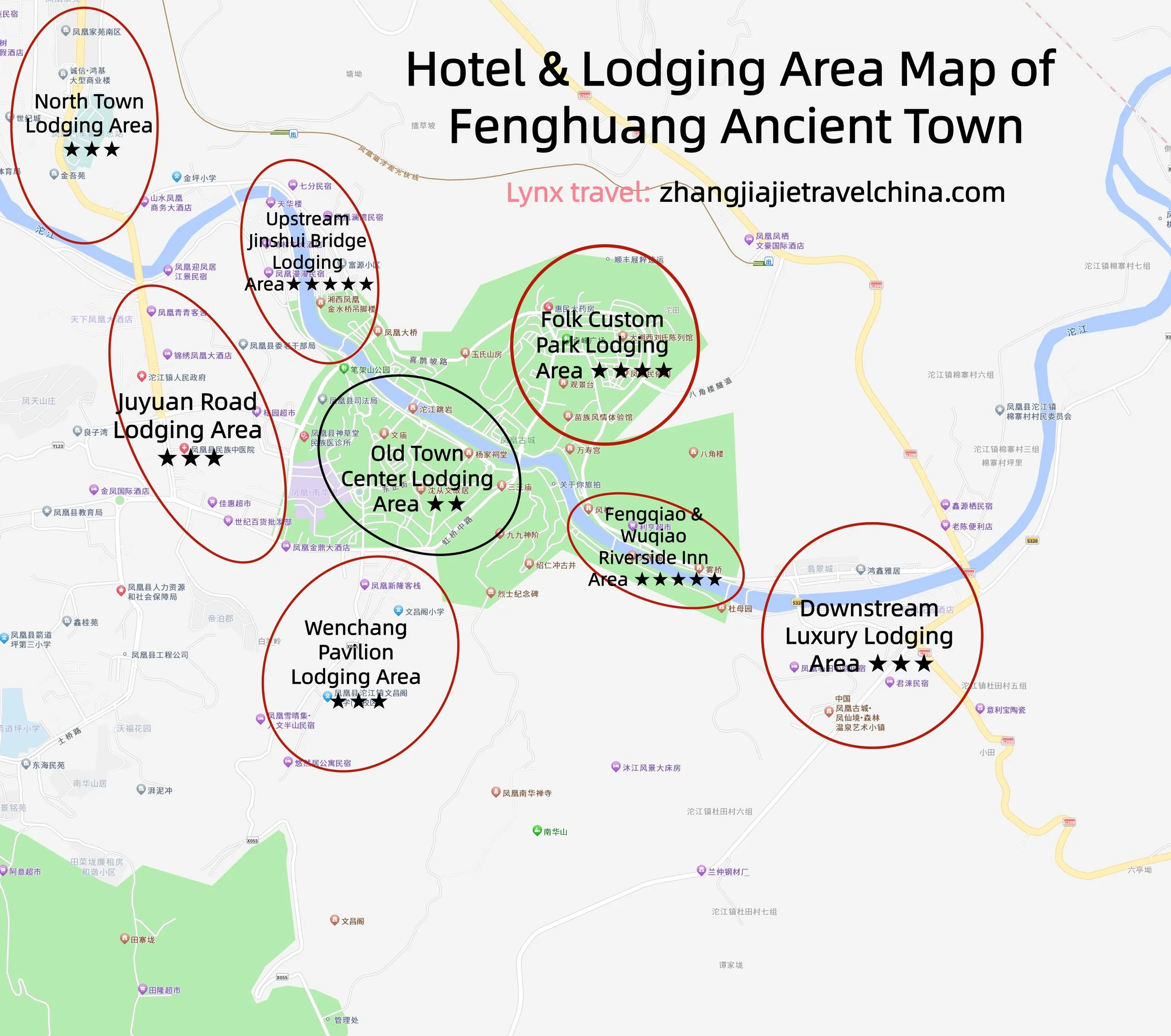
This is the biggest trap foreign visitors fall into in Fenghuang.
Where you stay matters more than which hotel chain you book. From twenty years in this business I have split Fenghuang into eight accommodation zones.
1. Downstream luxury zone
Where Southeast Asian tour groups tend to stay. It is far from the historic core — a 30-minute walk to North Gate pier. If you have high standards, this suits you. But be warned: after walking the old town to exhaustion, getting a taxi back here will test you. Average wait in peak season is 30 minutes, and you may not get one.
Getting there: from the high-speed rail station, take a taxi or ride the maglev to its terminus. When booking, always ask whether the hotel can pick you up at Fenghuang Waiting station. Same on the way back. Overall rating: three stars.
2. Fengqiao and Wuqiao riverside guesthouse zone
Where Chinese mid-to-high-end tour groups concentrate, and close to the core. There is a wide choice of riverside guesthouses, from high-end boutique inns to cheap ones. It is near the main road, so even staying across it does not mean a long detour, and there is a small footbridge to the other side less than every 100 metres. The downside is few food options and high prices — you have to walk a stretch of stone road with your luggage to reach a restaurant.
Getting there: take the maglev from the rail station to its terminus, and again ask about pickup at Fenghuang Waiting station. If your budget guesthouse does not offer it, take high-speed rail shuttle bus Line 1 to Qifeng Square and taxi from there. Same in reverse. Overall rating: five stars.
3. Folk Garden zone
A mixed area of domestic and international mid-to-high-end stays, close to the old town. Mostly converted village houses; conditions are comparable to the riverside guesthouses and there are plenty of budget hotels. Only a 3–5 minute walk from the core, and cars can reach the door, so you will not have to drag a suitcase over stone. The downside is that it is far from the new town, and the food there is expensive and mediocre.
Getting there: the maglev to its terminus works, and Fenghuang Waiting station is close to the zone — taxi or walk are both fine. If you would rather not walk, take high-speed rail shuttle bus Line 1 to Qifeng Square; the hotels are very close from there. Overall rating: four stars.
4. Old town centre zone
This is the core of the historic town. Lots of hotels, and poor conditions.
The reason is simple: the hotel strip is right here, and hotels stay open past 23:30, so the noise goes on. Ninety-nine percent of riverside guesthouses will have you dragging a suitcase up stone steps for 5–20 minutes. Several foreign bloggers have filmed visitors cursing while they do it — it almost always happens to people who booked into the core.
Food is passable, but you will have to walk out to the main road to find somewhere with locals in it. Avoid restaurants with expensive decoration and no customers. And yes, riverside restaurants are more expensive than those on the road.
Getting there: same as the Folk Garden zone. Overall rating: two stars.
5. Wenchang Pavilion zone
Where the old town meets the new town — a mix of chain hotels, guesthouses and village-house stays. Close to the core and to Hong Bridge and the West Gate. Chain hotels can be driven right up to the door; guesthouse conversions require a walk along stone. Because it is close to the new town, there is a lot of food and it is cheaper than inside the walls.
Getting there: from the rail station you can only use the high-speed rail shuttle bus. If your hotel is near Hong Bridge, take Line 1 to Qifeng Market and walk ten minutes along the road across the bridge. If your hotel is near the West Gate, take Line 2 to Nanhuali and walk 5–10 minutes.
This is the most awkward of the eight zones: close to the old town and close to both shuttle lines. Overall rating: three stars.
6. Upstream Jinshuiqiao zone
Where Chinese tour groups concentrate. Upstream of the old town, with a concentration of chain hotels and riverside guesthouses, but far enough from the core to be quiet. This is where I stay every time I drive to Fenghuang.
Rooms here split into riverside rooms and ordinary rooms, and the riverside rooms run 2–3 times the price of ordinary ones. The gap is that much because most of these are self-built village houses with poor soundproofing — in an ordinary room you can generally hear your neighbour snoring, and the light is poor.
So when booking, ask the owner to send real photographs of the actual room. There is plenty of food here but it is mediocre, and prices vary.
Getting there: take the maglev to Lansheng station; the lift brings you straight out into the hotel zone. That only works for hotels near Lansheng station. If you have booked across the river, near Nanhua Gate, you will need shuttle bus Line 2 from the rail station to Nanhuali and walk with your luggage.
Worth knowing: there is a road by Nanhua Gate that comes straight down to the hotel area. Do not take the stone path through the old town or you will become viral material on a foreign blogger's video. Overall rating: three stars.
7. Juyuan Road
The overflow option for Chinese tour groups. No riverside guesthouses here, only chain and budget hotels. Because it is near the new town there is a lot of food at sensible prices, and this is where locals eat.
You can reach the old town via Nanhua Gate or the West Gate — the distances are about the same either way. Download Amap first: Google Maps drifts badly here.
If you are a backpacker, this is the place for you. If you have a lot of luggage, it is also the place for you. If hotel quality matters to you, avoid it entirely.
Getting there: shuttle bus Line 2 from the rail station to Nanhuali, or a taxi from the station. Overall rating: three stars.
8. North of the city zone
Where Fenghuang's guides and drivers live.
Since 16 July 2020, Fenghuang has permanently enforced a rule that private cars and coaches cannot drive into the old town area — vehicles must transfer to a shuttle. So drivers and guides can only realistically stay here. It is also where ordinary residents live.
It is about a 30-minute walk from the old town, and a taxi queue takes 10–30 minutes. The upside is that it is quiet, uncrowded and cheap. The downside is that it is a culinary desert — with no local host you will never taste the flavours that are actually Fenghuang.
Getting there: shuttle bus Line 2 from the rail station to the Tourist Centre, then a 5–10 minute walk.
If you arrive by coach from Zhangjiajie, congratulations — you will get the VIP service of a coach that drops you at the hotel door.
And if you are exhausted after the old town at night and want a taxi back, I suggest you spend the fare on two bottles of Red Bull instead. There is a Chinese saying that fits: the good stuff should stay in the family. Overall rating: three stars.
Five things worth knowing when booking
Standard twin versus single, riverside versus lane-side, can differ by two or three times. Riverside guesthouse rates spike at weekends and on holidays. Travel off-season or book early.
Ask three questions before you book: do you offer pickup, what time do you close at night, and do you have a proper toilet and disposable toiletries. Most hotels do not provide toiletries. This is normal throughout Hunan.
The riverside paths have no railings. If you have been drinking, finish the bottle back at the hotel rather than walking the night view drunk.
The best way out of the high-speed rail station is the official shuttle bus or the maglev. If you take a taxi, agree the price before you get in.
Prioritise rooms marked "free cancellation", and screenshot the cancellation policy. If you book through an overseas OTA, check which domestic supplier it is actually reselling from. A free-cancellation room typically costs only a few tens of yuan more, and it is the only insurance you have if your plans change. If you book through us, our own cancellation policy is written in plain language.
One specific warning
In every ancient town, the thing that really costs you money is rarely the guesthouse itself. It is terms and conditions of the kind buried in small print.
They are written in Chinese, and the cancellation rules are often far stricter than international norms — especially "non-refundable" and "first night charged" clauses.
So: screenshot the cancellation rules before you book. Run the terms through a translation app. Do not assume international norms apply. If your plans might change, take the free-cancellation option even if it costs a little more.
This matters more than whether the room smells of mould. Because you can smell mould when you arrive. The charge happens automatically.
Chapter 7 · Getting There: Three Options
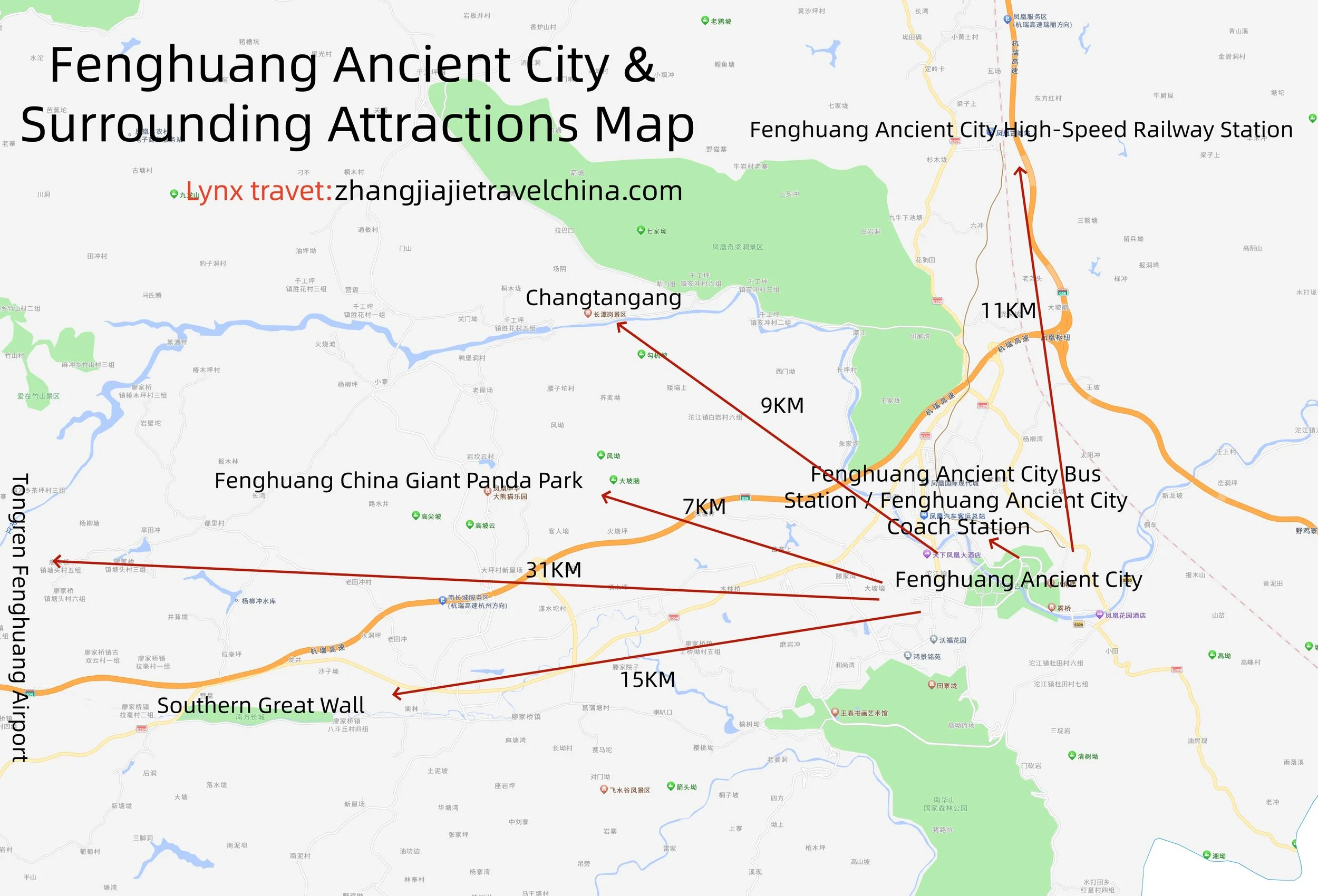
There are three practical ways in: high-speed rail, air, and routing through Zhangjiajie.
Fenghuang Ancient Town station is one of the seven passenger stations on the Zhangjiajie–Jishou–Huaihua high-speed line, opened on 6 December 2021.
It is not in the town. It sits in the new district of Fenghuang County, roughly 9.6–11 km from the historic core, and the transfer takes 20–30 minutes by car. Build that into your plan.
High-speed rail
Zhangjiajie West → Fenghuang Ancient Town
About 48 minutes to 1 hour 20 minutes. Second class is 76–93 yuan. There are 29 trains between 07:05 and 21:40. Trains are frequent, but several popular ones sell out, so book ahead.
Changsha South → Fenghuang Ancient Town
Fastest 1 hour 57 minutes, most around 2–2.5 hours. Second class is 194 yuan. Twelve trains between 07:02 and 18:45. Book ahead.
Furong Town → Fenghuang Ancient Town
Fastest 27 minutes. Second class from 53 yuan. Fourteen trains between 07:53 and 19:45.
Fenghuang Ancient Town → Guilin North
D3967, 6 hours 4 minutes. Second class 268.5 yuan. Note that second class is a reserved seat on this service every day and tickets are consistently in single digits.
Worth knowing: Fenghuang Ancient Town station is a small station. If it is the last stop of your China trip, consider ending in Huaihua or Zhangjiajie instead — Huaihua is a rail hub, and Zhangjiajie has an airport.
Air
The nearest airport is Tongren Fenghuang Airport, in Tongren, Guizhou province, roughly 37 km from Fenghuang by road.
It is the closest airport to town, but it is a 4C-class domestic regional airport. It is scheduled to operate 15 routes to 20 cities nationwide — though that figure reflects peak summer 2026 and the actual schedule moves with the season.
Airport → Fenghuang Ancient Town, three options
· ① Direct coach, around 25 yuan per person, about six departures daily, 1–1.5 hours.
· ② Via Tongren city: airport bus 15 yuan into town → North Bus Station → 20–25 yuan onward to Fenghuang. About 1.5 hours total.
· ③ Taxi or hired car, 100–150 yuan, 30–40 minutes.
If you are flying in from overseas, Zhangjiajie Hehua International Airport is usually the better choice. It is a 240-hour transit-visa port, it has far more international routes, and it is only about an hour from Fenghuang by high-speed rail.
Coach
Direct coaches from Zhangjiajie take about 3.5–4 hours; from Changsha South, 4.5–5 hours. Without a train, a coach is the fallback.
High-speed rail shuttle bus
Operating hours: 07:00 until the last trainFare: 7 yuan per person per tripConcession: under-18s and over-60s (inclusive)
Line 1 (standard route)
· Route: Fenghuang Ancient Town Station ⇄ Qifeng Square Tourist Centre
· Routing: direct, no intermediate stops
· Arrives at: Qifeng Square, near the downstream Tuojiang and Hong Bridge
· Suits: visitors staying downstream near Hong Bridge, or heading to Qifeng Square first
Line 2 (standard route)
· Route: Fenghuang Ancient Town Station → Tourist Distribution Centre → Coach Terminal → Nanhuali Tourist Centre
· Routing: three stops, covering the main transport nodes around the old town
· Arrives at: Nanhuali Tourist Centre, near the mid-upstream town and Nanhua Gate
· Suits: visitors staying mid-upstream near Nanhua Gate, or anyone who needs the distribution centre or coach terminal first
Line 3 (holiday-only temporary route)
· Route: Fenghuang Ancient Town Station ⇄ Yun Bridge
· Routing: direct, running only at holiday peaks
· Arrives at: Yun Bridge, near the upstream Tuojiang and the Treading Stones
· Suits: holiday arrivals staying upstream
Micro-shuttle inside the old town (paid)
After you arrive at the town entrance, if your accommodation is deep inside or you have a lot of luggage, you can switch to the micro-shuttle shuttle bus. It costs about 2 yuan per person per trip (under-1.2 m children and the national free categories travel free).
· V1: East Gate Visitor Centre — Three Lifetimes — Yun Bridge — Wu Bridge — Fenghuang Memory Farm Boat — Wanshou Palace — Qingxi Lane — Qifeng Square (round trip). Upstream to downstream along the Tuojiang.
· V2: Qifeng Square — Yushi Mountain House — Nanhua Gate — Nanhuali — West Gate Visitor Centre — Yongfeng Bridge — Nanhua Mountain (round trip). West side of the old town and the Nanhua Mountain direction.
· V3: Nanhua Gate — Jinjia Yuan Road — Tianxia Fenghuang Hotel — via Juyuan Road (no stop) — Nanhuali — Nanhua Gate (round trip). The north perimeter of the old town.
Fenghuang Maglev Sightseeing Express
About 9.12 km long, designed for 100 km/h, end to end in roughly 30 minutes. First train 08:45, last 21:30.
What makes it unusual is that the train runs through valleys and on viaducts, and the windows are larger than on an ordinary train.
Fares
· Single ticket 28 yuan: one ride. Good if you just want the experience or you are short on time.
· Tourist ticket 68 yuan: two rides over three calendar days, plus one visit each to the Maglev Science Hall and the Maglev Technology Experience Hall, and one maglev driving simulator session.
· Concession tourist ticket 48 yuan: for children 1.2–1.4 m, visitors aged 60–64, full-time students enrolled at undergraduate level or below, and disabled visitors.
Four themed stations, each worth choosing to get off at.
Fenghuang Ancient Town Station (the origin): zero-distance interchange with the high-speed rail station. Walk about 20 metres past the ticket gates and the maglev entrance is there; the building is shaped like a phoenix spreading its wings.
Fenghuang Welcome Station: good for families and anyone into technology. The Maglev Science Hall explains the "flying close to the ground" principle. Beside it is the Fenghuang History and Culture Museum covering Miao silver and Tiao batik.
Fenghuang Overlook Station: the best station on the line. The signature "Eye of the Phoenix" viewing platform cantilevers out over the Nanhua Mountain foothills and the Tuojiang — the definitive view over the old town and its nightscape. Inside is the Maglev Technology Experience Hall, with a driving simulator and VR. From there, an observation lift and boardwalk get you into the core in about 5–10 minutes on foot.
Fenghuang Waiting Station: closest of all to the scenic core. Wanshou Palace, Wanming Pagoda and Hong Bridge are all a short walk. Next to the station is Phoenix Waiting, an immersive theatre using holographic projection and 5D to stage the story of Border Town.
Ride-hailing in Fenghuang
You will mostly not get a car. This is not about price, it is about supply.
In August 2026 the Fenghuang County Transport Bureau publicly acknowledged, in its reply to a complaint, that there were instances of ride-hailing drivers refusing short-haul orders, and said platform operators had been summoned.
Multiple visitor accounts describe the same pattern: the app shows a price, and nobody accepts for half an hour.
So: prefer the shuttle bus and the maglev, which have fixed timetables and fixed prices. If you need a car, wave one down at the roadside rather than waiting on the app. For the return trip, ask your guesthouse or hotel to call one in advance.
Taxis
On 17 August 2026 the Fenghuang County Transport Bureau replied to a complaint about foreign visitors and taxis, stating:
After verification, the metered fare from the high-speed rail station to the old town is only 20–25 yuan. A quoted 50 yuan is an illegal overcharge.
Action taken: offenders were "penalised, suspended and re-educated", ride-hailing platforms were summoned, staff were stationed at the rail station, and taxis are now required to operate by meter. The complaint line is 3221575.
In other words: the correct metered fare is 20–25 yuan. Being asked 30 is high but near the ceiling. Being asked 50 is straightforwardly illegal.
The official position is that staff are now stationed at the station and meters are mandatory. Get in and say "打表" (dǎ biǎo) — those are the only two Chinese words you need.
Chapter 8 · Food and Where to Eat
Fenghuang has both the heat of Hunan cooking and the sourness of Guizhou cooking. For me, Fenghuang is a culinary desert.
Blood cake duck (xue ba ya): the signature dish, ordered on almost every table. It is made with duck blood and glutinous rice formed into a cake, pan-fried and then braised with local fat ducks. The cake is soft and chewy and soaked up the sauce; the duck meat is firm and well seasoned. Most places in the old town serve it in a dry pot that only improves as it keeps cooking.
Miao sour soup fish or sour soup cured pork trotter: the ancient fermented sour broth is the whole point — sour, spicy and extremely good against rich food. The fish is usually catfish or yellow catfish, both low in bones. The pork version braises smoked trotters in the sour broth until the skin is gelatinous and the meat falls apart.
Cured meats: Xiangxi bacon is slow-smoked over firewood, dark on the outside, but the fat turns translucent when sliced and the lean separates into fine strands. Salty-sweet and savoury, rich without being greasy. Usually served with fern shoots or steamed together with cured pork and sausage.
Shefan (society rice): a Miao festival dish of glutinous rice, wild artemisia, diced cured pork and peanuts, steamed together. The rice is fragrant, scented with the greens and the meat, and works as both a dish and a snack.
Sour pork: fatty pork cubes salted with pepper, coated in corn flour and sealed in a jar to ferment for at least half a month. The corn flour ferments naturally into the sourness, which is deep and mellow — a real "jar sour".
Beef rice noodles: a Fenghuang day starts with a bowl. Xiangxi beef rice noodles at a place locals actually use — rich broth, tender beef, thick noodles and a fried egg, hot and sour.
Rice tofu: smooth like pudding, usually served cold dressed with chilli sauce, pickled beans and crushed peanuts. Refreshing and appetising. There are stalls selling it along the middle stretch of Huilongge, the old stilt-house quarter.
Fresh-fried shrimp cakes: the "Man Shi" shrimp cakes at the bridgehead by Hong Bridge are worth trying. Live shrimp in batter, fried to order — crisp outside, sweet inside.
Tongye ba and maoyi ba: cakes wrapped in tung tree or corn leaves, sweet (sesame, red bean) or savoury (cured pork, preserved vegetable). Fragrant, soft and chewy.
Ginger candy: a local speciality on Hunan's intangible cultural heritage list, made by reducing fresh ginger juice with brown sugar. Sweet with heat, warming in cold weather. It is the defining food of Fenghuang and you will find it on every street.
Eat outside the city wall
If this guide were cut down to a single recommendation, this would be it.
The overwhelming majority of restaurants inside the scenic area are not good.
A Spanish writer travelling here in August 2026 wrote: "La grandísima mayoría de los que se ubican allá donde está todo el aparato turístico son de bajísima calidad. Pero nada más se sale de las murallas, en la ciudad común hay un gran número de lugares donde disfrutar de la picante cocina de Hunan."
Chinese platforms corroborate this. On Zhihu, the question "how much does a bowl of rice noodles cost inside the scenic area" returns 35 yuan, against 8 yuan for the same bowl outside the walls.
Mafengwo's price rule is: the further from the river, the cheaper
· Ordinary meat dishes: 18–30 yuan per portion
· Vegetable dishes: 8–20 yuan per portion
· 30–40 yuan per person is enough to eat well
One visitor's test: a ginger candy milk tea on the main street is 28 yuan. Two streets back in the residential lanes it is back to somewhere in the teens. Five minutes down a lane running perpendicular to the river, or straight out through the city gate into the county town, the same money buys a much better meal.
This is also how locals eat: in the residential streets, a bowl of noodles is 10–15 yuan, a stir-fried dish is in the mid-to-high teens or low twenties, and hotpot runs about 30-plus yuan per person.
Budget reference: breakfast 10–15 yuan, main meals 40–80 yuan per person, 80–120 yuan a day for food, depending on your taste.
Ordering, practically
Footfall is the most reliable way to pick a restaurant.
One visitor put it well: "If a restaurant is full, it is usually a good sign. If there are people standing outside trying to invite you in, check the price first and also look inside to see whether there are actually customers inside."
Three rules
① Ask the price of anything marked "market price" first
A single sour soup fish can be quoted at over 300 yuan. Establish the price before you order.
② Check the bill yourself
Visitors have recorded hand-written bills calculated wrong — 421 yuan totalled as 419, 406 yuan as 398. Both errors were in the restaurant's favour.
③ Avoid these three types
· Restaurants on Hong Bridge or in the dead centre of the old town (notoriously overpriced)
· Riverside net-famous shops with staff dragging you in
· Riverside barbecue stalls — what locals call "price assassins". One slice of potato, ten yuan.
Spice: Xiangxi food is hot, and genuinely hot
You need to know this in advance.
Xiangxi cooking is properly spicy. Not "fragrant spicy". It can be adjusted, but you have to ask.
Prepare two phrases in advance with a translation app: "不要辣" (bú yào là, no chilli) and "微辣" (wēi là, mildly spicy).
Mild options: rice tofu, stir-fried cured pork dishes, rice noodles (which you can ask for with no chilli at all).
But be aware: even "mildly spicy" here can still be hot to a foreign palate. If you genuinely cannot eat chilli, repeating "不要辣" works better than saying "微辣".
Chapter 9 · Practical Setup: Payment, Connectivity, Health, Clothing
Four boring things that decide whether your trip is smooth or miserable. None takes more than ten minutes to arrange, and every one of them is something that regularly goes wrong on day one.
1. Payment: set it up before you land, not at the gate
Alipay and WeChat Pay both accept foreign cards — Visa and Mastercard. This is the only payment method you need for the whole trip. Link a card and set a spending limit before you arrive, so that a rogue charge cannot hurt you.
You can register WeChat Pay with your passport. You need a photo of the document page and an SMS code that works on a foreign number. You do not need a mainland Chinese mobile number.
Fees: small transactions are free on both platforms. The percentage fee applies to larger ones, and there is no daily cap on what you can pay.
Carry some cash. Most stalls accept QR codes, but whether they can give change is a lottery. Small notes only — vendors cannot always break a 100.
Foreign Visa and Mastercard cards work in hotels and larger restaurants. They do not work at street stalls, and you will struggle to find an ATM that reliably handles foreign cards. Budget around Alipay, not around cards and cash.
Never pay by bank transfer to an individual account. If something goes wrong, see Chapter 13.
2. Phone and data
An eSIM is the easy answer. Airalo and Holafly both cover China. Buy before you fly. A physical China Unicom or China Mobile SIM at the airport also works, but you need your passport to register it.
Google and most Western apps are blocked in mainland China. You need a VPN before you arrive, not after.
Download offline maps before you leave home. Amap works in China. Do not rely on Google Maps — it drifts badly in Fenghuang and will send you into the river. This is the single most common complaint we hear from visitors who booked their own accommodation.
Save your hotel's address in Chinese characters and screenshot it. Showing the characters is faster than any translation app, and it also works on taxi drivers who do not read English.
3. Health and emergencies
Fenghuang County People's Hospital is the main hospital, and it can handle ordinary problems. For anything serious you are transferred to Jishou or Zhangjiajie, which are better equipped.
Bring the medicines you actually use. Pharmacies exist, but the dosing and the branding are entirely Chinese. Pack a small kit: loperamide, antihistamines, plasters, oral rehydration salts, and anything prescription you depend on, in its original packaging with the prescription.
Buy travel insurance that covers medical evacuation. This is not paranoia. It is the one thing that costs almost nothing and covers the only scenario that would end your trip early.
Emergency numbers: 120 ambulance, 110 police, 119 fire.
4. What to wear, and when
Fenghuang is wet, not cold. In the shoulder seasons — October, November, March, April — the river valley holds humidity and the mornings are genuinely damp. It is not freezing. It feels colder than it is because the stone is wet.
Bring a light jacket in every season. Even in July. Also in the caves, which sit at a steady 16°C all year.
Shoes are the one thing not to get wrong. The entire old town is limestone slab, worn smooth and slippery when wet. Trainers or flat shoes with grip. Heels are a genuinely bad idea.
Rain is normal. Carry a compact umbrella. The large ones are awkward in crowds.
Mosquito repellent for the riverside at dusk, particularly if you are sensitive to bites.
Chapter 10 · Itinerary and Luggage
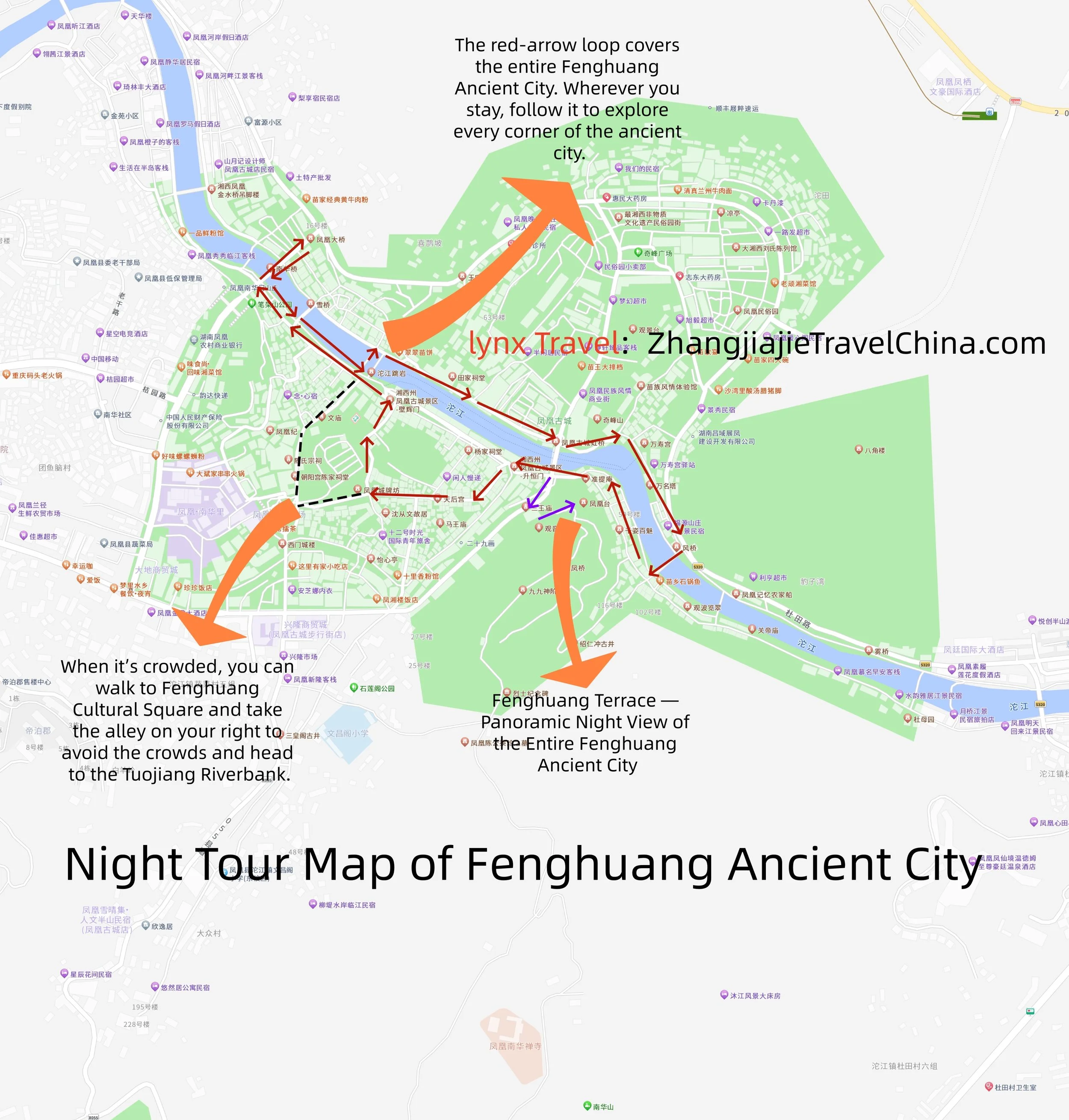
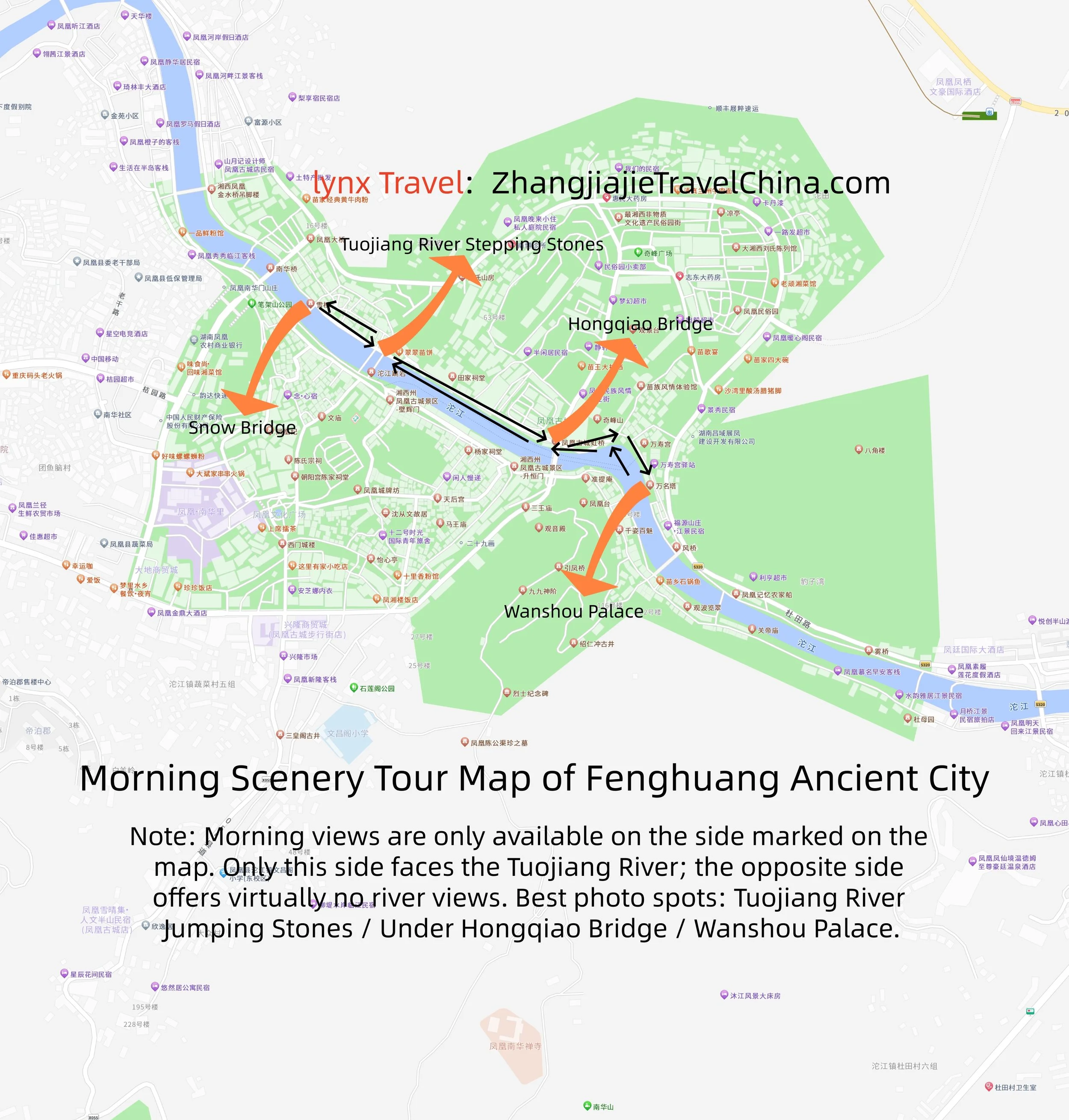
For the route inside the old town, just follow the map. The real planning work is the surroundings.
If this is your first time in China and Zhangjiajie is not already on your itinerary, you can give Fenghuang one night plus a half day.
Night one: arrive, check in, walk the route on the map. Leave nothing out.
Day two, 6am: get up for dawn photos along the old town, find a noodle shop for a bowl of Xiangxi beef noodles, then head to the Phoenix Giant Panda Park and return in the afternoon.
The bus to the Phoenix Giant Panda Park departs from Nanhuali stop in Fenghuang. First bus at 9:00, then roughly every half hour. Twenty minutes, about 7 yuan each way or 15 yuan return, and it connects seamlessly with the shuttle bus back to the high-speed rail station. Adult tickets 68 yuan, concession 48 yuan.
That arrangement saves time and gets you a look at China's national treasure. I will do a separate guide on Dehang Miao Village and Chadong at Border Town, so I will not go further into them here.
About luggage
Motor vehicles are not permitted in the historic core of Fenghuang, so taxis can only stop outside it.
Which means: if you book a guesthouse deep inside the old town, you will be dragging your own suitcase along stone.
One foreign visitor recorded what that cost her: "I learned this the hard way: I even walked into the wrong hotel thinking it was the one I had booked, carried my 20 kg suitcase upstairs, and only then realized it was not my hotel."
Another: "I saw many foreigners get dropped off with their suitcases at the West Gate and had to wheel over cobblestone-like pathways."
Advice
① Ask before you book: "How far is it from the drop-off point to your door? Are there steps?" You can do this with a translation app. Some guesthouses will send someone to the corner to meet you.
② There are shuttles in the old town: the in-town tourist shuttle is 28 yuan per person, valid three days, operating 07:00–23:00 (this one is more of a group and tour service, so confirm it on the spot). The connecting shuttle for private vehicles is 2 yuan per person per trip, 06:00–23:30.
③ Decide where you are staying before you travel. If you are hauling heavy luggage, stay on the edge of the old town — near Hong Bridge or the Second Ring Road — rather than dragging a suitcase over stone.
Getting back and going further
Fenghuang → Changsha: high-speed rail from 1 hour 51 minutes. Changsha is a hub, and changing trains is simple.
Fenghuang → Guilin and Yangshuo: the current timetable shows mainly one morning service in that direction.
Other stations on this line, often combined by foreign visitors
· Furong Town: the train stops in the town itself; Fenghuang to Furong Town is about 40–45 minutes by rail.
· Jishou East: the station for Dehang Miao Village and the Aizhai Bridge.
· Huaihua South: more onward connections.
On ride-hailing: even around Furong Town, cars are often unavailable. Try the ride-hailing service built into Alipay, or ask your accommodation to call one.
The smoothest route into Fenghuang is to fly into Zhangjiajie Hehua International Airport from overseas, clear immigration on arrival, and take roughly an hour by high-speed rail.
Coming from Changsha, take the high-speed rail to Fenghuang Ancient Town station and the 7 yuan shuttle into town — and ask the taxi driver for the meter at the junction, not at the destination.---
Chapter 11 · Scams and Traps: Seven Things That Go Wrong
This is the chapter worth bookmarking.
Photo shoots: a scam category, not a service quality problem
What it costs
· Makeup and dress only, self-shooting: 30–99 yuan, most commonly 30–68 yuan. This is by far the best value.
· Entry packages: 68–299 yuan.
· Full-service quality shops: 299–599 yuan. Some charge 699, some charge over a thousand.
· Retouching is almost always extra. Packages include 4–8 retouched images. Additional retouching runs 80–200 yuan each. This is the standard upsell.
Four ways it goes wrong
· Low opening price, then upgrades. Heavy Miao dress "upgrade fees", false eyelashes, props. All charged once you are already in the chair and already wearing the costume.
· Photo selection billing. In May 2026 a visitor complained about being charged for images they had not selected. A lawyer characterised it as a disguised forced transaction.
· Street photographers. A free snap, then a quote of 20 yuan or more for the print. Declining costs nothing. The pressure is the product.
· Fortune-telling stalls near Hong Bridge. A few sentences of "reading" followed by a several-hundred-yuan charge. This is not souvenir shopping.
The good news: between 2025 and 2026 Fenghuang carried out the most systematic crackdown on photo shoot studios anywhere in the country. It published the country's first group standard for tourism photography services, built a dedicated Fenghuang Photo Shoot Management Platform, reduced complaint volume by roughly 54%, and established a "15-minute dispute resolution circle".
How to book, in five steps
1. Agree the all-in total price before anything else, in writing if you can.
2. Ask how many retouched images are included. "Unlimited" is not a number.
3. Refuse the "shoot first, negotiate later" structure. It is always worse for you.
4. Keep the chat history. Screenshots are evidence if it goes wrong.
5. If it does go wrong, call the tourism complaint line in Chapter 13.
Miao village and Miao medicine: the worst category, read this carefully
If you do one thing in Fenghuang to protect yourself, refuse every low-priced Miao village tour.
Verified cases from 2026:
Case one (27–29 August 2026)
A complainant was sold a "Miao Valley one-day tour" through a guesthouse in the old town and paid 210 yuan on the spot.
They were then taken to a "free Miao medicine consultation", which became a 1,980 yuan purchase, and were afterwards walked to a shopping point where staff fabricated a background of "government investment, government support" to steer the sale.
Verified findings: the shop was a sole proprietorship with no government background of any kind; the practitioner held no licence; and the medicine carried no drug approval number. Three-way counterfeit.
Case two (16 July 2026)
In Lamu Village, Duli Township, Fenghuang County. A visitor first bought two 999 silver bracelets at 62.8 yuan per gram — 60.7 grams in total, 3,818 yuan — and was then taken to a Miao medicine hall inside the village.
The practitioner's line was: "Western medicine does not work for high blood pressure. Two months of Miao medicine and it is cured. Refuse, and you end up unable to walk." The medicine cost 2,600 yuan. The receipt was hand-written with no official stamp. The WeChat payment recipient was "Phoenix Yushi Zhai Handicraft Store No. 2".
⚠️ Note this detail: the payment recipient does not match the service. That is the signature of a three-way fake structure.
Common features of these tours, worth memorising
100 yuan Miao village one-day tours. 10 yuan Miao village one-day tours. 50 yuan Miao village half-day tours. These prices do not even cover transport, so the difference has to come out of what they sell you.
They are sold through your accommodation, and the operator has no travel agency licence.
The sales script has six fixed moves: sympathy; karmic reward ("buying is helping the poor"); pity; intimidation; superstition (cinnabar wards off evil); and health anxiety ("Miao medicine cures everything").
If you want to see a Miao village: go yourself by public transport, or book a pure-play tour through a licensed platform with "no shopping" written into the itinerary. A genuine pure-play day tour starts around 248 yuan per person. Anything meaningfully below that is a shopping tour in disguise.
The word "free"
This is a high-frequency category in Fenghuang complaints from 2025 to 2026, and it targets people who are too polite to refuse.
Common patterns: a free prayer ribbon, free incense, free fortune reading, free "rice wine" tasting, a free scan for a small gift, a free flower-crown photo.
So remember this: in Fenghuang, do not accept anything free that is handed to you.
Bar "host" scams
There were multiple cases in 2026, several naming specific venues. Two verified examples:
10 August 2026, Laoyingshao No. 18, "Fenghuang County Shiwangzhe Bar": a complainant said he was approached by a stranger who led him into the bar, where the prices for drinks were far above market rate — described as a host-led inducement to drink.
10 March 2026, near Xueqiao, "Fenghuang County Zhengye Hotel" and next door "Fenghuang County Hao Jiu Bu Jian Qingba": twelve 275 ml bottles of Budweiser came to 980 yuan. After moving on, "12 bottles of Budweiser plus 12 cocktails" came to 2,166 yuan.
Three defences
① Read the price list on entry. Twelve bottles of Budweiser at 980 yuan is 81 yuan a bottle. That is a bar price, not a market price.
② A stranger approaching you and taking you somewhere else to drink is the highest-risk signal there is. That is the complete host scam in one move.
③ Do not accept a minimum spend. Some guides report minimum spends of 388 yuan.
Solicitation and unlicensed cars
This is being enforced, and not gently.
Since 2025 there have been coordinated operations against illegal solicitation: 1,089 person-times handled, 14 administratively detained, 3 motorcycles confiscated, 1,089 person-times given formal warnings. Officially, "revving past to grab customers" is now treated as routine.
But that means it used to be serious.
Four rules
1. Refuse anyone offering to walk you in for 10 yuan. The old town is free. They walk you in and then take you to a shop.
2. Restaurants and silver shops recommended by drivers carry a commission.
3. Never buy a cheap tour package.
4. Insist on the meter in taxis.
Safety: a real question that has not been properly answered
A question was asked on Reddit that never got a reliable answer:
"How safe it is to travel at night back to Zhangjiajie? We are 2 females so safety is our top priority."
I would rather tell you the truth than hand you "it's very safe".
Objectively: Fenghuang is a heavily touristed county town. Violent crime is low. The real risk is to your property — overcharging, bar hosts, counterfeit goods — not to your person.
But there is no reliable measured data on women walking alone at night here. I am not going to invent a "it's very safe" for you.
What I actually advise
① Do not leave the main sightseeing areas or well-lit streets at night.
② Do not go to a second venue with a stranger you met in a bar.
③ Get back from the old town by guesthouse pickup or along the main road, because ride-hailing is unavailable at night. This is a real inconvenience, not a warning.
④ Two women travelling together who want to visit the surrounding Miao villages should book through a proper platform or take a pure-play tour, not a car touting on the roadside.
One thing to know for later: if you care about the water
Water quality in the Tuojiang is the most divided point in how people talk about Fenghuang. I will not decide it for you. Here is both sides.
The negative side: one account describes "visible rubbish in the river downstream, and sometimes a smell". An academic work describes the Tuojiang as "already polluted, with not only rubbish but odour".
The positive side: in 2026 visitors and bloggers have also described the water as "much clearer than you would expect" and "emerald green".
So this is a problem that is being managed. It is not solved, and it is not destroyed either.
What you see will depend on two things: which stretch you are on (the downstream end is worse) and where the current engineering works had reached (dredging was under way through 2026).
Chapter 12 · Photo Shoots and Miao Village Tours: The Two Costly Lessons
This chapter puts photo shoots and Miao village tours together, because they are the two things in Fenghuang that cost visitors the most money — but they fail in completely different ways.
Photo shoots overcharge you openly. Prices are on the table, and the extras accumulate while you are in the chair.
Miao village tours overcharge you after you have already paid. What you think was the ticket turns out to be the front of the real business.
Read both before you book either.
Part 1: Photo shoot studios
What it costs
· Makeup and dress only, self-shooting: 30–99 yuan, most commonly 30–68 yuan. This is by far the best value, and it is what most people should choose.
· Entry packages: 68–299 yuan. Usually a longer session plus a handful of retouched photos.
· Full-service quality shops: 299–599 yuan. Some charge 699, some over 1,000.
· Retouching is almost always extra. Packages include 4–8 retouched images. Additional images run 80–200 yuan each. This is the standard upsell.
Four ways it goes wrong
· Low opening price, then upgrades. Heavy Miao dress upgrade fees, false eyelashes, props — all charged once you are in the chair and already dressed.
· Photo selection billing. In May 2026 a visitor complained about being charged for images they had not selected. A lawyer called it a disguised forced transaction.
· Street photographers. A free snap, then a quote of 20 yuan or more for the print. Declining costs nothing. The pressure is the product.
· Fortune-telling stalls near Hong Bridge. A few sentences of reading, then several hundred yuan. This is not souvenir shopping.
What changed in 2025 and 2026
Fenghuang ran the most systematic crackdown on photo shoot studios in the country. It published the first national group standard for tourism photography services, built a dedicated management platform, reduced complaints by roughly 54%, and established a 15-minute dispute resolution circle.
How to book, in five steps
1. Agree the all-in total price before anything else, in writing if you can.
2. Ask how many retouched images are included. "Unlimited" is not a number.
3. Refuse the "shoot first, negotiate later" structure. It is always worse for you.
4. Keep the chat history. Screenshots are your evidence.
5. If it goes wrong, call the tourism complaint line in Chapter 13.
Part 2: Miao village and Miao medicine tours
If you do one thing in Fenghuang to protect yourself, refuse every low-priced Miao village tour.
Below are two verified cases from 2026. I give them in full because the pattern matters more than the individual stories.
Case one (27–29 August 2026)
A complainant was sold a "Miao Valley one-day tour" through a guesthouse in the old town, paying 210 yuan on the spot.
They were then taken to a "free Miao medicine consultation" which became a 1,980 yuan purchase, and afterwards walked to a shopping point where staff fabricated a "government investment, government support" background to steer the sale.
Verified findings: the shop was a sole proprietorship with no government background; the practitioner held no licence; the medicine carried no approval number — together, a complete three-way fake.
Case two (16 July 2026)
In Lamu Village, Duli Township, Fenghuang County. A visitor bought two 999 silver bracelets at 62.8 yuan per gram — 60.7 grams in total, 3,818 yuan — and was then taken to a Miao medicine hall inside the village.
The practitioner's line was: "Western medicine does not work for high blood pressure. Two months of Miao medicine and it is cured. Refuse, and you end up unable to walk." The medicine cost 2,600 yuan.
The receipt was hand-written and unstamped. The WeChat payment recipient was "Phoenix Yushi Zhai Handicraft Store No. 2" — a handicraft shop, not a clinic.
⚠️ The name on the payment does not match the name on the medicine. That is the single most typical feature of a three-way fake.
How to recognise a Miao village trap
· Prices that do not cover transport. 100, 50 or 10 yuan for a one-day tour. If the bus fare alone exceeds that, the difference comes out of what they sell you.
· Sold through your accommodation. The guesthouse takes a commission, which is why they push it.
· No operator licence. Ask for it. If there is none, leave.
· A fixed six-part script: sympathy, karmic reward ("buying is helping the poor"), pity, intimidation, superstition (cinnabar wards off evil), and health anxiety ("Miao medicine cures everything").
· A payment recipient that does not match. Compare the name on the WeChat transfer with the name on the shop.
The alternatives
Go to the Miao village yourself by public transport, or book a pure-play tour through a licensed platform with "no shopping" written into the itinerary.
A genuine pure-play day tour starts at about 248 yuan per person. Anything meaningfully below that is a shopping tour in disguise.
Chapter 13 · If Something Does Go Wrong: Who to Contact
The previous chapters are all about prevention. This one is about what to do afterwards — something no Chinese guide will tell you, because Chinese readers already know.
One thing to remember first: China has a national government service hotline, 12345, which works everywhere.
There are three numbers you can call in Fenghuang. All answer in Chinese only.
· 0743-3229654 — the tourist complaint centre, verified against both the Phoenix Ancient Town Scenic Area official website and Hunan Province's published list of tourism consultation and complaint numbers.
· 0743-12345 — the government service hotline.
· 0743-3223440 — a second consultation and complaint line.
Online channels (Chinese only)
"Xiang Wen" complaint express — ts.voc.com.cn — a Party-media accountability platform run by Hunan Daily. Complaints are published publicly and departments are required to respond within a set deadline.
Go online rather than phoning, because it is more effective: the complaint is published, so the department has to answer.
A note on language: none of the channels above has an English intake route that I could find. You will need to use a translation app to write your complaint in Chinese before submitting, or ask the guesthouse owner or tourist centre staff to place the call for you.
Three rules for afterwards, more important than telephoning anyone
① Keep the payment receipts and order screenshots
The phrase that keeps appearing in official replies is "please keep your payment vouchers" — without them, the official has nothing to check. Your WeChat or Alipay transaction history counts as a receipt.
② Raise it on the spot. Do not "deal with it later".
For high-value purchases such as silver or medicine, the difficulty of making a complaint rises steeply once you have left the shop. Settle it in the store using a translation app, and only phone the numbers above if that fails.
③ Watch out for one procedural trap
In a public reply from the Fenghuang County Market Supervision Administration dated October 2026, a complainant was told the matter "could not be verified or handled" because they had not supplied genuine identifying information, and was advised to provide it and then register by phone.
So: leave real contact details.
One honest note: these channels work, but they are slow and they are in Chinese.
For a single trip, the time cost often exceeds the amount in dispute. So the real value of this chapter is that you now know there is somewhere to go if the worst happens.
Chapter 14 · FAQ: Twenty-Two Questions
This section answers the questions foreign visitors ask most. I have ordered them by how often they come up.
Q1: Do I need a ticket to enter the old town?
No. The core area — the lanes, the Tuojiang river path, the North Gate stepping stones, the outside of Hong Bridge, Wanming Pagoda and the night view — is free and needs no booking. What costs money is the "Nine Sights" ticket (from 128 yuan). See Chapter 4.
Q2: Should I book a tour?
Probably not. Fenghuang is a place you can walk entirely on your own. Front-line staff do not speak English, but a translation app, gestures and writing the place name in Chinese for a driver will resolve almost everything.
When you should book: for the surrounding Miao villages, and for cross-city transfers. Reference price: a pure-play day tour from about 248 yuan per person — anything below that is a shopping tour (see Chapter 12).
Q3: Is there English here?
At the visitor centres, yes. On the ground, almost none. The four visitor centres in Fenghuang have Chinese, English and Korean signage, and ticketing, equipment rental and guided commentary are available in English, but front-line staff generally do not speak English. A translation app is essential, not a backup.
Q4: How do I pay?
Alipay and WeChat Pay, with a foreign card linked. Small stalls take cash too, so have some small notes.
WeChat Pay can be registered with a passport — you need a photo of the document page and an SMS code that works on a foreign number. You do not need a mainland Chinese mobile number. Transactions under 200 yuan are free.
⚠️ Cash works, but vendors may not be able to give change. Foreign cards do not work at street stalls, but they do work in larger shops and hotels. See Chapter 9.
Q5: How do I get there from Zhangjiajie?
By high-speed rail, about an hour to Fenghuang Ancient Town station on the Zhangjiajie–Jishou–Huaihua line, second class 76–93 yuan. By coach, 3.5–4 hours.
⚠️ Book ahead. Trains are not frequent. See Chapter 7.
Q6: Should I stay inside or outside the walls?
If you want quiet, stay upstream, downstream or outside the town. If you want a window on the river, stay midstream and accept the noise. See Chapter 6.
Q7: How long is worth spending?
One night minimum, two days and one night ideal. Do not day-trip. The daytime town and the nighttime town are two different places.
One English-language blogger put it most directly: "You can technically visit Fenghuang as a day trip, but I would not recommend it."
Q8: Fenghuang or Furong Town?
Coming from Zhangjiajie with only a day, choose Fenghuang — the density is higher and it holds up in daylight too. With two days you can do both; they are about 40 minutes apart by rail.
⚠️ Note: among foreign visitors, more people recommend Dehang than Fenghuang, because they find Fenghuang over-commercialised. That is a preference, not a fact. See Chapter 2.
Q9: What time of day is best?
6:00–7:00 in the morning, the only window that shows the real Fenghuang, and 19:30–22:00 after the lights come on. See Chapter 5.
Q10: Is it safe for two women?
Fenghuang is a tourist town. The real risk is to property — overcharging, bar hosts, counterfeit goods — not to personal safety. But there is no reliable measured data on women walking alone at night here, so I am not going to invent a "it's very safe" for you. At night, stay on the main roads and do not count on getting a car. See Chapter 11.
Q11: How do I get back to my hotel after the night view?
⚠️ This is the most practical problem in Fenghuang: ride-hailing is unavailable at night. In August 2026 the authorities publicly acknowledged "ride-hailing drivers refusing short-haul orders". Ask your guesthouse to call a car in advance, or walk back along the main road.
Q12: How do I buy train tickets?
The 12306 English site and app, which accepts valid foreign passports but requires identity verification first; or Trip.com, which is easier but costs more and is less flexible on changes; or the station window.
⚠️ Two things to know:
· Search the station name as "Fenghuanggucheng", not "Fenghuang". Multiple visitors have searched "Fenghuang" on Trip.com and found no services, because the pinyin of the station name is different.
· 12306 opens sales 15 days ahead. For popular dates, be on time.
Q13: Can I use a passport at the self-service gates?
Uncertain. The 12306 English FAQ says "automated gate or staffed lane", but under the Chinese real-name ticketing rules, an ordinary foreign passport is not among the documents self-service gates can read. Allow time and use the staffed lane.
Q14: Is Fenghuang a World Heritage Site?
No. It is on the Tentative List, not inscribed. The nomination name is "Phoenix Regional Defence System", first listed in 2006.
It is, however, a national 5A-grade scenic area, rated on 6 February 2024. ⚠️ 5A and World Heritage are two different systems. 5A does not mean World Heritage. See Chapter 3.
Q15: Is Fenghuang the town in Border Town?
No. Shen Congwen was from Fenghuang, but Border Town is set in Chadong, now Biancheng town in Huayuan County. "Chadong" appears 34 times in the novel, and you cannot find the name anywhere in Fenghuang County. See Chapter 3.
Q16: Are those clothes Qing dynasty?
No, they are Miao. Fenghuang is in Xiangxi Autonomous Prefecture of Tiao and Miao Ethnic Minorities — "Miao" and "Tiao" sit side by side in that name. The features of Miao dress are silver, batik, embroidery and five-colour silk. See Chapter 3.
Q17: Should I bring cash?
Bring a little small change, but do not rely on it. The backbone is Alipay or WeChat with a foreign card linked. Most small stalls accept QR codes.
Q18: Is Chinese food very spicy? Can I avoid chilli?
Xiangxi cooking is properly spicy. You can ask for no chilli, but you have to ask.
Keep two phrases to hand: "不要辣" (no chilli) and "微辣" (mild). If you genuinely cannot eat chilli, repeating "不要辣" works better than saying "微辣". Mild options include rice tofu, stir-fried cured pork and rice noodles.
Q19: Is it cold in winter?
Cold and wet, with mist in the mornings. Some people love it; some find it oppressive.
⚠️ Note: some accommodation in older buildings has no heating. This is common feedback for ancient towns of this type, but I could not find first-hand evidence specifically for Fenghuang, so ask the property.
Q20: What is included in the ticket?
The Nine Sights typically include: Shen Congwen's Former Residence, Xiong Xiling's Former Residence, Yang Family Ancestral Hall, East Gate Tower, Hong Bridge, Wanshou Palace, Chongde Hall, the Ancient Town Museum and the daytime Tuojiang boat ride. Some versions also include the Nanhua Mountain Shenfeng Culture Scenic Area.
⚠️ Go by the official published listing, since versions differ. The Nine Sights ticket starts at 128 yuan.
Q21: Can foreign visitors get a discount?
⚠️ Probably not. The standard concessions in Fenghuang — children free, elderly free or half price, military free, disabled free, students half — mostly apply to Chinese citizens. With a foreign passport you will almost certainly pay full price. Do not plan on saving money with a senior card; confirm with the seller before you travel.
Q22: Why do you recommend 6am so strongly?
Because those two hours are the only time you see Fenghuang without a filter on it. After half past eight the tour groups arrive, and after nine the river becomes a market.
One visitor wrote: "the best time to hit up fenghuang is at the crack of dawn, before the massive influx of tourists. The old city is mostly empty, you'll actually see locals wandering down by the river."
This is the single most important thing in this guide.
Chapter 15 · One Last Thing
Fenghuang has a strange quality: almost every positive review comes with a "but" attached, and almost every negative review admits the place is beautiful.
That is not me splitting the difference. That is the real structure across 2,074 ratings.
The first complaint foreign visitors register is not commercialisation. It is crowding — "crowded" appears 77 times, while all the "commercial" words put together come to half that. At the same time, 86.2% of reviewers give four stars or more.
So my advice comes down to one sentence: do not come here expecting an unpolluted ancient town.
It is among the most worthwhile river and night views in the country, and with the right timing it is entirely worth it. Six in the morning for the river mist, eight in the evening for the lights. See both, and the trip is complete.
Whether it is worth it, and how much it is worth, is your own judgement. My job is only to tell you what foreign visitors and locals are each being worn down by, and which way of playing the place costs you the least effort.
Want help putting this together?
If you want to fit Fenghuang — or Zhangjiajie plus Fenghuang — into your trip, I can:
· Put together a quoted itinerary based on your days and group size, with accommodation standard, tickets, transfers and whether the Nine Sights are included all written out
· Tell you whether you have two days or three, given where you are starting from
· Add airport and rail transfers, show tickets and ticket booking if you want them bundled
Contact
· Email: rosewuqjzh@gmail.com
· WhatsApp: +86 172 6789 8631 (always save with +86, or the number may not display on the other end)
· LINE: manmanlovetravel
If you cannot be bothered to type it all out, just reply with "Fenghuang, X days, X people, from ___", and I will put the plan and the price together for you.