
Tianmen Mountain in 2026: Tickets, Routes, and the Cable Car Change That Rewrote Every Guide
This guide was written for visitors coming to China from abroad, and that changes where it starts. It doesn't assume you already know how Chinese ticketing systems, mobile payments, real-name reservations, or park shuttle logistics work. Anywhere that requires your passport, a transfer, or has a step people commonly stumble on, it gets explained on its own.
Prices and schedules below were cross-checked in early September 2026 across official announcements and multiple booking platforms. Things change. Always defer to the scenic area's official channels on the day you go.
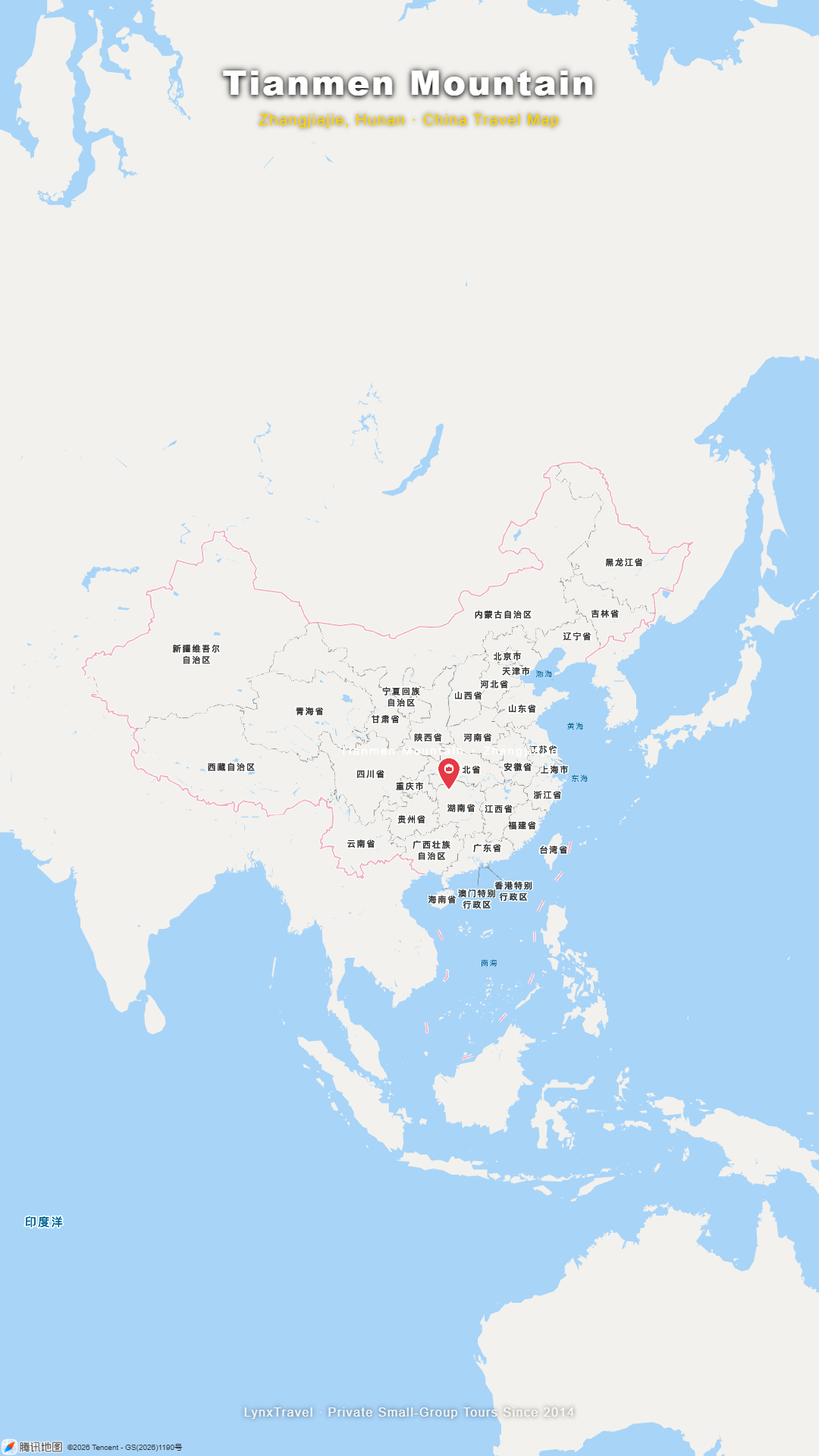
Tianmen Mountain sits in Yongding District, Zhangjiajie, Hunan Province — on the southern edge of the city proper, roughly 8 km from downtown. It's the signature landmark of Zhangjiajie, and its main summit, Yunmeng Xian Ding (the "Fairy Summit of Yunmeng"), tops out at 1,518.6 meters, making it the highest peak within Zhangjiajie city.
For international visitors, Tianmen has one advantage no other major sight here can match: it's practically inside the city. The cable car's lower station is downtown — a ten-to-fifteen-minute taxi from most hotels. You don't need the hour-long drive that Wulingyuan demands. If your Zhangjiajie itinerary only has a day or two to spare, Tianmen is the highest-value ticket on the board.
But there's a change in 2026 you need to know about before reading anything else, because it overturns most of what's written online. The upper section of the famous 7,455-meter cable car (mid-station to summit) stopped running on November 6, 2025 for a full overhaul and has not reopened since. The classic "ride the cable car straight to the top" experience no longer exists, and every summit route has been rearranged around that fact. The routes section below goes through it in full — and if you want the long-form local perspective on the mountain's classic experiences, the site also has a separate 20-year local expert's playbook for Tianmen Mountain; the two guides are built to be read together.
First There Was the Story, Then There Was the Cable Car
Tianmen is a mountain that accumulated its meaning long before anyone built infrastructure on it. Locals call it "the First Sacred Mountain of Western Hunan" and "the soul of Wuling" — and in local eyes it isn't just scenery. It carries something sacred.
The door that opened on a recorded date
The most widely accepted origin story comes with a precise timestamp. In the sixth year of the Yong'an era of the Wu kingdom (263 AD), a cliff face on what was then called Songliang Mountain suddenly split open, piercing the mountain north to south like a gate. King Sun Xiu of Wu took it as an auspicious omen, renamed the mountain "Tianmen" — the Gate of Heaven — and established Tianmen Commandery here. A mountain entering the written historical record because of a single geological event: that's rare even among China's famous peaks.
Folk versions are more romantic. In western Hunan, the story goes that a boulder on the mountain gathered the essence of heaven and earth until it burst open into today's cave; other tellings credit Guiguzi (a legendary strategist-sage) carving the gate, or a thunder god splitting it. There's also a detail almost every local guide will tell you: mist frequently pours out of the cave — locals call it "Tianmen breathing mist" — and legend says that anyone who catches forty-eight drops of the "plum rain" drifting from the cave will ascend to immortality. Guides usually add the same dry punchline: nobody has managed it yet.
The hermits
If you remember one thing about this mountain's history, remember this: Tianmen's story is, at its core, a long series of people walking up the mountain to withdraw from the world.
The earliest was Chisongzi (Master Red Pine), said to be the rainmaster of Shennong, one of the three sovereigns of ancient China. Legend places his alchemy and his pursuit of longevity on this mountain, and a whole string of place names up here still carry him: Danzao Peak (the "Alchemy Stove Peak"), Chisong Mountain, Chisong Ping, Chisong Village, Chisong Bridge, Chisong Pavilion, Chisong Cliff, and the Golden Water Pool. That last one is almost comically specific — about 1.3 meters long, 0.6 meters wide, and only a few centimeters deep, yet said to never dry out no matter the drought, because it's where the master drew his alchemy water. Danzao Peak itself is shaped like a stove, with a Thunder Cave and a Lightning Cave beneath it — the fire needed lightning to reach temperature, apparently. There's even a town on the mountain's southern slope that was originally named Chisong Ping; today it's been renamed Tianmen Town, and you can spot it from the summit. Stand in front of these little relics and you realize the legends aren't abstract. Local people pinned them to the ground, one place name at a time.
Chisongzi's influence ran straight into the Han dynasty. The Records of the Grand Historian has Zhang Liang — the great strategist who helped found the Han — declaring after his triumphs that he wished to "abandon the affairs of the human world and roam with Master Red Pine." The man he wanted to follow was the one said to be refining elixirs on this very mountain.
Then came Guiguzi — the Warring States-era teacher of Su Qin and Zhang Yi, patriarch of the entire school of political strategy. Legend has him following Chisongzi's path up the mountain. On a stone wall in the valley on the mountain's northern side there's a Guigu Cave, where he's said to have faced the wall studying the Book of Changes and written fourteen chapters. The Daoguang-era gazetteer of Yongding County describes it as "a secluded stone chamber with a clear stream below... seal-script inscriptions on the rock face"; another local chronicle adds that the cave hangs on an unclimbable cliff, and that a woodcutter who once stumbled in saw strange inscriptions and surging clouds. Folk belief insists Guiguzi didn't keep his arts locked in the cave — he came down to teach "Guigu divine skills," which is why the Guanliping area on the northern foothills is considered one of the birthplaces of Chinese hard qigong. A Qing-era county magistrate named Zhao Hengling summed the mountain up in one line: "Chisong's alchemy stove, Guigu's clear stream — long the dwelling places of immortals." And here's the practical footnote for your trip: when you visit Wulingyuan, the big evening show Charming Xiangxi performs the "Guigu divine skills" onstage — the legend is still a working act.
The temple above the clouds
By the Tang dynasty, there was a temple. Tianmen Mountain Temple — anciently called Yunbo Nunnery, Lingquan Abbey, or Songliang Hall — was first built at the very top of Tianmen Cave itself. The siting logic was elegant: a clear spring seeped through a rock crevice on the east side into a small pool, overflowed the cave mouth, and scattered into mist — the same "plum rain" from the legends. The temple took its name Lingquan ("Spirit Spring") from that pool. In the Ming dynasty, after the original site repeatedly suffered wind damage and water shortages, the temple moved off the east peak, and it later grew to nearly 10,000 square meters with thriving incense business. Locals summarized its layout in a rhyme: "three halls deep, six side rooms, brick walls, iron tiles, and a wok big as a workshop."
The lintel is carved with "Tianmen Immortal Mountain," and the gate couplet reads: "Beyond heaven there is heaven, and heaven is never dark; above the mountain there is no mountain, and the mountain stands alone" — attributed to Yefu, a general under the late-Ming rebel leader Li Zicheng. In August 1975, excavations at the old Lingquan Abbey site turned up a seven-star bronze sword inscribed "Ancestral Emperor of Tianmen Mountain Xuantian," along with four Tang dynasty bronze statues. Buddha and Daoism grew layered into the same mountain.
In the late Tang, a retired scholar named Zhou Pu lived in seclusion at Lingquan Abbey and left behind a poetry collection. And sixteen centuries after Zhou Pu — in 1997 — the famous Chinese singer Li Na came up the mountain, retreated from public life, and took Buddhist vows. The same mountain, a millennium apart, took in two different eras' worth of people who wanted to exit the stage. As for Yefu himself, his real weight in this mountain's story only becomes clear in the "buried treasure" section below.
A Century of Trying to Get Through the Door
The previous section was about people going up the mountain to leave the world. This one is about people going up to prove something.
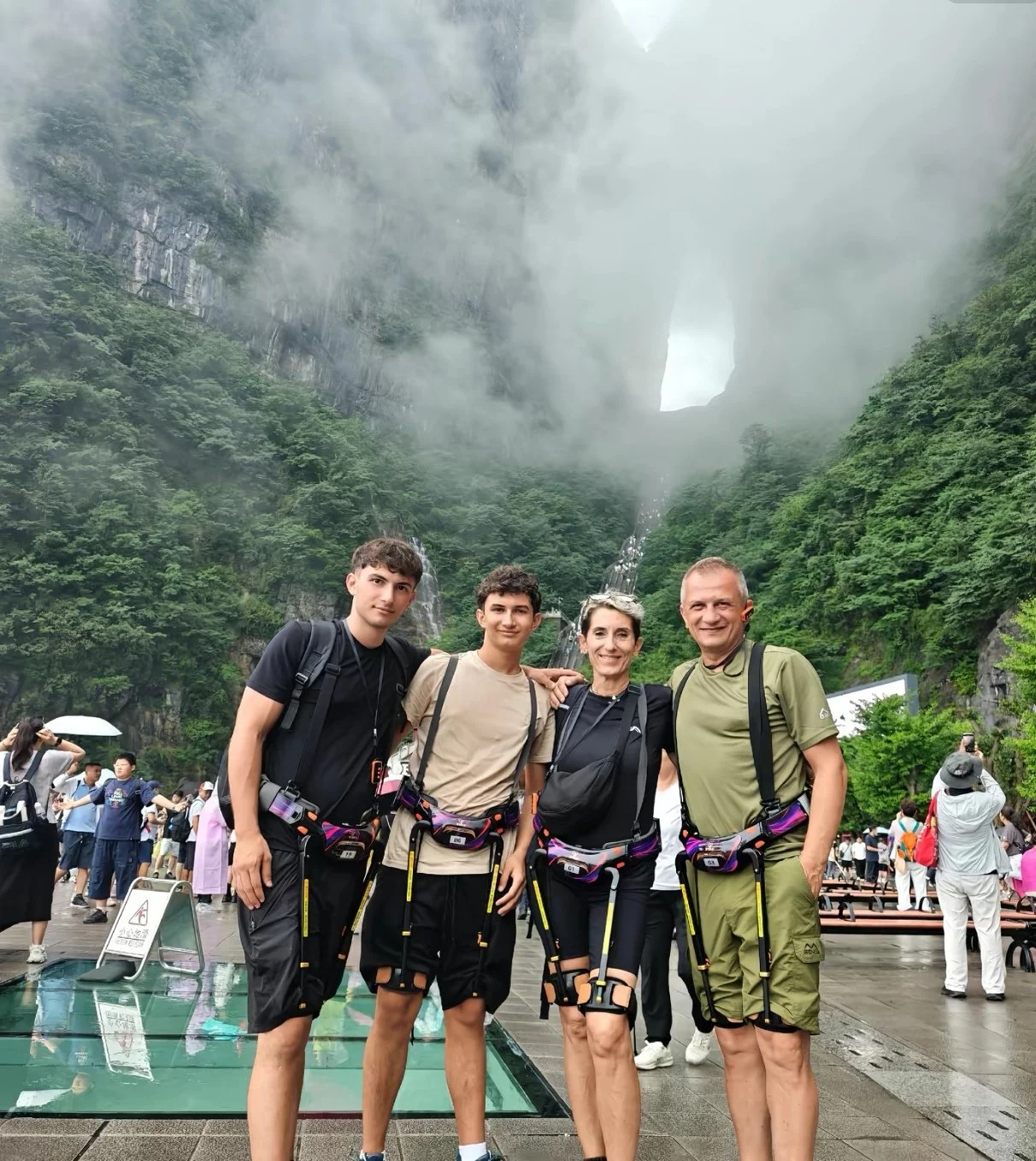
First, be clear about what the "door" actually is. Tianmen Cave sits at roughly 1,300 meters elevation: 131.5 meters high, 57 meters wide, more than 60 meters deep, piercing the mountain north-to-south through a near-vertical cliff — the world's highest natural cave that cuts clean through a mountain. It isn't really a "cave." It's a genuine hole through the sky: on a clear day, standing beneath it and looking up, the far end frames another piece of sky. Human instinct about doors is to want to pass through them. Tianmen's development history is simply a hundred years of different people trying to get through this one — first with their feet, then with machines, finally with their bodies and, once, a life.
Before 1999: only the climbers
Until 1999 there was exactly one way to reach Tianmen Cave: walk up from the base, on stone steps along what would later be engineered into the numbered "Tongtian Avenue" route. No road existed. Not many people made it, and most of those who did were local pilgrims.
December 1999: the first flight through
That winter, an event billed as "World Stunt Masters Fly Through Tianmen Cave" put the mountain on global news for the first time. Pilots came from Hungary, Russia, the USA, Kazakhstan, the Czech Republic, and Lithuania; the Hungarian aerobatics ace Peter Besenyei made the successful pass, the first time humans had flown aircraft through a natural cave. Contemporary reports put the live broadcast audience at 800 million, and the flight earned a Guinness World Record.
The aftermath mattered more than the event itself: Tianmen was now defined as "the door that can be flown through," and the world's challengers began lining up.
2005: a road that took seven years
Tongtian Avenue opened — the mountain road running from the base to Tianmen Cave, 10.77 kilometers long with 99 bends, seven years in the making. The engineering itself is the story: major mountain excavation work, nearly a kilometer of vertical gain, many sections carved directly into cliff faces. Construction began in 1998 and cost over 100 million yuan. It's been billed as "the most spectacular road wonder on earth," and affectionately nicknamed "the cake road" for its layered switchbacks.
One detail worth knowing before you ride it: on every bend whose number contains a 9 — the 9th, the 19th, the 29th, all the way to the 99th — a mythical guardian beast stands beside the road. That's a later design choice rooted in traditional Chinese fengshui numerology, and there's more on what those beasts mean below.
March 2006: the door has limits
A Russian air force aerobatic team performed at Tianmen. The original plan called for Sukhoi Su-27 and Su-30 heavy fighter jets to fly through the cave; the pass was ultimately abandoned as too difficult and too risky. The event still drew global media attention — but the real message was quieter: this door has a physical upper limit, and not everything can go through it.
November 18, 2007: not through — up
The French "Spiderman" Alain Robert climbed the rock walls inside Tianmen Cave with no safety equipment at all. He didn't go through the door. He grabbed its edges and pulled himself up it — a different answer to the same question.
September 24, 2011: the first human body through
American wingsuit pilot Jeb Corliss flew through Tianmen Cave in a wingsuit, no motor — widely treated as wingsuit flying's Chinese debut. The documentary that followed, Tianmen, later won Best Film at the 2013 Banff Mountain Film Festival. Twelve years after the airplanes, a human body finally did the same thing.
October 2012: it becomes a championship
The World Wingsuit League held its first championship at Tianmen, with 15 pilots from 9 countries. TIME magazine listed the event among its "25 best inventions of 2012."
October 8, 2013: the turning point
This was the heaviest day in the mountain's entire development history — and it's a day that domestic guides almost never write about.
That day, Hungarian pilot Viktor Kovács crashed during a test flight. He was an experienced wingsuit jumper with more than 700 jumps to his name and three national champion titles in skydiving. According to on-site reporting, his parachute failed to open; he went down on the cliff base near the mountain road's twentieth bend. The search and rescue operation lasted nearly 24 hours, involved around 200 rescue personnel, and getting his body down from a drop of roughly 350 meters took more than six hours. On October 9, the World Wingsuit League and the competing pilots held a memorial at the cliff edge.
The competition wasn't canceled — it ran October 11 to 13 as scheduled.
The meaning of that day isn't "Tianmen is dangerous." It's that a line was drawn: this door costs lives, and the line was drawn by the outside world, not by the scenic area. After 2013, Tianmen's appetite for extreme events visibly shrank; wingsuit and aviation events were never again scheduled at the 2011–2012 pace.
2019 and 2023: the door keeps answering
On November 14, 2019, the French "Jetman" pilot flew through the cave in formation wearing jet-turbine wing packs at roughly 385 km/h. On April 30, 2023, Chinese wingsuit pilot Zhang Shupeng threaded it at about 200 km/h — the first Chinese pilot to complete the flight. The same year, an unprotected highliner crossed a steel cable strung between two peaks, choosing once again to answer the door by walking above it rather than through it. Since then: rollerbladers, ice-endurance acts, a whole parade of people testing themselves against this mountain without going through the door. How many editions of the wingsuit world championship have actually been held here? Sources disagree — you'll find both 8 and 11 in circulation, and I won't pretend to settle it.
The two things that actually changed your experience
None of the stunts above changed what a normal visitor does. Two pieces of infrastructure did.
First, Tongtian Avenue, opened in 2005 — it turned a four-hour climb into a 30-minute park bus ride. Second, the Tianmen cable car, running since 2005: 7,455 meters long, once the world's longest high-altitude passenger ropeway, lifting you from the city center directly to the summit in roughly 28–30 minutes while the city and the hairpin road shrink below. The cable car became one of the mountain's most famous "attractions" in its own right.
Put bluntly: the extreme athletes went through that door with their lives on the line; you pay ¥285 and a steel cable carries you up. The distance between those two kinds of "getting through" is the entire story of this mountain's development.
⚠️ And right now, only 70% of that cable car is running. Details in the routes section below — this is the first thing any 2026 Tianmen guide needs to check.
The Mountain of Riddles: Six Unsolved Mysteries
Locals have another nickname for Tianmen: "the Riddle Mountain." The six most widespread puzzles — known as the Six Ancient Riddles of Tianmen — are the cave's opening, the mountain's flooding, its shifting face, Yefu's buried treasure, Guigu's apparition, and the auspicious beast. None has a convincing scientific explanation. Here they are, ordered by how much they tend to unnerve people.
The Opening of the Gate. The cave itself. Set into a kilometer-high cliff like a mirror hung in the sky, breathing out clouds, fog, and thunder in every season. Its formation is still debated — "funnel karst erosion" is one explanation, but the argument continues. A mountain opening a door in a year that's explicitly recorded in dynastic histories is, by itself, the biggest riddle on the list.
The Turning Waters. The most unsettling one. On the cliff to the left of Tianmen Cave, at 1,500 meters elevation, floodwater sometimes thunders out during drought seasons — the very seasons when it shouldn't. The waterfall has no findable source, and each episode lasts only 15 to 45 minutes. Locals have kept a tally: 1949, 1965, 1976, 1989, 1998 — every date sits next to a major upheaval or natural disaster in modern Chinese history. Folk interpretation treats it as a warning from heaven. Coincidence or something else, nobody can say.
The Shifting Face. This one you can verify with your own eyes. Seventy or eighty years ago, standing at the South Wharf by the river in downtown Zhangjiajie, you could see Tianmen Cave clearly. Stand in the same spot today and you see the mountain but not the door — you have to walk four kilometers to Dayongqiao Park to see it. And in recent years, residents of Guanping Town, a dozen-plus kilometers beyond Dayongqiao, report that the cave's visible angle keeps widening. The mountain, apparently, is still turning.
Yefu's Buried Treasure. The only riddle with a shadow of official history. Yefu was the monk's name taken by Li Guo, a top general under the rebel king Li Zicheng, who ordained after their defeat. The Guangxu-era gazetteer of Yongding County records: "In the late Ming, Yefu arrived at this mountain from Jiashan Temple; Yefu was of the bandit Li's remnant party — his affairs failed, yet he escaped Heaven's punishment." When Li Zicheng withdrew from Beijing he carried off a fortune in treasury gold and silver, intending a comeback; Yefu's move to Tianmen is widely read as relocating that treasure. Legend says he arrived with over a hundred men and horses and much wealth, traveling up the Lishui River in nine boats in secret; before dying he had the treasure scattered and hidden, then poisoned the laborers who'd done the burying. Treasure hunters have come for hundreds of years. Every one has left empty-handed. Yefu himself is buried at Gao Feng Mao An in Cili County.
Guigu's Apparition. In the 1980s–90s, a veteran from Chisong Village on the mountain's southern slope named Li Guangyu repeatedly rappelled into Guigu Cave on ropes. On one descent he photographed a side profile on the cave wall that resembled the sage Guiguzi — the facial contours clear, strikingly close to Guiguzi's traditional portrait. He returned to the same spot several times to photograph it again. Nothing, ever again. One appearance — chance, coincidence, or something else. That's the riddle.
The Auspicious Beast. Records describe a unicorn-like creature seen in the mountain's primeval forest: built like a tiger, entirely red, with a single curved horn rising from the center of its head, vanishing instantly whenever anyone approached — a figure that matches the auspicious-beast motifs of ancient Chinese art remarkably well. Forestry workers reported seeing it in the 1970s–80s. The animal was too alert to ever be photographed.
The beast is real — in one sense. You'll meet it on the mountain.
If you assumed the auspicious beast is pure legend, here's the twist: the park built it, in more than one place.
First, at the mouth of Tianmen Cave. Folk tradition holds that "a qilin guards the gate": a threshold runs across the cave entrance, watched over by guardian beasts on both ends. Complete the 999 steps of the Heaven-Linking Ladder, the story goes, and the beast greets you with a benevolent smile — cross the threshold and you've entered the immortal realm after all your trials. There's even a prescribed way to touch it: start at the tail and run your hand along the spine all the way to the head, for a life that keeps rising. So many people have done exactly that that the beast's front half is polished bright. Today you'll typically find a gilded guardian beast at the cave (some trip reports call it a Pixiu), often with local elders offering incense to the mountain god nearby.
Second, along the mountain road — and this one follows a rule. The legendary one-horned beast is said to be Guiguzi's mount, left behind on the mountain to guard it. So the park did something rather clever: on every bend of Tongtian Avenue whose number contains a 9, a one-horned guardian beast stands watch, from the 9th bend to the 99th, with a pair more flanking Tianmen Cave itself. This is worth noticing, because it isn't decoration — it's a narrative turned into physical form. Every "9" bend you round is a pass under guard. Look back after you've come down and you'll realize the whole road was strung together as one continuous story.
Every Major Sight, From Mid-Mountain to the Summit
These are ordered from mid-mountain upward, so you can string them into your route as you go. For each one, the point is what you'll actually see and feel standing there.
The cable car — the first "attraction" is the ride itself
Strictly speaking it's transport, but nearly every travel account treats the cable car as the mountain's number-one sight, so here it is.
Its most unusual feature isn't the length — 7,455 meters, once the world's longest high-altitude passenger ropeway — but the starting point: downtown. Guests have pushed open their hotel window and watched cable cars glide past outside. The lower station really is in the city. For the first kilometer or two the cabin drifts slowly over the city — past the bus station, the railway station, houses, vegetable plots, and streams; one rider described the odd sensation of "floating over people's laundry."
Then the buildings shrink inch by inch, as if sinking into the ground. Farther up, the view changes character entirely: the first half still shows you rooftops; the second half climbs straight into cloud — white nothing outside the window, the black silhouette of an opposite peak surfacing now and then. Plenty of people understand for the first time here that clouds can sit underneath you. One traveler wrote, "the clouds gradually slid beneath our feet as we rose, as if riding the mist"; another: "the fog wrapped the peaks — now like gauze laid gently over them, now like waves surging." There's a frequently quoted moment of a child beside the window whispering "Mama, the clouds are moving!" — and most adults in the cabin are silently agreeing.
Look down and the 99 bends of Tongtian Avenue coil beneath you like "an ochre rope." The cabin gives a distinct jolt at every support tower — a brief weightless dip. The final climb steepens to nearly 38 degrees; one rider said "it doesn't feel like a cable car, it feels like an elevator." The full ride runs about 28–40 minutes. One essayist's line may be the best summary anyone has managed: "The seven-kilometer cable is a harp string, flicking you from the human world up into fairyland." Or, more precisely still: Tianmen's charm isn't in "high." It's in floating — floating on cloud, floating in light.
Tianmen Cave — the heart of the mountain, and the only core sight not on the summit
It hangs at mid-mountain. Stand in the plaza beneath it, look up, and the first reaction is usually losing your sense of scale: a door 131.5 meters high and 57 meters wide, framing a whole block of blue sky, mist pouring continuously out of it, sheer cliffs rising on both sides. One visitor described it as "a mirror inlaid in the sky, flickering in and out of the fog." Another, standing under it, managed only: "all other mountains dwarfed."
In front of it are the 999 "Heaven-Linking Ladder" steps — 218 meters long end to end, about 120 meters of vertical rise, at a gradient over 37 degrees (some sections hit 41), five gentler stretches alternating with four steeper ones, laid out to mean "nine-nine returning to one." The three characters for "Heaven-Linking Ladder" are carved into the rock beside them. Locals map the ladder's five sections onto five blessings: fortune, prosperity, longevity, happiness, wealth.
Climbing it has a script. You start brisk. It steepens; you grab the railing. Around step three hundred, the laughter has turned to heavy breathing. One climber reported her legs "stopped taking orders" around step 700 — and that only when her fingers touched the cool rock at the cave mouth did it register that she had actually put all 999 steps behind her. People who make it tend to throw their arms up and cheer at the crowd above — a very pure, defeated-the-stairs kind of joy. The mountain wind hits right after, cool enough to make you laugh; sometimes a drip from the cave roof lands on your face.
If your stamina, knees, or traveling children argue against the stairs, don't force it: a seven-stage escalator bores through the mountain behind the cave — about 897 meters long and 340 meters of rise — which one grateful rider called "the existence worshipped from afar by every pair of trembling legs."
One detail most people walk past: below the cave mouth there's a small pool. On a clear day the sky, the clouds, and Tianmen Cave all reflect in it completely, red carp cruising through the image — "you can't tell which side is the real heaven," as one visitor put it. Before heading down, walk around to the pool and look.
Tongtian Avenue (the 99 Bends) — the roller coaster you didn't sign up for
10.77 kilometers, from about 200 meters elevation up to 1,300, with 99 bends — mostly 180-degree hairpins. Started in 1998, built over seven years, fully open in 2005, cost over 100 million yuan. "The most spectacular road wonder on earth," or less reverently, "the cake road."
The ride is closer to a roller coaster than a bus trip: the vehicle swings and pivots, sometimes skimming the cliff-side guardrail, centrifugal force shoving you sideways, the cabin full of shrieking. One passenger said the driver turned the wheel "like a Shandong cook flipping a crepe"; another said the bus "danced a waltz across the ballroom floor"; a third compared it to watching F1. Coming down, about 20 minutes takes you from over a kilometer of altitude to the 200-meter valley floor.
There's a stark contrast in the cabin: passengers white-knuckled, drivers serene. The park hires veteran specialists, and visitors routinely marvel that they're "not a bit worse than professional racers." One rider got off, discovered the driver was a woman, and wrote an entire review about what it must be like to drive this road twice a day.
⚠️ The motion-sickness risk here is real and frequent. One account: "halfway up, three people on the bus were already looking for sick bags." Practical defenses: fasten your seatbelt, keep a sick bag at hand, sit front-row by the window and look at the far horizon (staring at near scenery is what does you in). The rapid altitude swing can pop your ears — swallowing helps. If you're prone to motion sickness or traveling with elderly people or young children, seriously consider Route C, which skips this road entirely.
One more fact worth knowing: private cars aren't allowed on this road at all. You ride it only on the park's own shuttle buses with their staff drivers.
The 7-stage through-mountain escalator — the ride that now decides everything
An indoor escalator system hidden inside the mountain itself: seven stages, roughly 897 meters long, 340 meters of elevation, linking Tianmen Cave with the summit. Since November 2025 this is the critical link for reaching the top, and it's included in your combo ticket — no extra payment. There is a genuinely confusing second escalator people constantly mix this up with; the tickets section untangles it, because this is where money gets wasted.
Guigu Plank Walk — hanging off the middle of a cliff
On the west line, named for running along the cliffs above Guigu (Ghost Valley) Cave. It runs 1,600 meters at an average elevation around 1,400 meters, starting at Yihong Pass and ending at Little Tianmen. What sets it apart from most walkways: the usual plank path hugs the base of a cliff, while this one travels along the middle of a sheer face — from a distance it reads as a giant snake wrapped around the cliff. Underfoot, "a bottomless valley; it stunned me just to look," as one visitor put it. In fog you walk on cloud; when the wind picks up, mist pours over the rim like a waterfall. On lucky clear mornings after rain, you may even catch a "Buddha's light" — a rainbow ring around your own shadow on the mist. One reviewer said the views here were "so overwhelming my fear of heights forgot to be afraid."
The Glass Skywalk — sixty meters of honesty about yourself
Off the Guigu Plank Walk, about 500 meters in, a junction leads to the glass skywalk: 60 meters long, its highest point at 1,430 meters, floor fully transparent, nearly 400 meters above the valley floor — among the highest glass walkways in China.
What fear actually looks like here is worth knowing in advance. People step on, look down, and break out in a cold sweat — calves trembling, feet numb, heart pounding. Some press themselves against the rock wall and inch along; some crawl; some take three careful steps and back out. On the walkway, "some laugh, some cry, some wear frozen expressions, some stroll along fine." One father, too afraid to cross, took the inner stone path and waited for his family on the far side.
The good news: a normal stone path runs alongside, and nervous walkers can bypass the glass entirely. The advice from veterans is also genuinely useful — don't look down; look ahead and walk, and it's fine. Keep to the mountain side, and don't linger for photos at windy corners.
Two practical notes: you wear shoe covers on the glass (about ¥5), and the walkway closes in rain, heavy fog, or ice. Some visitors also grumble that with so many feet crossing it, the glass has gone semi-opaque — "the thrill is watered down." And per multiple trip reports there are actually three glass-style walkways on the mountain — east line, west line, and one on the Panlong (Coiling Dragon) cliff — and walking one or two is plenty.
Yunmeng Xian Ding (Fairy Summit) — the top of the top
The main peak, 1,518.6 meters, the highest point in Zhangjiajie city. Sheer on three sides, looking down over the whole urban area and the surrounding ranges — the mountain's first-choice spot for cloud seas and panoramas. A small forest sightseeing chairlift gets you there for ¥25 one way.
Tianmen Mountain Temple — the "Heavenly Buddhist Realm" on the southern summit
The heart of the summit's Buddhist zone and a significant temple for western Hunan, with the Heavenly Kings Hall, Mahavira Hall, and Guanyin Pavilion all on site. Its history runs deeper than most visitors guess — founded in the Tang dynasty under its old names Yunbo Nunnery / Lingquan Abbey / Songliang Hall, first built at the top of Tianmen Cave itself, then relocated in the Ming after wind damage and water shortages. (Online sources still split between Tang and Ming founding dates; this guide follows the "founded in Tang, relocated in Ming" account.) The lintel reads "Tianmen Immortal Mountain," and that gate couplet — "Beyond heaven there is heaven, and heaven is never dark; above the mountain there is no mountain, and the mountain stands alone" — is attributed to Yefu, the same man from the buried-treasure riddle.
Tickets: Prices, What You're Actually Paying For, and the Two-Escalator Trap
This is where international visitors get stuck most often, so this section runs long on purpose.
Current prices (checked September 2026)
Adult combo ticket (same price on all three routes): ¥288 through booking channels; ¥285 is the official posted price. The ¥3 gap is bundled park insurance.
Seniors aged 60 up to (not including) 65: ¥152 / ¥149 official — valid ID required.
Seniors 65 and over: ¥116 / ¥113 official — valid ID required.
Students (full-time, undergraduate and below): ¥152 / ¥149 official — student ID required.
Youth concession, ages 14 up to (not including) 18: ¥152 / ¥149 official — valid ID required.
Children under 14: free — no base ticket charge, but you must collect the ticket at the staffed window.
Every discount tier shows the same ¥3 gap in the same direction, which is the signature of channel-bundled park insurance. Book through the official channel and you keep the ¥3.
You'll see three prices online. Here's why none of them is "wrong"
Chinese-language guides simultaneously quote 285, 288, and 278. They're not contradicting each other:
¥285 is the official listed price, reportedly backed by government pricing approvals (Xiang Fagai Jia Fei [2025] No. 517, Zhang Fagai Jia Fei [2025] No. 57).
¥288 is 285 plus ¥3 insurance — the actual transaction price on Ctrip/Trip.com, Qunar, and most channels. This is what the overwhelming majority of visitors actually pay.
¥278 is the pre-renovation price or a quote excluding insurance. It is not the September 2026 price, no matter how recent the article looks.
What the combo ticket actually contains
The park's published component pricing adds up to ¥302: base entry ¥72 + one-way lower cable car segment ¥54 + the 7-stage through-mountain escalator round trip ¥84 + one-way shuttle bus ¥16 + the Tianmen Cave fast cable car ¥76.
Because the cable car's upper section is out of service, the lower cable car segment and the park shuttle are both running at half price (cable car ¥108→54, shuttle ¥33→16). But the combo ticket still sells at the pre-renovation ¥285 official rate — the park is absorbing the difference itself.
For reference, individual posted prices: base entry ¥72; Tianmen cable car one-way ¥108; Tianmen Cave fast cable car one-way ¥76; 7-stage escalator one-way ¥42; road shuttle one-way ¥33.
⚠️ Two escalators. People mix them up constantly.
This is the single most error-prone fact in Chinese-language guides, and a recurring source of complaints. There are two different escalators:
The 7-stage through-mountain escalator (Tianmen Cave ↔ summit): ¥84 round trip, already included in your combo ticket. Pay nothing extra.
The "stair-climbing" escalator (below Tianmen Cave, next to the 999 steps): ¥32. This is the one that costs extra — it simply substitutes for climbing the 999 steps.
The widespread online claim that "the escalator costs an extra ¥32" refers to the second one. Reviews are full of confused visitors — one complained that "the elevator ticket included with admission is for the second segment; without buying the first segment you can't ride at all," which is precisely this mix-up. Simple version: the escalator to the summit is in your ticket; the cave's escalator is optional — climb the 999 steps for free, or pay if your legs would rather not.
Other optional spends on the mountain: the forest sightseeing chairlift to the Fairy Summit (¥25) and glass walkway shoe covers (around ¥5).
Booking as a foreign passport holder
Yes, you can book online with a passport. Tianmen runs real-name, time-slot reservations, with each ticket bound to a passport number and an entry window.
Ticket collection is at the staffed counter. Foreign passport holders must go to the group-sales window (a human counter) on the day, present passport and order number to collect or activate the ticket. Self-service machines won't work for you. Follow on-site signage for the specific window number.
Bring the physical passport. Entry requires the original document plus a facial-recognition registration; after that you can use the face-scan lanes for the rest of the visit. The name and passport number you book with must match the document exactly — photocopies, photos, or digital copies are not accepted.
Book ahead. One to three days out is usually fine; in peak season (March–October, summer holidays, Golden Week) book a week or more ahead. Same-day walk-up tickets are frequently unavailable in high season.
Official channels: the "Zhangjiajie One-Stop Travel" (Zhangjiajie Yi Ji You) mini-program and the official "Zhangjiajie Tianmen Mountain Scenic Area" WeChat account. Both are Chinese-language only, paying via WeChat Pay or Alipay. English interfaces exist on Klook, GetYourGuide, and Trip.com, but expect to pay roughly 20–45% more, and note they still require real-name passport booking. Or skip the interfaces entirely: book our Tianmen Mountain day tour and send us your passport details — we handle the real-name booking for you (same passport requirement, none of the Chinese-app friction).
Don't buy "discount tickets" from unauthorized vendors outside the gate. Counterfeit tickets that fail at the turnstile are a real, documented problem.
Paying for things
China's mobile payments have gotten genuinely friendly to foreign visitors. Before you leave, install Alipay and WeChat, bind your Visa / Mastercard / JCB / Discover card inside the app, and complete passport verification. Small transactions under ¥200 are generally fee-free; above that, expect a service charge of around 3% on foreign cards. Carry a modest amount of cash as backup — but don't lean on physical Visa/Mastercard alone, because plenty of small merchants won't take them. Our complete payment guide for foreign travelers walks through the whole setup step by step.
The visa situation, briefly
Zhangjiajie Hehua International Airport is one of the approved ports of entry for China's 240-hour (10-day) two-way transit visa-free policy, in effect since December 2024 — you'll need an onward ticket to a third country. Separately, China grants unilateral 30-day visa-free entry to ordinary passport holders from around 50 countries; the current policy window runs through December 31, 2026 (for Russia, through December 31, 2027). The United States is not on the 30-day list — US citizens use the 240-hour transit option or obtain a visa in advance. Our China visa-free guide for 2026 covers who qualifies and how, and the official English site of China's National Immigration Administration (en.nia.gov.cn) is the authoritative source for current rules.
⚠️ Visa policy changes frequently. Before you fly, confirm against the latest announcements from the National Immigration Administration or the Chinese embassy or consulate in your country.
Getting There
The cable car's lower station is on Dayong Road, Yongding District — in the city itself. That's Tianmen's single biggest geographic advantage, and it makes arrival logistics almost embarrassingly easy:
From Zhangjiajie West Railway Station (high-speed rail): bus routes 4 or 17, about 30–50 minutes, ¥1–2. Taxi, about 15–20 minutes, ¥20–40 (sources disagree on the fare). Coming in from another city by rail? Our 2026 train guide for foreign tourists explains tickets, stations, and what to expect on board.
From Hehua International Airport: bus route 4, ¥1–2. Taxi, 12–15 minutes for the roughly 5 km, ¥20–30.
From Zhangjiajie Station (conventional rail): taxi, 5–10 minutes, ¥6–8.
From anywhere downtown: bus routes 1, 4, 10, 13, or 17 — get off at Wulingshan Zhen'guan (Wuling Mountain Rare Objects Hall) stop. ¥1–2.
For taxis, use Didi or Amap (Gaode) — both have English interfaces. Read our breakdown of Didi vs. taxis and the hidden costs before you ride. Ignore anyone at the station gates offering "shuttle services" or unmarked cabs.
International flights
For the 2026 summer-autumn season, Zhangjiajie Hehua International Airport schedules 13 direct international routes across 8 countries and regions, roughly 100 international passenger flights a week. South Korea is the densest market — Seoul (Incheon), Busan, Daegu, Cheongju, and Jeju — with steady Southeast Asia service to Ho Chi Minh City, Bangkok, Jakarta, Penang, and Singapore, among others.
Here's a number that puts things in perspective: of all travelers passing through Zhangjiajie's border inspection in the first half of 2026, 91.5% were foreign nationals, and summer 2026 inbound arrivals grew 197% year-on-year — the fastest of any Chinese city. Translation: meeting other foreign travelers here is the norm, not the exception. We covered the official inbound tourism data in depth here, and the city's new inbound routes and policy measures here.
The Big Change: The Cable Car Is Only 70% Running, and Every Summit Route Now Doubles Back
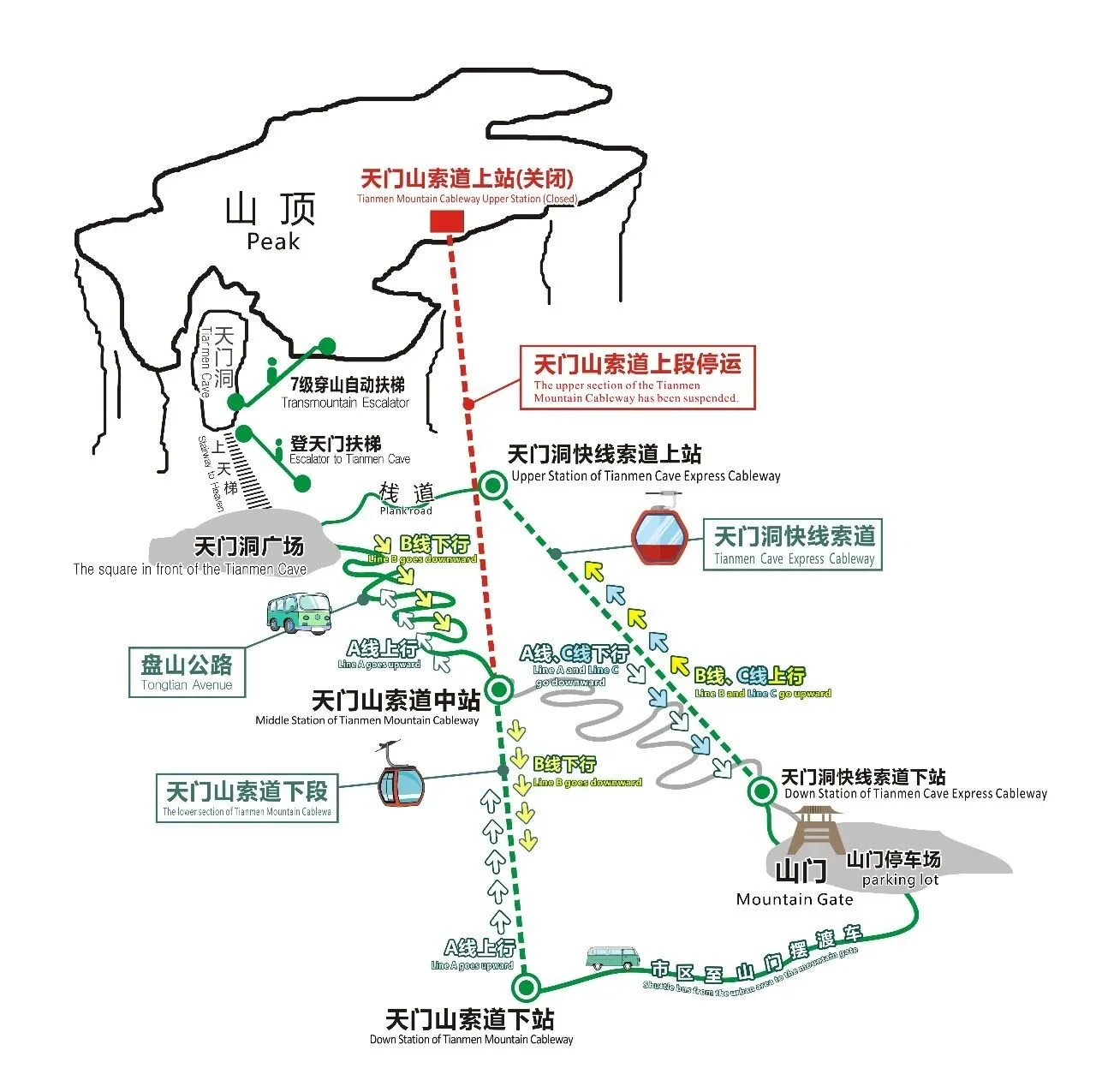
Since November 6, 2025, the upper section of the Tianmen cable car (mid-station to summit station) has been out of passenger service and is being dismantled for rebuild. Only the lower section (downtown station to mid-station, about 5,300 meters — roughly 70% of the original run) still operates. The official line on reopening is that it depends on construction progress and will be announced separately. The publicly listed government key-project schedule runs the cable car upgrade through December 2027 — treat that as a planning horizon, not a reopening date.
The direct consequence: the old Route A's most celebrated feature — a full loop with zero backtracking — no longer exists. Getting to the summit now always involves doubling back at some point.
Also suspended: one-way cable car Lines 1 and 2.
Route A — the classic, now with a built-in return trip
The flow: board the cable car at the downtown station → ride to the mid-station → transfer to the park shuttle for the 99 Bends road up to Tianmen Cave → take the 7-stage escalator to the summit → retrace on the escalator back down to the cave → take the Tianmen Cave fast cable car down to the mountain gate → shuttle bus returns you to the city. This is the full-panorama route — and the one with the longest queues going up.
Route B — the off-peak pick
The flow: enter at the mountain gate → fast cable car up to Tianmen Cave → escalator to the summit → back down the same way → park shuttle down to the mid-station → cable car down to the city. Usually half the queue time of Route A. If you want the summit and the cave without the crowds, this is your line.
Route C — no big cable car, no mountain road
Here the routine shrinks to: mountain gate → fast cable car up to Tianmen Cave and back, that's it. No big cable car, no 99 Bends. Built for seniors, young children, and anyone who gets carsick — the trade-off is you skip the 7,455-meter city-to-mountain cable car experience entirely.
Route B riders returning to the Tianmen Cave plaza can, if they'd rather not take the shuttle to the mid-station, voluntarily switch to the fast cable car down to the gate (same as Route C).
The weather cutoff
In ice, heavy fog, or severe rain, when the mountain road can't be guaranteed safe, the shuttle between the mid-station and Tianmen Cave stops running, and Routes A and B temporarily switch to Route C's transport plan.
Read that again: buying an A-line ticket does not guarantee you'll ride Route A that day. If you're visiting in the rainy season or winter, walk in with that expectation set.
Hours
From August 31, 2026: ticket sales 7:30–16:00, operations begin 8:00. To dodge the queues, be at the gate before 7:30. Multiple visitors report that catching the first slot keeps waiting under ten minutes — and that by 9 a.m. the lines balloon fast.
Tianmen and Zhangjiajie National Forest Park Are Different Parks
Zhangjiajie National Forest Park (Wulingyuan) and Tianmen Mountain are two separate areas, 30–40 km apart, 40–60 minutes by car. Do not try to do both in one day. Each deserves its own full day — our Zhangjiajie Forest Park guide covers the other one properly.
Where to Stay
Pick your base first, then pick your hotel
The cable car station being downtown decides the whole strategy:
Mainly here for Tianmen, or catching an early train/flight: stay downtown. City hotels run roughly 30–40% cheaper than the Wulingyuan area, and the Dayong Fucheng food street and the Qishiqilou (72 Wonders Building) night market are both walkable.
Mainly here for Wulingyuan / the National Forest Park: stay near the Wulingyuan landmark gate and save yourself 1.5–2 hours of daily commuting.
Doing both: the classic split is one night downtown plus one or two nights in Wulingyuan.
One more thing: on-mountain summit lodging was fully cleared out in 2018. You cannot sleep inside the scenic area.
⚠️ Foreign passport holders: confirm the hotel can actually take you
This one matters: not every hotel in China is licensed to host foreign guests. Budget hotels and guesthouses without the registration capability will refuse your booking outright. When booking, check the property's guest policy in the listing, or enter your nationality honestly at booking time and let the platform filter.
These properties explicitly accept foreign guests or offer English service (information current as of 2026):
Pullman Zhangjiajie (Wulingyuan) — Accor-managed, listing explicitly states it welcomes guests from all countries; high share of foreign guests.
Zhangjiajie Zhenmian International Hotel — policy states it accepts guests of all nationalities; airport transfers available.
Vienna International Hotel (Tianmen Mountain branch) — 105 rooms, refreshed and reopened July 21, 2026, with its foreign-guest reception capability specifically highlighted in coverage of the reopening.
Zhangjiajie Lantian (Blue Sky) Grand Hotel — four-star, explicitly designated a foreign-guest hotel; passport check-in.
Wulingyuan Hotel — Wuling Avenue, Wulingyuan; about a 3-minute walk to the core park entrance.
Tianmen Boutique Hotel (Yongding District) — free transfers, English service, close to the cable car station; equipped with Chinese-English translation tools and staff who help with ticketing.
Sky Realm Grand Hotel (downtown) — on-site English service and currency exchange.
Near the cable car station / Dayong Old Town: the real feedback
The following comes from actual reviews on Chinese and English booking platforms. On the Chinese platforms, the complaints cluster around noise insulation, cleanliness gaps, cigarette smell, dated facilities, and missing elevators.
Consistently solid (9+ scores, few negative reviews):
Tianyi Hotel (Tianmen Mountain Cable Car branch) — just over 300 m from the start of all three routes; large, clean, quiet rooms with good soundproofing, cable car views, luggage storage.
May's Home Designer Guesthouse (Cable Car Station / Dayong Old Town) — about 1.3 km from the cable car; the host will book your park tickets for you.
Meiyi Light-Luxury Guesthouse (Dayong Fucheng branch) — about a 10-minute walk to Dayong Old Town.
Frequently criticized (avoid or go in with eyes open):
7 Days Inn (Dayong Old Town / Cable Car Station branch) — repeated complaints of heavy cigarette smell, standing water and slow drainage in bathrooms.
Shell Hotel (Cable Car Station / Dayong Old Town) — cleanliness problems raised again and again.
Home Inn (72 Wonders Building branch) — listed renovation year doesn't match reality; wall-mounted AC blowing directly at the bed; standing water in the shower.
Borui Courtyard Hotel (Cable Car Station) — no elevator, poor soundproofing, small flying insects at night.
Booking pitfalls worth knowing
Treat "free pickup" promises with suspicion — there are reports of drivers taking long detours.
Beware "¥0 reservation" listings; the difference often gets collected at check-in.
"Close to the National Forest Park" is not the same as close to the entrance you're actually using. Check the exact gate and walking distance on a map before paying.
To judge whether reviews are real, read the criticisms inside five-star reviews — review-farming produces uniform perfect scores, while genuine problems surface in the middle ratings.
Prefer properties opened or renovated after 2020.
Reference prices: downtown budget hotels around ¥140–180; mid-range ¥250–300 with breakfast; upscale ¥350–500. Peak-season surcharges are significant — Wulingyuan can climb 30–50%.
The People of the Mountain: This Isn't Han Territory
For many foreign visitors this turns out to be the most valuable section in the whole guide — because it explains why everything you eat, hear, and see after you come down the mountain looks the way it does.
The counterintuitive fact: Han Chinese are the minority here
Zhangjiajie's sixth national census (2010) put ethnic minorities at 75.28% of the city's population. Walk out of the Tianmen cable car station into downtown and you are, statistically, in a city where Han people are the minority. This isn't a performance laid on for tourists — it's daily life here.
The main groups:
Tujia: 66.43% of the city — about 980,852 people (2010). The region's original inhabitants.
Bai: 6.45% — about 95,235 people.
Miao: 1.62%.
The city also has 12 ethnic townships: seven Tujia, five Bai.
The Bai of Sangzhi: a 700-year-old story that reads like a novel
Zhangjiajie's Sangzhi County has five Bai townships and roughly 95,000 Bai people. But the Bai people's ancestral homeland is Dali, in Yunnan — over 1,000 kilometers from Zhangjiajie in a straight line, around 1,500 kilometers by the routes anyone actually walks. How did a Bai population end up in Hunan?
The timing is late Southern Song into the early Yuan dynasty. The Bai armies of the Dali kingdom — forces known as the "Cunbai Army" — marched north and east with the Mongol war machine; when the fighting ended, some of those soldiers were disbanded where they stood and settled in western Hunan. The recorded early ancestors bear names like Gu Junwan, Wang Pengkai, and Zhong Qianyi, and the places they put down roots are today's Furongqiao, Mahékou, and Maidiping districts.
Fast-forward: today's Hequn Village in Furongqiao Bai Township is 97% Bai — one of the most concentrated Bai villages anywhere outside Yunnan. In the 1980s, Hunan's ethnic affairs commission investigated and formally confirmed that the Sangzhi Bai and the Dali Bai share one origin. And in 2012, Hequn Village and Zhoucheng Village in Dali became sister villages — seven hundred years after the split, the two branches of the same people reconnected.
What they carried wasn't just bloodline but an entire culture. The Zhanggu Drum Dance is the shared national-level intangible cultural heritage of these seven Bai townships — its moves descend from Dali's Bazhawhip and octagonal-drum traditions, yet after seven centuries in Hunan it has grown into something distinctly local. A sentence for the foreign reader: the Bai people you see in Zhangjiajie are a branch that left Dali 700 years ago and survived on its own in the Hunan mountains. Their speech, their dance, their houses have all drifted from Dali's — but the genealogy still connects.
The Tujia: the actual hosts
If the Bai are the branch that arrived, the Tujia are the people who were always here.
The Hand-Waving Dance (Baishou Wu) is the Tujia signature — in the Tujia language, "Shebari," a national-level intangible cultural heritage. Its hallmark move is waving hands and feet on the same side, which looks awkward until you see several hundred people doing it together and the whole plaza undulating like water. Every first lunar month, Tujia villages hold the "Baishou Tang" gathering — days of dancing at a stretch.
Xilankapu is Tujia brocade, two thousand years old and also nationally listed. In Tujia speech "xilan" means bedspread and "kapu" means flower — "a flowered bedspread." It's woven on an ancient waist loom, pattern-side down, and a single complex piece takes months. Museums and workshops around Zhangjiajie still demonstrate hand-weaving — nothing like the machine-woven scarves in the souvenir stalls.
Diaojiaolou are the Tujia houses: wooden, suspended on stilts, cantilevered layer by layer — and the most refined form, the "corner-turning tower," is built without a single nail. There's an old Tujia saying that doubles as a structural engineering review: "Folk songs are easy to sing but hard to begin; a carpenter struggles to raise a corner-turning tower."
Maogusi is called "the living fossil of Chinese theater" — a primal drama performed during the Hand-Waving gatherings, performers draped in straw, mimicking the ancestors' hunting and farming, the movements so coarse they can be traced straight back to antiquity. Scholars argue about its age (one claim says six thousand years), but its rawness is genuinely rare.
The Tima are the Tujia shamans and priests, within the Nuo worship tradition. The three great bodies of Tujia folk literature — the Tima Song, the Baishou Song, and the Weeping-Marriage Songs — all survive through the Tima's oral transmission.
Weeping marriage is the Tujia wedding custom: the bride begins crying and singing seven to ten days before the wedding — thanking her parents, scolding the matchmaker, saying goodbye to her sisters. By Tujia logic, the longer and hoarser she cries, the deeper her love. You can still encounter it in some western Hunan villages, though it's growing rare.
Guonian ("the early year") is the Tujia's most important festival: they celebrate New Year one day before the Han calendar date. The origin story has Ming-dynasty Tujia soldiers ordered off to war before New Year's Eve, with their families feasting them a day early — and the custom never stopped.
Where to actually see this (not just the stage version)
Zhangjiajie Tujia Folk Customs Park — the concentrated option:
Rating: national 4A scenic area
Location: Dayong Road, Nanzhuangping subdistrict, Yongding District — only about 10 minutes' drive from both the airport and the railway station. Closer than Tianmen Mountain.
Hours: 08:30–18:00
Admission: ¥165
Buses: routes 5 or 10
What you get there:
The Baishou Hall: Hand-Waving Dance performances daily at 11:00 and 15:00 — visitors are pulled in to dance along.
The Xilankapu workshop: hands-on weaving. You work the loom; it isn't behind glass.
"Tusi Dynasty": staged daily at 10:30 and 14:30, dramatizing western Hunan's chieftain (tusi) history.
The Nine-Heavens Diaojiaolou: an entire mountain-clinging stilted complex built without nails — a Guinness World Record holder.
Good fit if you want the core of Tujia culture covered thoroughly in half a day.
Dayong Old Town — on the sixth day of the sixth lunar month, the town holds the Tujia "June 6th" festival. If your dates line up, this is the most alive Tujia experience available: not a show, but local people celebrating their own holiday.
The one-line decision rule: concentrated viewing, pick the Folk Customs Park (¥165, 2–3 hours); free and on your way, pick Xibu Old Street; hunting the festival, aim for lunar June 6th.
That cup of "mei tea" you'll be offered — also Tujia
The food section below covers mei tea (berry tea) in full; the background belongs here. Its core growing area is the Maoyan River zone of Zhangjiajie, and it was a Tujia drink long before it was an industry — the Tujia call it "the Tujia sacred tea" or "longevity vine." The widespread legend: in the Ming era, the Tujia leader King Qin Hou rose against the court; defeated, his people retreated into the deep mountains and survived on a wild vine gathered there, eating it as food and medicine. That vine became mei tea, and that's why the Tujia treat it as sacred. (⚠️ The uprising's year is given as both 1370 and 1379 in different sources, and the legend is folk narrative — treat it as story, not history.)
The actual industry is post-1993: the forestry scientist Huang Hongquan documented the plant (formal name Ampelopsis grossedentata, commonly vine tea) around the Maoyan River, and the press later dubbed him "the father of mei tea." A centuries-old Tujia legend and a multi-billion-yuan modern supply chain, joined at the same leaf.
What to Eat
Zhangjiajie cooking belongs to the Tujia branch of Hunan cuisine — heavy on cured meats, sour notes, and chili. Downtown, ¥30–70 per person buys a genuinely good meal. Food inside the scenic area is markedly overpriced; eat in town and carry a few snacks and water up the mountain.
Sanxiaguo — the dish this city is known for
Zhangjiajie's signature dish. Choose several from pork intestines, pork belly, cured pork, beef tripe, lamb tripe, and pig trotters, stewed together in one pot — dry-pot or soupy, both work. Expect numbing-spicy, cured, rich flavors, traditionally served with pickled radish and fried tofu to soak up the sauce. The traditional preparation is listed as Zhangjiajie municipal intangible cultural heritage. A pot runs ¥30–50, and ¥40–50 per person downtown leaves you stuffed.
Where locals actually send you: Gong Popo Tu Chu (cable car branch), directly across from the Tianmen cable car station, ¥30–49 per person — the most convenient option if you're sleeping downtown; Hu Shifu Sanxiaguo (Fengwan Bridge / Sanjiaoping area); Lao Nongcun Home Cooking's sanxiaguo (pedestrian street branch); and Fu Zhengyi Sanxiaguo in Wulingyuan, slow-cooked in a heritage iron pot.
Other Tujia dishes worth ordering
Rock fungus stewed with free-range chicken — rock ear fungus was a Ming-Qing tribute item; slow-stewed with village chicken, the broth is clean and deep.
Dagupi (drum-skin beef) — the skin-on meat from between the ribs of western Hunan yellow cattle, flash-fried with mountain pepper; crisp, springy, and the local first choice to accompany liquor.
Also in rotation: kudzu root stir-fried with cured pork, blood tofu, hezha (soybean mush), and Tujia steamed pork.
Cheap eats
Lamb-offal rice noodles — made from local selenium-rich rice with a cured-meat topping, around ¥13 a bowl.
Pig-head cold noodles — braised pig ear, shredded kelp, and peanuts in sour soup with litsea oil, around ¥18.
Straw-hat noodles — around ¥5.
Haozi baba — soft, fragrant glutinous rice cakes with wormwood, sold all over the streets.
Mei tea — the local cup you'll be handed everywhere
You'll meet it at every turn: hotel lobbies, gift shops, relatives' toasts. It's a vine-gathered tea (high in flavonoids, notably bitter-then-sweet), grown at 800–1,300 meters in the Maoyan River area, and as the ethnic section above explains, it started as the Tujia's own "sacred tea" centuries before it became a packaged industry. Buy a small tin as a souvenir — it brews pale and tastes unlike any green or oolong you know.
Where to hunt: Huilong Road Food Street (downtown's main eating strip), Xinfeng Food Street (mostly local snacks, around ¥50 per person), Sanjiaoping (the old guard of sanxiaguo restaurants), and Dongmenqiao Night Market (open-air stalls, wallet-friendly prices).
⚠️ If offal isn't your thing, just tell the sanxiaguo kitchen to use only cured pork and trotters. They'll accommodate — they hear it all day.
How to Actually Plan Your Day
Before you go
Check the cable car status. Re-check the park's official WeChat account or mini-program for the latest announcement on which routes are running and whether hours have shifted.
Lock in your real-name reservation. Three to five days ahead; a week or more in peak season. Tickets bind to your passport number and an entry time slot.
Pick the right route. Most visitors pile onto Route A; Route B usually cuts queue time in half. Traveling with seniors or kids, or prone to carsickness? Take Route C and don't look back.
Go early. At the gate before 7:30. This is the single most effective queue-reduction tactic. Nothing else comes close.
Bring a jacket. The summit runs 6–8°C cooler than town, and it's windy. Waterproof shell if rain is forecast.
Wear grippy sneakers. Fog and wet stone steps are constant; heels are a bad idea.
Carry some water and snacks. Mountain prices run 5–8 times downtown rates.
When you arrive
Foreign passports: go to the staffed ticket counter first to collect or activate — don't queue for the machines.
Entry requires the original passport and a facial-recognition registration.
During peak periods the park enforces entry by time slot strictly. Show up on your slot — arriving 30 minutes early is the safe play.
How long to budget
Five to six hours is the comfortable full experience. Trip reports put 4 hours 15 minutes at "rushed" and 2–3 hours at "cursory." Worth understanding: the summit itself is not a hike — the top loop is flat and paved, and the mountain's interior has escalators. The only genuine physical test on the whole site is the 999 steps at Tianmen Cave, and an escalator substitutes for those. So the mountain asks little of your legs and a great deal of your queue patience.
Scams and traps
"I can take you through the fast lane" — no. There are reports of guides privately selling queue-jumping, but the park has no such lane. Ctrip and similar platforms do sell an official "combo + fast channel + lounge" product (adults around ¥438) — if skipping lines matters to you, that's the legitimate route.
Shoe-cover vendors at glass walkway entrances overcharge; use the park's own covers.
"Special price" and "insider" tickets sold outside the park are high-risk. Book official or authorized only.
Eat downtown; mountain prices punish everyone.
Bad weather closes the glass walkway. Check the forecast — going up in fog and seeing nothing is the single most common regret in English-language reviews.
No stopping for photos along the mountain road — it's an active shuttle route.
What Travelers Actually Say
The international reviews
On TripAdvisor and similar English platforms, Tianmen's reviews skew overwhelmingly positive. People call it "the best site I saw in China" and hold it up against the Great Wall; others describe it as the most memorable stop of their entire China trip. The recurring conclusion in English travel blogs: spectacular scenery, and far easier to reach than expected.
The points that keep coming up:
English signage is sufficient. Multiple reviewers note you can navigate the whole mountain without a word of Chinese. Citywide, Zhangjiajie has rolled out Chinese-English-Korean signage across all 37 of its graded scenic areas and key tourism sites, and fields more than 2,000 foreign-language guides and interpreters.
The glass walkway divides opinion. Some find it thrilling; others say straight out that it's short, the view from it is ordinary, and it's not worth a dedicated photo queue — the real stars are Tianmen Cave and the road views. Afraid of heights? Every cliff walkway has an inner bypass route.
Queues decide everything. One visitor who booked the first 7:30 slot reported "the first two hours felt like a private park," with no line at the glass walkway even at 11 a.m. Others who visited in July and October hit peak crowds and two-hour waits. Late August gets cited as relatively calm.
Your passport is your ticket. It gets scanned at entry — carry the original, not a photo of it.
Don't pair it with the National Forest Park in one day. The two are about 45 minutes apart and each needs its own full day.
The Chinese-platform reviews
On Qunar and similar Chinese platforms, Tianmen National Forest Park holds a 4.6 composite score across more than 15,000 reviews.
The praise centers on the cable car ride itself — "worth the ticket price for the cable car alone" comes up repeatedly, along with the sensation of the whole city shrinking beneath you. One frequently cited ranking of the experiences: cable car > glass walkway > 99 Bends road > Tianmen Cave.
The criticism clusters into a few buckets:
The renovation gap. "Half the cable car is under repair, so the journey drags" — expectations built on old guides meeting new reality.
Reservation versus reality. "They don't actually admit you by booked time slot, and the shuttle waiting area is chaos."
Signage and flow. "The wayfinding signs are unclear; easy to walk extra distance."
The escalator fee confusion. As covered above — the two-escalator mix-up generates a steady stream of complaints.
Weather. "It rained on the mountain, saw nothing, froze" is a high-frequency one-star review. So is "they shouldn't sell tickets in weather like this."
One piece of background you should have
On April 27, 2026, China's Ministry of Culture and Tourism (mct.gov.cn) used its quarterly press conference to call out a batch of 5A-rated scenic areas for recurring problems — Tianmen Mountain and Wulingyuan were both on the list, alongside Lijiang Old Town and Jade Dragon Snow Mountain (Yunnan), Hukou Waterfall (Yellow River), Li River (Guilin), Shaolin Temple (Songshan), Huangguoshu Waterfall (Guizhou), and Wudang Mountain (Hubei). The cited issues included pricing disputes, overcrowding and stranded visitors, service attitude, safety and emergency readiness, and sanitation — with an explicit warning that parks failing to rectify would be downgraded or stripped of their rating.
A necessary clarification, because the Chinese internet has muddled this: the viral "visitors stranded at the summit at midnight, chanting for refunds" incident happened at Yulong (Jade Dragon) Snow Mountain in Lijiang — not at Tianmen. The parks specifically named for shuttle-bus problems in that same announcement were Longhu Mountain, Changbai Mountain, Tianzhu Mountain, Daocheng Yading, and Laoshan. Tianmen was not among them.
Why include this at all? Because it's the honest framing: Tianmen is a park with world-class scenery and a service layer that genuinely strains at peak times. Pick your date and your route well, and the experience is a different animal.
A Note on Sources
Every price and schedule in this article was cross-checked in early September 2026 against park announcements, official media reporting, and multiple booking platforms:
The cable car upper-section closure, the A/B/C route flows, the suspension of one-way Lines 1 and 2, and the weather cutoff — verified against official announcements from Hunan Daily / New Hunan (Nov 6, 2025) and Rednet / Zhangshi Zhangjiajie (Aug 31, 2026), two independent official confirmations.
Operating hours (ticket sales 7:30–16:00, operations from 8:00) — same-source announcements confirmed across Rednet's travel channel and New Hunan.
Ticket prices — read directly from live Ctrip/Trip.com and Qunar pages, then reconciled with the official posted rates.
The Ministry of Culture and Tourism statement — confirmed across Jiemian News, CCTV, Guangming Daily, and The Paper.
On the ethnic-culture material: population shares (2010 sixth national census), the count of ethnic townships, and the Folk Customs Park's admission and performance times follow public records and the park's own postings. Items with conflicting accounts or folk-narrative status, to be read as "local tradition": the exact years of the Bai migration into Sangzhi (given here only as "late Southern Song to early Yuan"); the year of King Qin Hou's uprising (both 1370 and 1379 circulate); mei tea's growing elevation (two figures: 800–1,300 m and 800–1,500 m); and Maogusi's age (the "six thousand years" claim is academically contested). The Customs Park's performance schedule can shift seasonally — check the day's lineup before you go.
On the legends and riddles: the six-mysteries and guardian-beast material is folk tradition and local narrative, not verifiable history, and sources disagree on details. The gazetteer quotations (the Guangxu-era Yongding County Annals, the Yongding County Historical Records, the Daoguang-era Yongding County Annals) are transcriptions from the original local chronicles. Specific disputed details, to be read as "local legend": how many times the cave explorer Li Guangyu descended into Guigu Cave (six times or seven, depending on the source); what to call the guardian beast at the cave mouth (qilin or one-horned beast in legend; most visitors on site call it a Pixiu); the temple's founding century (Tang or Ming — this guide uses "founded in Tang, relocated in Ming"); and the number of wingsuit world championship editions (8 or 11).
Items that rest on a single source or show conflicting figures — verify with the park before relying on them: the exact meaning of the ¥278 figure; the taxi fare from Zhangjiajie West Station (¥20 vs ¥40 in different sources); specific bus route itineraries; whether the ¥5 glass walkway shoe covers are included in the ticket; whether the ¥438 fast-channel product is sold directly by the park; the cable car's actual reopening date; and September's specific refund and change rules.
All prices, hours, and route arrangements can change. The park's official channels on the day are the final word.
If the only thing standing between you and this mountain is the logistics, hand them to someone who does this every week. Our Tianmen Mountain one-day private tour covers tickets, transport, and timing end to end — or build it into a longer Zhangjiajie itinerary with your own guide and car. Since 2014 we've run private trips here for thousands of international visitors, and we'd rather you spend your day on the mountain than in a queue.