

The Great Wall of China, Explained Properly: What Almost Every Guide Gets Wrong (2026)
By the LynxTravel editorial team · Updated September 2026 · Facts checked against official Chinese heritage surveys and state media
Most Great Wall articles you'll find online are the same paragraph reshuffled: "Badaling is crowded, Mutianyu is quieter, wear good shoes." That's not a guide — that's a fortune cookie.
Here's the thing: the Great Wall is one of the most visited, most photographed, and least understood places on Earth. Three of its most famous "facts" are simply wrong — wrong enough that China's own astronauts, historians, and official media have spent years correcting them. And the practical advice that actually matters (which section, which scam, which new law) almost never makes it into English-language guides at all.
This article fixes that. By the end, you'll understand the Wall better than most taxi drivers in Beijing — and you'll know exactly which section to visit, and why.
First: Four Facts That Will Reset Everything You Think You Know
1. It's not one wall. It's thousands of them.
"The Great Wall" (Changcheng, 长城) is not a single continuous structure. According to China's State Administration of Cultural Heritage, which completed the first rigorous national survey in 2012, all Great Walls built across Chinese history total 21,196.18 kilometers — scattered across 403 counties in 15 provinces, comprising 43,721 individual heritage sites: walls, trenches, forts, beacon towers, and passes.
That survey is public record via the official China Great Wall heritage database, and it's the number Chinese authorities themselves use. One famous architect, Luo Zhegwen, argued the true historical total may exceed 50,000 km — the official figure is the conservative one.
2. The wall you'll actually visit is (almost certainly) Ming Dynasty — and the idea of the Wall is 3,000 years old
Walls went up in China long before the Qin Dynasty and its famously tyrannical emperor. Warring States kingdoms were walling their borders by the 7th–5th centuries BC — the Chu state's "Fangcheng" wall has the oldest claim in written records, while archaeologically the Qi state's wall in Shandong (5th century BC) is the earliest surviving. Scholars still debate which came first; both predate Rome's Hadrian's Wall by half a millennium.
What you'll buy a ticket for, though, is Ming. The Ming Dynasty (1368–1644) built the 8,851.8 km wall that runs from Hushan on the North Korean border to Jiayuguan in the Gobi — and Badaling, Mutianyu, Jinshanling, Simatai, Shanhaiguan: all of it is Ming wall, much of it built or rebuilt by the general Qi Jiguang. When a guide tells you you're "walking where Qin Shi Huang built," you're not. You're walking a 400-year-old structure from a dynasty 1,800 years later.
3. Roughly a quarter of the "Great Wall" isn't a wall at all
Here's the detail that breaks the postcard image: of the Ming wall's 8,851.8 km, 2,232.5 km are classified as "natural barriers" — cliffs, rivers, and ridges used as the wall, with no construction at all. Add 359.7 km of trenches, and the actual built, walkable wall is about 6,259.6 km.
The Wall was never one continuous rampart. It was a line — sometimes a wall, sometimes a gorge, sometimes a trench — backed by forts and signal towers.
4. You're looking at the survivor of a dwindling species
Per the 2012 survey, less than 10% of the Great Wall's man-made wall is well preserved, and about 30% has already vanished entirely — eroded, quarried for bricks by nearby villages, bulldozed for roads. The glossy, crenellated wall in your head is the exception. The eroded earthen ridge fading into grassland is the rule.
Which means every visit is a look at something genuinely endangered — and it explains why China has been passing increasingly strict laws about it (more on that below, including a brand-new one from 2026 that no English-language guide mentions).
Three Famous "Facts" That Are Simply Wrong
This is where most guides — and plenty of guidebooks — fall apart. All three of these myths have been officially debunked in China, with state media paper trails. You will still hear all three from tour guides this year.
Myth 1: "It's the only man-made object visible from space"
Ask China's first astronaut. Yang Liwei, who orbited Earth in 2003, was asked directly whether he saw the Great Wall. His answer: no. He added that spotting man-made structures from that altitude is "very difficult" — you could strain your eyes all you want and still not see it. Buzz Aldrin has said the same.
The physics is unforgiving. The wall averages about 6 meters wide — from low Earth orbit, 300–400 km up, that's like spotting a matchstick from kilometers away, in a gray-brown structure colored almost exactly like the terrain around it. Chinese Academy of Sciences researchers calculated the human eye's practical limit for an object that size is roughly 36 km. From the Moon, seeing the Wall would be like seeing a single human hair from nearly three kilometers away.
Two footnotes that make this myth even better:
The European Space Agency once published a photo it claimed showed the Wall from orbit. It turned out to be a river flowing into Beijing's Miyun Reservoir. ESA formally corrected itself.
The myth was printed as fact in Chinese elementary school textbooks ("The Great Wall Brick" lesson). After Yang Liwei's honest answer, a national legislator submitted a formal proposal, the Ministry of Education intervened, and the lesson was pulled. China corrected its own national myth — a fact worth more than the myth itself.
Satellites can image the wall, to be clear — that's cameras, not eyeballs. The People's Daily science channel ran the full debunking if you want the receipts.
Myth 2: "Meng Jiangnu's tears collapsed the Great Wall"
The legend: a devoted wife's grief at her husband's death while building the Qin wall was so powerful it collapsed a section of the Great Wall. It's embroidered into Chinese culture, performed in opera, and marked with a shrine near Shanhaiguan.
The documented history of the story reads like a 2,000-year game of telephone:
Spring & Autumn period (7th c. BC), Zuo Zhuan: A Qi general named Qi Liang dies in battle. His widow — unnamed — politely insists his funeral rites be done properly at home. No wall. No crying.
Warring States era: the widow now weeps mournfully. Still no wall.
Western Han: the weeping collapses a city wall. Not the Great Wall — a city wall, and it's a morality tale about sincerity, not history.
Tang Dynasty: a poet relocates the whole story to the Qin Dynasty and the Great Wall. Now she's crying down the Wall.
Ming Dynasty: the full blockbuster version assembles — the husband becomes a conscript named Fan Xiliang, the cruel emperor tries to marry her, she walks a thousand li delivering winter clothes. Every "ancient" detail you've heard was added last.
Historians, notably Gu Jiegang in the 1920s, traced this layering document by document. The story is a national treasure of folklore — it's even on China's intangible cultural heritage list — but as the China News Service put it bluntly after reviewing the scholarship: Meng Jiangnu never cried at the Great Wall, and her husband never died building it.
Myth 3: "He who has never been to the Great Wall is not a true man" — about THIS wall
The line (不到长城非好汉) is Mao Zedong's, from his 1935 poem Mount Liupan. It's plastered across a stone stele at Badaling, where thousands of tourists queue daily for a photo. Tour guides at Badaling have even been caught using the stele to upsell ¥140 cable car tickets ("you can only see the stele from the cable car" — you can't).
Here's what the stele's admirers are rarely told: Mao wrote the poem in Ningxia, roughly 1,000 km from Beijing, after climbing Mount Liupan during the Long March. And the "Great Wall" in the poem? Historians — including the director of the Mount Liupan Long March Memorial, speaking on CCTV — identify it as the Warring States-era Qin wall near Guyuan, Ningxia: a 2,300-year-old earthen ridge, largely unmarked and visited by almost no one.
So the most famous line ever written about the Great Wall isn't about the wall you're queuing to climb. Mao's army marched along that crumbling Qin rampart for over 200 km — and that's the wall he meant. The Party History and Literature Research Institute's own account lays out the evidence.
It's Not a Wall — It's a Military Operating System
Once you drop the "one long wall" assumption, the whole structure makes sense.
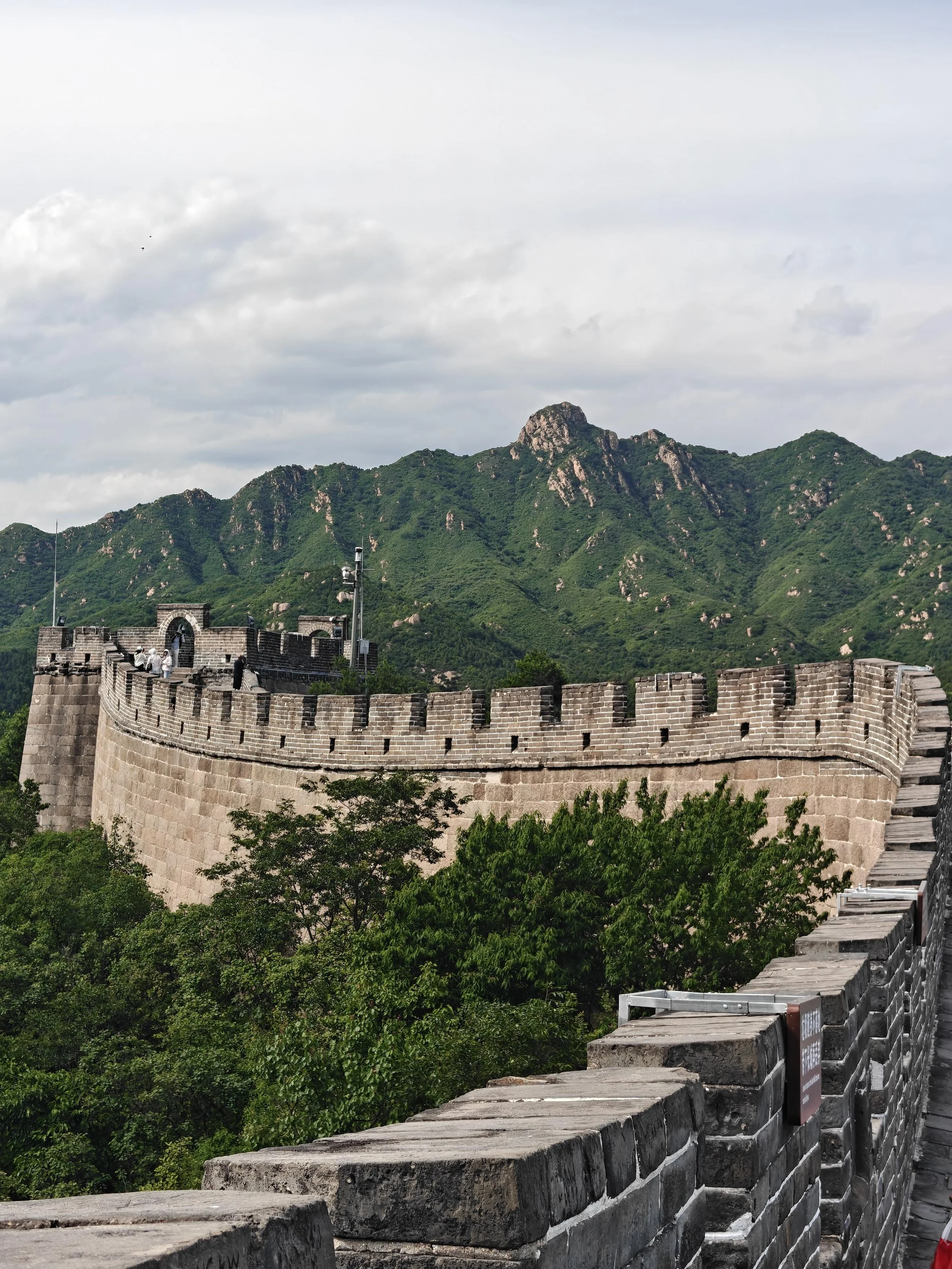
What tourists call "the Great Wall" was a layered defense network with three interlocking systems: early-warning (beacon towers on distant hilltops), combat (the wall itself, with crenellations and firing ports), and reinforcement (garrisons and fortresses positioned to counterattack). The wall you walk on is maybe a fifth of the installed hardware.
Han-dynasty documents even give us the vocabulary: a section of frontier was a sai (塞), a small fort carved into the wall's inner side was a zhang (障), and signal towers — fengsui — staffed by about ten soldiers each, transmitted messages with coded combinations: smoke and raised signals by day, torches and beacon fires by night, each pattern meaning something specific. A warning could cross hundreds of kilometers of frontier in hours, at a time when "fast communication" elsewhere meant a horse at full gallop.
When you stand on a restored section and look at the next watchtower, you're not looking at decoration. You're looking at one node in a relay.
So Which Section Should You Actually Visit?
Short answer for most first-time foreign visitors: Mutianyu. If you're a serious hiker or photographer: Jinshanling. If you want the Wall at night: Simatai. Almost never: Jiankou (it's illegal and it kills people). Here's the full reasoning.
The verdict: Mutianyu, and here's exactly why
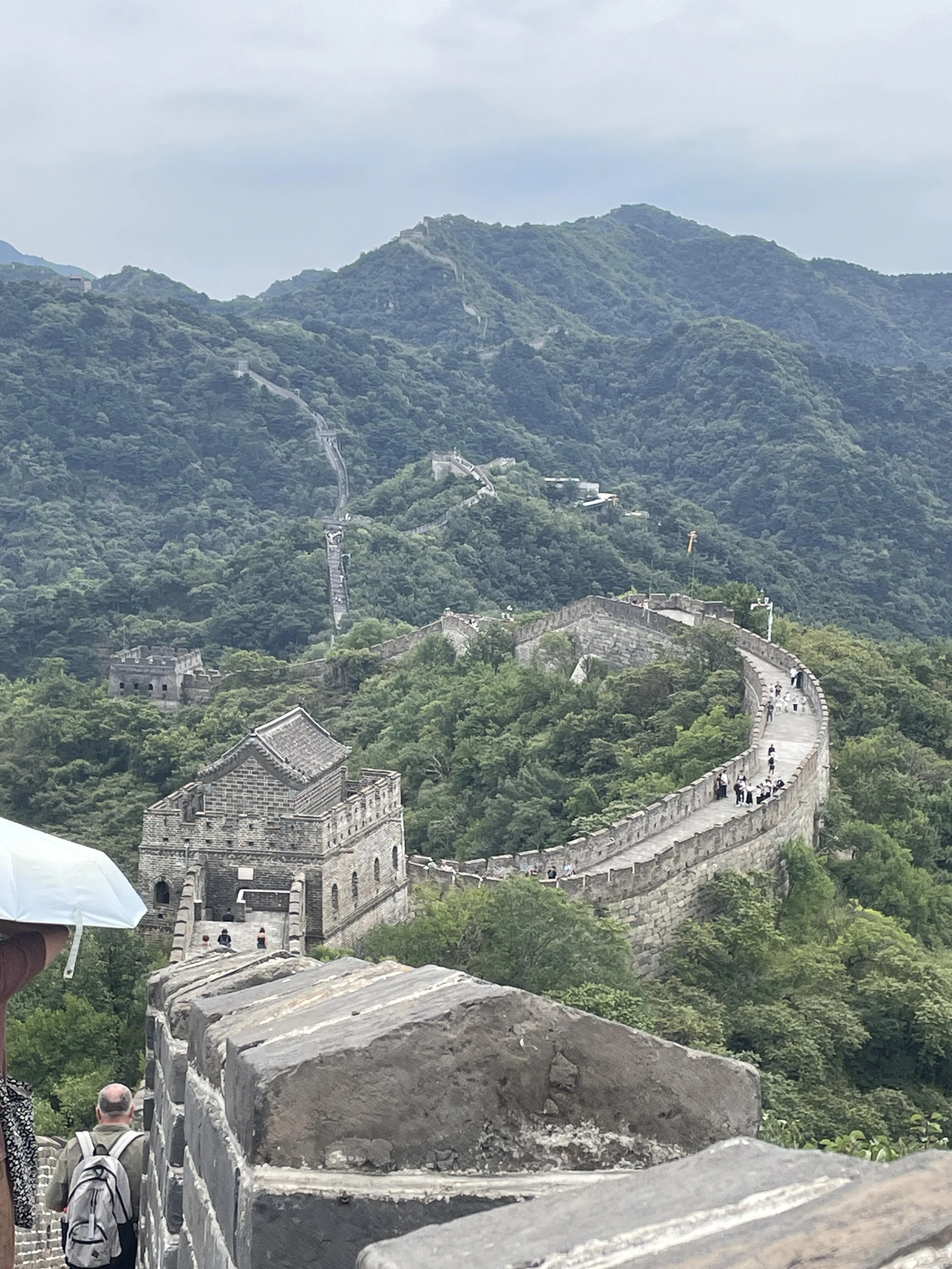
Mutianyu is what Badaling's brochures promise: a fully restored, spectacularly sited Ming wall — built under Qi Jiguang — with the logistics of a modern attraction and a fraction of the crush.
The specific reasons, in order:
Crowd math. Badaling absorbs up to 70,000 visitors per day at peak — a number with its own crowd-management news cycle. Mutianyu's visitor numbers are dramatically lower, and on a weekday morning you can get long stretches of wall nearly to yourself.
It's the fun one, objectively. Mutianyu has a cable car up and a toboggan slide down — a 1.5 km metal luge you control with a hand brake, which alone justifies the trip for most kids and every adult pretending not to be one.
The wall itself is arguably better. 2,250 meters are open, with 22 densely packed watchtowers — including the unusual Zhengguantai, where three towers stand side by side in a structure found nowhere else. Vegetation covers 90%+ of the valley: the wall rides a forested ridge, which photographs completely differently from Badaling's bare mass tourism corridor.
It's where visiting heads of state get taken — Reagan, Clinton, Obama have all walked it. The hostesses know something.
Ticketing is simpler for foreigners. No Beijing-resident-style booking scramble: buy on-site or online, shuttle bus from the gate, cable car optional. (More on Badaling's 2026 booking system below — it works, but it's built around Chinese ID and WeChat.)
It's the section the better China itineraries use. For reference, our own 8-day Beijing–Xi'an–Shanghai and 11-day Beijing–Xi'an–Zhangjiajie–Shanghai private tours default to Mutianyu with round-trip cable car included, keeping Badaling as the alternative — that's a deliberate choice, not an upsell.
Honest caveats: entry ¥45 plus ¥15 return shuttle; the cable car adds ¥100–140 depending on one-way/round trip (prices mid-2026, subject to official posted rates). From central Beijing count 1.5–2 hours each way. And it is not empty on national holidays — nothing in China is.
The quick comparison
Mutianyu — Fully restored · Moderate crowds · 1.5–2 h by bus/car · Cable car up, toboggan down, forested ridge · Best for first-timers
Badaling — Fully restored · Extreme crowds (up to 70k/day) · Only section with high-speed rail (20 min, ¥23) · The icon; widest wall ("five horses abreast") · Only if mobility-limited or train-locked
Jinshanling — Half restored, half wild · Low crowds · 2.5–3 h; weekend tourist bus or car · 10.5 km, 67 towers, sunrise photography · Best for hikers & photographers
Simatai — Restored, original Ming fabric · Low–moderate crowds · 2.5 h · The only section open at night · Best add-on with Gubei Water Town
Jiankou — Unrestored "wild wall" · Not a tourist site · "Eagle flies upside down" cliffs · Illegal. Don't.
Jinshanling: if you've seen one wall already, see this one
Jinshanling, 130 km from Beijing in Hebei, is the connoisseur's section: 10.5 km of wall with 67 watchtowers, part beautifully restored, part deliberately left crumbling — which is exactly the texture photographers fly in for. It holds two genuine treasures most visitors walk past without knowing: a 500-meter stretch of "character brick" wall where seven in ten bricks are stamped with their manufacturing inscription, and the Kylion Tower's carved relief screen. Sunrise here, mist pooling in the valleys, is the shot that ends up in coffee-table books. Open astonishingly early (main gate from 4:00 AM in season) specifically for sunrise hikers; expect to pay ¥65 entry (peak season March 16–Nov 15; ¥55 off-season; cable car ~¥40–60 one way). A weekend tourist bus runs from Beijing's Wangjing West; weekdays mean private car or a high-speed train to Chengde South plus an hour's taxi.
Simatai: the Wall after dark
Simatai — an hour's walk from Jinshanling along the ridge, though most visit separately — is the one section where you can stand on the Great Wall at night, floodlit, looking down at Gubei Water Town's lanterns. It's also praised by Chinese conservationists (including Luo Zhegwen, the survey-era dean of Great Wall studies) as the section that best preserves its Ming-dynasty original fabric. Manage expectations: only a handful of towers are open to night visitors, and you'll see them via cable car in about an hour. Pair it with the water town below and it's the best evening in Beijing's orbit that isn't a duck dinner.
Badaling: when it still makes sense — and how booking works in 2026
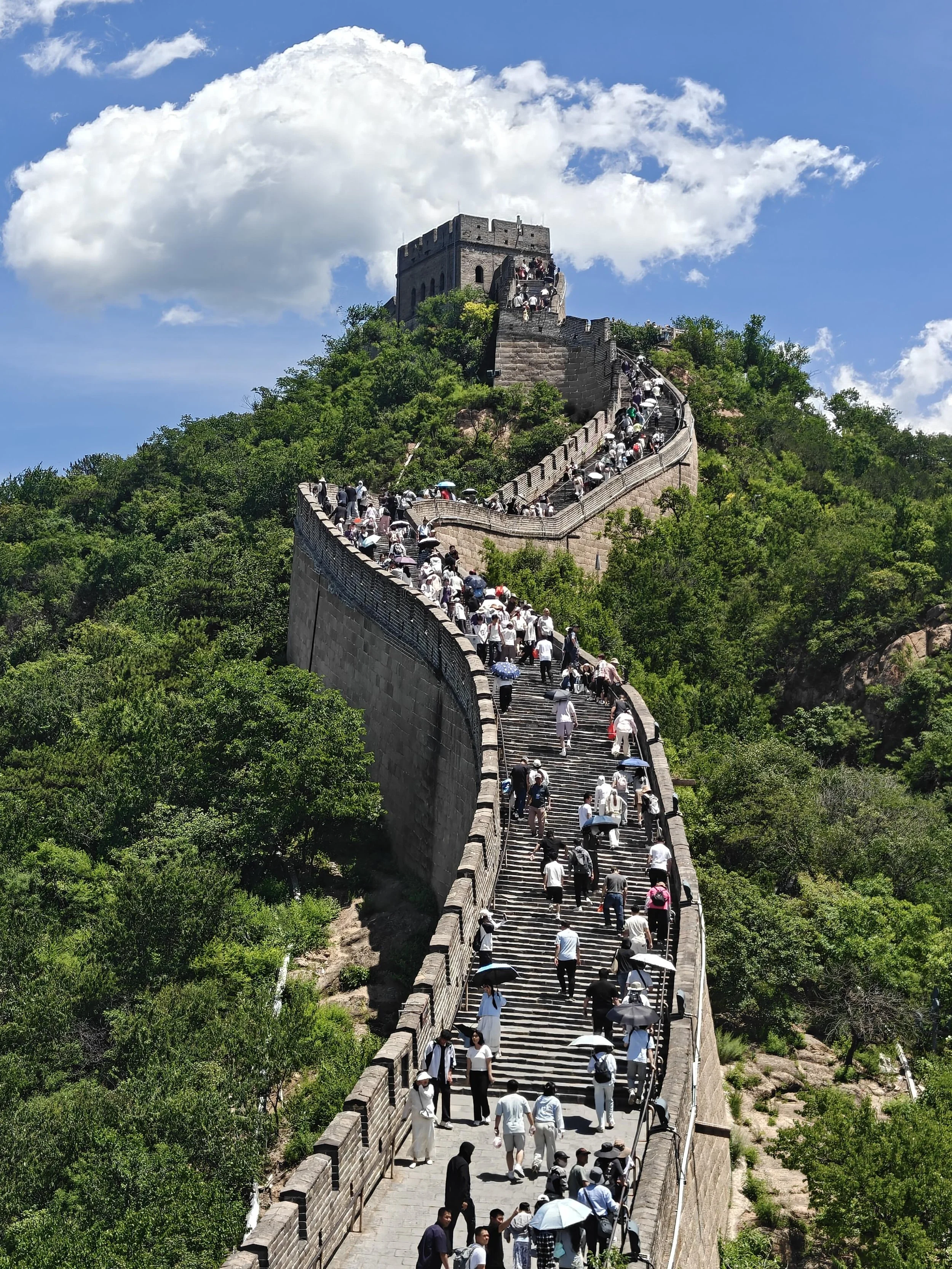
Badaling deserves fairness. It's the most restored, most accessible, most grandiose stretch — the wall at its widest ("five horses abreast, ten men in rank," as the saying goes), with North Tower 8 sitting at 888 m with views down ten kilometers of ridgeline. And it's the only Great Wall section with its own high-speed railway: 20 minutes from Beijing, ¥23. If your mobility, your schedule, or your kids' patience demands the fastest possible wall, Badaling is legitimately the right answer.
The 2026 logistics, honestly stated: every visitor — including children and seniors — needs a real-name ticket tied to an ID or passport, obtained through Badaling's official WeChat channels or mini-program ("Badaling Great Wall" / "Great Wall Inside and Outside"), up to 7 days ahead. Peak-season day entry runs 6:30–17:00, with a separate night session (18:30–21:30, around ¥181). Recent official notices also mention on-site ticket windows operating during high season — the system is in flux, so reconfirm on the official channels before you go, and note that entry is timed: arriving outside your booked window can mean being turned away.
Foreign passports work with real-name booking, but the interfaces are Chinese-first. If that sounds like friction, that's a real signal: it's the same friction that keeps international visitors funneled to Badaling's tour-bus economy — which brings us to the scams.
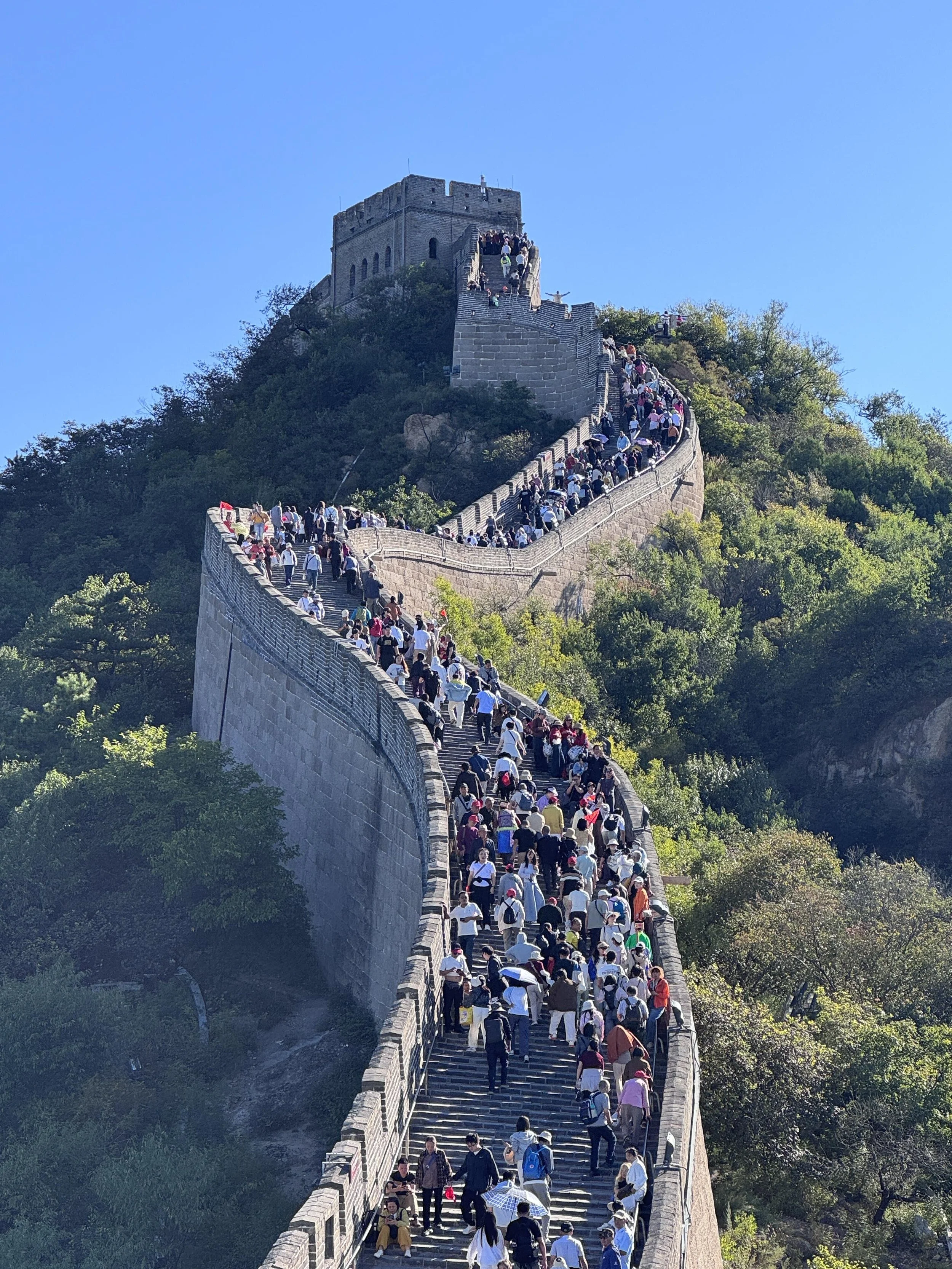
Jiankou and the wild wall: illegal, and it kills
The photogenic derelict wall in every dramatic Great Wall photo — the razor ridgeline, the "Eagle Flies Upside-Down" tower, the near-vertical "Heavenly Ladder" — is Jiankou, and it is not a tourist site. Climbing unopened sections of the Great Wall is illegal in Beijing, full stop. The death toll is not hypothetical: a lightning strike killed two hikers in 2009; a climber fell to his death in 2014; in 2023 a 32-year-old member of the Blue Sky rescue team — a volunteer — fell to his death while saving stranded wall-climbers. Volunteer rescue teams were averaging one Jiankou callout a week as of early 2023.
Here's the part worth knowing even if you'd never go: Beijing passed a new Great Wall Protection Regulation, effective March 1, 2026 — its first law dedicated solely to the Wall (Beijing municipal government announcement). It codifies a blacklist of prohibited acts (chiseling bricks, carving graffiti, fires, driving across the wall) and — notably — authorizes electronic fences to detect and deter unauthorized climbing, a shift from "wardens chasing people off" to automated enforcement. Carving your name is no longer "bad manners"; it's a case number (a woman who carved into the wall at Badaling in October 2025 was formally investigated by police). Older rules still apply underneath: fines of ¥200–500 for individuals caught on unopened sections, ¥10,000–50,000 for organizers.
And a line every would-be "off-the-beaten-path" traveler should memorize: viewing and climbing are different things. Standing in Wulonggou valley looking at untouched 500-year-old wall: legal and magnificent. Climbing it: a fine, a rescue, or worse. Several "wild wall" sections you'll see hyped on social media (Wulonggou, Shangyi, Wudaoliang) sit in exactly this legal gray zone — treat them as scenery, not staircases.
Getting There (Realistic Version)
Badaling — high-speed rail from Qinghe or Beijing North station: ~20 min, from ¥23. Book seats days ahead; morning trains sell out.
Mutianyu — tourist shuttle (Bashida/Mubusi lines from downtown) or private car: ~1.5–2 h each way, shuttle ~¥80 return.
Jinshanling — weekend tourist bus from Wangjing West, or private car (2.5–3 h). Entry ¥65 peak season.
Simatai / Gubei Water Town — private car or tourist bus, ~2.5 h.
A note on the famous 877 bus to Badaling from Deshengmen: it's real and cheap, but the bus stop area is the venue of Beijing's most persistent tourism scam, documented by local journalists — men in imitation uniforms with fake signs directing tourists onto "official" buses that cost 100 yuan "including the wall ticket" and deliver them instead to a fake or different section (see below). If your Chinese is zero, a prebooked shuttle or private driver removes the entire attack surface.
The Scams Worth Knowing (These Are Specific, Not Generic)
The fake Great Wall. Budget day-tours have been caught driving visitors to Shuiguan or "Badaling Ancient Wall" — different, shorter sections — and presenting them as Badaling. One family's 2026 account went viral in China under the headline "We climbed a dead-end fake Great Wall." Shuiguan is a real (separate) attraction — the scam is the substitution. Confirm in writing which section you're visiting.
Fake staff at Deshengmen. Imitation-uniform "staff" with fake route signs redirecting 877-bus passengers onto overpriced private buses. Real staff are at the actual bus bay; when in doubt, board inside the designated stop.
The stele cable-car upsell. Guides claiming the "He who has never been to the Great Wall" stele is only visible by cable car (¥140). The stele is on the wall itself, and — as covered above — the poem isn't even about this wall. Double irony.
The impossible schedule. Budget tours that arrive at the wall at 11:30 AM, feed you lunch at 3 PM, and insert two "tea shops." A wall day trip should put you on the wall by 9–10 AM.
None of this is an argument against organized visits — a good private guide solves the booking friction, the timing, and the transport in one move. It's an argument against the cheapest organized visit.
If You've Seen the Classic Sections: Where the Wall Actually Goes
The Wall bookends are worth a trip of their own, and almost no first-timers see them:
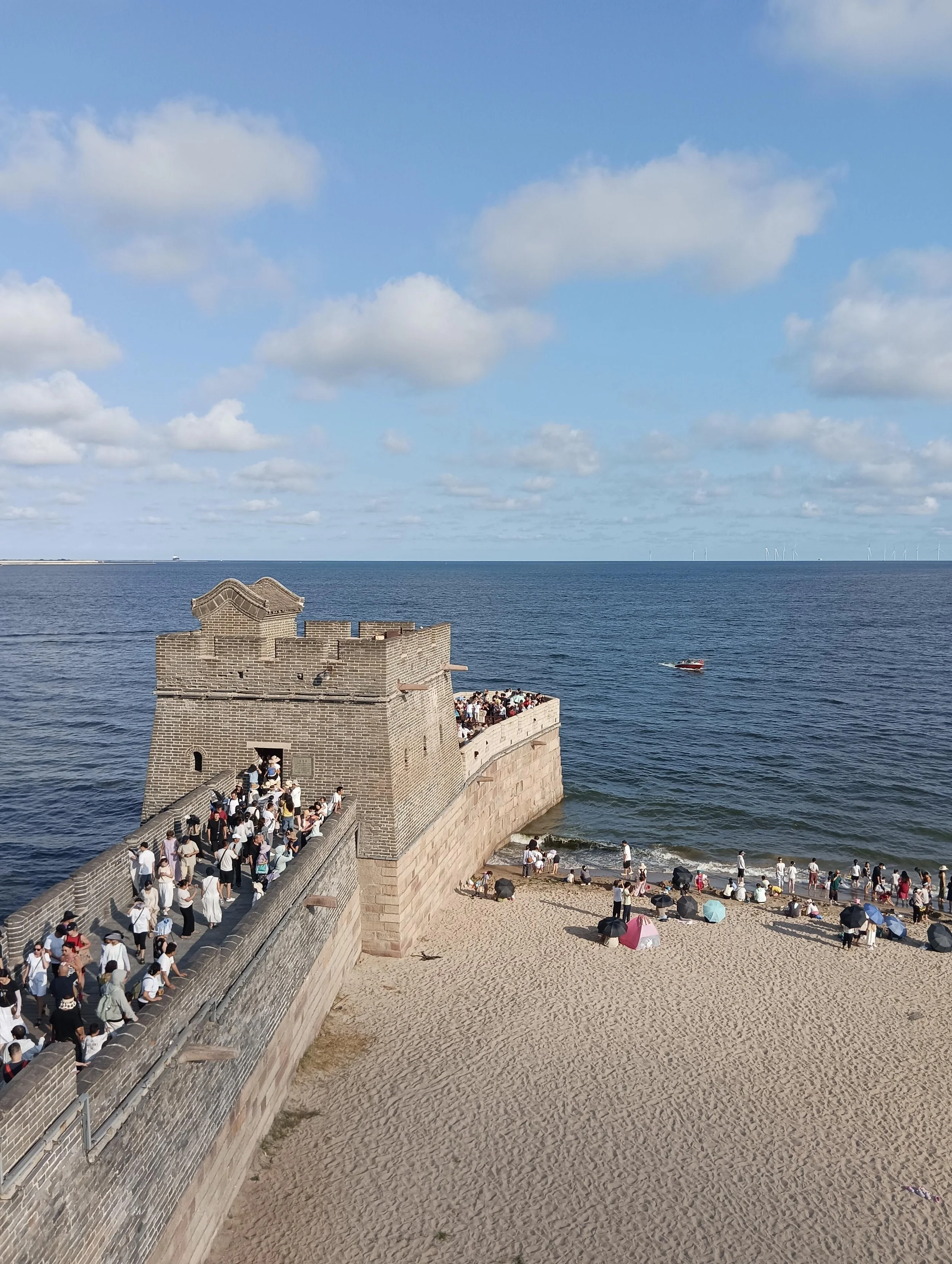
Where it meets the sea: Laolongtou ("Old Dragon's Head") at Shanhaiguan, where the Ming wall runs into the Bohai Sea — plus the Jiumenkou section, the only stretch of the Great Wall built across a river on a nine-arched bridge.
Where it drowns: at Panjiakou Reservoir in Hebei, 1970s flooding submerged sections of wall; when water levels drop, towers surface from the lake — China's genuine "underwater Great Wall."
Where it ends in the desert: Jiayuguan's fortress in Gansu, the Ming wall's western terminus — a staggeringly photogenic citadel against the snow peaks of the Qilian range.
Where it's oldest: the Qi wall in Shandong and the Warring States Qin wall near Guyuan, Ningxia — earthen lines older than the Ming wall by two millennia, and, in Ningxia's case, the actual "Great Wall" of Mao's poem.
Where it becomes beacon towers in empty country: west of Yumen Pass in Gansu, the "wall" dissolves into strings of Han-dynasty signal towers marching toward Xinjiang — the frontier system in its rawest form.
For second-time China visitors, pairing the Wall's endpoints with Xi'an's Terracotta Army or a Silk Road run through Gansu makes far more narrative sense than a third afternoon at Badaling. Several of our multi-country China itineraries build exactly this kind of route.
FAQ
Can you see the Great Wall from space? No. Astronaut Yang Liwei said he couldn't see it; the Chinese Academy of Sciences calculated the eye's limit for an object its width at roughly 36 km; ESA once mistook a river for the Wall and formally corrected itself. Satellites can photograph it — cameras aren't eyes.
Which Great Wall section is least crowded? Jinshanling and Simatai on weekdays. Mutianyu is moderate and far quieter than Badaling, which can absorb 70,000 people a day at peak.
Is Badaling or Mutianyu better for kids? Mutianyu, without hesitation: shorter walks between towers, cable car up, toboggan down.
Is it true the Great Wall is visible from the Moon? Even further from true — from the Moon it would be equivalent to seeing a human hair from 2.6 km away.
Can foreigners book Badaling tickets? Yes — real-name booking with a passport via Badaling's official WeChat/mini-program channels, up to 7 days ahead; timed entry is enforced. Interfaces are Chinese-first, so many visitors book through a tour or use Mutianyu instead.
Is the wild (unrestored) Great Wall legal to hike? No. Unopened sections are off-limits; fines run ¥200–500 for individuals and up to ¥50,000 for organizers, and Beijing's new regulation effective March 2026 adds electronic-fence enforcement. Multiple climbers and one rescuer have died on Jiankou.
When's the best time to visit the Great Wall? Mid-October for autumn color (Jinshanling is spectacular), late April–May for green hills and mild heat. Avoid Chinese national holidays — genuinely, all of them.
Prices, opening hours, and booking rules above were checked in September 2026 against official announcements and multiple booking platforms; all are subject to change, so confirm on official channels before you travel.
Plan your trip
LynxTravel (Zhangjiajie Travel China) has designed private, fully customizable China journeys since 2014 — English-speaking in-house guides, private car and driver, no hidden fees. The Great Wall pairs naturally with Xi'an's Terracotta Army and Zhangjiajie's Avatar mountains in routes like our 8-day Beijing–Xi'an–Shanghai tour, or browse all China itineraries and start a custom plan. Reach us anytime: rosewuqjzh@gmail.com · WhatsApp +86 172 6789 8631 · LINE: manmanlovetravel.