

China Autumn vs the World: 11 Types of Fall Color, Compared
Somewhere around late September, the whole northern hemisphere runs the same play. Aspen turns the Colorado hillsides gold. Vermont's sugar maples follow. Seoul's ginkgo trees drop a yellow carpet along the Deoksugung stone wall, and Kyoto waits until the very last week of November to peak.
Watch it happen a few times and you start thinking there's a script. Which is how the claim got started: that China has a version of every autumn on Earth, and that its poplar forests and red hills are things nobody else can copy.
Half of that is true. The other half falls apart the moment you look at what's actually growing in the ground.
Three things get repeated constantly, in English and Chinese alike, and all three are wrong:
Xiangshan's red leaves are not maple. Ejina is not the world's largest poplar forest. And Jiuzhaigou's travertine lakes are not unique on Earth.
So let's do this properly — eleven autumn types, each one put next to the foreign landscape people compare it to. Some pairs really are near-identical twins. Others fall apart under inspection. A few are genuinely one-of-a-kind, but not for the reason you'd guess: in almost every case, the uniqueness isn't the tree. It's what got stacked on top of the tree.
If you're mainly here to plan a trip — dates, tickets, transport, how long to spend where — that's the other half of this. Start with our 2026 China autumn travel guide, Kanas to Tengchong, which walks through all thirteen destinations by peak date. This article is the "why" behind that calendar. Read it first and the timetable stops looking arbitrary.
Start here: the eleven types
Before comparing anything, break "autumn abroad" into recognisable categories. Do that and half the internet arguments dissolve on their own.
One note before the list. Most comparisons of this kind — including the Chinese-language version this article grew out of — only count landscapes built from trees. That's a blind spot. Some of the world's most spectacular autumn is grass, or a salt marsh, or a flooded rice terrace. Five of the eleven types below don't involve a single tree, and China is strongest in exactly those.
The tree-based types
City autumn — Paris. Horse chestnut, plane tree, beech. China's counterpart: Xiangshan, Beijing, and its smoke tree (黄栌).
Golden aspen — Aspen, Colorado. Quaking aspen. China's: Ejina, Inner Mongolia, and its Euphrates poplar.
Ginkgo avenues — Seoul, South Korea. Ginkgo (introduced). China's: Tengchong, Yunnan. Ginkgo (native).
Temperate red maple — Kyoto, Japan; Vermont, USA. Japanese maple and sugar maple. China's: Benxi, Liaoning, with twelve maple species.
Golden conifer — Canadian Rockies. Lyall's larch. China's: Kanas, Xinjiang, with Siberian larch.
Lakeside autumn — the European lake districts. Broadleaf woodland around water. China's: Jiuzhaigou, Sichuan, with travertine lakes and colour forest.
The five the usual lists miss
Red wetland — Camargue, France. Glasswort — the same Salicornia genus China uses. China's: Panjin, Liaoning.
Steppe autumn — Mongolian grasslands, Scottish Highlands. Feather grass and heath. China's: Hulunbuir and Bashang, Inner Mongolia and Hebei.
Golden rice terraces — Bali, Indonesia; Sa Pa, Vietnam. Paddy rice. China's: Longji in Guangxi, Wuyuan in Jiangxi.
Bald cypress and dawn redwood — Louisiana and Florida, USA. Taxodium distichum. China's: Zhimang Ridge in Nanjing, Siming Lake in Zhejiang — and, more interestingly, the dawn redwood.
Pure birch forest — Finnish Lapland, northern Sweden. Downy birch. China's: Ergun in Inner Mongolia, and Jiaohe in Jilin.
Now the first real surprise, sitting right there in the first two rows.
1. City autumn: Paris plants horse chestnut, Xiangshan plants smoke tree
Autumn in Paris doesn't happen on a mountain. It happens in parks.
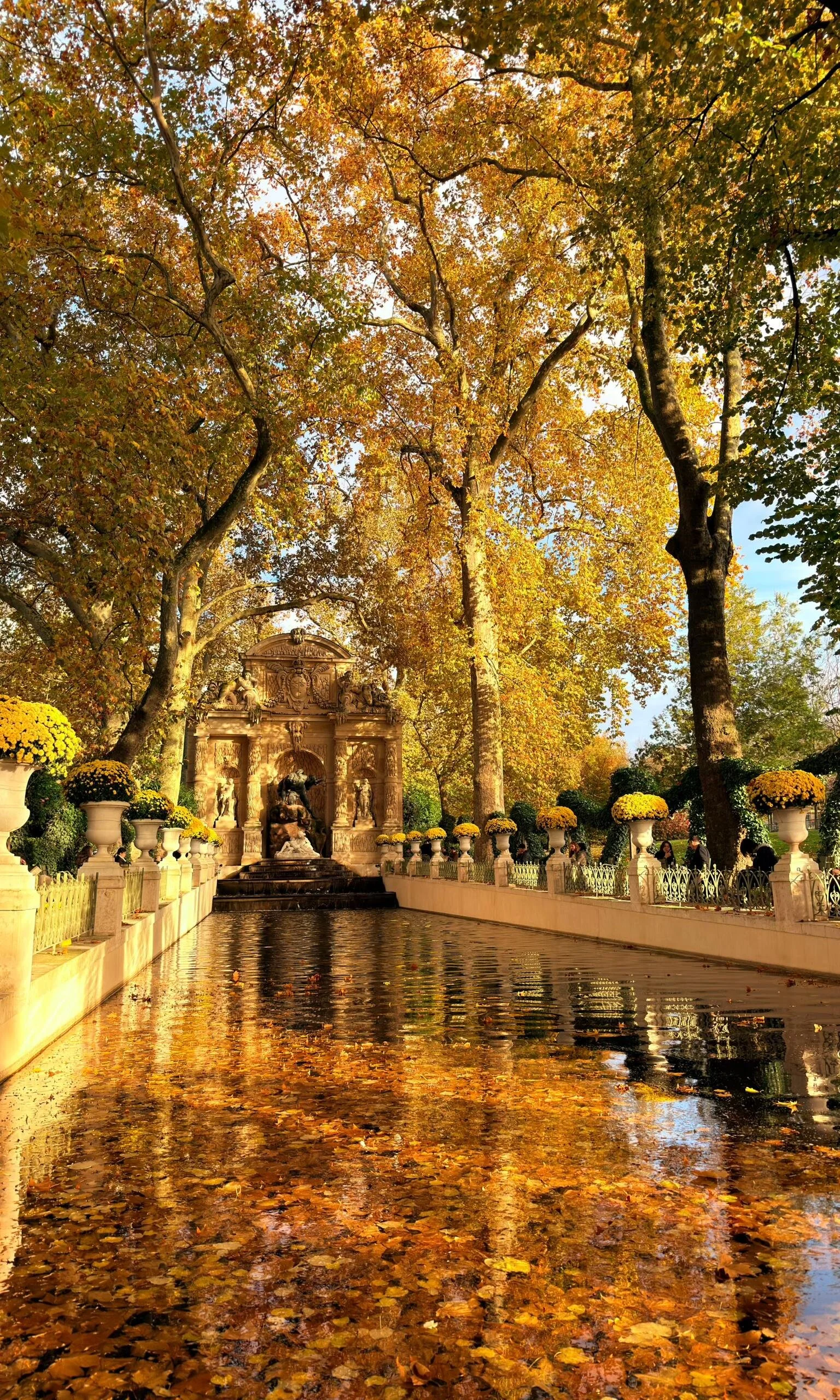
The Luxembourg Gardens holds around 3,000 trees, and the leaves drift onto the Medici Fountain. The Bois de Vincennes adds 995 hectares. Forty-five minutes southeast by RER gets you to Fontainebleau forest. By the city government's own count, Paris has more than half a million trees.
But if you're expecting "the maples turn red," you've got the wrong tree. Paris's street trees are mostly plane and horse chestnut. The forests are oak, Scots pine, and European beech. Maple accounts for something like 6% of Paris street trees. What you actually see in Paris is brown-gold, orange, and dull crimson against clipped geometric garden beds — autumn inside a designed landscape, which is a completely different aesthetic from autumn in the mountains of East Asia.
Beijing's Xiangshan is the reverse case, and it carries a misunderstanding worth clearing up.
The red at Xiangshan is not maple. It's smoke tree — Cotinus coggygria var. cinerea, in the cashew family. Every official source agrees: the Beijing Municipal Forestry and Parks Bureau, the park's own administration, and state science media all give the same figure — Xiangshan's autumn foliage covers 8 families and 14 species, roughly 100,000 trees, and the species producing the vast majority of that red is smoke tree, at close to 100,000 individuals.
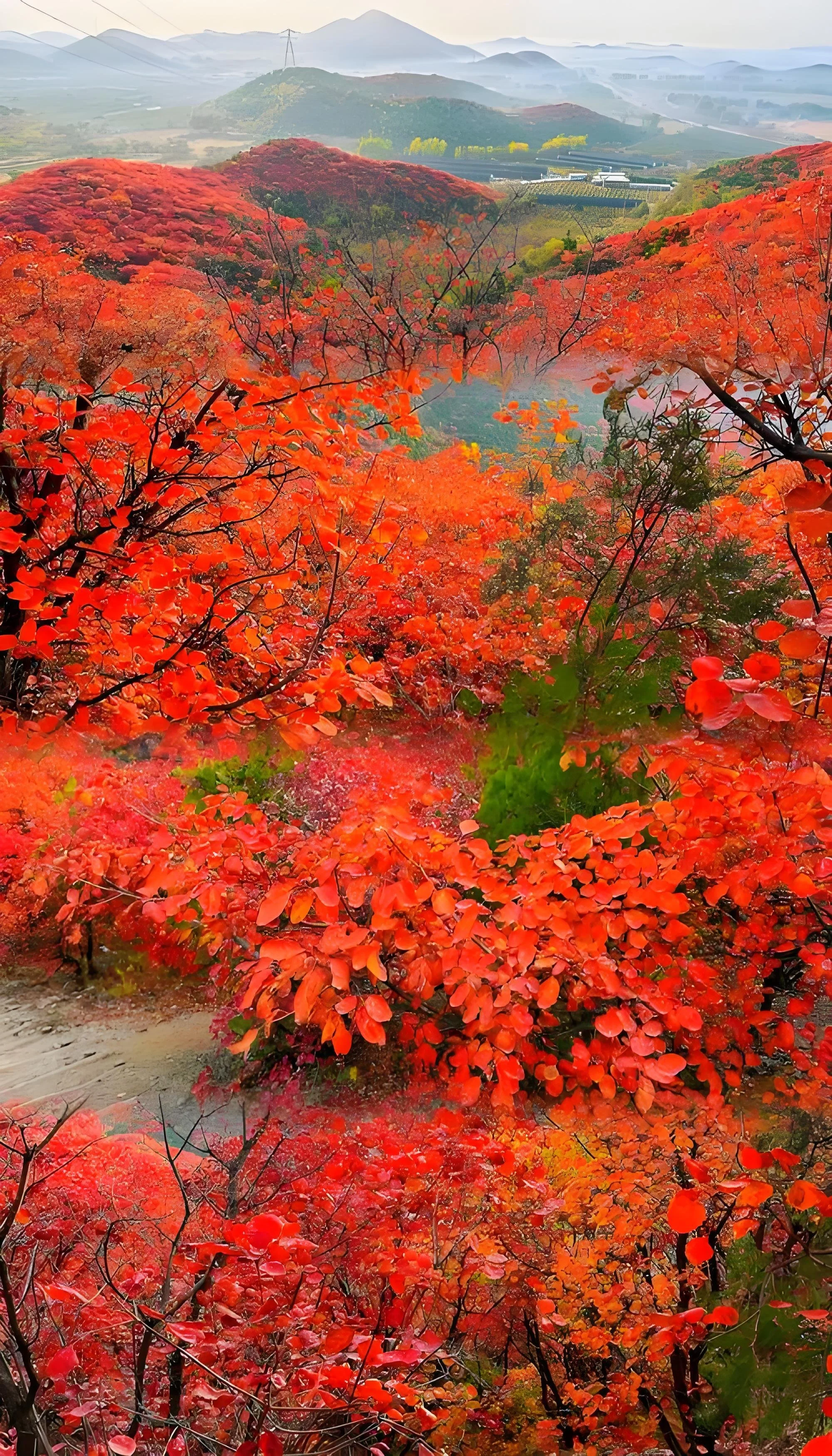
So why does everyone call it maple? Because the word "枫" in classical Chinese poetry usually means sweetgum — the witch-hazel family tree — which can't survive northern winters and grows mostly in the south. Southern writers came north, saw a tree with vaguely similar leaves that also turned red, and called it maple. The confusion has now survived several hundred years. Xiangshan does have trident maple and Japanese maple, but only scattered around Jingcui Lake and Yuhua Peak. They are not the show.
Smoke tree has a second name worth knowing: smoke bush. After flowering, the sterile stems persist as feathery plumes, so the tree looks like it's smouldering from a distance.
So where is Xiangshan's uniqueness, if not in the tree? Smoke tree grows wild from southern Europe through western Asia to the Himalayas and northern China. Europe has cultivated it since 1594, when it entered the Leiden botanical garden, and European parks are full of horticultural varieties today. The uniqueness is three things stacked:
Scale. Nearly 100,000 smoke trees across almost 200 acres. This didn't grow by itself — it's the product of more than two centuries of maintenance dating to the Qianlong emperor's mass planting in the 1700s. They chose smoke tree because maples wouldn't survive the northern climate inside the pass.
Imperial garden pedigree. Xiangshan was Jingyi Garden, one of the Qing dynasty's "Three Hills and Five Gardens." In 1745 Qianlong laid out 28 named scenic spots; one of them is called, literally, "Splendid Autumn Grove."
Literary lineage. A Jin dynasty poem from around 1200 is the earliest documented praise of Xiangshan's autumn colour, and it's still quoted today.
Nowhere else on Earth took a plant that Europe treats as a park curiosity and grew it into a national autumn landmark. That's the honest version of the claim.
Getting there
Xiangshan Park, Haidian District, northwest Beijing — about 20 km from Tiananmen as the crow flies, but 25–35 km of real road, and well over an hour on a peak autumn weekend.
Take Metro Line 10 to Bagou, transfer to the Xijiao tram line, ride to the terminus at Xiangshan station, walk 5–8 minutes to the East Gate. The tram has oversized windows and the ride itself is part of the experience. Buses 318, 331, 563 and 698 also stop at Xiangshan. Driving is the one option I'd actively discourage in peak season — parking fills before 7am.
Inside: East Gate → Qinzheng Hall → Jingcui Lake → Shuangqing Villa → Xiangshan Temple → Yuhua Peak → Xianglu Peak, exiting via the North Gate past Biyun Temple (separate 10 CNY ticket). The smoke tree is concentrated on the mid and upper slopes.
Window: late October to early November, usually peaking between October 25 and November 5. The trigger is temperature, not the calendar: colour starts below 10°C and completes between 0 and 5°C. A wide day-night swing speeds it up.
Tickets: 10 CNY in peak season (April 1 – November 15), or 15 CNY with Biyun Temple included. Book through the official WeChat accounts — Xiangshan Park or Changyou Park. Shuangqing Villa needs its own booking and closes Mondays.
2. Aspen and Ejina: cousins, not the same person
Aspen, Colorado, is named after the tree. In 1880 the town changed its name from Ute City because of the aspens everywhere around it. The famous shot is Maroon Bells: twin peaks reflected in water with an entire hillside going gold at once, regularly called the most photographed mountain view in North America.
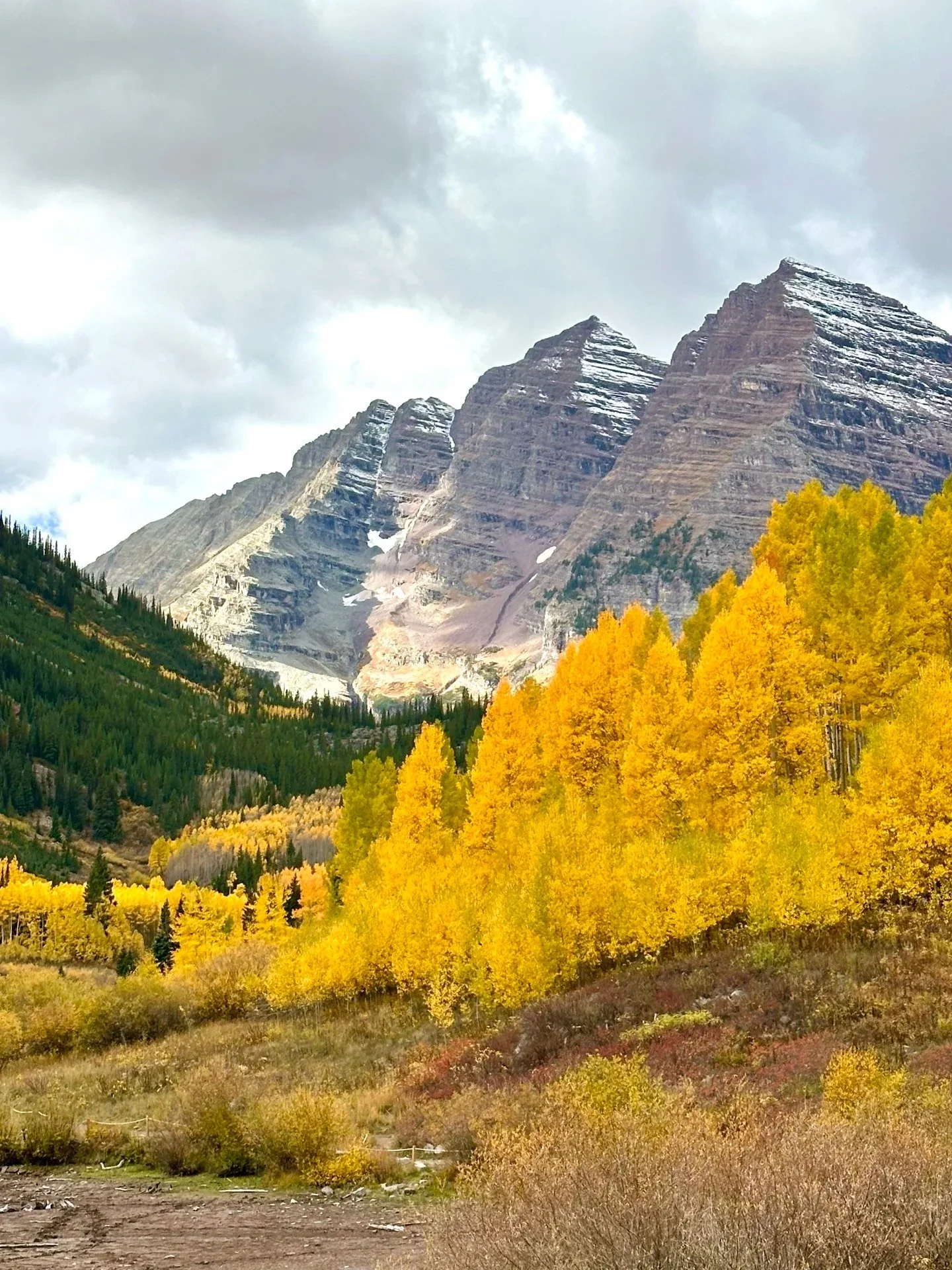
That tree is quaking aspen, Populus tremuloides — willow family, poplar genus. Ejina's tree is Populus euphratica. Same genus, different section. The poplar genus splits into five sections; euphratica sits alone in its own, while quaking aspen belongs to the aspens and cottonwoods. Molecular work puts euphratica near the base of the entire poplar family tree — possibly the most primitive group in the genus.
The accurate phrasing: close relatives within the same genus, with completely different shapes and colours. Euphrates poplar evolved for extreme drought, which is why it branches in a zigzag, aborts its terminal bud, and grows leaves that change shape on the same tree — willow-like low down, rounded higher up. That's why it also gets called the "diverse-leaf poplar."
Aspen peaks in the third and fourth weeks of September, and the mechanism is elevation: colour descends roughly 500–1,000 feet per week, so the valley floor can hold out until mid-October. Maroon Bells needs a daytime reservation; parking permits run about $10 per vehicle and the shuttle from Aspen Highlands is $16 round trip.
Ejina peaks in early October, with a golden window of about twenty days. The two windows barely overlap. Seeing both in one trip means crossing half the planet and burning a month.
Now the correction that matters: Ejina is not the world's largest poplar forest. It's not even close, and the real answer is more interesting than the myth.
China's official language about Ejina is careful and limited. Xinhua calls it "one of the world's three remaining original Euphrates poplar forests." The regional forestry bureau calls it "the best-preserved primary poplar forest in the world today" and "the largest poplar forest in China's desert regions." Note the qualifier — desert regions.
Three Xinjiang sites hold the actual records, and they're distinct from each other:
Bachu Poplar Forest National Forest Park, Kashgar Prefecture — 316,000 mu (about 52,000 acres) of primary poplar, described officially as the world's largest contiguous natural poplar forest.
Tarum Poplar Forest National Forest Park, Luntai County — 43.6 mu-scale core area (roughly 7,200 acres within a 100 sq km park), described as the world's largest, densest, and healthiest natural poplar forest park, and the only desert poplar park among the world's 1,200 forest parks.
Ejina — around 40,000 mu of forest across the wider banner, restored and expanded considerably since 2015. The "one of three remaining original forests" framing is the accurate one.
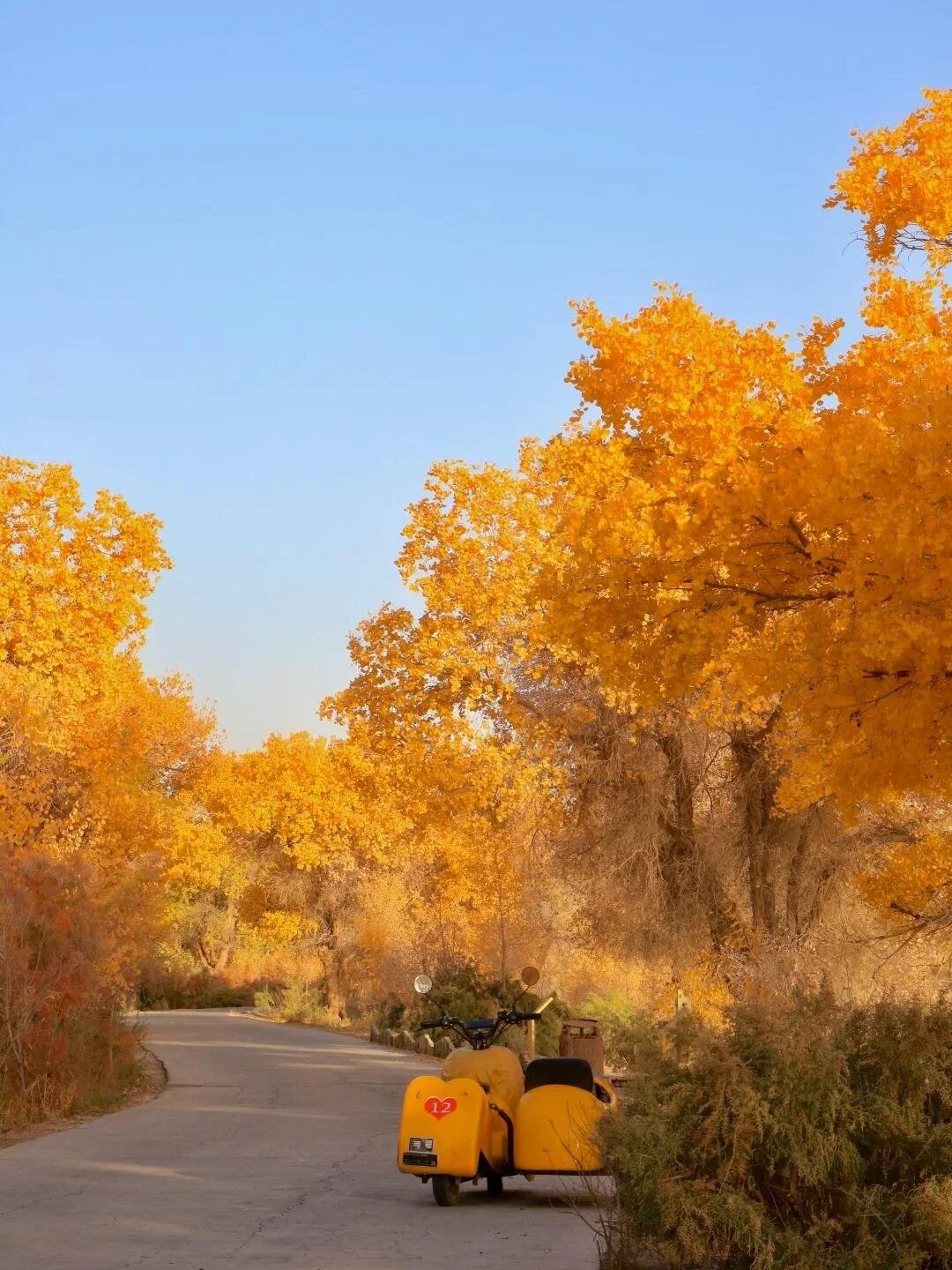
While we're correcting numbers: the folk saying that poplars "live a thousand years without dying, stand a thousand years after dying" is poetry, not data. Ejina's oldest single tree, called the Sacred Tree, was measured at 880 years old — a first-class protected ancient tree, about 27.5 m tall with a 2.07 m trunk diameter.
So what makes Ejina special? Not the species. Euphrates poplar grows across roughly 20 countries; China holds about 61% of the global total and Central Asia about 31%. What's special is everything stacked on top of the forest:
The northwestern edge of the Badain Jaran Desert, where the forest functions as a barrier against the desert's northward creep
Juyan Lake — the terminal lake of the Hei River, also known as the Ruo Shui, the very river behind the proverb "of the three thousand leagues of weak water, I take only one ladle." It runs 800-plus km from the Qilian Mountains through Qinghai, Gansu and Inner Mongolia
Khara-Khoto, the Tangut city, a nationally protected site and one of the best-preserved Silk Road cities anywhere
The Ghost Forest — a stand of dead poplar trunks, spectacular as silhouettes at sunset
Badaling Bridge No. 8, where the forest meets the Badain Jaran dunes
Kazakhstan has plenty of Euphrates poplar. It does not have a Tangut city and an inland river's terminal lake sitting next to it. This is the hardest "unique by combination" case in the whole country.
Getting there
Ejina Banner, Alxa League, Inner Mongolia — the westernmost tip of Inner Mongolia, bordering Mongolia to the north and Gansu's Jiuquan to the west. The base town is Dalaihob. Coordinates are roughly 41.97°N, 101.07°E.
Two ways in, and the difference matters:
Ejina Taolai Airport (EJN) — in-banner, about 12 km from Dalaihob. Limited routes, strong seasonality. Check schedules before planning around it.
Jiayuguan Airport (JGN), Gansu — about 400 km out, 4–5 hours by private car. This is the route most foreign visitors actually use. High-speed rail to Jiuquan South, then private transfer, takes about 4 hours.
During the October poplar festival, extra tourist trains run from Lanzhou — watch for official announcements.
Inside the park, distances between viewpoints run from a dozen to several dozen kilometres, so you need a vehicle. The forest runs in a band along the Hei River, numbered by bridge: Bridge 2 has water and reflections and is the most photogenic; Bridge 4 is the Hero Forest, oldest and thickest trunks; Bridge 7 is Dreamland, the most saturated colour; Bridge 8 meets the desert and offers camel rides. Khara-Khoto and the Ghost Forest sit about 25 km southeast of town on the same road, so they pair naturally — dead trunks against a sunset. Juyan Lake is 50 km north-northeast and means a pre-dawn start for sunrise and birds. Suponaoer, further out, is quieter.
Window: early October, roughly twenty days. The official trigger is 80%+ yellow leaf coverage. Early October's National Day holiday usually catches the trees mid-turn with patchy colour — the safer bet is October 5–15.
Tickets: 240 CNY in 2025, under a "one ticket, two parks" system covering both the main scenic area and the Desert Poplar area, valid for unlimited re-entry over 30 days from first entry. Real-name entry with your physical passport or ID — photos and photocopies don't work.
What nobody warns you about: the temperature swing. Days run 15–20°C, nights drop to around 0°C. Bring a proper cold-weather layer, a dust mask and sunglasses, and something to protect your camera sensor — this is desert. If you're driving, fill the tank before you head out; services and petrol stations are sparse.
3. Ginkgo: Seoul made it the city tree, China invented it
Deoksugung's stone wall road runs about 900 m, lined with ginkgo on both sides, and the leaves are deliberately left unraked. It's Seoul's most famous autumn street. The city publishes 103 foliage routes totalling 158 km, lined by roughly 70,000 street trees.
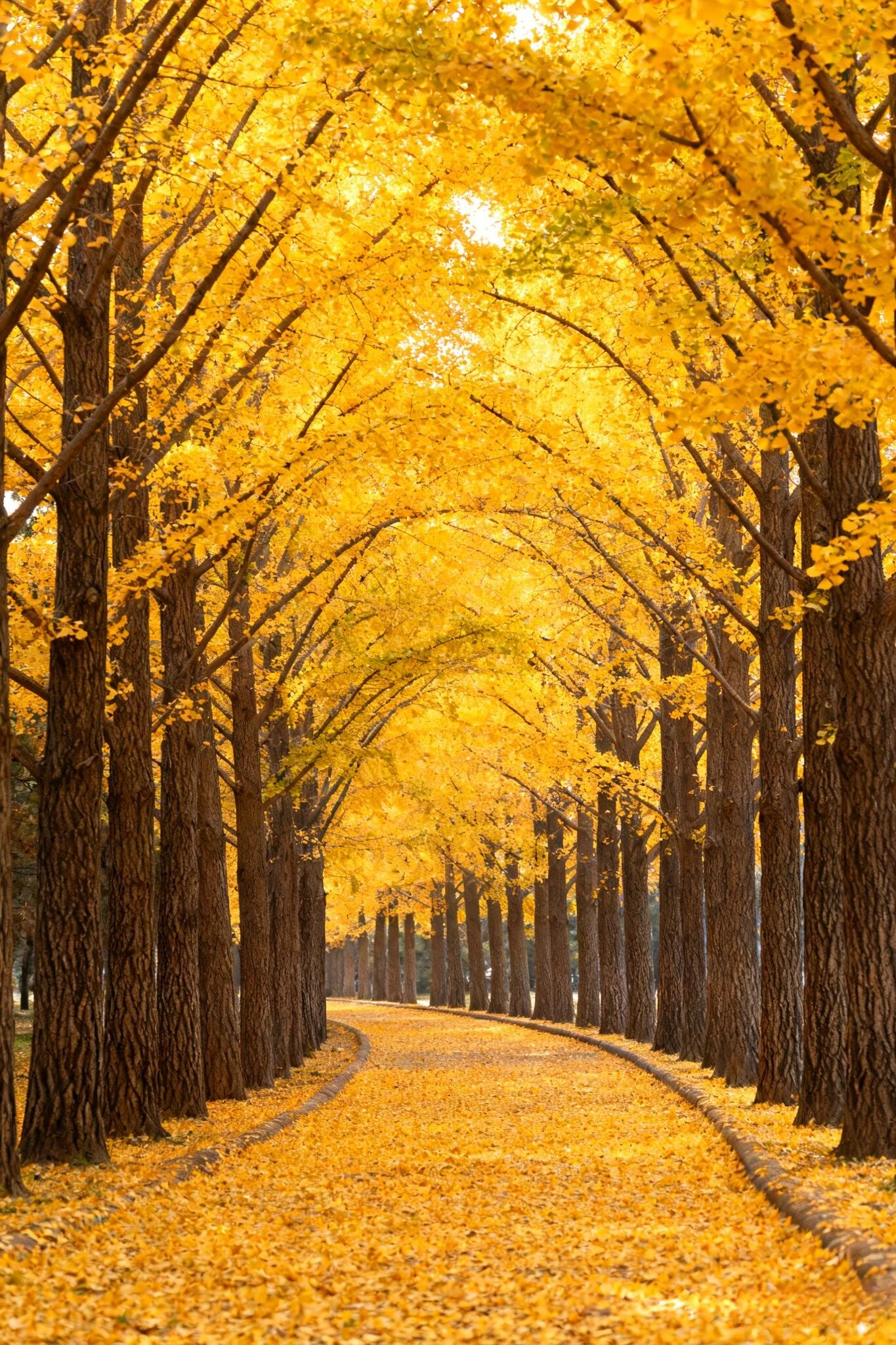
And ginkgo is native to China.
The wild population of Ginkgo biloba is believed to survive only around Tianmu Mountain in Zhejiang province, and the species is listed as Endangered. A 2019 study in Nature Communications sequenced 545 ginkgo genomes from around the world and concluded that essentially every ginkgo on Earth descends from the eastern Chinese population represented by Tianmu Mountain. The same study identified three glacial refugia in China: Tianmu in the east, Wuchuan and Jinfoshan in the southwest, and Nanxiong with Xing'an in the south.
Korea's and Japan's ginkgo are both introductions, not natives. Korean records tie the tree's arrival to Confucianism and Buddhism coming from China; Japan received seed around the late 13th to early 14th century, alongside Buddhist transmission. Europe and North America got ginkgo from Japan in the early 1700s — but the genetics still trace back to China.
Seoul's official city tree is ginkgo, designated on 3 April 1971. It now makes up more than a third of the city's street trees.
So the same species is simultaneously an endangered wild tree whose mature stands produce almost no natural regeneration, and the signature street tree of a foreign capital with 300,000-plus planted individuals. That contrast is more interesting than any claim of Chinese uniqueness, and unlike most such claims, every word of it is verifiable.
China's best ginkgo viewing is about living history. Jiangdong village in Tengchong, Yunnan, has over 10,000 mu of ginkgo woodland and more than 30,000 trees, over 1,000 of them a century or older. The oldest, the "Ginkgo King," is nearly 1,300 years old. Peak colour runs mid-November to early December, with 80–90% of leaves yellow.
Worth adding, since most English-language lists miss it: Haiyang township near Guilin, Guangxi, which calls itself China's number-one ginkgo township and holds ginkgo on a scale of a million-plus trees. Peak is late November to early December, mainly around the Dadongmuwan and Xiaopingle villages. It's a top-three ginkgo destination in the country and almost unknown outside China.
The Xi'an ginkgo at Guanyin Temple, traditionally said to have been planted by Emperor Taizong, is another entry in the same category.
Getting there
Jiangdong village, Gudong township, Tengchong, Baoshan, Yunnan — about 40 km north of Tengchong city.
Fly into Tengchong Tuofeng Airport (TCZ), roughly 12 km from the city centre. From the Tengchong bus station, services to Gudong township cost about 15 CNY, then a five-minute minivan ride. The city also runs four free shuttle buses daily from Yuquan Park. Driving, navigate to Tengchong Ginkgo Village or Chenjiazhai core area; parking is about 10 CNY a day.
Inside, the core is Chenjiazhai: Ginkgo King Square, then the ginkgo tunnel behind the village, the Yang family courtyard lanes, farmhouse terraces, and the old trees at the village entrance.
Window: mid-November to early December, usually peaking November 20 – December 5. Check local conditions three days out — this one moves.
One caution: some old courtyards require buying tea (30–50 CNY per person) before you can photograph inside. Ask first. Don't shake the trees or pick leaves. And the day-night temperature swing exceeds 10°C, so bring a real jacket.
Planning Xi'an and Beijing on the same trip? See our Xi'an private tours — the temple ginkgo pairs with the city wall and the Terracotta Warriors in a three-day stop.
4. Red maple: Kyoto's garden art vs Benxi's 26,500 acres of wild forest
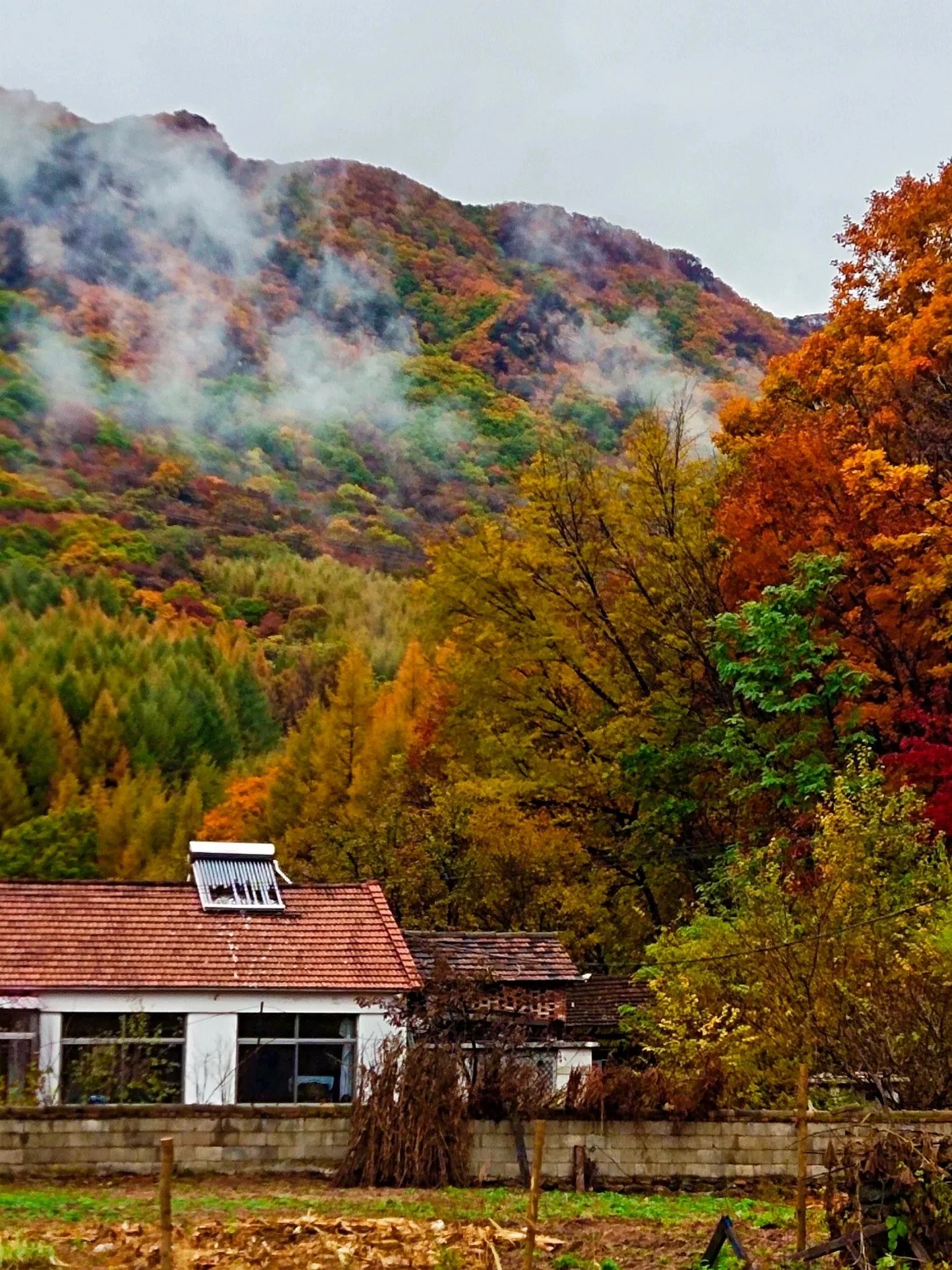
Kyoto's autumn red is Japanese maple, Acer palmatum, called iroha momiji locally. The standard window is mid-November to early December, usually peaking in the final week of November. Tofuku-ji's Tsutenkyo bridge is the headline act — around 350,000 autumn visitors, admission rising from 600 to 1,000 yen in foliage season, and no photography allowed on the bridge.
Kyoto's problem is people. In 2024 the city recorded 56.06 million visitors, 10.88 million of them foreign, up 53.5%. Overnight guests hit a record 16.3 million, of which 8.21 million were foreign — the first time since records began in 1958 that foreign overnight guests outnumbered domestic ones. Among Japanese visitors, 48.4% report dissatisfaction with crowding and etiquette.
Benxi, Liaoning, is the match — and this is the pairing where I have to be honest: it's the most genuinely equivalent pair on this list.
Benxi's "maples" are also maples, same genus as Kyoto's. The city government's official count names twelve species, and Japanese maple is on the list — it grows here too.
So Benxi's case can't rest on species. It rests on scale. The city holds 26,500 mu of maple forest, 3.2% of its wooded area. Across Liaoning, maple covers 56 mu-scale thousands, with 48,900 concentrated in the eastern mountains: Benxi 26,500, Fushun 16,400, Dandong 6,000. In 2011 the national forestry administration designated Benxi "China's Maple Capital," and in 2021 Liaoning passed the province's only single-species protection ordinance, specifically for Benxi's maples.
This is contiguous wild maple forest, not cultivation. Kyoto's maples are landscape art planted inside temple gardens; Benxi's are a forest growing up a mountain. That's the real distinction, and it's the one worth telling people.
Getting there
Benxi, Liaoning, with the main viewing in Benxi Manchu Autonomous County (Guanmenshan, Laobiangou, Dashihu) and Huanren County (Fenglin Valley).
The train gets you to Benxi station in about 30 minutes from Shenyang; Guanmenshan is another 50 km, an hour or so by road. Nanfen North station puts you closer. If you're driving, the Benxi–Huanren highway is nicknamed China's Maple Avenue — 130 km of colour where the road itself is the attraction, no scenic-area ticket required. That's how locals do it.
Guanmenshan holds a roughly 200-year-old "Maple King," insured for 10 million CNY, which turns earliest and drops latest and carries leaves with anywhere from 3 to 13 lobes on the same tree. Laobiangou is a stream valley; Dashihu adds water; Fenglin Valley in Huanren is quieter.
Window: early to mid-October. Guanmenshan's 2025 golden period was October 5–15.
Tickets: Guanmenshan lists at 90 CNY, discounted online from about 50. Laobiangou and Dashihu run 50–78.
If Kyoto's crowds are what put you off — and the numbers above suggest they should — Benxi in the first half of October is the honest alternative: same genus, thirty times the acreage, a fraction of the people. Our Beijing private tours connect to Liaoning easily if you want to pair it with the Wall.
5. Golden conifer: the Rockies' larch and Kanas's
The Canadian Rockies offer a different kind of autumn — not red leaves, but gold needles. The star is Lyall's larch, Larix lyallii, the only deciduous conifer in the subalpine zone of the Canadian Rockies. It turns gold in autumn and then drops its needles entirely, which is how it survives extreme snow load and cold.
The window is brutally short: mid-September to early October, peaking in the last two weeks of September, full colour for only 7–10 days. Access is the hard constraint — Moraine Lake Road has barred private vehicles in peak season since 2023, a measure Parks Canada has classified as permanent. You take the shuttle, and larch-season seats sell out weeks to months ahead.
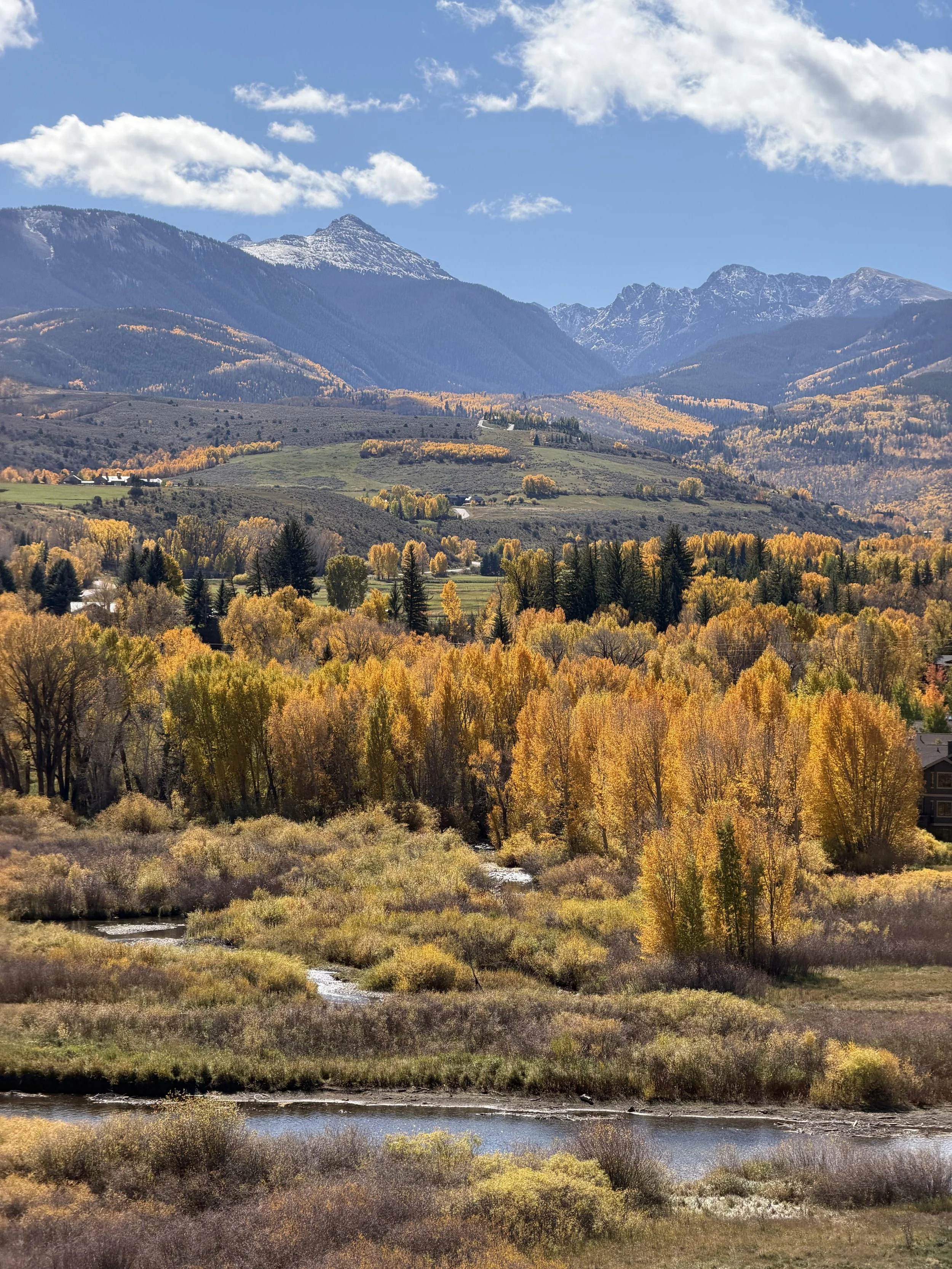
Kanas, in Xinjiang, counters with Siberian larch, Larix sibirica, the canopy dominant and a tree that turns 5–7 days ahead of the birch. The Kanas reserve is described as China's only European–Siberian taiga ecosystem, and more precisely in academic terms as the southern limit of Siberian flora's post-glacial spread down the mountains — the last place those species reached.
Colour here arrives in layers. Early September takes the high ground first, above 1,800 m — the ridges around Kanas Lake and the slopes behind Hemu. Mid-to-late September brings the 1,200–1,800 m band: the Three Bays and the Hemu river valley. Early October closes with European aspen flushing red. The golden window is roughly September 20 – October 5.
One technical correction: the "birch" at Kanas is mostly downy birch, Betula pendula, also called European silver birch. It grows across Europe, Siberia, eastern Kazakhstan and Mongolia. Which means Kanas's golden birch is the same species as Scandinavia's and supports no uniqueness claim whatsoever.
The uniqueness lives somewhere else entirely: Tuva villages. China retains just three Mongol-Tuva settlements — Hemu, Kanas, and Baihaba — roughly 2,000 people total. Log cabins are stacked from raw timber without nails, chinked with moss, steep-pitched to shed snow, some half-buried. Taiga plus log cabins exists in Russia, Finland and Canada. Taiga plus birch plus a Tuva settlement plus a glacial dam lake plus morning mist — as one package — does not exist anywhere else.
Getting there
Kanas scenic area, Burqin County, Altay Prefecture, Xinjiang — the Altai mountains where China meets Kazakhstan, Russia and Mongolia.
Fly to Kanas Airport (KJI), about 60 km from the park, with seasonal routes from Urumqi, or Altay Airport (AAT), roughly 160 km out and 3–4 hours by road. By train, Urumqi to Beitu, then bus or private car, 6–7 hours total. Driving is about 12 hours from Urumqi on G217 — but note that private cars cannot enter the scenic area in normal season; you switch to the internal shuttle.
Inside: Kanas Lake and the fish-viewing platform; the Three Bays — Shenxian Bay for morning mist, which means arriving early; Moon Bay; Wolong Bay, with a walkable trail between them; Hemu village, where the pre-dawn climb to the viewing platform for mist over the village is the signature shot, staying in a wooden cabin. Baihaba, China's northwesternmost village, requires a border permit — arrange it at your local police station or the Burqin government service centre beforehand.
Window: roughly September 20 – October 5. Avoid October 1–5 entirely; that's the peak holiday crush.
Tickets: 160 CNY peak season (May 1 – October 15), valid two days, plus 70 CNY round-trip shuttle. Book via the Kanas official WeChat accounts. Days are mild and nights need a down jacket. UV is strong — SPF 50 and above. Take insect repellent; the forest is buggy.
If Kanas is on your list, see our Xinjiang tours — the timing and permits are the two things that trip people up, and both are handled for you. Our China by train guide covers the Urumqi and Beitu legs.
6. Lakeside autumn: what Jiuzhaigou's real rival is
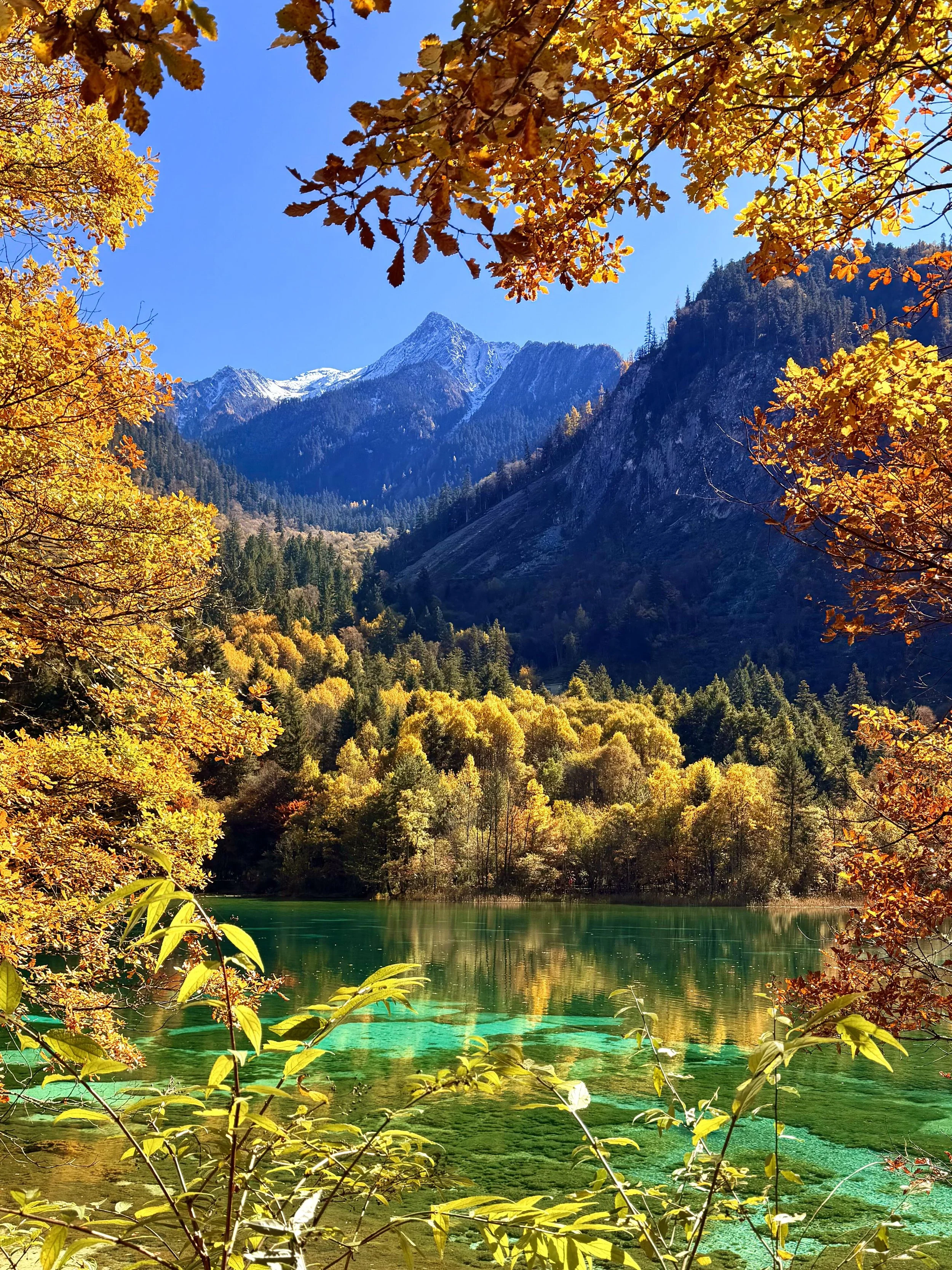
Jiuzhaigou's autumn is travertine lakes plus colour forest — 114 lakes, terraced pools and cascades, and the 270 m wide, 24.5 m tall Nuorilang Waterfall. Travertine covers about 2.4 sq km of the core valley, built up over roughly 30,000 years. It was inscribed with Huanglong as a World Natural Heritage site in 1992, and the travertine is the core of its Outstanding Universal Value. Peak viewing is late October to early November, when foliage indices reach 60–95% and the red-to-turquoise contrast is at its strongest.
But "the world's only travertine lake" doesn't hold up.
There are several comparable sites, and more than one of them is in China. Huanglong has over 5,100 travertine pools, golden rather than turquoise, and the largest of their kind — and it is not part of Jiuzhaigou; the two are more than 90 km apart and separately ticketed. Pamukkale in Turkey is white terraced travertine, 2,700 m long and 160 m high, fed by 17 springs at a constant 36–38°C, sitting alongside the Roman city of Hierapolis — also a World Heritage site. Yunnan's Baishuitai is a fourth.
The mechanisms differ too. Huanglong is chemical plus biological deposition, with around 86 algal species and over 80% vegetation cover, producing a porous, loose structure that degrades easily. Pamukkale is mainly physicochemical, with about 38 algal species and low vegetation cover, producing dense, highly crystalline travertine that doesn't collapse.
So the claim that survives is narrower and better: Jiuzhaigou is a rare combination of travertine-dammed lake groups and terraced cascades, and its singularity lies in the composite — travertine lakes plus terraced falls plus colour forest plus snow peaks, all inside one valley. Travertine isn't unique to China. Getting all four into a single frame is rare.
Getting there
Zhangzha township, Jiuzhaigou County, Aba Tibetan and Qiang Autonomous Prefecture, Sichuan — southern Minshan range, at the headwaters of the Baishui River.
Jiuzhai Huanglong Airport (JZH) sits at 3,448 m in Songpan County, about 88 km from the park, 1.5 hours by road — watch for altitude sickness on arrival. Better now: Huanglong Jiuzhai high-speed rail station, roughly 2 hours from Chengdu East, then a 2-hour bus. Driving from Chengdu takes about 8 hours via Dujiangyan, Wenchuan and Songpan.
Inside, the valley is a Y shape. The Rize valley on the right is the highlight: Five-Flower Lake, Pearl Shoal Waterfall, Mirror Lake, Arrow Bamboo Lake, Panda Lake. The Zechawa valley on the left has Long Lake and Five-Colour Pool. The Shuzheng valley trunk runs Nuorilang Waterfall, Rhino Lake, Shuzheng Waterfall, Sparkling Lake, Reed Lake and Bonsai Shoal.
Window: late October into early November. Jiuzhaigou's is tight — miss it by ten days and you'll catch bare branches against turquoise water, which is beautiful but not why you came.
Tickets: 190 CNY plus 90 CNY shuttle in 2025 peak season (April 1 – November 15), 280 total. Online real-name booking only — no ticket window on site. The only official channels are the Jiuzhaigou WeChat account and the Aba tourism site. Peak season realistically needs 3–5 days' lead time; in 2025, tickets for October 2–6 sold out on September 27.
For the Sichuan leg as a whole, including the panda base, see why Chengdu is known for pandas — it's the natural pairing with Jiuzhaigou.
7. Red wetland: the type almost every list forgets
Here's where the standard comparison breaks down completely, because it's looking in the wrong place. Some of the world's best autumn colour isn't foliage at all.
Southern France's Camargue, in the Rhône delta, protects over 100,000 hectares. Among its habitats are the sansouïres — salt meadows growing glasswort, in the genus Salicornia — which turn vivid red in autumn. The same area has salt pans coloured pink by Dunaliella salina algae, and hosts Europe's only breeding colony of greater flamingos.
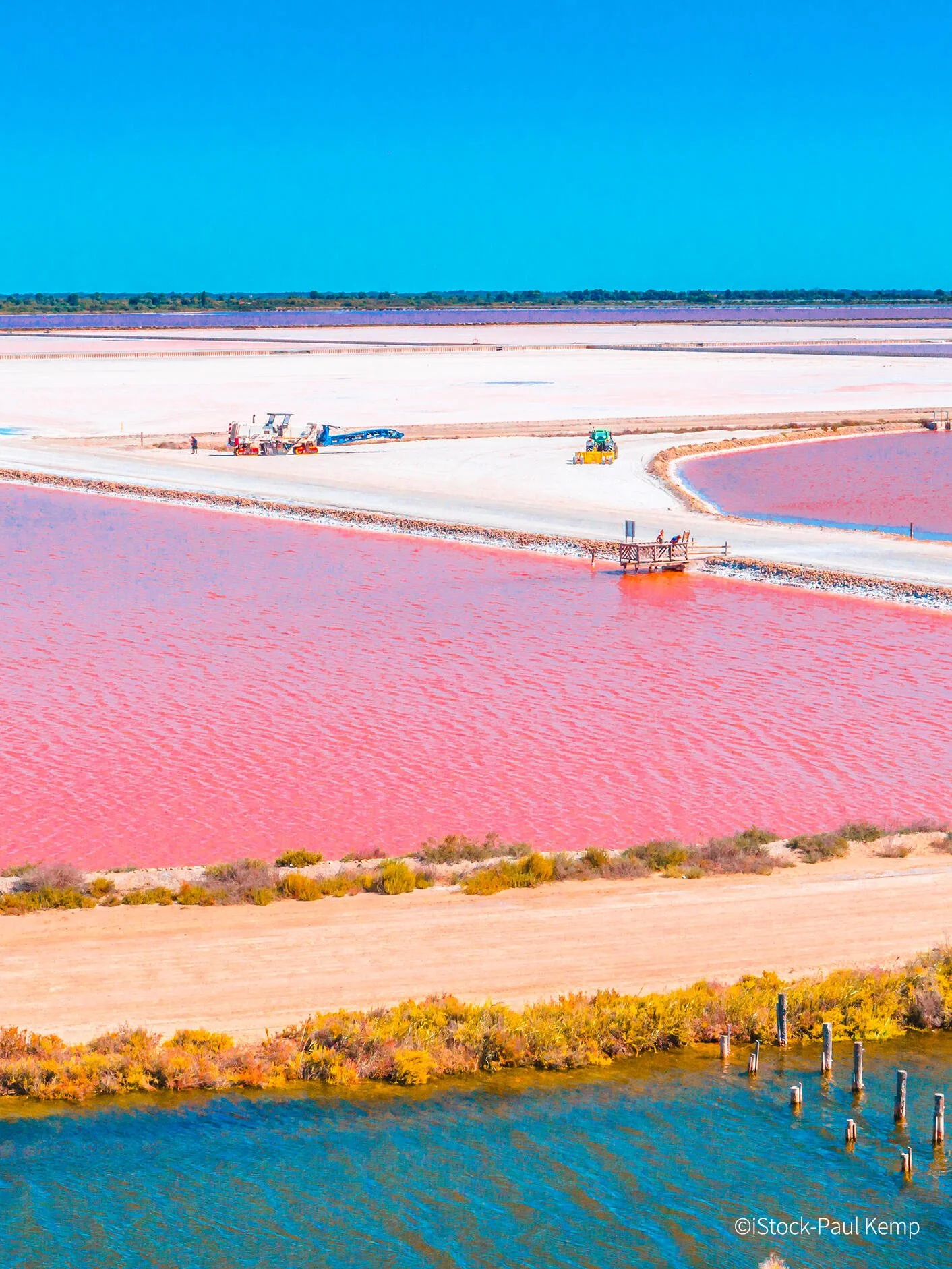
Panjin in Liaoning answers it, and the plant is saltmarsh seepweed — same family, same genus as the French glasswort, growing on the same kind of saline flat, turning from green to red to purple on the same autumn schedule. This is the cleanest international pairing in the entire article: not analogous plants. The same group of plants, doing the same thing, on two continents.
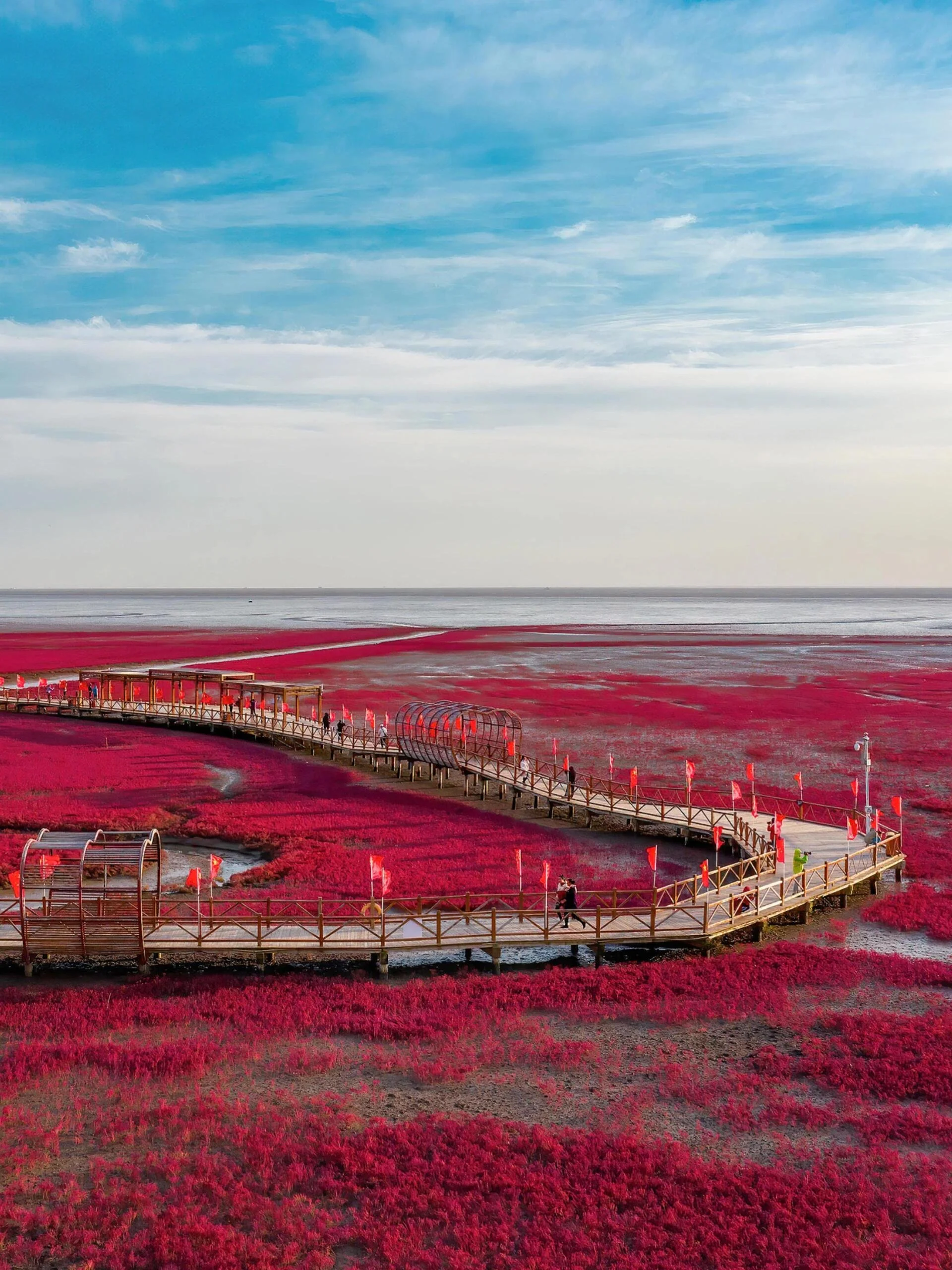
And Panjin's case is the stronger one, for three reasons.
Continuity and purity of scale. The Red Beach Scenic Corridor runs 18 km along the coast and holds 5A national scenic area status. After years of restoration, seepweed coverage reached 28,500 mu by 2025, up fourteenfold from 2,000 mu in 2018, covering essentially the full 18 km shoreline. The Camargue's red meadows exist as fragments scattered across salt marsh. Panjin is one continuous red carpet for 18 km.
It sits beside the world's largest coastal reed marsh — Panjin's reed wetland is stable at 1.2 million mu, producing around 400,000 tonnes annually. Red seepweed against green reed beds in a single frame is Panjin's signature composition, and the Camargue has no equivalent.
It stacks industrial heritage and a migration stopover on top. Liaohe oilfield pump jacks work right beside the reed marsh — industry and wetland in one view, which is unique to Panjin. The same wetland is a key staging post on the East Asian–Australasian Flyway, hosting over 300 bird species and millions of birds annually. Overwintering red-crowned cranes went from 5 individuals in 2014 to 280 in 2026. The Saunders's gull breeding population hit 11,200 in 2025 monitoring, and the Liao River estuary now supports more than half the global population of the species.
One point worth clarifying, because it's widely misunderstood: seepweed's red isn't caused by cold the way maple and ginkgo colour is. There's no anthocyanin response to low temperature driving this. The colour comes from salinity, temperature and light acting together. It sprouts in April and shifts green to red to purple from September into mid-October. Maple and ginkgo run on cold and anthocyanin; seepweed runs on salt stress. Different biology, same visual result — and knowing that is exactly the kind of detail that separates a real guide from a rewritten one.
Getting there
Red Beach National Scenic Corridor, Dawa District, Panjin, Liaoning — the centre of the Liao River delta on the northern shore of the Bohai Sea, China's northernmost coastline.
Panjin itself is odd in a way worth mentioning: average elevation is about 4 m, the highest point is 18.2 m, and there are no mountains at all. Twenty-one rivers cross it. It's the rare city in the northeast that's entirely flat.
Trains from Shenyang take about an hour, and an hour and a half from Dalian; Panjin North serves the Beijing–Harbin line. Allow an hour's drive from the city to the scenic area. Public transport reaches the Erjiegou gate.
Inside: the wooden boardwalk for the classic shot (light-coloured clothing against the red flat reads best), the Sky Mirror platform for sunrise and sunset, the rice paddy art tower giving a 360° view of the field paintings, and the reed beds for backlit silhouettes at sunset.
Best photography hours: 6–8am and 4–6pm.
Window: September to mid-October, strongest as it shifts from red toward purple.
Tickets: 110 CNY adult (2025 figure), half price for students and seniors. Open 8:30am–5:30pm.
Worth knowing: Panjin's own government publishes two different seepweed figures — 28,500 mu in one release, 67,000 mu in another. If you see conflicting numbers elsewhere, that's the source, not an error in your reading.
8. Steppe autumn: five types of tree, zero of which are the point
Here's the flaw running through most autumn comparisons, including the Chinese-language version this piece came from: they only count trees. But some of the most spectacular autumn on Earth is grass.
The foreign reference points are Mongolia's Khentii grasslands, where feather grass and wheatgrass go gold; the Scottish Highlands, with heather and coarse grasses; and North America's prairie remnants.
China's versions are Hulunbuir in Inner Mongolia and Bashang in Hebei. The layering at Hulunbuir runs: grassland grasses turning gold, then birch turning yellow, then larch turning gold, stacked. Ergun's birch forest is the purest single sample of this type.
China's advantage here has nothing to do with species, and everything to do with two other things.
Terrain relief. Bashang is a rolling, hilly steppe — undulating ground, scattered woodland, hay bales on the slopes. That's visually nothing like the flat expanse of the North American plains. When photographers talk about golden waves running across the land, relief is what makes it possible. The Scottish Highlands are also undulating, but with heather and a different palette entirely.
Imperial hunting-ground overlay. Mulan Weichang was the Qing dynasty's imperial autumn hunting reserve, and Saihanba National Forest Park and the Yudaokou ranchlands sit in the same region. Steppe autumn, plus a Qing imperial reserve, plus one of the world's largest man-made forests planted over sixty years, stacked in one place. There's no foreign equivalent. This is another "unique by combination" case — and one the tree-counting approach would miss entirely.
Getting there
Bashang spans Weichang Manchu and Mongol Autonomous County (Mulan Weichang, Saihanba, Yudaokou) and Fengning Manchu Autonomous County in Chengde, Hebei — geographically the southern edge of the Inner Mongolia plateau.
About 300–400 km from Beijing, 4–5 hours by car via the Jingcheng expressway, then the Chengwei expressway. Public transport is impractical here — drive or hire a car. Roads are good; an ordinary sedan handles them.
Key stops: the Baili Tianlu scenic highway, which is the autumn spine; Saihanba National Forest Park; Yudaokou ranch for hay bales and livestock; and Jinshanling Great Wall to the southwest, where autumn colour peaks in mid-to-late October and pairs well.
Window: mid-September to early October is the photographic peak — about twenty days. The grassland reads well from September through November.
Note that Bashang's distances are large and services are sparse; plan fuel and food accordingly.
9. Golden rice terraces: where Bali meets its match
Another type the tree-based approach misses entirely, and one where China can compete directly with the international destinations people already know.
The familiar foreign references are Bali's Tegallalang terraces, Sa Pa in northern Vietnam, and the Banaue rice terraces in the Philippines, which hold World Heritage status.
China's are Longji in Guangxi and Jiangling in Wuyuan, Jiangxi, with Jiabang in Guizhou as a third. Longji's autumn is rice turning from green to gold across the whole slope, and the official viewing peak is mid-to-late September through October.
Longji holds two advantages.
Elevation span and density. Longji climbs from the valley floor to the ridge, and the vertical range combined with the tight spacing of the terrace lines produces a line density most Southeast Asian terraces don't have. Bali's terraces are more open and amphitheatre-like by comparison.
The terraces are bound to ethnic minority settlement. Longji's core areas — Ping'an, Dazhai, Jinkeng — are Zhuang and Yao (specifically Red Yao) villages, and terrace plus stilted timber house plus Red Yao community forms a complete living landscape. Bali's terraces have temples and settlements too, but paired with Balinese Hindu shrines rather than an ethnic minority timber architecture. That difference can't be substituted.
While we're here: Wuyuan Huangling's shaiqiu — the "drying autumn" practice of setting out trays of chillies and corn — peaks late October through November, which means Wuyuan has a continuous autumn window of well over a month when you combine the terraces in September and October, the drying racks in late October and November, and Shicheng's maples in November.
One fair point about shaiqiu, since it's often oversold as uniquely Chinese. Similar drying traditions exist abroad: Espelette in France's Basque country strings and sun-dries chillies on balconies from September to October, a practice dating to the 17th century, protected under AOP status since 2000, with a chilli festival on the last weekend of October. Japan's hoshigaki and Korea's gotgam are the same idea. So shaiqiu's originality isn't the drying. It's that a working agricultural process was turned into a landscape, and bound to Huizhou architecture. Huangling was founded in the Ming dynasty, the practice has run for over 500 years, and the village sits on a 20–50° slope — the third storey of each house is a dedicated drying floor, used for that purpose because there's no flat ground to work with. Necessity became a visual language.
Getting there
Longji town, Longsheng Various Nationalities Autonomous County, Guilin, Guangxi — about 80 km northwest of Guilin.
Trains from Guilin take two hours to Guilin North or Guilin station, then a bus or private car onward. Guilin also runs direct tourist shuttles. Flying, Guilin Liangjiang International (KWL) is about 100 km out.
Three viewing areas inside, and they're separate trips within the park: Ping'an, with the Nine Dragons and Five Tigers and Seven Stars Around the Moon viewpoints, oldest and best set up for accommodation; Jinkeng / Dazhai, the largest, with three viewpoints and a cable car; and Ancient Zhuang Village, the most untouched and least visited.
Window: mid-to-late September through October. One warning — once the rice is harvested the terraces turn grey-brown, so arriving a week or two late means you've missed it entirely.
Allow one to two days and stay up on the mountain. The paths are steep and the timber guesthouses have thin walls, which is part of the experience.
For the Guangxi side as a whole — Guilin, Longji, and the Guilin–Guizhou route — browse all our China tours to see how it connects.
10. Bald cypress and dawn redwood: a rare case where China is the importer
This one is genuinely interesting because it inverts the pattern of everything above.
Look at the American South — Louisiana and Florida — where bald cypress, Taxodium distichum, grows in swamps with flared, buttressed trunks and woody knees rising from the water, needles turning rusty red in autumn and reflecting in the surface below.
China's versions are Zhimang Ridge in Nanjing, Siming Lake in Zhejiang, Qinglong Bay in Anhui, and Shimen National Forest Park in Guangzhou.
Key fact: both bald cypress and pond cypress are native to North America. China introduced them. This type has no species-level uniqueness for China at all, and saying otherwise would be dishonest. It's the exact inverse of the ginkgo situation.
So what is there to see? The way water and planted forest combine. In southern China these trees are typically planted around reservoirs, lakes and wetland parks, producing "water forests." The stands at Siming Lake and Zhimang Ridge were planted at scale in the 1950s through 1970s as water-conservation cover, and have grown into ordered groves whose reflection in still water creates a regular red array. It's another example of a plantation maturing into a landscape.
A common confusion worth clearing up: bald cypress, pond cypress and dawn redwood are three different trees. Dawn redwood, Metasequoia glyptostroboides, is Chinese, and is the famous "living fossil" — its wild population survives only where Hubei's Lichuan, Chongqing's Shizhu and Hunan's Longshan meet. So in this category, China's genuinely unique contribution isn't bald cypress, which it imported. It's dawn redwood, an endangered relict species that grows wild nowhere else in the world, and Lichuan is where you go to see it.
Getting there
Zhimang Ridge Forest Park, Zhuzhen township, Luhe District, Nanjing — about 80–90 km north of central Nanjing, roughly 1.5 hours by car. Public transport doesn't serve it well; drive.
Window: late November to early December.
Nanjing's advantage is that three different autumn types peak simultaneously in late November: Zhimang Ridge's cypress, Qixia Mountain's maple — one of China's four classic maple sites, at 88 Qixia Street — and the Ming Xiaoling stone elephant road's ginkgo avenue, along with the plane trees of Lingyuan Road near Meiling Palace and the ancient ginkgo at Huiji Temple. Three weeks, three foliage types, one city. That's a genuinely efficient autumn trip and most foreign visitors don't know it exists.
Add Xi'an or Beijing and you have a classic first-China itinerary with autumn colour built in. If you're still sorting out entry paperwork, our 2026 visa-free guide covers the fifty eligible countries.
11. Pure birch forest: honest answer, no uniqueness
When Kanas's birches came up earlier, the conclusion was that downy birch is the same species growing across Scandinavia and Siberia. That conclusion stands, and there's no reason to dress it up.
China's birch in the northeast and Inner Mongolia is usually recorded as Betula platyphylla, which some taxonomic systems treat as a subspecies or variety of Betula pendula. The classification debate is live and this article won't settle it — flagging it is more honest than picking a side, because different references will give you different answers.
The foreign equivalents are Finnish Lapland, northern Sweden and Siberia. So this type offers no uniqueness, and the honest conclusion is that birch autumn is a general mid-to-high-latitude subarctic landscape — Scotland to Hokkaido to Alaska.
What China does have, worth mentioning once: the birch-larch mixed layer. In the Greater Khingan range and around Arxan, birch in gold and Siberian larch in gold interleave by elevation and aspect, and volcanic landforms sit inside it — Arxan's crater lake, the stone forest, Azalea Lake, the Three Gorges. Elsewhere has birch forest, and elsewhere has volcanic terrain. The specific combination of contiguous birch, contiguous larch, and a volcanic-dammed lake group is uncommon. But this is a soft claim and I'd rather say so than inflate it.
One addition the usual lists miss entirely: Jiaohe's Red Leaf Valley in Jilin, which placed third in China National Geographic's ranking of China's ten greatest autumn landscapes, scoring 90.75. It runs over 50 km along a valley on the Laoyeling range, a spur of the Changbai mountains, with more than ten deciduous species. The local name for it is "five-flower mountain" — because species respond to frost differently, you get fiery red, orange, gold and still-green leaves simultaneously.
Getting there
Ergun birch forest, Ergun City, Hulunbuir, Inner Mongolia — about 40 km north of Ergun city centre along Provincial Road 201. Fly to Hailar (HLD), then drive or hire a car, roughly 2.5 hours. No convenient public transport. Window late September to early October. Tickets with shuttle around 62 CNY.
Jiaohe Red Leaf Valley, Qingling and Songjiang townships, Jiaohe, Jilin — in the Qingling area of Lafa Mountains National Forest Park. About 36 km west of Jiaohe city; from Jilin city, take the road toward Jiaohe and turn onto the valley road at Qingling, roughly an hour. Drive. Window is September 25 – October 10, about two weeks, which is generous by the standards of this article. Tickets 50 CNY for the main valley, 100 CNY for a pass covering Hongye Valley, Guzhong Valley, Qingling Waterfall and Guwai Valley.
What actually makes Chinese autumn unique
Eleven comparisons in, the conclusion is fairly clean: smoke tree, ginkgo, Euphrates poplar, birch, aspen, maple, seepweed, rice — not one of these species belongs to a single country. The claim that China has every type of autumn and that its landscapes can't be copied doesn't survive contact with the botany.
But a narrower version does hold, and it's more useful anyway: China's distinctiveness is in the density of its combinations. Any single element is unremarkable. Stack them and you get something that can't be reproduced.
Ejina — Euphrates poplar, the Badain Jaran Desert, an inland river's terminal lake, a Tangut city ruin, and a ghost forest. Kazakhstan has the poplars. It doesn't have the city or the lake.
Xiangshan — smoke tree, a Qing imperial mountain garden, a classical literary lineage, and 20 km from a capital city of 22 million. Europe has smoke tree. Versailles and Fontainebleau never turned it into a national landmark. (A note on a claim you'll see repeated: there's no reliable source for the idea that Versailles planted smoke tree, so don't pass it on.)
Panjin — seepweed, 1.2 million mu of the world's largest coastal reed marsh, an oilfield, and a flyway hosting over 300 species. The Camargue has the seepweed and the flamingos. It doesn't have the reed marsh at that scale, and it certainly doesn't have pump jacks in the frame.
Jiuzhaigou — travertine lakes, terraced cascades, colour forest and snow peaks, stacked in one valley.
Kanas — taiga, birch, Tuva settlement, glacial dam lake, morning mist.
Wuyuan Huangling — a working agricultural process turned into landscape, bound to Huizhou architecture on terrain with no flat ground to spare.
That's the honest case, and it's a better one. "China has everything" invites scepticism and gets fact-checked. "These specific things only line up in these specific places" is verifiable, and reads like a person who actually went and looked.
Why China's autumn lasts three months
Foreign windows are narrow. Canadian larch peaks for 7–10 days. Vermont's individual sites run about a week. Aspen gives you the third and fourth weeks of September and that's it. This is the single most practical difference, and it's why planning a China autumn trip is less stressful than planning a New England one.
China's north-south span and elevation range stretch autumn into a near-three-month line, running north to south and high to low in sequence, varying only by a few days year to year. This is geography, not marketing.
Mid-to-late September — Kanas and Hemu, Xinjiang: Siberian larch and downy birch, taiga gold
Late Sept – early Oct — Hulunbuir, Ergun and Arxan, Inner Mongolia: birch and larch, Greater Khingan colour
Late Sept – early Oct — Bashang, Mulan Weichang and Saihanba, Hebei: steppe grasses turning gold, hay bales on rolling hills
Late Sept – mid Oct — Panjin, Liaoning: seepweed shifting green to red to purple
Late Sept – early Oct — Jiaohe Red Leaf Valley, Jilin: five-flower mountain, ten-plus deciduous species
Mid-to-late Sept – October — Longji, Guangxi: golden rice terraces
Early-to-mid October — Ejina, Inner Mongolia: poplar at full gold, roughly twenty days
Early-to-mid October — Benxi, Liaoning: contiguous wild maple
Late Oct – early Nov — Xiangshan, Beijing: smoke tree, nearly 100,000 trees
Late Oct – early Nov — Jiuzhaigou, Sichuan: travertine lakes and colour forest at peak
Late Oct – November — Wuyuan Huangling and Shicheng, Jiangxi: drying racks and maple
Mid-to-late November — Seoul, South Korea (for comparison): Deoksugung ginkgo
Mid-to-late November — Nanjing, Jiangsu: maple, bald cypress and ginkgo all at once
Mid-Nov – early Dec — Tengchong, Yunnan: 30,000-plus ginkgo trees
Late Nov – early Dec — Haiyang, Guangxi: ginkgo on a million-tree scale
February to December, minus the gap, gives you a continuous window from mid-September to early December. Very few countries can say that.
For the operational detail on each of these — tickets, booking lead times, day-by-day routing, transport links — our 2026 China autumn travel guide covers all thirteen destination chapters with current pricing. That piece is the itinerary; this one is the background.
Things to sort before you go
Pick the window before the destination. The most useful way to read the timeline above is backwards: find your leave dates, then see what's peaking. Get this wrong and you travel a long way for the wrong colour. Ejina over the National Day holiday usually means trees mid-turn with uneven colour; October 5–15 is the safer bet.
Book peak-season tickets ahead. Jiuzhaigou is online real-name only with no on-site window, needing 3–5 days in peak season. Xiangshan takes weekend bookings in foliage season. Kanas doesn't allow private vehicles and needs shuttle reservations. Maroon Bells needs a parking or shuttle reservation during the day. Panjin is worth booking online in peak season too.
Carry your actual passport or ID card. Ejina and Jiuzhaigou both require real-name entry on a physical document in peak season. Photos and photocopies are refused.
Plan for ten degrees between day and night. Northern and western destinations swing hard. Kanas and Ejina both flirt with freezing at night. Ejina adds dust and dryness — protect your camera.
Watch the foliage reports, not the calendar. From September, regional meteorological services and scenic areas publish foliage updates. Xiangshan's hard trigger is minimum temperature: colour starts below 10°C and completes between 0 and 5°C. Ejina's official threshold is 80% yellow leaves. Panjin's is seepweed colouration and coverage. Check the latest official update a few days out rather than trusting a guide written a month earlier — including this one.
Fill the tank before Ejina. Services and petrol stations are sparse on the approach. Top up before you head into the desert.
Get the Baihaba border permit in advance. Either at your local police station or the Burqin government service centre. Without it you can't enter the village, and there's no workaround at the gate.
Questions we get asked
Is Xiangshan's red actually maple? No. It's smoke tree, Cotinus coggygria var. cinerea, nearly 100,000 trees. The park holds 14 species across 8 families; maples exist only in scattered pockets at Jingcui Lake and Yuhua Peak. The "maple" confusion traces to classical poetry, where the character usually meant sweetgum — a southern tree that can't overwinter in the north.
Is Ejina the world's largest poplar forest? No. The world's largest contiguous natural poplar forest is at Bachu in Xinjiang, about 316,000 mu. The largest, densest and healthiest poplar forest park is at Luntai, also Xinjiang. Ejina's accurate framing is "one of the world's three remaining original poplar forests" and "the largest poplar forest in China's desert regions."
When should I go to Ejina? Early October, with a golden window of roughly twenty days. The official threshold is 80%+ yellow leaves. The first days of the National Day holiday usually catch the trees mid-turn; the reliable slot is October 5–15.
Do poplars really live three thousand years? That's literary framing, not data. Ejina's oldest tree, the Sacred Tree, was measured at 880 years — a first-class protected ancient tree.
Is Jiuzhaigou's travertine unique? No. Huanglong has over 5,100 travertine pools and is a separate site more than 90 km away. Pamukkale in Turkey and Baishuitai in Yunnan are comparable. The accurate claim is that Jiuzhaigou is a rare combination of travertine-dammed lakes and terraced cascades, with its distinctiveness lying in the composite with colour forest and snow peaks.
Is ginkgo native to China or Korea? China. The wild population is believed to survive only around Tianmu Mountain in Zhejiang, and it's listed as Endangered. Korea's and Japan's ginkgo are introductions. Seoul's city tree is nonetheless ginkgo, designated in 1971.
Is the red at Panjin caused by autumn cold? Not the way maple colour is. There's no low-temperature anthocyanin response here. Seepweed's colour comes from salinity, temperature and light acting together, developing from September into mid-October. Camargue's glasswort, in the same genus, works the same way.
Is Kanas's birch unique? No. It's mostly downy birch, Betula pendula, the same species found across Scandinavia and Siberia. Kanas's genuine distinctiveness is the Tuva log-cabin settlements combined with taiga, glacial lake and mist as a single package.
What about Japan's autumn versus China's? If you want the temple-garden version — refined, dense, framed by architecture — Kyoto is unmatched and worth the crowds. If you want wild scale and room to breathe, Benxi in early October is the same genus across 26,500 mu, with a fraction of the visitors. Genuinely different products; pick by temperament.
Can I still see autumn colour in late November and December? Yes. Xiangshan runs late October to early November, Jiuzhaigou late October to early November, Nanjing's combined maple, cypress and ginkgo peak mid-to-late November, and Tengchong's ginkgo village runs mid-November to early December, as does Haiyang in Guangxi.
Travel with people who know which tree it is
There's a practical reason to care about the botany. Guides who call Xiangshan's foliage "maple" are also the guides who'll take you to the wrong viewpoint in the wrong week. Getting the tree right is usually a sign the rest of the planning is right too.
We've been running private tours in China since 2014 — fourteen years, with in-house guides and drivers rather than freelancers, and local teams in Altay, Ejina, Beijing, Zhangjiajie, Wuyuan, Huangshan and Tengchong. Autumn is the season we plan hardest for, because a five-day shift in temperature changes everything, and that means itineraries need buffer days rather than fixed commitments.
What that looks like in practice: your own vehicle and driver, English-speaking guides who actually tell you what you're looking at, tickets booked ahead of the quotas, permits handled — including the Baihaba border paperwork and Tibet permits — and a coordinator reachable by WhatsApp from landing to departure. If early snow closes a road in Kanas, which happens after mid-October, we shift the itinerary rather than cancel the day.
The full 2026 autumn guide with all thirteen destinations and current pricing is here.
Or just tell us your dates and we'll tell you what's peaking — no charge for the answer, and we'd rather steer you to the right week than sell you the wrong one.
WhatsApp: +86 172 6789 8631
Email: rosewuqjzh@gmail.com
All destinations:zhangjiajietravelchina.com/china-tours

Sources
Every botanical name and figure in this article was checked against the following. Seasonal windows and ticket prices move; reconfirm on the official scenic-area account about 30 days before travel.
Ginkgo genome study, 545 genomes — Nature Communications, 2019
IUCN Red List of Threatened Species — iucnredlist.org
World Heritage listings (Jiuzhaigou, Huanglong, Wulingyuan, Pamukkale, Huizhou villages) — UNESCO World Heritage Centre
Plant taxonomy and accepted names — Plants of the World Online, Royal Botanic Gardens Kew
Species occurrence data — GBIF
Cotinus coggygria species profile — USDA PLANTS Database
Paris street tree figures — City of Paris
Seoul foliage routes and city tree — Seoul Tourism Organization
Larch Valley and Moraine Lake Road access — Parks Canada, Banff National Park
Panjin Red Beach restoration data — Panjin Municipal People's Government (panjin.gov.cn)
Ejina and Alxa poplar forest framing — Inner Mongolia Forestry and Grassland Bureau; Xinhua
Bachu and Luntai poplar forest records — Xinjiang Production and Construction Corps; Luntai County Government
Xiangshan foliage data — Beijing Municipal Forestry and Parks Bureau; Xiangshan Park Administration
Jiaohe Red Leaf Valley ranking — China National Geographic, China's Ten Greatest Autumn Landscapes, 2010
Written by Lynx Travel's content team in Xiangxi, Hunan, with input from our local teams in Altay, Ejina, Beijing, Zhangjiajie and Tengchong, and checked against the sources above. Pricing and windows verified August–September 2026.