

Furong Town: The Ancient Town Hanging on a Waterfall
Furong Town or Fenghuang Ancient Town — Which One Should You Choose?
Furong Town is a thousand-year-old town hanging on a waterfall. It is much smaller than Fenghuang Ancient Town, but it is the only ancient town in China with a waterfall running straight through it. Every other old town looks the same 365 days a year — the only difference is whether it is raining or sunny. Furong Town is different. Its most spectacular sight, the lit-up waterfall at night, depends entirely on how much water there is. If you come in the dry season — the flow starts dropping in September, and December to January is the low point — what you see may be very different from the videos that convinced you to come. June to August is the high-water period; February to June comes next; December to January is the lowest. But 2026 is not a normal year: a strong El Niño event has affected Furong Town even in what should be the dry season. All I can honestly say is that it will have an effect — how big, I don't know.
The important point: you need a ticket to enter Furong Town. And if you are giving Zhangjiajie three days out of your China trip, you should absolutely make the trip out here.
Furong sits inside the wider Zhangjiajie & Xiangxi travel guide — it's one of the stops on the map.
Fenghuang Ancient Town is the home of Shen Congwen, the great writer of western Hunan. It is not, however, the town in Border Town — the place he actually wrote about is another town in Xiangxi called Chadong. Fenghuang is one of China's most celebrated ancient towns, and its scale is far bigger than Furong.
You may ask why Chinese people love wandering old towns so much. I can only answer from my own point of view. Chinese textbooks and novels are written either about the author's hometown or about the utopia inside their head — so students, and readers moved by those books, want to go and see the place from the book for themselves. What social media now calls a bucket list. Fenghuang is exactly that: countless readers came because of one novel. What is interesting is that half of Fenghuang is architecture left from history, and half was built later, once enough people started coming. If you ask me which buildings are old and which are new — I don't know either.
The reason Fenghuang holds that position is not only the book. It also has a culture and history nothing else has, and its night view is genuinely beautiful. When Rewi Alley visited, he named the two most beautiful small towns in China: Changting in Fujian, and Fenghuang.
If your time in China is tight and you don't want to give up either one, my suggestion is this: after Tianmen Mountain or the Grand Canyon, take a private car to Furong Town for the night view, then sleep in Fenghuang. One line, nothing missed.
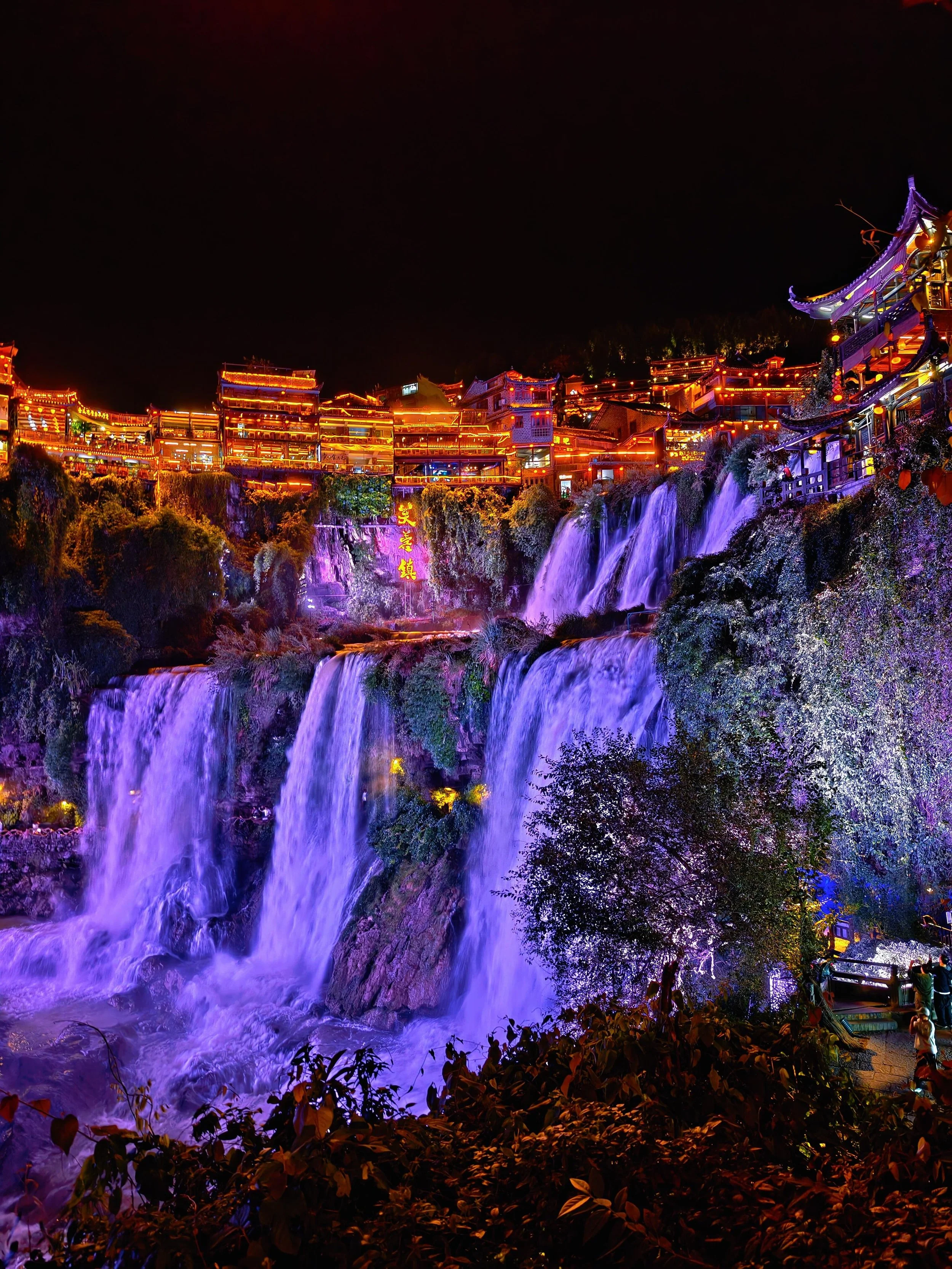
Furong Town and Zhangjiajie — What Is the Relationship?
Many bloggers call it "Zhangjiajie Furong Town." That is a misunderstanding. Zhangjiajie is Hunan's youngest prefecture-level city — it was only carved out as a separate city in 1988 — and the least populous of them, with about 1.46 million residents. Furong Town, however, administratively belongs to the Xiangxi Tujia and Miao Autonomous Prefecture. The correct way to say it is: Xiangxi's Furong Town.
Furong Town is about 65 km from Zhangjiajie city. Driving from the city, it takes about an hour and a half on the expressway (usually joining at Qingping); from Wulingyuan it is also about an hour and a half (joining at Yanghe). High-speed rail plus a short transfer comes to roughly the same hour and a half. If you are watching your budget, the train costs just ¥40. If you care about convenience, go by road — our 7-seat MPV round trip between Zhangjiajie and Furong Town is ¥1,200, and the driver can wait for you in Furong Town while you finish the night view. No transfers, no watching the clock; split six ways that is around ¥200 each, which is hard to beat.
Furong Town is about 110 km from Fenghuang Ancient Town, 33 minutes direct by high-speed rail — but the last train is at 19:45. During Golden Week holidays in May, October and Spring Festival, extra services run and the last one is at 22:05. Our private car package from Zhangjiajie to Furong Town to Fenghuang (one way, 7-seat MPV) is ¥1,700. It costs more than the train, but on a trip like this, not having to worry about intercity transport and not having to rush your photos is worth a great deal.
One important warning: the high-speed rail station is called Furongzhen. On 12306 or Trip.com, searching "Furong" may return nothing — search "Furongzhen" or the Chinese characters 芙蓉镇. For Fenghuang the station is Fenghuang Gucheng (凤凰古城). "Fenghuangcheng" and "Fenghuang Airport" are not the station you want.
If you are still sorting out how to use the rail system, our guide to buying train and domestic flight tickets with a foreign passport covers the part that trips most people up.
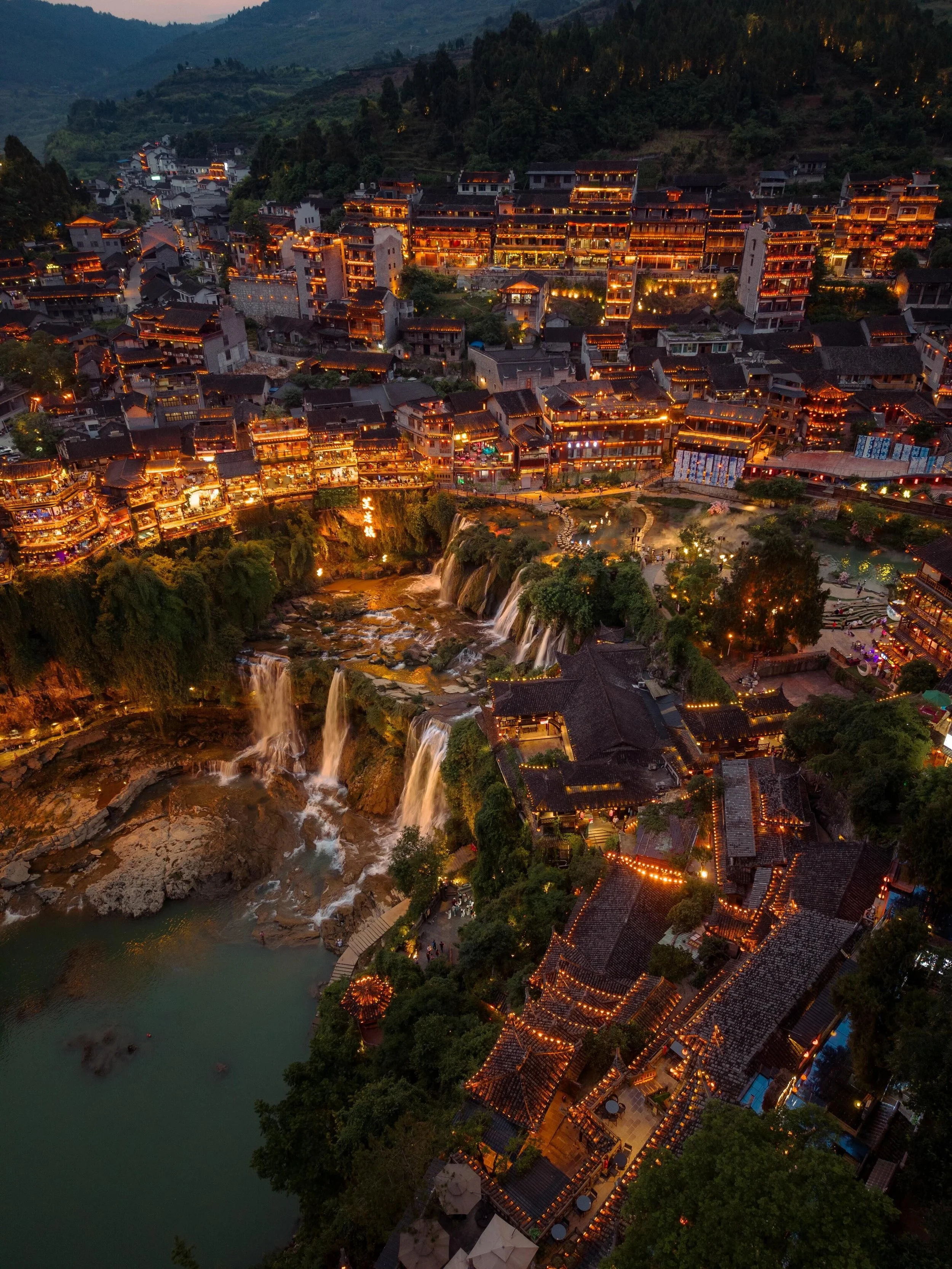
How to Get to Furong Town
The nearest airport is Zhangjiajie Hehua Airport (IATA code DYG), about 84 km from Furong Town. From the terminal, bus No. 4 goes to the high-speed rail station for ¥2 (about 1 hour 20 minutes), or a ride-hailing car takes 20 minutes for around ¥27 (that was my holiday price; it is usually a little lower). The train to Furongzhen station costs ¥40 and takes 23 minutes.
From Furongzhen station to the scenic area: taxis outside the station typically ask ¥30 per car. There is also a minibus to the bus station for ¥3; from the bus station, a 7-seat van into the scenic area is ¥30 per car if you take it directly, or ¥5 per person if you wait until it fills up.
From inside Zhangjiajie: from Zhangjiajie National Forest Park (south gate) or from Wulingyuan / Suoxiyu (east gate), take the city-to-park shuttle to the high-speed rail station for ¥13, then follow the same steps as above. From Tianmen Mountain, bus No. 17 takes 46 minutes to Zhangjiajie high-speed rail station for ¥2, or a taxi takes 17 minutes for about ¥20.
From Fenghuang Ancient Town: the shuttle between the old town and Fenghuang Gucheng station costs ¥7 flat, half price (¥3.50) for under-18s and over-60s. If you are staying downstream, near the Snow Bridge or the Ten Thousand Names Pagoda, take Line 1: Qifeng Square Visitor Center ⇌ Fenghuang Gucheng station. If you are near Nanhua Gate, Fenghuang Square or upstream of the Snow Bridge, take Line 2: Fenghuang Gucheng station ⇌ Tourist Distribution Center ⇌ Main Bus Terminal ⇌ Nanhuali Visitor Center. Line 3 only opens during holidays: Yunqiao ⇌ Fenghuang Gucheng station. From Fenghuang to Furong Town the train costs ¥53 and takes 34 minutes, then the same steps as above.
If you would rather not deal with any of the transfers, we run a private transfer from Zhangjiajie West Station, Hehua Airport and Wulingyuan, and a 7-seat business van if you are travelling as a group.
Furong Town Tickets
Adult ticket: ¥108 per person (government-guided price, including the "Hibiscus Bloom" folk performance inside the scenic area). Booking online in advance usually comes to around ¥98.
Where foreign visitors should buy: Trip.com first — one traveler I know bought theirs on the train and paid slightly less than at the gate. Domestic platforms such as Tongcheng also list a "non-mainland China visitor" ticket at around ¥100, purchasable online with your passport. Some guesthouse owners can also book a discounted ticket for around ¥70–90. Why do prices swing this widely? This is exactly why I wrote, in an earlier article, that foreigners travelling in China must carry a passport for train and flight tickets — scalpers here are extremely good at what they do. If you are staying in Furong Town, let your guesthouse owner issue the ticket for you. If you are not staying in town and a scalper is waving tickets at you by the ticket office door — don't believe them.
Half-price ticket ¥54: visitors aged 14–18, 60–65, and full-time students, with valid ID.
Free entry: children under 14, visitors over 65, active military personnel, disabled visitors and others, with valid ID.
Validity: once activated, the ticket allows multiple entries for three days.
Opening hours: 08:00–23:00, last entry at 22:00.
Two things worth knowing before you go, both of them reported first-hand by foreign visitors: the ticket must be validated with your passport and a facial scan before you enter, and at the gate you are issued a paper ticket you need to show every time you leave and re-enter — keep it on you for the whole visit. And at the ticket window itself, foreign cards can be used, though I would still have Alipay set up in advance as a backup.
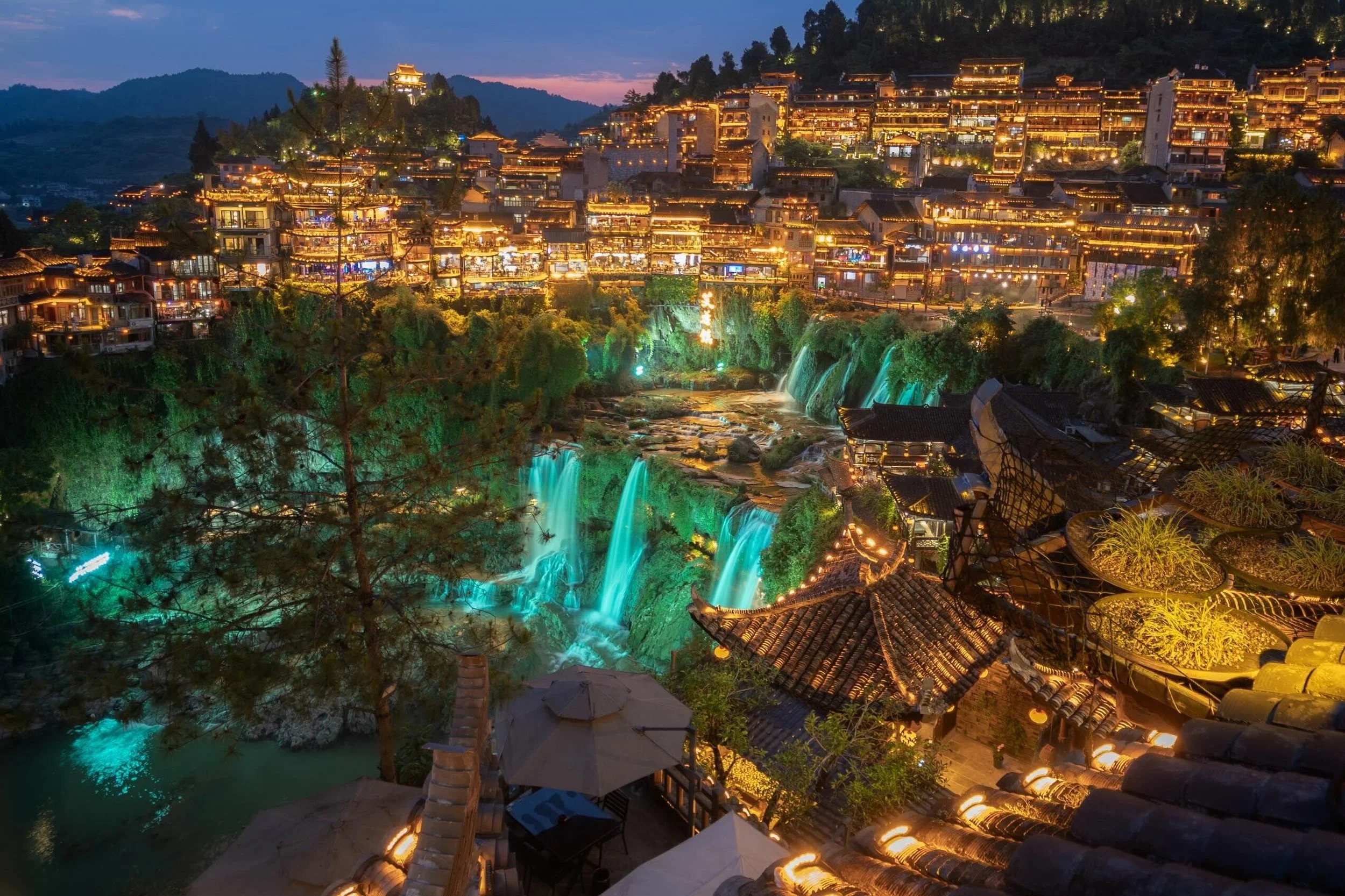
Where to Stay in Furong Town
Across Xiangxi and Zhangjiajie, Furong Town has the most expensive accommodation. The reason is simple: there is very little space, and nearly half the buildings hang off the cliff face — which is also part of why it stands out among Chinese ancient towns. Hotels away from the scenic area, on the other hand, cost about the same as in Zhangjiajie or Fenghuang. Inside the old town, I only recommend two places.
Water Cloud Gully Lodge (水云涧客栈)
● Location: No. 23, Xinqu Community, inside the scenic area, near Tuwang Bridge — about 250 metres in a straight line from the big waterfall
● Opened in 2021, guest rating around 4.7/5 (500+ reviews)
● Its waterfall-view balcony rooms and river-view rooms are the draw — you can watch the lit waterfall at night from your own balcony
● Free high-speed rail station pickup and free parking, which solves the "I can't get a car" problem outright
● From around ¥300 per night in normal periods, higher in peak season
Huashi Pubuwan 280° Waterfall-View Riverside Inn (花事·瀑布湾280度观瀑布临江美宿)
● Location: No. 032, Hepan Street, right in the core of the scenic area
● Opened in 2023, only 8 rooms, guest rating around 4.5–4.6 (590+ reviews)
● The selling point is a 280° front-on waterfall view — from the balcony it feels like your own private viewing platform
● Also offers free high-speed rail pickup; breakfast not included; it sits right beside the waterfall, so there is water noise at night — light sleepers should bring earplugs
● Peak-season rates are high, roughly ¥800–2,000 per night, but "lying in bed watching the waterfall" is hard to replace anywhere else in Furong Town
Three things to check before booking:
● Confirm with the property that they can host foreign guests. Hotels in China need specific conditions and must register foreign guests with the police, and small guesthouses cannot always do it. Being turned away at the door is the worst way to end a day. Both of these places are likely to accept foreign guests — there are foreign guests in their reviews — but ask "Can you host foreign guests?" before you book. It takes ten seconds.
● Be mentally prepared for winter. Xiangxi winters are damp and cold, and guesthouses — like most accommodation in southern China — have no central heating; air conditioning doesn't really solve it. Ask whether they have an electric blanket. It decides whether you sleep that night or not.
● Balcony views depend on the actual room type. Before you book a view room, check whether it is a "front waterfall" room or a "side river" room — the angle makes a big difference.
Both can be booked on the major booking platforms.
As for families or larger groups: I don't recommend staying the night in Furong Town. There are few hotels and prices are high. You can take the train or a private car back to Zhangjiajie, or go straight on to Fenghuang. Which one depends on where your next stop after Zhangjiajie is. If your next stop is a flight, you have to return to Zhangjiajie anyway. If your next stop is by rail, stay a night in Fenghuang instead — Fenghuang doesn't serve many destinations directly, but the next stop, Huaihua, is a rail hub in Hunan with more onward trains than Zhangjiajie. The point is that for the same money, you spend a night's sleep seeing one more of China's most beautiful ancient towns.
If you want a Zhangjiajie base rather than a Furong Town one, our where-to-stay guide and 4-day itinerary covers the alternatives.
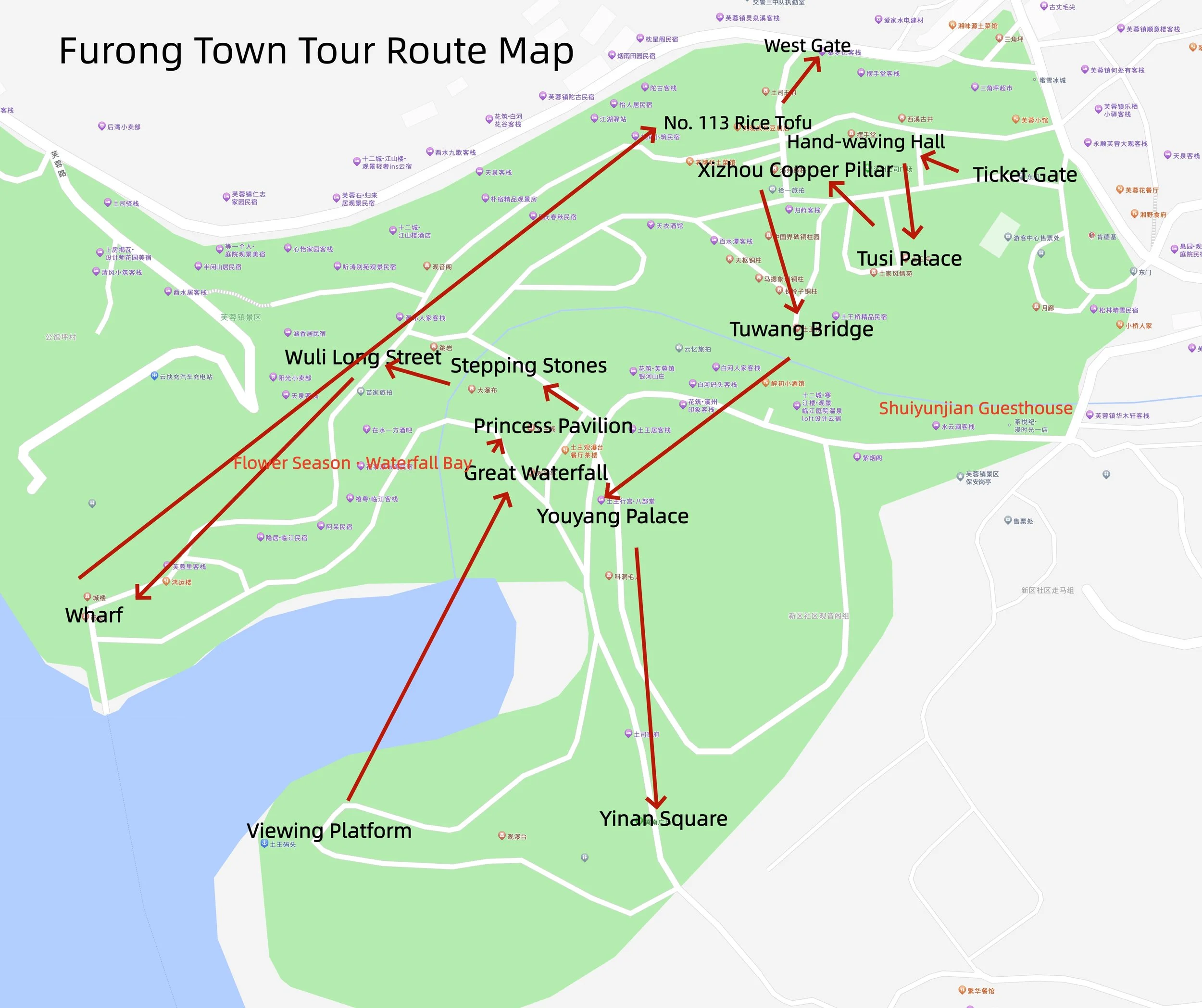
The Route Through Furong Town
Furong Town is small — you can walk the core area in two or three hours. The right way to do it is: Tianmen Mountain or the Grand Canyon in the morning, travel to Furong Town after lunch, and enter the town around 16:00. That timing is just right.
One warning: do not follow an AI-generated route. An AI itinerary will have you miss the Hibiscus Bloom performance entirely — unless, of course, that doesn't interest you.
The route: enter through the ticket gate → Baishou Hall → Tusi Palace → Xizhou Bronze Pillar → Tuwang Bridge → the viewing platform → Yinan Square → Youyang Palace → the Great Waterfall → Princess Pavilion → Tiaoyan stepping stones → Wuli Long Street → the wharf → backtrack → No. 113 Tofu Jelly → exit at the West Gate.
Whether you are here for half a day, a full day or two days, the route is basically the same. This is the most complete walking route I have put together in more than twenty years of guiding groups — it gets you to the Hibiscus Bloom performance and also to every corner of Furong Town. And the sunset from the wharf, the "Youyang sunset" — all it needs is for you to put it on your social media.
If you are combining this with the other Zhangjiajie sights, see our Tianmen Mountain guide, the Grand Canyon and Glass Bridge guide, and the Zhangjiajie National Forest Park guide.
What to Eat in Furong Town
Furong Town's food ranks among the best in China — but not everyone can eat it comfortably. Why? You will find out when you get there.
The flavour profile is salty, spicy and sour. Plenty of Chinese visitors say Xiangxi people eat too heavily; that isn't really it. It is tied to the local climate and geography — in autumn and winter, one mouthful of sour, spicy, salty chilli drives the cold out of your body. Enough talk. Here is the menu.
Tofu jelly (米豆腐): No. 113, the Liu Xiaoqing tofu jelly shop, ¥10 a bowl. Rice is ground into a slurry and set with alkali; the texture is smooth and tender. It comes in two shapes — small cubes or tadpole-shaped. The correct way to eat it: add pickled radish, then add chilli sauce and litsea oil from the table yourself. A drop of litsea oil — the soul of Xiangxi cooking — wakes you right up, sour and spicy and extremely appetite-opening.
Rice noodles (米粉): the local breakfast. Rice processed with alkaline water into thin noodles, springy and chewy, ¥8–15 a bowl. The price depends on the topping: three-delicacies (wood ear and pork), shredded pork with green pepper, braised pork intestines with soybeans, beef brisket with radish, or braised beef chunks. Three-delicacies and green pepper pork are the cheapest; beef is the most expensive. Remember to add two drops of litsea oil. It will wake you up.
Cured pork (腊肉): pork that has been salted and smoked over a long period. The texture is dry but the smoke flavour is full. This is a must-eat in Zhangjiajie and Furong Town. Stir-fried with mountain bamboo shoots it is at its best — the pork is streaky, rich without being greasy, and the shoots soak up the smoke; crisp, slippery, never tough.
River snails (田螺): for me, this is the one dish I never skip in Furong Town, and only Furong Town does it this way. Unlike Guangzhou's version, Furong Town's snails come from wild paddy fields; the big ones are the size of an egg, and the texture is crunchy. Use a toothpick to lift the shell lid and pull out the meat — sweet, with plenty of heat and sourness. When you order, ask whether they add perilla. Without perilla it loses a note of wild mountain fragrance. Then have them add a few drops of litsea oil, and the snails will completely win you over.
Shrimp cakes (虾饼): fresh river shrimp in a batter, fried to order, golden and crisp, ¥5 each. Eat them hot, on your feet — get them into your stomach before they cool down.
Mugwort cakes (蒿叶粑粑): a classic snack in Furong Town and across Xiangxi, and a spring-only treat for Hunan people. Glutinous rice flour is cooked and kneaded with mugwort, then filled with cured pork and garlic, crushed peanuts with sugar, or red bean paste. ¥3–5 each, soft, sticky and stretchy.
Mandarin fish (鳜鱼): Furong Town sits on the You River, and the water is clear; the mandarin fish caught by local fishermen — often called guiyu in Xiangxi — is firm and delicate, and it is a specialty seafood here not to be missed. It is usually braised Hunan-style, simmered with yellow sauce, or made as Huizhou-style "stinky" mandarin fish. I lean towards the Huizhou style: it smells strong and tastes extraordinary, and the more you eat, the more you want. Before ordering a whole fish, always confirm two things with the owner: whether it is priced by portion or by weight, and the exact total. A good mandarin fish must be killed and cooked to order — tell the owner "xiàn shā" (freshly killed), and the flesh will come out in firm garlic cloves instead of something tired and soft.
I won't push other dishes too hard. We only have half a day or one night in Furong Town, and telling you about too much food would only leave you feeling you missed out. I'll share the rest of Xiangxi's food in the Fenghuang guide.
FAQ
Before you go
Do I need to buy Furong Town tickets in advance?
It isn't mandatory — you can buy at the gate. But buying a day or two ahead on Trip.com is usually ¥20–30 cheaper and the entry check goes faster: all foreign visitors have to show a passport and register at the visitor centre, then have their face recorded, and during holidays that step can take twenty minutes in line. The guests I guide buy in advance and walk straight in.
Can foreigners buy Furong Town tickets at the gate with a passport?
Yes. Go to the foreign-visitor window at the visitor centre, show your original passport, register and have your face recorded, and you will be issued a paper ticket. That paper is your pass for every exit and re-entry over three days — carry it the entire time, and if you lose it, go back to the visitor centre with your passport to have it re-verified. One German blogger confirmed the ticket window accepts international credit cards directly, but don't put all your hopes on the card machine — having Alipay linked to an international card is safer.
And to answer a question someone actually asked us: my train arrives at 8 pm — can I still buy a ticket and get in? Yes. The gate is open until 22:00, extended to midnight on holidays. But I have to ask: entering town at night, on stone steps, dragging a suitcase — are you sure that's what you want to do?
What apps should I install before arriving in China?
Google, Instagram and WhatsApp are all blocked in mainland China. Whatever tool you use to get around that must be installed and tested before you fly — after you land, you can't find it in the app store and you can't install it. This is the most common way a trip starts badly. Also arrange a foreign SIM or enable international roaming. Don't rely on Google Maps for navigation: in China the location drifts, many place names don't match what is on the ground, and even people you ask for directions will struggle to find what Google Maps shows. Install Amap (高德地图) — it has an English interface. For payments, link an international card in Alipay before you arrive and install WeChat Pay as a backup. Carry ¥200–500 in cash as a safety net: at the scenic area and roadside stalls, you can only pay by QR code or cash — a physical Visa card will not work.
Should I tip in China?
China has no tipping culture. If you feel a restaurant, hotel or driver looked after you especially well, you are welcome to give what you think is appropriate as a reward — they will be genuinely happy, because in Chinese culture that is taken as recognition of their service.
What plug adapter do I need for China?
220 volts. US-style two flat-pin plugs generally fit directly; European and UK (three square-pin) plugs need an adapter. A multi-port universal adapter is the easiest solution.
Is Furong Town worth the ¥108 ticket in the dry season?
Honestly, it depends on the season. In the high-water months of June to August, with the waterfall at full flow plus the night lights and the performance, most people don't feel short-changed by ¥108. December to January has the least water — the waterfall can shrink to a single line of water, and that is when most of the "felt ripped off" reviews get written. My advice: if you want the town hanging on a waterfall, come in the high-water season, stay a night for the lights, and it is worth it. Coming in deep winter just for the waterfall is not. And one more honest note — with El Niño this year, the old dry-season and high-water timetable doesn't really apply in 2026; how much it changes things, I don't know. The most reliable approach is to search "芙蓉镇 实时" (Furong Town, live) on Douyin a week before you travel and look at real footage of the current water flow.
Can I visit both Furong Town and Fenghuang Ancient Town?
Yes — and it isn't really an either/or. They sit on the same high-speed line, about thirty-odd minutes apart. Furong Town is the night view you cannot miss on a China trip; Fenghuang is where another ethnic group actually lives, and it has nothing to do with weather. The way Chinese travellers do it is: Zhangjiajie → Furong Town (night view) → sleep in Fenghuang. One route, no regrets.
Does Fenghuang Ancient Town charge an entrance fee?
The old town itself is free — without a ticket you can still walk the Tuo River bank, the stilt houses, Hongqiao Bridge, the stepping stones and the night view. What costs money are the packages for the nine inside attractions, around ¥128 for three days, covering Shen Congwen's former residence, Wanshou Palace, the boat ride and similar. (The night boat on the Tuo River is the one I'd recommend; the rest, not so much.) If you have read that Fenghuang charges a hundred-plus yuan entry fee, that is very old information.
On the way
Why can't I find Furong Town on the train booking app?
The station name is 芙蓉镇站, romanised as Furongzhen — one word. On 12306 or Trip.com, searching "Furong Town" or "Furong" may return nothing; search Furongzhen, or the Chinese 芙蓉镇. Fenghuang is the same: the station is Fenghuang Gucheng, and neither "Fenghuangcheng" nor "Fenghuang Airport" is the station you want.
How do foreigners book train tickets in China?
The official 12306 app has an English version, and you can register with a passport and link an international card. The trap is the name fields: surname and given name go in two separate boxes, copied exactly as printed in your passport; prefixes like MR or MS are not filled in; spaces and hyphens in your name are kept as they appear. On the day of travel you must use the manual ticket-check channel — a passport won't scan at the automated gates — and you must carry the original passport. If that sounds like too much trouble, use Trip.com: English interface, timetables, tickets. Whatever is easiest. (Official booking: 12306 in English; or Trip.com trains.)
Does Didi work in Furong Town?
It's unreliable. During the day you can occasionally get one at the high-speed rail station; in the evening, when everyone leaves at once, you basically can't. One blogger paid about ¥85 for four people sharing a car to the rail station — and that was a lucky outcome. Two reliable options: first, stay in a guesthouse inside the town, since almost all of them offer free high-speed rail pickup — just confirm when you book; second, use the metered-by-negotiation taxis outside the station. Agree on a total price before you get in. Around ¥10–20 per car to the scenic area is normal; if the opening price is several times that, walk to the next car. For background on ride-hailing in China, see our Didi for foreigners and Didi vs taxi guides.
Can I do Furong Town as a day trip from Zhangjiajie?
Technically yes, but I don't recommend rushing back after the night view. The last train is G3648 at 22:01; after the night view you usually can't leave before 21:00, and the stretch from town to the rail station is exactly where cars are hardest to find. Miss that last train and you are paying private-car prices back to Zhangjiajie. Left luggage can go at your hotel or at the rail station (if you are travelling Furong Town–Fenghuang, the only left-luggage option is Furongzhen station — there is nothing in between, so ask what time the counter closes). My advice: if there are several of you, a private car is better value. Accommodation here is expensive and transport is inconvenient.
Do I need to join a tour for Furong Town?
Not at all. High-speed rail plus a short transfer gets you there on your own, and whatever a group tour saves you, it takes back in time and freedom. If you want it easy, hire one of our licensed vehicles — you decide what time you leave and where you stop.
In town
Do I have to buy the ticket even if I stay overnight inside the town?
Yes. The ticket is the cost of entering the old town, and it has nothing to do with whether you are staying. Don't count on staying guests being let in free. The good news is that the ticket is valid for three days with multiple entries, so a night's stay still only costs you one ticket.
Is the walkway under the waterfall always open?
No. The walkway that passes behind the waterfall closes when it rains hard — the more water, the more dangerous it is, and the scenic area locks it whenever they decide to. If it is locked, the night view is still there: from the viewing platform or from the waterfall-view restaurants on the old street, the angle is arguably better. You just lose the experience of standing behind the curtain of water. If you do walk it, wear shoes with grip and put your phone in a waterproof pouch — you will pass through a curtain of water.
Can I fly a drone in Furong Town?
No. Drones are banned in the scenic area by default, and flying one requires advance permission from the scenic area and the local police. When it is busy, even a tripod may be discouraged.
Can I drink tap water in China?
Not straight from the tap. Hotels generally provide a kettle or bottled water; buy a bottle of mineral water from a convenience store.
Are there Western toilets in Furong Town?
The scenic area and the old street are mostly squat toilets; hotels and some newly built visitor centres have seated ones. Most toilets do not provide paper, so carry a packet of tissues — it matters more than you'd think. Searching "公共厕所" on Amap shows the nearest ones.
Is it safe to walk around town alone at night as a woman?
The main street inside the town has lighting and people, so walking alone is completely fine. Just be careful on rainy days, when the stone paving is slippery. If you are catching a train that night, leave earlier as described above, and have your guesthouse arrange the trip to the station.
What scams should I watch out for?
Three: never trust tickets offered by scalpers outside the rail station; for silver jewellery, ask whether it is priced by gram or by piece; and if someone offers a "free photo" or a "free bracelet" and then asks for money, walk away. Photographers offering costume shoots quote ¥100–300 — negotiate if you want one, or rent an outfit and shoot it yourself. Nobody can force you.
What if I get sick or need help?
Police 110, ambulance 120, and the tourist complaint hotline 12301 has English service. The nearest hospitals are in Yongshun county town (about 50 km) and Zhangjiajie city (about 65 km); on the old street there are only small pharmacies, so bring your own regular medication.
The History of Furong Town
Furong Town was originally called Wangcun, and since the Qin and Han dynasties it was an important wharf on the You River — "linking Sichuan and Guizhou, reaching Hubei and Luzhou" — with a natural advantage in river transport. In 940 AD, the Chu king Ma Xifan and the Xizhou governor Peng Shichou made peace and fixed their border at Yongshun, raising the Xizhou Bronze Pillar as the pledge. The pillar is about four metres tall with more than 3,000 characters of inscription, and it is a nationally protected heritage site — a living archive of Tujia history. After the "return of the chieftains' lands" reforms in the Yongzheng period of the Qing, Wangcun remained an important commercial port in western Hunan.
What is genuinely a thousand years old here is the Xizhou Bronze Pillar and the town's history as a wharf. The rows of stilt houses you see in front of you were mostly built or rebuilt in recent decades as tourist scenery. That is not a secret Furong Town keeps to itself — the great majority of "ancient towns" in China are the same. Knowing that before you arrive means you won't feel cheated in daylight; you will put your attention where it belongs, on the one thing here that cannot be reproduced: a real, working small town built on top of a waterfall.
In modern times this town was also connected to a world war. Wangcun and the nearby Luoyixi wharf were a collection point for tung oil from western Hunan: oil pressed in the mountains was loaded onto boats, carried down the You River into the Yuan River, through Changde, to Hankou, and on to Shanghai and out to sea. By the Second World War, tung oil had become a priority strategic material for the Allies. In 1942 the U.S. Ordnance Department switched the treatment oil on M1 Garand rifle stocks from linseed oil to Chinese tung oil, for a very practical reason: the heat and humidity of the Pacific made linseed-treated walnut stocks absorb water, swell, and jam the action, while tung oil sealed the wood far better. The 1939 Sino-American Tung Oil Loan of US$25 million put this vegetable oil pressed in the mountains into the economic history of the war as well — American consumption of tung oil passed 100 million pounds a year by 1942, and essentially all of it went to the military.
From a wharf beside a waterfall to a rifle stock coating in the Pacific — this is the part of Furong Town most easily overlooked, and the part most worth telling you about.