

Days, budgets, fitness and real prices — a full comparison for 2026
If "Huangshan or Zhangjiajie" is on your list for a first trip to China, you have probably already spent two hours reading advice that contradicts itself.
Here is the answer first.
Three days or more, or anyone over 65 or under 12 in your group: go to Zhangjiajie. Two days or more, decent fitness, and you would rather have quiet and good photographs than a glass bridge: go to Huangshan. Both, if you have six or seven days — and there is no direct train between them.
Below is how we get there: how many days each mountain actually needs, what it costs, and where foreign visitors usually get it wrong.
One practical note before you start planning: citizens of 50+ countries can enter China visa-free for 30 days or more, so a mountain trip does not need to sit behind a visa application.
Prices and rules checked 13 November 2026. Every entrance, cable car and shuttle figure below is the published RMB tariff, not an estimate. Tour prices are quoted in US dollars. Budget totals further down are planning allowances for a full-price foreign-passport trip, not published tariffs. Scenic areas do change their tariffs, so confirm the price on the day you book.
1. Make the decision first: days, who with, budget
Three questions settle it: how many days you have, who is coming, and what you want to spend. You do not need to read the rest to make the call.
By days available
1 day — Zhangjiajie. Tianmen Mountain, or one day inside the National Forest Park. Zhangjiajie's headline scenery lands in a single day. Huangshan in one day means half the front-and-back loop — no sunrise, no West Sea Canyon, and you will be walking in a queue.
2 days — Zhangjiajie. Forest Park plus Tianmen Mountain. Our 2-day private tour starts at US$169 and covers both without a day spent in a car.
3 days — Zhangjiajie. Two days in the Forest Park, one day at Tianmen Mountain. Three days is Zhangjiajie's sweet spot. If the weather closes in on day one, you still have two weather windows left.
4 days — Zhangjiajie. The most comfortable version. Our 4-day private tour starts at US$339. The extra day goes into weather insurance and depth.
5 days or more — both. Zhangjiajie first, then Huangshan. See the section on doing both below.
2 days, and you only want mountains — Huangshan. Two days and one night on the summit. Huangshan pays you back in depth. Go when the crowds are thin or do not go.
Who's coming
A child under 6 — Zhangjiajie. There are no pushchairs on Huangshan. Every route is stone steps, and the park's own advice for a two-year-old is to spend the day in Hongcun instead. Zhangjiajie's park is mostly level path with lifts and cable cars.
Parents over 70 — Zhangjiajie. Level boardwalks, shuttle buses and elevators get you to the viewpoints without the stairs.
Anyone with a bad knee — Zhangjiajie. On Huangshan the cable car only takes you halfway. The descent is the part that wrecks knees.
A fear of heights — Zhangjiajie. The glass bridge and the glass walkway are optional add-ons — skip them and the trip is unaffected. On Huangshan, the Tiandu Peak ridge is one person wide and needs its own booking.
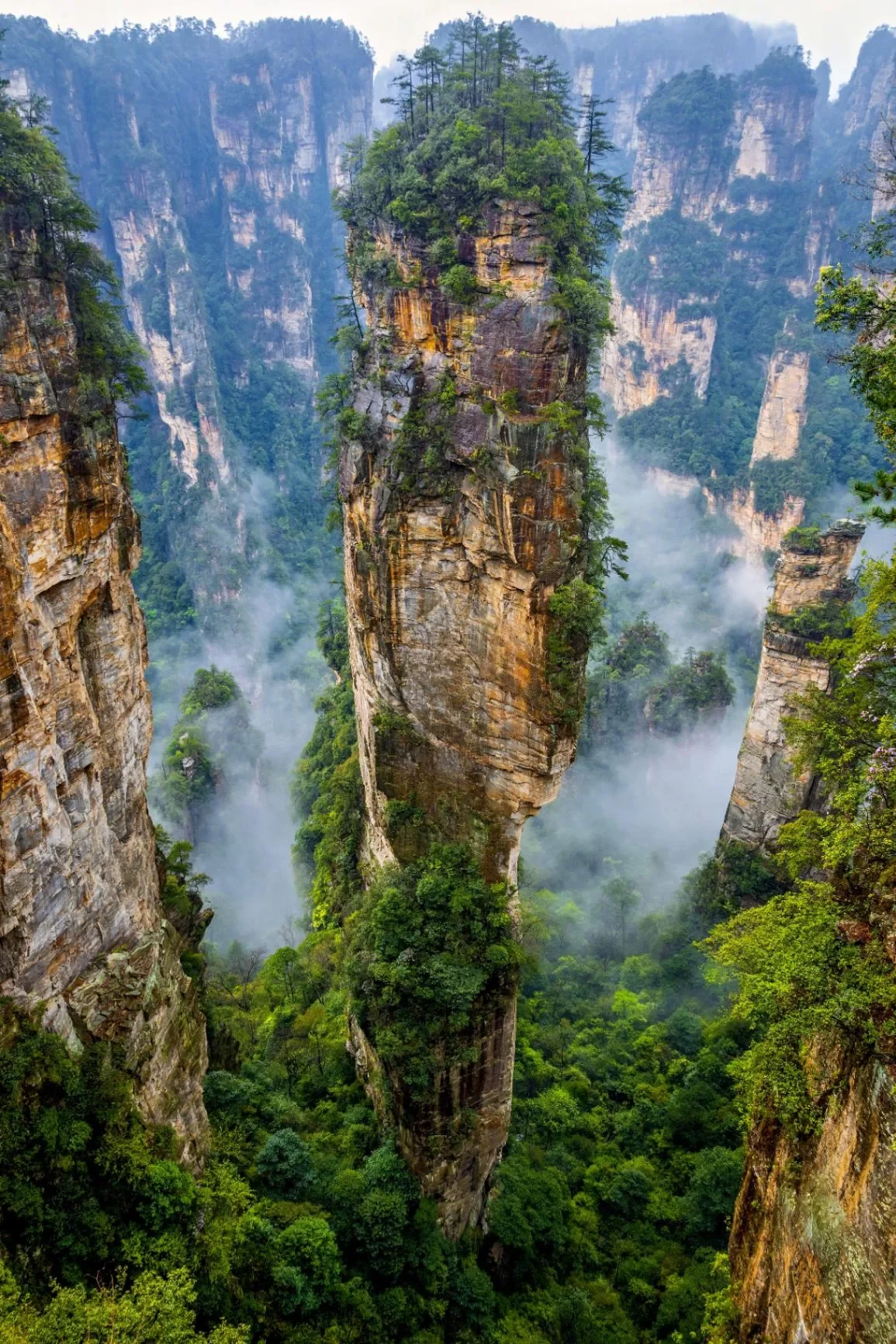
Photography first — Zhangjiajie. Yuanjiajie's floating peaks are the most instantly recognisable view in China, and they are best after rain, when cloud wraps the summits.
Hiking and climbing — Huangshan. Twenty thousand steps a day, and 660 metres of continuous descent on wet stone through West Sea Canyon. The vertical climbing is the experience.
Chinese landscape and culture — Huangshan. Ming and Qing dynasty inscriptions carved into cliff faces, poetry on the rocks, and pines trained for centuries. No other famous mountain in China carries that much cultural layering.
Ethnic culture — Zhangjiajie. Tujia and Miao village life, the Tujia brocade workshop, the fire-night performances.
A honeymoon, or you want quiet — Huangshan. Sea of clouds, sunrise, hot springs, and a pace you set yourself.
One mountain only — either. Huangshan is the painterly China. Zhangjiajie is the wild China. It depends which one you are actually here for.
By budget
One note before the numbers: foreign passports do not qualify for the domestic student or senior half-price tickets. Everything below is full price. These are planning allowances for the whole trip, not published ticket prices — those are listed in section 10. These are planning allowances for the whole trip, not published ticket prices — those are listed in section 10. These are planning allowances for the whole trip, not published ticket prices — those are listed in section 10. These are planning allowances for the whole trip, not published ticket prices — those are listed in section 10.
Tickets and basic rooms only. Huangshan: RMB 800. Zhangjiajie: RMB 800.
Comfortable. Huangshan: RMB 1,400–1,800. Zhangjiajie: RMB 1,050.
With a private guide and car. Huangshan: quoted per group. Zhangjiajie: US$237 per person for 3 days, US$339 per person for 4 days.
And one result that surprises people. A 4-day private tour at US$339 includes every ticket, three nights in a four-star hotel, a private car and driver for four days, and a private guide. Booking the same tickets and rooms yourself lands between RMB 1,800 and RMB 2,500. The guide is not what you are paying for — you are paying for the time you do not spend queueing. Between Zhangjiajie's three separate districts, a day can lose two hours to driving.
The short version
Fewer than three days → Zhangjiajie, no hesitation.
Children or elderly parents → Zhangjiajie. That is a constraint, not a preference.
You want quiet and atmosphere, and you can handle stairs → Huangshan.
Tight budget but you do not want to be overcharged → Zhangjiajie, Forest Park only. Fewer tickets, level ground, fewer games.
You want both → Six to seven days, Zhangjiajie first, then Huangshan.
2. Both mountains, side by side
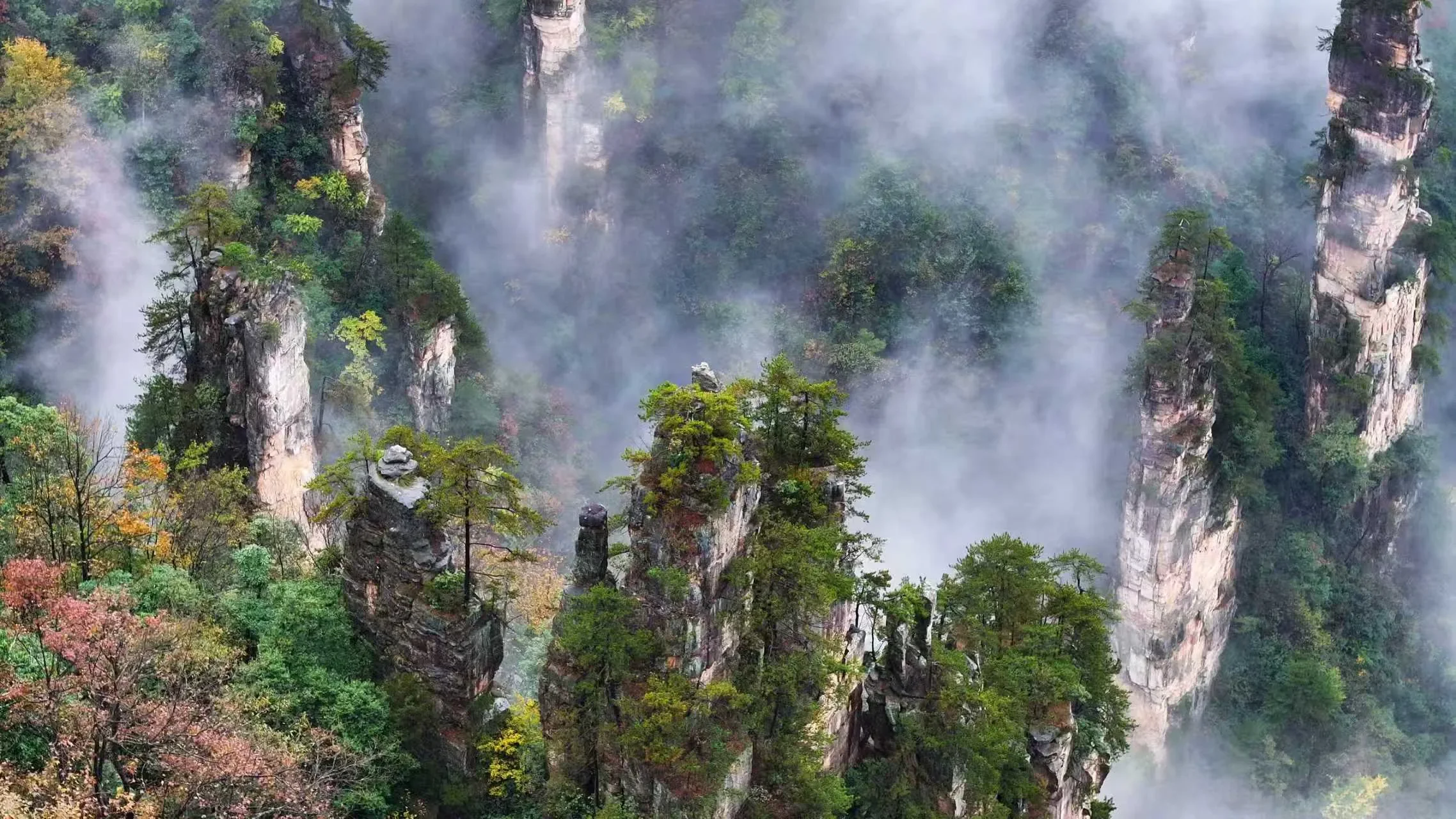
Geology. Huangshan: granite peaks — one whole mountain carved into hundreds of summits. Zhangjiajie: sandstone pillars — seabed sediment sliced into free-standing columns.
What you see. Huangshan: pines, rocks, sea of clouds, winter snow, hot springs. Zhangjiajie: three thousand peaks, Golden Whip Stream, a glass bridge, Tianmen Cave.
Character. Huangshan: paid in instalments — the deeper you walk, the more it gives you. Zhangjiajie: paid in full — the first view is the peak, and it fades by day three.
What tires you. Huangshan: your legs. Around 20,000 steps a day, and the cable car only reaches halfway. Zhangjiajie: your patience. Transfers between districts, winding mountain roads, carsickness.
Crowds. Huangshan: linear congestion. A few stairways, and one bottleneck stops the whole line. Zhangjiajie: spread out. The park is large, and outside a handful of viewpoints you can walk freely.
Entry. Huangshan: RMB 190 (RMB 150 in winter), valid three consecutive days, unlimited re-entry. Zhangjiajie: RMB 239 including the park shuttle, valid four consecutive days, unlimited re-entry.
Cable cars. Huangshan: Yuping RMB 90, Yungu RMB 80, Taiping RMB 80. Zhangjiajie: Bailong Elevator RMB 65, Tianzi Mountain cableway RMB 72, Yangjiajie cableway RMB 76, Huangshizhai cableway RMB 65, one way each.
Where you sleep. Huangshan: summit dorm beds RMB 200–300; peak-season twins RMB 700–1,100, over RMB 2,000 on holidays. Zhangjiajie: guesthouses in Wulingyuan town RMB 300–400 a night; cheaper in the city.
Culture. Huangshan: literati landscape — cliff inscriptions, poetry, Huizhou villages. Zhangjiajie: ethnic culture — Tujia and Miao traditions, staged folk performances.
Weather. Huangshan: everything depends on it. Best sea of clouds November to April. Zhangjiajie: high stakes, but there is a way out. Fog days can be spent in the valley streams.
Days to give it. Huangshan: 2, if you want sunrise. Zhangjiajie: 3. Two is rushed, four is right.
3. Geology: two mountains, two kinds of logic
The two do not just look different. They were built by completely different processes, and that difference decides how you should walk them.
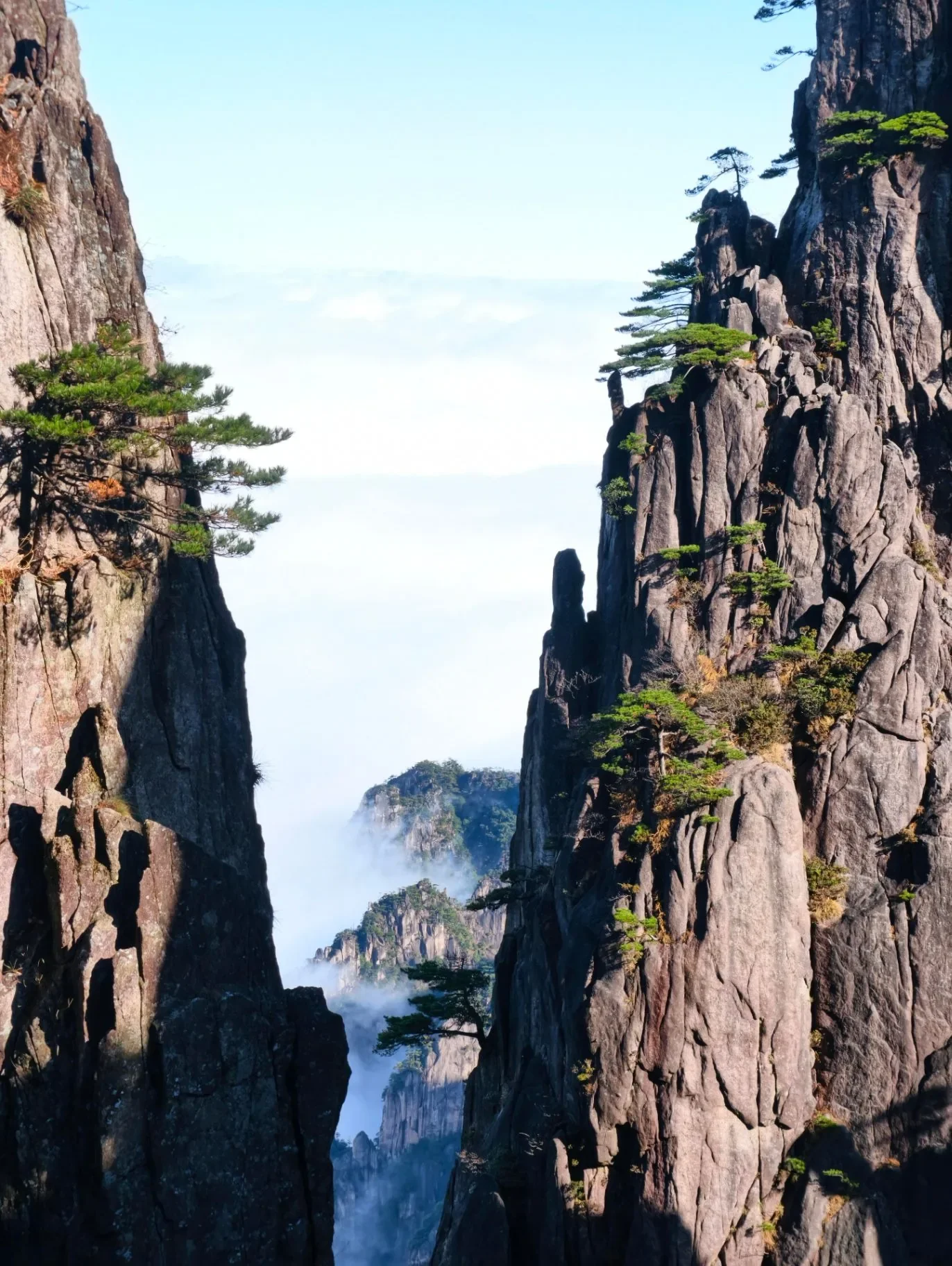
Huangshan is granite. Magma cooled deep underground about a hundred million years ago into one solid granite body. The land rose, the rock weathered and collapsed, and the wind and water carved along its joints into the peaks and strange boulders you see today. Put simply, Huangshan is one enormous mountain with hundreds of summits cut out of it, and the summits are joined by ridges. You climb upward across the same rock body, and the view opens a little more with every hundred metres.
Zhangjiajie is sandstone. This was the bottom of an ocean. Silt settled in layers and became horizontally bedded quartz sandstone. When the land rose, running water cut straight down through the bedding planes and sliced the whole layer into separate columns with deep canyons between them. You walk between the pillars, and the view is always broken up by a column in front of you. From the Tianzi Mountain viewpoint the peaks stand entirely separate from each other, which is where the sense of floating comes from.
The practical difference: Huangshan is one mountain you walk all day. Zhangjiajie is a region you drive between. Everything else follows from that.
4. What the scenery feels like
Taste is subjective, but visitor reviews keep landing in the same two places. Huangshan pays you back in instalments. Zhangjiajie pays you out front.
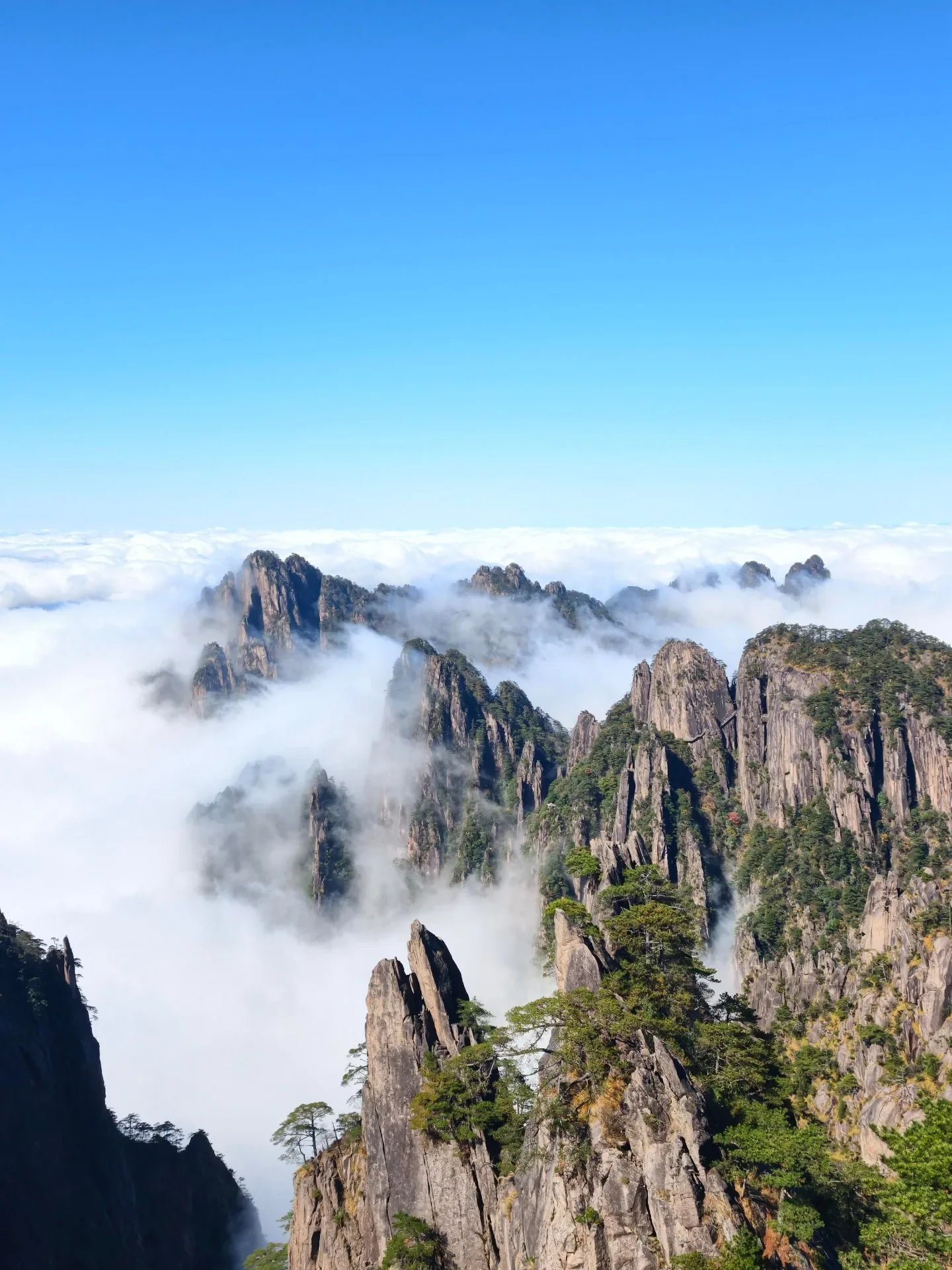
Huangshan is known for its five signatures: pines, rocks, sea of clouds, winter snow and hot springs. The beauty is not a shock at the gate — it changes as you walk. The same boulder looks different at dawn, midday and dusk. With cloud and without cloud, you are in two different places. In winter, rime ice turns the whole mountain into something else entirely. Travellers keep using one word: enduring.
One traveller wrote of it: "I sat at Bright Summit from five in the morning and the cloud filled the valley like liquid galaxy. A phone cannot take that. Grey day, it is an ink painting. Clear day, it is coloured glass."
But that beauty leans hard on the weather, and this is where the complaints come from. A traveller who planned a week ahead, walked 20,000 steps to reach the summit in the dark, and found the Guest-Greeting Pine and Bright Summit under thick fog, said the trip was "the distance for nothing, tiring and humbling."
Another point that catches foreign visitors: Huangshan needs some cultural context to land. Without it, it is a lot of rocks and pines, and you leave remembering the climb rather than the mountain. People who know the poetry and the cliff inscriptions get something the rest of us do not.
Zhangjiajie is immediate. There is no cultural warm-up required. You step up to the viewpoint and three thousand columns standing straight out of the ground hit you. When rain leaves cloud wrapped around the tips, it looks exactly like the floating mountains in a science fiction film, and the photographs are effortless.
And then it fades. Yuanjiajie, Tianzi Mountain and Yangjiajie are different angles on the same geology, and the difference between them is smaller than you expect. A frequent complaint: "the scenery is repetitive — the same rocks and pillars from every viewpoint. Most of the time you are in a car. The actual sightseeing takes very little of the day."
It depends on the weather just as much. In hard sun the pillars are grey lumps. In thick fog you see nothing at all.
What this means in practice: if you want a photograph that stops people scrolling, Zhangjiajie delivers faster. If you want day three to be better than day one, Huangshan is the better bet — but you have to slow down for it.
5. Layout: one mountain, one city
Most visitors do not realise Zhangjiajie is a city, not a single scenic area. We compare all five park ticket gates if you want to pick an entrance. The three headline sights sit in three separate districts: the National Forest Park in Wulingyuan, Tianmen Mountain in Zhangjiajie city, and the Grand Canyon glass bridge in Cili County. They are 30 to 60 minutes apart, each separately ticketed and separately run.
Every year people arrive in Zhangjiajie city and discover that the peak forest from Avatar is another 40 kilometres away. One traveller put it plainly: "Zhangjiajie is not a scenic area, it is a whole city. Forest Park, Tianmen Mountain, Grand Canyon — all tens of kilometres apart. Plenty of people trip over this on day one."
The complaint that follows is transfers. Try to see Tianmen Mountain and the Forest Park in one day and you lose most of it to mountain roads. Some visitors find the winding switchbacks enough to be carsick.
The other side of that coin is Zhangjiajie's internal transport, and it is genuinely good. Park entry includes the shuttle buses, and the ticket is valid four days, so you can take any bus you want without paying again. Cable cars and the Bailong Elevator carry you to viewpoints without a hard walk. The park runs a complete shuttle network and you never have to hike to reach the main platforms. If you want to pick a hotel on evidence rather than instinct, our guide to where to stay in Zhangjiajie breaks down the city versus Wulingyuan decision.
Huangshan is the opposite. One continuous mountain, about 160 square kilometres of core scenic area, every sight on the same rock body, entrance at Tangkou at the south gate. The classic loop is in at the front, out at the back. No crossing the city, no second ticket.
One mistake catches people repeatedly, and it is the one that wrecks a first morning. Huangshan city (Tunxi) is not the scenic area. It is about an hour from the gates, and Huangshan North railway station is another 40 minutes from Tangkou. Book a hotel in "Huangshan City" and you will be getting a taxi at five in the morning to reach a bus you thought was next door.
6. Getting there, and the two things that catch foreign visitors out
Zhangjiajie
By air: Zhangjiajie Hehua airport (DYG) is 10 minutes from the city by ride-hailing, RMB 20–30; the airport bus is RMB 10. To Wulingyuan it is 30–40 minutes, RMB 100–140.
By train: Changsha South to Zhangjiajie West is under two hours on the fastest services. Most visitors from Europe or North America fly into Shanghai, Guangzhou or Beijing and connect.
International flights into DYG are rare. Plan on a domestic connection.
Huangshan
By train: Huangshan North is 1 hour 13 minutes from Hangzhou West and 2 hours 16 minutes from Shanghai Hongqiao on the fastest services. Both cities have plenty of international flights, which makes either one a clean entry point.
By air: Huangshan Tunxi airport (TXN). International routes are limited.
Buying train tickets with a foreign passport
Your passport is both the ID you book with and the ticket you board with. Give the exact full name and passport number as printed, and make sure they match. Chinese train tickets go on sale seven days before departure, and popular routes sell out on the hour.
The 12306 site has an English interface and takes foreign cards, but passport entry can still trip people up. The practical fix is to send us your passport details and let us book it. We do it routinely for clients and it takes one message. Our guide to buying trains with a foreign passport covers the details, and the broader China train guide covers the routes that matter for this trip.
Payments, and the booking step that catches everyone
Paying: Alipay and WeChat Pay both link to foreign cards — Visa, Mastercard and Amex all work. Setting up takes about ten minutes. Cards work in hotels, department stores and better restaurants; street food and taxis are easier with mobile payment. Carry RMB 100–200 in cash per person per day for small noodle shops and market stalls that take notes only.
Booking tickets: Both scenic areas run named, timed, real-name reservations, and you must book 1 to 7 days ahead. In peak season the ticket windows have almost nothing left. Where foreigners differ:
Zhangjiajie — foreign visitors enter with their passport and booking barcode. Discount ticket types are linked to Chinese ID cards and do not apply to a foreign passport.
Huangshan — entry, the shuttle bus and the cable car are three separate purchases, and each subsequent day of your three-day ticket needs its own free "multiple entry" reservation in the official mini-program, with a daily quota. Foreign passports get no standing discount. Buy at full price, confirm your time slot, and move on.
This is the part that goes wrong for people who do it themselves. It is not that the tickets are hard to buy. It is that the reservation step needs a Chinese mobile number and the mini-program, and on Huangshan you have to make a second and third reservation yourself on day two and day three. Miss one and you are walked down the mountain.
7. Weather and the best months
Huangshan
High alpine climate, with a sharp vertical gradient. Mean temperature at the summit is around 8°C. Even in July the summit sits in the low twenties during the day and the low teens at dawn, and the wind is cold and damp. The summit runs 8 to 10 degrees below the valley.
Rain and fog arrive fast. It is often clear in the valley while the summit is in cloud, and a raincoat is not optional.
The sea of clouds is most likely from November to April, especially on cold mornings after a front has passed. There is only one reliable way to improve your odds: sleep on the mountain for one night, which buys you two dawn windows and two dusk windows. A single up-and-down day gives you one, and it usually lands on the flattest light with the most people on it.
Winter brings its own reward in rime ice and snow. The winter entry is RMB 150 and the winter cable car fares drop too (Yuping RMB 80, Yungu RMB 75, Taiping RMB 65), but summit rooms can fall below freezing, and the heating in a Chinese mountain hotel is not always reliable.
Zhangjiajie
Wulingyuan has a humid subtropical monsoon climate and it is warmer and damper than Huangshan. Summer is sticky, the mountains block the winter cold, and winters are mild — though the snow scenery is nothing like Huangshan's.
If Tianmen Mountain is on your list, check the 2026 ticket and cable car changes before you book — the routes have shifted recently.
Rain is a double-edged sword here. Thin mist after rain is the best light in the park. Thick fog hides everything, and Tianmen Mountain is the worst for it — clear sky in the city, solid cloud on the summit, the glass walkway and Tianmen Cave both wasted.
Huangshan has no answer to bad weather. Zhangjiajie does. When the summit is white, move down to the valley streams — Golden Whip Stream and the gorges below the pillars — and the fog turns into atmosphere instead of a wasted day. And because the ticket is valid four days, you can simply come back up tomorrow.
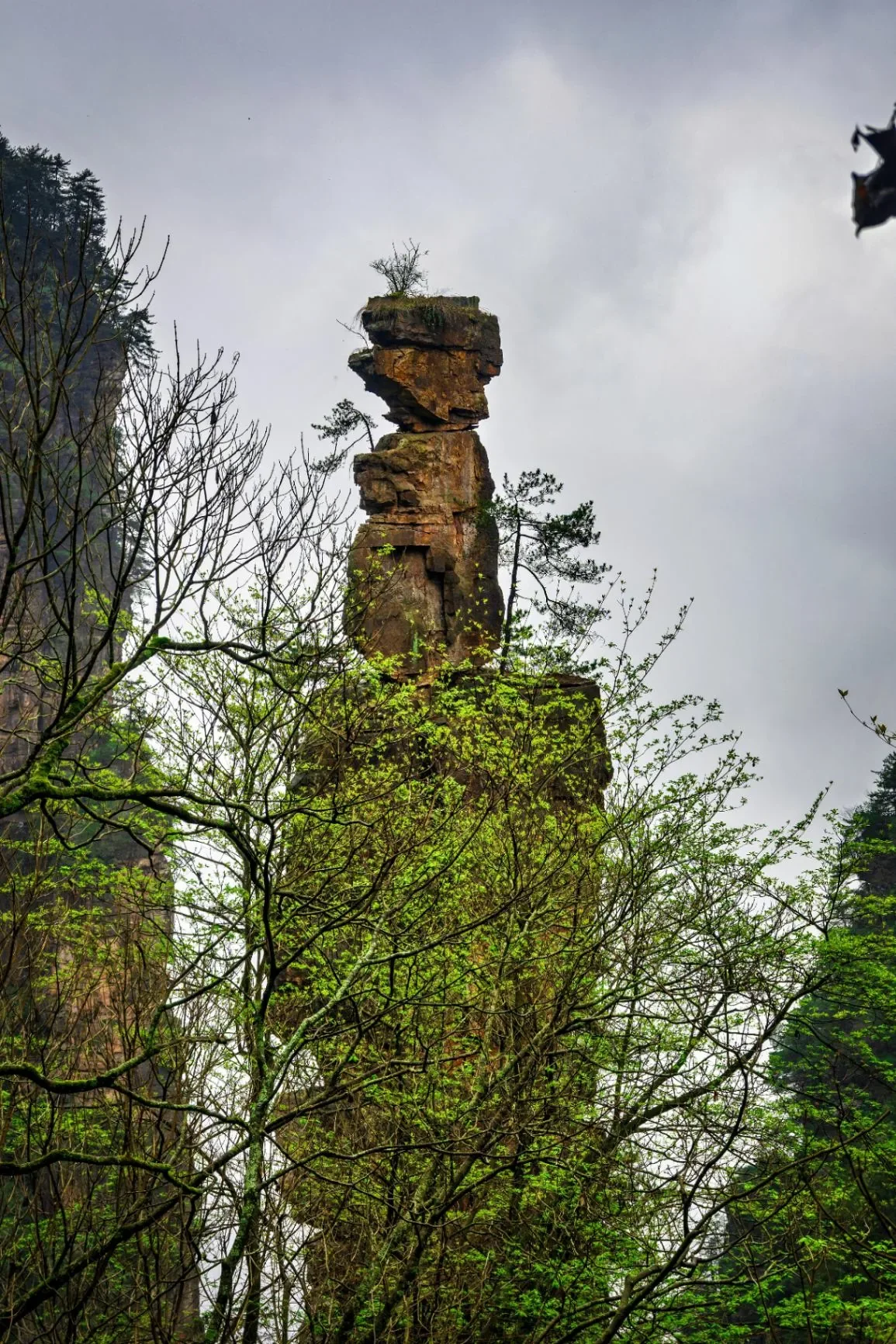
The months that work
Huangshan — best months. April–May and September–November for cloud and autumn colour; December–February for snow and rime, when entry drops to RMB 150. Avoid: National Day holiday, 1–7 October. Where the peak-season premium sits: summit rooms, where a twin can pass RMB 2,000 on holiday dates.
Zhangjiajie — best months. April–May and September–November. Avoid: National Day holiday; July and August. Where the peak-season premium sits: flights and hotels, which can double in July and August.
8. Culture: literati landscape versus ethnic culture
Huangshan's culture grew from the top down. It is a consensus built by a thousand years of writers, emperors and officials. Li Bai wrote "Huangshan, four thousand ren high". Xu Xiake left "the most remarkable sight of my life". Ming and Qing inscriptions are carved into the cliffs, temples and pavilions line the paths, and the Flying-Over Rock opens the 1987 adaptation of Dream of the Red Chamber. Below the mountain, Hongcun and Xidi are Huizhou villages, with stinky mandarin fish and Huizhou ink and inkstones completing the picture.
One traveller wrote: "Reading the cliff inscriptions the whole way up — Xu Xiake, Guo Moruo, centuries of people looking at the same view. That resonance across time is something no other famous mountain gives you."
It also has a threshold. Visitors without cultural background say the inscriptions are unreadable and the legends unfamiliar, and that they remember being tired. Tunxi Old Street and Hongcun are also criticised as over-commercialised.
Zhangjiajie's culture grew from the bottom up. It is rooted in the daily life of Tujia and Miao people in the Wuling mountains, then layered with film — Avatar and Journey to the West. The good reviews focus on participation rather than observation: dancing the Tujia Bojia dance around a fire with no idea what you are doing, and everyone laughing about it anyway. The Charm of Western Hunan show, Tujia brocade weaving, sanxiaoguo hotpot and the smashed-bowl rice wine are the parts people remember.
The complaint is that folk culture gets turned into a sales pitch. One highly upvoted post: "So-called Tujia villages and folk experiences — it all ends with selling silver and cinnabar. The folklore is just a wrapper." Dayong Ancient Town and the Tujia Folk Garden get called out as old shells with shopping inside.
The difference that matters for a foreign visitor: Zhangjiajie needs no knowledge of Tang poetry. The first view stops you cold, and it photographs beautifully. Huangshan needs a little context to appreciate properly. That is not better or worse. It is a different entry price, and one of them costs you money, context or nothing.
9. The day-to-day: two different kinds of tired
Fitness: Huangshan costs you legs, Zhangjiajie costs you car time
The tiredness at Huangshan is walking tiredness. Even with a cable car, it only takes you to the halfway point. The rest is steep stone steps with no flat sections, and West Sea Canyon and Lotus Peak mean constant climbing up and down. Around 20,000 steps a day is normal. 30,000 happens.
A one-star review said it better than any guide: "Do not believe that the cable car saves you. It only reaches the halfway point, and everything after that is steep steps up and down. I walked West Sea Canyon and my knee hurt for a week."
Families with small children consistently find it hard. No pushchairs, and everyone is in a hurry to get to the next point. But for anyone who came to walk, the sense of having earned the summit on your own legs is not something a cable car can replace.
The tiredness at Zhangjiajie is transfer tiredness. Inside the Forest Park the paths are level, and Golden Whip Stream is flat and shaded. You can take the shuttle bus or the mini train whenever you like, which makes it far kinder to anyone with low stamina, to older people and to children. The vertical climbing is outsourced to the elevator and the cable cars, and ordinary visitors get to stand on a cliff edge without doing anything heroic.
The price is getting between the districts. The shuttle network is frequent but circuitous, the mountain roads wind, and people get carsick. One visitor put it this way: "You are either in a car or waiting for a car. We changed shuttles three or four times inside the park. If the road twists like that, you will be sick."
Trying to cover all three districts means driving 40 kilometres a day. Half your trip happens in a seat.
Crowds: linear congestion versus spread-out crowds
Both are busy in season, but the shape of the crowd is different, and so is how you get around it.
Huangshan congests in lines. There are only a few stairways up the mountain and they are not wide. In season, Hundred Steps Ladder, One-Line Sky and Yuping are shuffling queues rather than walking. You cannot route around this. The only fix is timing: take the first cable car up, or the last one down, or sleep on the summit and let the crowd queue below you.
Zhangjiajie spreads out. The park is large, so the crowds are diluted, and outside a few specific points — the Bailong Elevator entrance, the main Yuanjiajie viewpoint — you can usually find space. The tour-group flow is concentrated between 9:30 and 3pm: in through the east gate, up the Bailong Elevator, round Yuanjiajie, down from Tianzi Mountain. Walk that route backwards, or get in before 7am, and the place feels half empty.
The sights that are overrated, and the ones that are not
Both parks put their iconic landmark where it is easiest to reach, and hide the better scenery a little further on. It is true of both mountains.
Huangshan
Overrated: the Guest-Greeting Pine and Bright Summit. The Guest-Greeting Pine is a national symbol, so there is always a crowd around it and you will never get a quiet moment with it. Bright Summit is a landmark, but for pure views, Shixin Peak is better.
Underrated: Shixin Peak and West Sea Canyon. Shixin Peak has the densest concentration of Huangshan pines on the mountain, with clean peaks and almost nobody there in the early morning. West Sea Canyon has the best scenery-to-effort ratio on the mountain, and most day-trippers skip it.
Zhangjiajie
Overrated: the Tianmen Mountain glass walkway and the Grand Canyon glass bridge. Both are adrenaline products. One to two hours in a queue for a few minutes of the actual experience.
Underrated: the deep end of Golden Whip Stream, and Wulongzhai Tianbofu. Most tour groups walk a third of Golden Whip Stream and turn back. The further in you go, the quieter it is and the pillars close overhead — this is the most peaceful stretch of Zhangjiajie. Wulongzhai and Tianbofu are narrow, uncrowded and awkwardly placed, which is exactly why they are good.
Service and management
Huangshan's reputation is better. Signage is clear, the park is well managed, and the number of touts is lower than in Zhangjiajie. Prices are high but they are posted, and one visitor noted the logic: "Everything up there is expensive, but the prices are on the wall, and you understand — a person carried it up on their back."
The problem is the summit monopoly. A common complaint: "Three thousand-plus yuan a night for a room that is damp, no WiFi, and a service that does not match the price." Holiday cable car queues of three hours are routine, and there is no good fallback. Guides also report that the route signage on the mountain itself is weak — you end up researching it yourself.
Zhangjiajie divides people. Guests like the local guesthouses and the cave guides. The complaints are relentless: taxis and restaurants marking you up together, low-price group tours that spend half the day in shopping outlets, touts offering "internal tickets" and "skip-the-queue" channels, and monkeys that take food and occasionally scratch.
One practical note: check the price before you order. It is common sense everywhere and it matters more here than most places.
10. What it actually costs
Full price, foreign passport, no international flights included. All figures checked 13 November 2026.
Huangshan: cheap entry, expensive nights
Fixed costs
Entry (three consecutive days, unlimited re-entry): RMB 190; RMB 150 in winter.
Shuttle bus, south gate to the cable car stations, return: RMB 38.
Cable car, one way: Yuping RMB 90, Yungu RMB 80, Taiping RMB 80. In winter, RMB 80, RMB 75 and RMB 65. Each leg is bought separately.
All three together: entry RMB 190, shuttle RMB 38 and one cable car fare. There is no combined ticket — you buy the three separately.
Accommodation — this is where the budget moves
Summit dorm bed: RMB 200–300.
Summit room without a window: cheaper than a view room.
Summit twin room, peak season: RMB 700–1,100.
Summit twin room, public holiday: over RMB 2,000.
Tangkou, below the south gate: RMB 200–600.
Tunxi (Huangshan city): RMB 250–900.
One thing to plan around: summit tent service stopped booking and operating on 5 November 2026. Whether it returns in 2027 has not been announced. Build the trip as though there is no tent.
Food: a summit buffet lunch runs RMB 120 and dinner RMB 180. A bottle of water from the lobby shop is RMB 15. Noodles and vegetables from a street stall cost RMB 30–35. Budget RMB 80–150 a day for food up there, and it will be the most expensive meal of your trip. The saving move is to eat properly at a stall around two or three in the afternoon and skip the dinner buffet. Carry instant noodles and a flask — hot water is free everywhere.
Three budgets, two days and one night, no international flights
Backpacker: RMB 800 — entry, shuttle, cable car, a summit dorm bed, simple meals.
Comfortable: RMB 1,400–1,800 — peak-season twin room and proper meals.
Sunrise plus high-end lodging: RMB 2,000–3,400 — a premium summit hotel.
We quote Huangshan tours per group, not per person, because summit room inventory and the day-by-day reservation process make a per-person price misleading. Your quote includes the private car, an English-speaking guide, a custom itinerary and ticket booking.
Zhangjiajie: cheap entry, add-ons stack up
Tickets and internal transport
National Forest Park, entry plus shuttle, four days: RMB 239.
Tianmen Mountain, all routes include the cable car: RMB 288.
Grand Canyon, line B with the glass bridge: RMB 178.
Bailong Elevator, one way: RMB 65.
Tianzi Mountain cable car, one way: RMB 72.
Yangjiajie cable car, one way: RMB 76.
Huangshizhai cable car, one way: RMB 65.
Ten-Li Gallery mini train: RMB 38 one way, RMB 76 return.
Four-ride transport combo, transport only (no park entry): RMB 238.
Unlimited transport, four days, transport only (no park entry): RMB 298.
Charm of Western Hunan show: RMB 228–328.
Three budgets, no international flights
Backpacker, Forest Park only (3 days, 2 nights): RMB 800.
Comfortable, Forest Park only (3 days, 2 nights): RMB 1,050.
Everything, all three districts (4 days, 3 nights): RMB 1,800–2,500.
For the full-district tier, the three admission tickets are RMB 288 for Tianmen Mountain, RMB 239 for the Forest Park and RMB 178 for the Grand Canyon. Inside the park, the Bailong Elevator is RMB 65 one way, the Tianzi Mountain cable car RMB 72 one way, the Yangjiajie cable car RMB 76 one way and the Ten-Li Gallery mini train RMB 38 one way (RMB 76 return). Add three nights of accommodation at RMB 450–600 a night, RMB 300 for food and RMB 200 for transfers between districts, plus whatever else you add — an evening show, Yellow Dragon Cave or Baofeng Lake.
Getting there and around: RMB 20–30 by ride-hailing from DYG airport to the city, RMB 100–140 to Wulingyuan, airport bus RMB 10. Luggage transfer between the city and Wulingyuan runs RMB 20–25 a piece.
Doing it yourself versus a private tour
This is the calculation worth doing properly, because it is the one most visitors get wrong.
On your own: you buy the tickets above, book the rooms, arrange the shuttle and the transfers, and then deal with three timed reservations for three separate districts. Three days in Zhangjiajie also means sourcing an English-speaking guide separately if you want one.
With us: our Zhangjiajie private tours start at US$59 for a Tianmen Mountain day, US$169 for two days, US$237 for three days, US$339 for four days, and US$439 for five days including Furong Town and Fenghuang. Every quote includes the admission tickets, the cable cars and lifts, a private car and driver, an English-speaking private guide, accommodation at the stated grade, daily pick-ups and drop-offs, bottled water, travel accident insurance and the 72 Qilou night walk. Meals, gratuities and optional extras are not included.
Our honest view. A 4-day tour is US$339, and the same tickets and rooms booked separately land between RMB 1,800 and RMB 2,500. The tickets are close to even. What the guide buys you is that you do not handle the reservations, your car waits for you, and your day is not half spent in it. If you are travelling with elderly parents, if you only have three days, or if this is your first time in China, that is where the money is worth spending. Travelling solo, with time, and willing to work through the booking process, going it alone is perfectly reasonable.
Where to see the tours
4-day, 3-night private tour — the one most first-time visitors book
3-day private tour — the shortest comfortable version
2-day tour — the shortest full route
2-day Forest Park tour — Forest Park only
Tianmen Mountain day tour — a single day, from US$59
5-day route — adds Furong Town and Fenghuang
All of them are listed on the private tours page. If you only need a guide for part of the trip, the custom itinerary planning service prices by city. For a group quote covering both mountains, send us your dates and group size.
11. Doing both in one trip
First, the fact that decides everything: there is no direct train between Huangshan North and Zhangjiajie West. You transfer at Changsha South or Shangrao, and the total is 5 to 9 hours, second class RMB 618–642. Driving takes 9 hours 20 minutes. Flying from Zhangjiajie Hehua (DYG) to Huangshan Tunxi (TXN) with connections runs 9 to 16 hours.
So the correct approach to "both" is not to squeeze them in. Plan the travel as part of the itinerary.
A workable six or seven day version
Day 1. Arrive Zhangjiajie. Airport pick-up, check in, city or Wulingyuan.
Day 2. Forest Park: Bailong Elevator up, Yuanjiajie, Tianzi Mountain.
Day 3. Golden Whip Stream and Huangshi Village; afternoon Tianmen Mountain or the Grand Canyon glass bridge.
Day 4. Train to Huangshan, transfer at Changsha South or Shangrao. Stay in Tangkou.
Day 5. Cable car up, walk slowly, sleep on the summit or come down the same day.
Day 6. Dawn for sunrise and cloud, then Hongcun and Xidi — or head home.
Why Zhangjiajie first
Huangshan needs time to sink in. The reward comes from walking slowly and going deep, and if you put the visually overwhelming Zhangjiajie in front of it, Huangshan can feel like the anticlimax. Spectacle first, then landscape — the order that works.
The practical warnings
Transfers at Changsha South or Shangrao mean changing trains inside the same station. Book both legs together and leave at least 40 minutes for the connection.
Zhangjiajie city and Wulingyuan have a luggage transfer service at RMB 20–25 a piece. It is far easier than dragging suitcases across three districts.
If there are elderly parents or children in the group, a private car for the nine-hour transfer beats the train, but budget a full day for it.
12. The final decision
Pick your line and go.
You want Chinese landscape, have some fitness, and like taking it slowly → Huangshan. Give it at least two days and one night on the summit, and build West Sea Canyon into the route. Its cultural resonance and its staying power are unmatched among China's famous mountains. Accept the physical test and the gamble on the weather.
You want the first-view impact, are bringing children or parents, and like having a lot to do → Zhangjiajie. Peak forests, the elevator, the glass bridge and stream walks all in one trip. Three days is right, and two is enough for the core. Plan around the shopping stops and the touts.
Budget-conscious and want to stay in control → play the Forest Park only. On ordinary itineraries the two mountains come out level, but Huangshan's charges are easier to read — entry, shuttle and cable car, all posted — while Zhangjiajie's extras stack up quietly. List your budget first, and walk away from any price below the published one.
Time to do both → six or seven days, Zhangjiajie first, then Huangshan, following section 11.
Travelling solo → two or three days in Zhangjiajie is more realistic. On Huangshan, the linear queues in season spoil it, so go outside the holidays.
Photography first → three days in Zhangjiajie, Yuanjiajie plus Tianzi Mountain plus the Grand Canyon, timed after rain. For cloud and pines together, add Huangshan.
Universal warnings
Queues at both mountains in season are severe. Go on weekdays and avoid public holidays. We would not recommend either mountain during the National Day holiday, 1–7 October.
Check the forecast before you go. Winter snow at Huangshan and post-rain cloud at Zhangjiajie are the best conditions you will get — and both carry a fog risk. At Zhangjiajie you can move to the valleys when the summit is blank; at Huangshan you are largely waiting on luck.
Skip the famous landmarks that everyone photographs and walk 20 minutes further. You will get better light and fewer people.
Check the price before you order, and refuse "internal" tickets. Both habits work at both parks.
Book 2 to 4 weeks ahead for normal dates, 1 to 2 months ahead for peak season. Train tickets go on sale seven days before departure — be there when they do.
Whichever you choose, the view is better when nobody else is standing in front of it.
13. Frequently asked questions
Which is better, Huangshan or Zhangjiajie?
There is no better one, only a better fit for your trip. For impact and convenience, choose Zhangjiajie. For quiet, depth and photography, choose Huangshan. With children under 12 or parents over 65, choose Zhangjiajie — that one is a constraint, not a preference.
How many days do I need for each?
Two days for Huangshan, including one night on the summit if you want sunrise; three is more relaxed. Three days for Zhangjiajie is the sweet spot — two is rushed, four is ideal. Both together needs six to seven days.
Which is cheaper?
At full foreign-passport prices, the difference is smaller than most people expect. Huangshan entry is RMB 190 for three days. Zhangjiajie's Forest Park is RMB 239 including the shuttle for four days, and you add Tianmen Mountain at RMB 288 and the Grand Canyon at RMB 178. The real difference is accommodation: a summit twin room in Huangshan runs RMB 700–1,100 and over RMB 2,000 on holidays, while a Wulingyuan guesthouse is RMB 300–400 a night. For normal itineraries the two come out level.
Can I see both in one trip?
Yes, but there is no direct train — you change at Changsha South or Shangrao, and it is 5 to 9 hours, from RMB 618 in second class. Allow six or seven days in total, and do Zhangjiajie first.
Which one for families with children or elderly parents?
Zhangjiajie. Huangshan is stone steps from end to end, the cable car only reaches halfway, and there are no pushchairs on the summit. Zhangjiajie's park is mostly level, with shuttle buses, lifts and cable cars that let people who cannot manage stairs still reach the viewpoints.
Is there a discount for foreign passports?
There is no standing student or senior discount for a foreign passport. Buy at full price. On Huangshan, confirm your time slot at the window; on Zhangjiajie, the concession ticket types in the official system — ages 14–17, 60–64 and 65+ — are tied to Chinese ID cards and do not apply to a foreign passport.
When should I go?
Huangshan: April to May and September to November for cloud and autumn colour, December to February for snow and rime ice — and entry falls to RMB 150 in winter. Zhangjiajie: April to May and September to November. Avoid the National Day holiday at both.
Do the multi-day tickets actually work as advertised?
Zhangjiajie's ticket is valid for four consecutive days with unlimited re-entry, so you can spread the park over three days. Huangshan's is valid for three consecutive days, also with unlimited re-entry — but each subsequent day needs its own free reservation in the official mini-program, with a daily quota. Book it on the morning of each day. Zhangjiajie is the more flexible of the two; on Huangshan, that second-day reservation is the step people forget.
What happens if I book everything myself?
The tickets are not the hard part. The reservation is. Zhangjiajie's three districts need separate named, timed, real-name bookings, and Huangshan needs a second and third "multiple entry" reservation on the days after your first. Both run through a Chinese mini-program that needs a Chinese mobile number. Add the transfers between three districts 40 kilometres apart, and it is a lot to hold in your head while you are trying to enjoy the place.
How much more is a private tour, and is it worth it?
A 4-day private tour at US$339 includes the tickets, three nights in a four-star hotel, a private car and driver for four days, and a private guide. Booking the same tickets and rooms yourself lands between RMB 1,800 and RMB 2,500. The difference buys you three things: nobody has to handle the reservations, your car waits for you, and you get your day back. With children, with three days, or on a first trip to China, it is worth it. With more time and a willingness to do the booking, going alone is fine.
Do you run tours in Huangshan as well?
Yes. Huangshan is quoted per group — private car, English-speaking guide, custom itinerary and ticket booking included — because summit room inventory and the day-by-day reservation process make a per-person price misleading. Send us your dates and group size and we will price it.
14. Next step
Send us your dates and number of travellers, and we will put together a free, itemised quote — car, hotels, tickets and guiding listed separately, no packaging and no shopping stops.
WhatsApp: +86 172 6789 8631
Email: rosewuqjzh@gmail.com
We are a licensed travel agency, Travel Agency Licence No. L-HUN-100749, issued by the Hunan Provincial Department of Culture and Tourism, with our own licensed travel agency in each of our 11 destination cities, all holding inbound tourism authorisation. Our guides are in-house, not resold through middlemen — one contract, one coordinator, from landing to departure. Every trip carries commercial travel insurance. Payment by Alipay, TenPayGo, bank transfer or WorldFirst, settled in RMB, with prices quoted in US dollars converted at the mid-rate.
Full terms are on the payment and safety page and the FAQ page.