

Zhangjiajie's Viral Bottle Collector Video: What Was Real and What Was Invented in 48 Hours
In the last week of August, a phone video went through Chinese social media like a fire through dry grass.
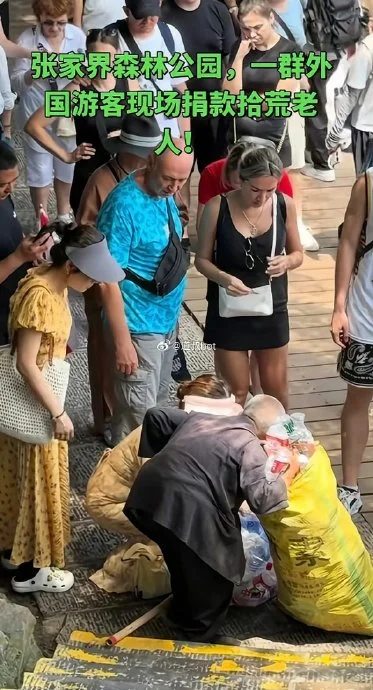
The footage itself is simple. On a walking trail in Yuanjiajie, part of the Wulingyuan scenic area in Zhangjiajie, an elderly man with a badly curved back drags a stuffed woven bag behind him, stooping to pick plastic bottles out of the dirt near visitors' feet. A few foreign tourists stop. They press cash into his hand. He waves it off twice, then takes it.
No voiceover. No captions. Just the picture.
Inside forty-eight hours, it had been given a whole story.
The story went like this: he was 92 years old, had no children, had lost his wife years earlier, lived alone, and survived by collecting scrap inside the mountains. Even the foreigners could not walk past it.
The story was made up.
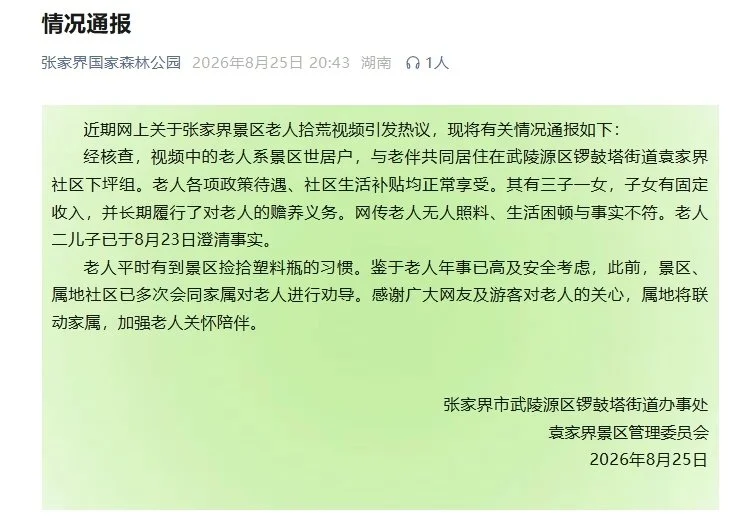
On the evening of 25 August 2026, the Luoguta Subdistrict Office of Wulingyuan District and the Yuanjiajie Scenic Area Management Committee jointly issued an official notice. The findings came out almost exactly the opposite of what had circulated. The man is a long-established resident household — shìjūhù in Chinese, a formal category in Zhangjiajie's relocation policy. He lives with his wife. He has four children: three sons and a daughter. All of them have steady incomes and have been supporting him, as they are legally required to. His policy entitlements and community living allowance are paid on schedule. Picking up plastic bottles in the scenic area is a habit he has kept for years. It is not how he eats.
We have written this kind of piece before. Back in July, when the Sayram Lake story was going around, we did the same read-through of the evidence (that article is here). This one deserves more attention, because what got rewritten was not the event. It was a man's entire life.
1. Start with the notice itself
Every claim you read about this case should be measured against one document. It is short. Here it is in full.
Issued by: Luoguta Subdistrict Office, Wulingyuan District, Zhangjiajie
Date: evening of 25 August 2026
First channel: the official WeChat account of Zhangjiajie National Forest Park
Recently, a video of an elderly man collecting recyclables in the Zhangjiajie scenic area has drawn wide discussion online. We now report the relevant facts as follows:
Upon verification, the man in the video is a long-established resident household of the scenic area. He lives with his wife in Xiaping Residents' Group, Yuanjiajie Community, Luoguta Subdistrict, Wulingyuan District. He receives all his policy entitlements and the community living allowance as normal. He has three sons and one daughter. His children have steady incomes and have long been supporting him. Reports online that he has no one looking after him and lives in hardship are not true. His second son publicly clarified the facts on 23 August.
The man has a habit of going into the scenic area to pick up plastic bottles. Given his advanced age and for safety reasons, the scenic area management and the local community have on several occasions, together with his family members, spoken with him about it. We thank netizens and visitors for their concern for the man. The local authority will work with his family to give him more care and company.
— Luoguta Subdistrict Office, Wulingyuan District, Zhangjiajie, and Yuanjiajie Scenic Area Management Committee, 25 August 2026
The full text is carried on Huanqiu. Beijing Daily ran a complete report that same night, with its app edition publishing in parallel. The Beijing Daily piece also brought in the family's account: the man is 88, has worked with his hands his whole life, and simply cannot sit still.
Hold on to that date. The evening of 25 August. Anything you see after it can be checked against this notice. Anything published before it went out while there was still no official finding at all.
2. Three words in the notice you need unpacked first
The notice runs to a bit over two hundred Chinese characters, and three of its phrases stop most foreign readers cold. They also stop plenty of Chinese city dwellers. Without them, the rest of the case does not make sense.
First: shìjūhù — long-established resident household. Literally, "a family that has lived here for generations". This is not a literary flourish. It is a defined status category inside Zhangjiajie's ecological relocation programme. It means original residents who were here before the scenic area was developed, who hold household registration, contracted farmland and a house. The label comes with a specific compensation and resettlement standard. The fact that officials reached for this exact term in a rumour-busting notice is the point: they are saying he is a formally registered resident, not an outsider and not a homeless man.
Second: Xiaping Residents' Group, Yuanjiajie Community. That is a full Chinese grassroots administrative address, read from largest to smallest: Wulingyuan District → Luoguta Subdistrict → Yuanjiajie Community → Xiaping Residents' Group. The important thing here is what the existence of a "community" and a "residents' group" tells you. There is a formal village-level administration up on the mountain. There is a community committee, a group leader, household registration, and a local allowance that gets paid out. This is not a few people living rough in the wilderness. It is a village that sits inside the administrative system.
Third: huìtóng jiāshǔ — "together with family members". Huitong is bureaucratic Chinese for "jointly with". So the subject of that sentence is not only the scenic area and the community. It includes the family. The family was in the room the whole time. The notice uses the phrase to answer the question everyone was asking: are his children actually looking after him? The answer is that when the community went to talk to him, his children were there.
Once those three terms are clear, the rest of this article will read differently.
3. Claim by claim: what circulated, and what the check found
For each line below, the claim comes first — the version you may have seen on short video or in a self-media post. The finding follows.
"92 years old" — Doubtful. The man's second son, when he spoke publicly to set the record straight, said 88. The official notice gives no age at all. The "92" was added by self-media accounts after 23 August. Neither the family nor the authorities said it.
"No children" — False. He has three sons and one daughter.
"Widowed young, lives alone" — False. He lives with his wife.
"Nobody looks after him" — False. His children have steady incomes and have long supported him.
"Destitute, surviving by collecting scrap" — False. His entitlements and community living allowance are all being paid. The bottles are a habit, not an income.
"Has been collecting scrap in the scenic area long-term" — False. The notice says he "has a habit of going into the scenic area to pick up plastic bottles". "Has a habit of going" describes something occasional. "Long-term collecting" describes a livelihood. Those are not the same claim, in either duration or nature.
The name "Grandpa Zheng" — Unusable. It comes from a self-media article that got the facts wrong. The authorities have never released the man's name.
"Obviously foreign forces smearing China" — No evidence. That is an emotional add-on from self-media after the debunking. No level of official review produced that conclusion.
Line them up side by side and you notice that what got fabricated was not one detail. It was an entire identity. A lonely, dirt-poor, forgotten old man was fitted neatly onto a silent video. Every invention pushed the same direction: turning a local man who cannot sit still into a pitiable figure who needed rescuing.
4. How the story was built, layer by layer, over three days
The spread has clear timestamps. You can trace each step.
Around 20 August — the footage is shot inside the Wulingyuan scenic area. The exact shooting date has not been officially confirmed, so this is as tight as the window gets.
22 August, 16:02 — the video appears on Weibo and starts to gain traction (original post page). Look at the caption at this stage. No age, no family, no circumstances. One clip and one sentence. Whoever posted it first did not invent a backstory.
22 August, 19:52 and 21:06 — two related videos go up on Bilibili, and the titles start using "European and American tourists" and "kind-hearted tourists donating". The material is still descriptive. No identity has been invented yet.
23 August — the man's second son publicly sets out the facts. The official notice names this as a key point. Remember the date. It comes up again below.
23 August, 16:38 — a self-media account, "Hukan Shehui Baitai", publishes an article containing "92 years old, no children, lost his wife early, lives alone and collects scrap to survive". This is the main source of the false material. The whole invented identity enters mass circulation at that moment.
24 August, 17:20 — Bilibili videos keep repeating the number 92. Second wave.
25 August, from 21:09 — Jiemian News, The Beijing News, Beijing Daily's app edition and other established outlets begin reporting.
25 August, evening — the subdistrict office and the scenic area management committee issue the official notice and the rebuttal lands (notice repost page).
26 August — Phoenix News, carrying Observer Network, and other platforms push the story to a much wider readership; Guangming Online carrying Huashang Daily, and The Paper's video report, follow. The tide turns that day.
The real window is only three days: video goes viral on 22 August, family clarifies on 23 August, official notice on 25 August.
One detail is worth pulling out on its own. The family's clarification came on 23 August. The false identity appeared on 23 August too — the same day, clarification first, invention second. In other words, whoever wrote the fabricated version put pen to paper after the truth was already public. Most of the false material in this chain was produced in the period after the family had already spoken.
5. What a "long-established resident household" actually is, and why people live inside the park
This is the part foreign readers find hardest, and it is the part that matters most. Without it, the phrase "long-established resident household of the scenic area" in the notice means nothing at all.
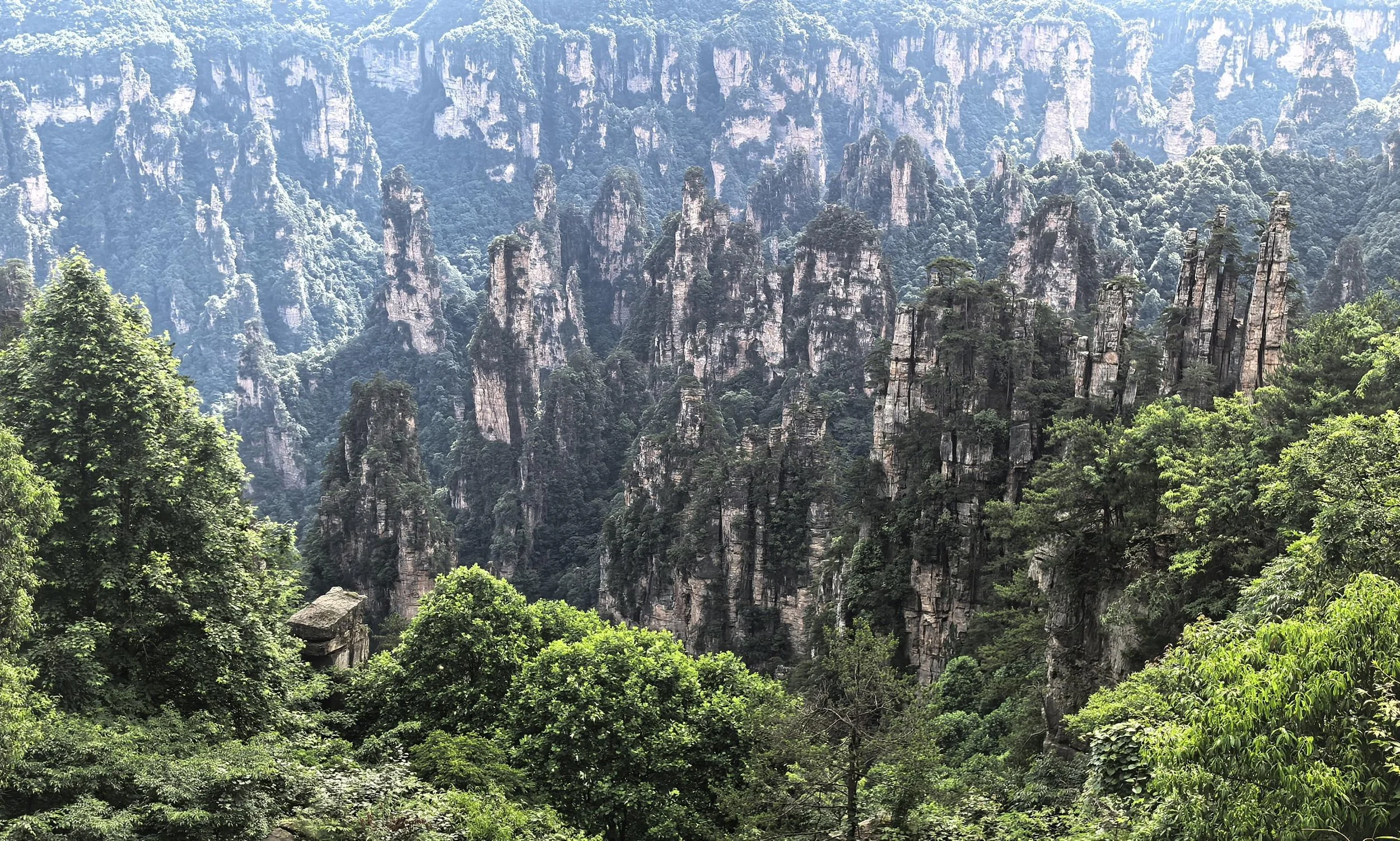
Start with the geography. Zhangjiajie is a prefecture-level city. Its urban core is Yongding District, which is where Tianmen Mountain sits. The famous quartz sandstone peak forest is in Wulingyuan District, inscribed by UNESCO as a World Natural Heritage site in 1992. The core of that heritage area is Zhangjiajie National Forest Park, covering Yuanjiajie, Tianzishan, Huangshizhai, Yangjiajie, Golden Whip Stream, Ten-Mile Gallery and more. Yuanjiajie, where this happened, is one section inside the park.
Here is the key point: people already lived inside this area.
Take the Yuanjiajie Community named in the notice. Government records describe it this way: it sits inside the Wulingyuan core scenic area and was incorporated into the Zhangjiajie state forest farm in 1983 — the farm that became today's Zhangjiajie National Forest Park. The community covers roughly 12 square kilometres and is made up of three residents' groups, Shangping, Zhongping and Xiaping, with 205 households and 558 people (Zhangjiajie municipal government portal).
Put plainly, they were here first. The scenic area came later. When the forest farm was set up in 1983, this mountain was already home. They are not traders who moved in to catch the tourist trade. They live in their own houses.
And their standard of living is probably nothing like what you are picturing. The same government record notes that residents' "main sources of income are government policy subsidies and tourism service businesses", and puts annual net income per person at 53,400 yuan. That is well above the Chinese rural average and above quite a few cities. A 2021 report in Zhangjiajie Daily is more specific still: residents of Yuanjiajie Community run businesses out of their own houses, with annual incomes ranging from 30,000 to 400,000 yuan. Locals there call the houses on the mountain their "golden houses" (Zhangjiajie Daily).
Use that number to test the video's premise. Would a resident who lives in a "golden house", draws a subsidy and has four adult children spend his days collecting scrap for pocket change?
So why move anyone out? Because a World Heritage core area cannot have permanent residents living inside it long term. This was not a sudden decision. In 2013 Zhangjiajie wrote "ecological relocation of the Wulingyuan core scenic area" into its scenic area upgrade plan, and began the first phase in 2014 (Zhangjiajie People's Congress public document).
The relocation zone was later fixed at six areas across the core, covering 1,085 households and 3,087 people, with 185,100 square metres of housing (Zhangjiajie municipal government portal). Phase one alone, covering Yuanjiajie and Tianzishan, ran to 580 households and 1,230 people (The Paper). By 2022, more than 95% of residents in the Tianzishan and Yuanjiajie sections had moved down the mountain into resettlement housing below (Xinhua report).
But relocation does not happen overnight. It runs in phases, one household agreement at a time, and it involves resettlement flats, new livelihoods and, very often, the wishes of the elderly people themselves. That is why a small number of residents still live inside the core area today. The man in the notice is one of them.
That background connects to your trip in a few direct ways:
The local people you pass on the trails in Yuanjiajie or Tianzishan are very likely villagers who live inside the scenic area, not homeless men and women. It sounds like a small distinction. It changes how you read the scene in front of you.
The farmhouse restaurants, guesthouses and small stalls inside the park, and the staff doing cleaning, guiding and shuttle driving, are mostly villagers whose families have been here for generations. That is not unlicensed vending. It is what several generations of living on this mountain looks like.
Our own guides are Zhangjiajie locals, not script-readers hired in from elsewhere (about our team). That sounds like marketing, but it is actually the premise for reading this kind of story correctly. The elderly people on the trails, the community down the road and the park authority are three parties inside one network of people who know each other. When a community goes to talk an old man out of climbing the mountain, they are not policing a stranger. They are reasoning with a neighbour. That is also why the notice uses words like "spoke with him" and "care and company" instead of penalties or enforcement.
If you want the full layout of the park and how to move through it, we keep a complete Zhangjiajie National Forest Park guide. Yuanjiajie, where this happened, is the core section inside it.
6. What the official notice did not say, which matters just as much
There is a common habit in reading news like this. We demand evidence for what we dislike and ask nothing at all about what we would like to believe. To avoid that, here is what the notice does not cover.
The donations — how much, from how many people, how it happened. The notice says nothing. It confirms exactly two things: that the man picks up plastic bottles in the scenic area, and that "reports online that he has no one looking after him and lives in hardship are not true". How much those tourists handed over, and whether other visitors had given him money before, is unaddressed. A lot of the "moving details" circulating online are unverified.
The man's age. Not released. The 88 comes from the family. The 92 comes from self-media. We cannot independently verify either, so this article says only "in his eighties".
The tourists' nationality. Not mentioned. Video titles variously say "European and American tourists" and "Russian tourists". The notice says "tourists".
Who filmed it and why. Not established. The exact shooting date is unconfirmed too. The best anyone has is around 20 August.
The man's name. Please do not go looking for it. It has never been released. After his family spoke publicly, what they most likely wanted was for him to go back to his ordinary days.
Drawing those boundaries is not nitpicking. The value of a fact check rests entirely on whether it stays inside the evidence. You can apply the same method yourself. The next time a viral China story reaches you, ask one question first: is this line from an official source, from the family, or from a self-media account?
7. If you do meet an elderly person like this in Zhangjiajie
Start with this: those tourists did nothing wrong. They saw an old man bent over working on a mountain path and reached for their wallets. That instinct is human. The video spread as far as it did largely because the kindness in it was real. We are not going to second-guess it.
But as a local team that hosts a lot of foreign visitors every year, there are things we would rather say straight out, because you will almost certainly run into these scenes: elderly people inside the park, villagers selling mountain produce, locals who strike up a conversation with you.
One: tell "habit" apart from "hardship" before you decide anything. In rural China, it is extremely common for people in their eighties and nineties to keep doing odd jobs. That is not by itself a marker of poverty.
Rural residents draw a basic pension from age 60 — the national minimum in 2026 is 163 yuan a month, up from 143, and Hunan's actual standard is around 198 yuan a month (Shandong Development and Reform Commission policy brief, provincial standards round-up). From 80, most provinces add a separate old-age allowance, some lower the threshold to 70, and Shanghai starts at 65 (Beijing News policy breakdown). On top of that, supporting your parents is a legal duty under China's Civil Code, not a voluntary gesture.
So when a man has a pension, an allowance and four grown children, and still insists on collecting bottles, the plainest explanation is that he cannot sit still. He has lived his whole life that way. In the countryside they say it is not that life is unlivable. It is that he cannot sit down.
Two: cash does not fix the risk he actually faces. The only sentence in the notice that carries a commitment to act is this: "Given his advanced age and for safety reasons, the scenic area management and the local community have on several occasions, together with his family members, spoken with him about it." Look at what that sentence worries about. Not money. The safety of an elderly man on mountain paths in moving crowds. When someone in his eighties slips on wet stone steps, the consequences do not reverse. The few dozen yuan you hand over does not change that. The community and the family kept going back to talk him out of climbing the mountain precisely because they understand the risk.
One number makes the "surviving by collecting bottles" line collapse on its own. On the scrap market, a single plastic water bottle fetches roughly 0.04 to 0.15 yuan. In some places you need twenty of them to make a single yuan. Even a hundred bottles in a day comes to a few yuan. That is an order of magnitude away from a livelihood.
Three: if you want to do something, these moves beat handing over cash.
Deal with your own bottle. That is what he is picking up. Dropping an empty bottle into a park bin instead of leaving it on a railing is the most direct kindness available to you.
Do not crowd, do not film, do not turn him into content. In the video that travelled furthest, the man is boxed in by a ring of people. A clip that turns him into "material" can cost him more than a year's worth of bottles.
Read before you share. If you want to tell this story after you get home, tell the official finding with it. This whole episode started with one true image. The damage came from the script added over the next forty-eight hours.
If you want to give, use a proper channel. A registered charity or a recognised donation route is far more reliable than cash on the street, and it is how you would do it back home. Our complete guide to paying in China covers the practical side.
One more thing while we are here. This is also why we suggest guests heading into the mountains bring a refillable bottle, as set out in our China packing list, rather than buying bottled water the whole way. Bins inside Zhangjiajie National Forest Park are not spaced as tightly as they are in a city. Carrying your own bottle back down is worth more than it sounds.
8. Does any of this affect your trip
No.
To be explicit: no route, trail or ticket inside Zhangjiajie has been altered, closed or capped because of this episode. Yuanjiajie is open as usual. The Bailong Elevator, Tianzishan and Golden Whip Stream are all unchanged. This was an information event, not a management event.
If anything, inbound visitor numbers to Zhangjiajie are at a historic high. The official figures we have put together show both arrival volumes and policy support at record levels this year (the data and policy read-through is here), and the "Greater Zhangjiajie" programme has rolled out internationalisation measures including multilingual services and integrated inbound routes (the 15 measures and 8 inbound routes). Come now and the odds of running into other foreign visitors are far higher than they were three years ago. The tourists in that video were just one ordinary day inside a much bigger wave.
If you are still deciding, a few things are worth settling early: check whether you qualify for visa-free entry (the 50-country eligibility check), and work out whether you want to come independently or with a guide (what to know before a solo trip to mainland China). As for safety, the real risk in a mountain park like Zhangjiajie was never crime. It is stone steps, weather and stamina — we go into all of it in our safety guide for China travel.
9. Why we bothered writing this
The most ironic thing about this whole affair is that it circled around a hardship that did not exist. The one risk the notice did confirm — the safety of an elderly man in a difficult environment — went almost undiscussed. The scenic area talked to him. The community talked to him. His family talked to him. All of that got buried under a few hundred million views.
One outlet did call the circus what it was: a commentary in Dute News, out of Shenzhen. Its target is specific, and it is the self-media writers. People who were not on site, did not know the situation, and could still produce paragraphs about how wretched the man's life was — "chasing traffic by making things up, and using public opinion to correct what they made up".
We are a local operator that has been working in Zhangjiajie for fourteen years and has hosted a great many Chinese and foreign guests. Here is how it looks from where we stand.
The video itself was not malicious. Whoever posted it first simply filmed what was in front of them — the earliest caption on 22 August did not even mention an age or a family situation. The malice arrived over the following forty-eight hours, when a group of people who had never set foot in Zhangjiajie rewrote a living man into a prop for traffic.
For anyone who travels to China often, there is a more practical warning buried in this. A lot of what you scroll past about China has been "completed" the same way. A silent video plus enough plausible-sounding detail becomes a finished story. And the more specific the detail, the easier it is to believe and the harder it is to spot as invented. This time we happened to have all three things at once — the official finding, the family's clarification, and precise timestamps. Use them to recalibrate how you judge every story of this kind.
The next time a clip about China makes you angry or moved, do one thing first. Check whether an official notice has come out yet.
Frequently asked questions
Is Zhangjiajie safe?
For international visitors, the crime risk in Zhangjiajie is low, and that is part of why inbound arrivals have kept climbing. What deserves real attention is the physical environment: wet stone steps, low visibility in fog, endurance and sudden weather. Travel with a licensed operator and most of that gets handled before you arrive.
Do people really live inside Zhangjiajie's scenic area?
Yes. There are several original-resident communities inside the Wulingyuan core area. "Long-established resident household" is the official term for people who settled here before the scenic area was developed and who hold household registration and property. Yuanjiajie Community, the one in this case, was incorporated into the Zhangjiajie state forest farm in 1983 and has 205 households and 558 people today. These communities are being relocated downhill in phases. By 2022, more than 95% of residents in the Tianzishan and Yuanjiajie sections had moved out, but a small number still live inside the park. The locals you pass on the trails, the farmhouse restaurants and the small stalls are mostly villagers whose families have been here for generations, not outside operators.
Was the video fake?
The footage is real. The official notice confirms that the man does pick up plastic bottles in the scenic area. What was false is the identity attached to it: 92 years old, no children, living alone, surviving on scrap. Every one of those claims has been rejected by the official check.
Should I give money to an elderly bottle collector in the park?
We are not going to tell you not to. Our experience is simply that it rarely helps. For people like this, hardship and the circumstances you are seeing are not necessarily connected, and the official notice spells out both his entitlements and his children's support. Bin your bottle, do not film him, and do not invent a story about him online. Those three things come closer to what kindness was supposed to mean.
What did the authorities actually do afterwards?
The action named in the notice is that "the local authority will work with his family to give him more care and company". Beyond that, there was no penalty and no enforcement measure against the man, and his name was never released. That restraint is itself part of the story.
Planning a trip to Zhangjiajie?
We have operated in Zhangjiajie for fourteen years. Every route we run is handled in-house, with no middlemen. If you want to know how the trails actually work, when the crowds thin out, or whether the walking suits older travellers and young children, just ask one of our people. Our own guides live at the foot of the mountain.
Zhangjiajie private tours overview — our main itineraries from 3 to 5 days, with a private guide, a dedicated vehicle and ticket booking included.
Zhangjiajie National Forest Park day tour — this is the route through Yuanjiajie, where the video was filmed, including the Bailong Elevator and Tianzishan.
Custom itinerary planning (from $10 per city) — tell us where you want to go. Tickets, vehicles, guides and permits are all handled on our side.
Multi-city China tours — if you want to link Zhangjiajie with Beijing, Xi'an, Chongqing or Chengdu, start here.
Still have questions? Get in touch with us directly. Someone answers around the clock.
For more China travel news read the way we read it, we keep a dedicated section updated every week: China travel news. And for Zhangjiajie's intangible heritage and local culture, see our 2026 Zhangjiajie intangible cultural heritage compilation.
The factual content of this article rests on three groups of sources. First, the official notice issued on 25 August 2026 by the Luoguta Subdistrict Office of Wulingyuan District, Zhangjiajie, and the Yuanjiajie Scenic Area Management Committee. Second, published reporting by Huanqiu, Beijing Daily, Phoenix News carrying Observer Network, and Dute News. Third, public records from the Zhangjiajie municipal government portal, a Zhangjiajie People's Congress document, Xinhua, The Paper and Zhangjiajie Daily on the resident system inside the scenic area, plus policy material from the Shandong Development and Reform Commission and Beijing News on rural pensions and old-age allowances. Anything not confirmed by official sources is flagged as such in the text.