
Where to Stay in Beijing 2026: A Foreign Tourist's No-Nonsense Hotel Guide
6 districts, real hotel picks, and the stuff most guides won't tell you about checking in with a foreign passport.
Most Beijing hotels guides are written for Chinese domestic tourists. They quote platforms you can't access, recommend hotels that can't legally check you in, and assume you have WeChat Pay. This one doesn't.
I've spent the last month cross-checking Trip.com, Booking.com, and Agoda for every hotel in this guide — looking at actual foreign guest reviews, not just aggregate scores. I've also called front desks to verify whether they can actually swipe a Visa card, not just claim they can on their listing.
Here's what you're getting:
Six accommodation districts, ranked honestly — not by star rating, but by what actually matters when you don't speak Chinese
Hotel picks with scores from platforms foreigners actually use (Trip.com, Booking.com, Agoda)
The one thing that can ruin your check-in: foreign guest registration rules explained in plain English
Airport and train station logistics — which hotels save you a 5 AM panic
Eight traps that waste your money or your morning
One thing before we start: Beijing is not a city where you book any hotel and figure it out. The wrong district can add two hours of subway transfers to every day of your trip. Pick your hotel before you pick your itinerary, not the other way around.
1. Beijing's Geography — 60 Seconds Before You Book
Beijing's tourist attractions sit on a north-south spine. If your hotel is on the wrong side of the city, you'll spend your vacation on Line 1 of the subway.
The core axis (what you'll actually visit):
South end: Temple of Heaven, Qianmen
Center: Tiananmen Square, Forbidden City, National Museum
North end: Jingshan Park, Drum Tower, Nanluoguxiang, Olympic Park (Bird's Nest)
The two off-axis zones that still matter:
Northwest: Summer Palace, Old Summer Palace, Peking University, Beijing Zoo — all on Line 4
Far southeast: Universal Studios Beijing — Line 7 all the way to the end
The trick most first-timers miss: Line 8 runs straight up the middle of everything — Temple of Heaven, Qianmen, Wangfujing, Drum Tower, Olympic Park. If your hotel is on Line 8, you're never more than 20 minutes from a major sight. If it's not, you're doing a transfer every single time.
The two airports matter more than you think:
Beijing has two airports, and they're on opposite ends of the city. Capital Airport (PEK) is northeast, connected by the Airport Express from Dongzhimen. Daxing Airport (PKX) is way down south, connected by the Daxing Airport Express from Caoqiao. If you're flying out of Daxing and your hotel is in the northeast, you're looking at a 90-minute slog. More on this in Section 5.
2. The Six Districts — What Actually Matters When You Don't Speak Chinese
I'm ranking these by what a foreign tourist needs: proximity to sights, Metro convenience, front-desk English, and whether they'll actually let you check in with a foreign passport.
District 1: Qianmen / Dazhalan — The Sweet Spot
If you only remember one district from this guide, make it this one.
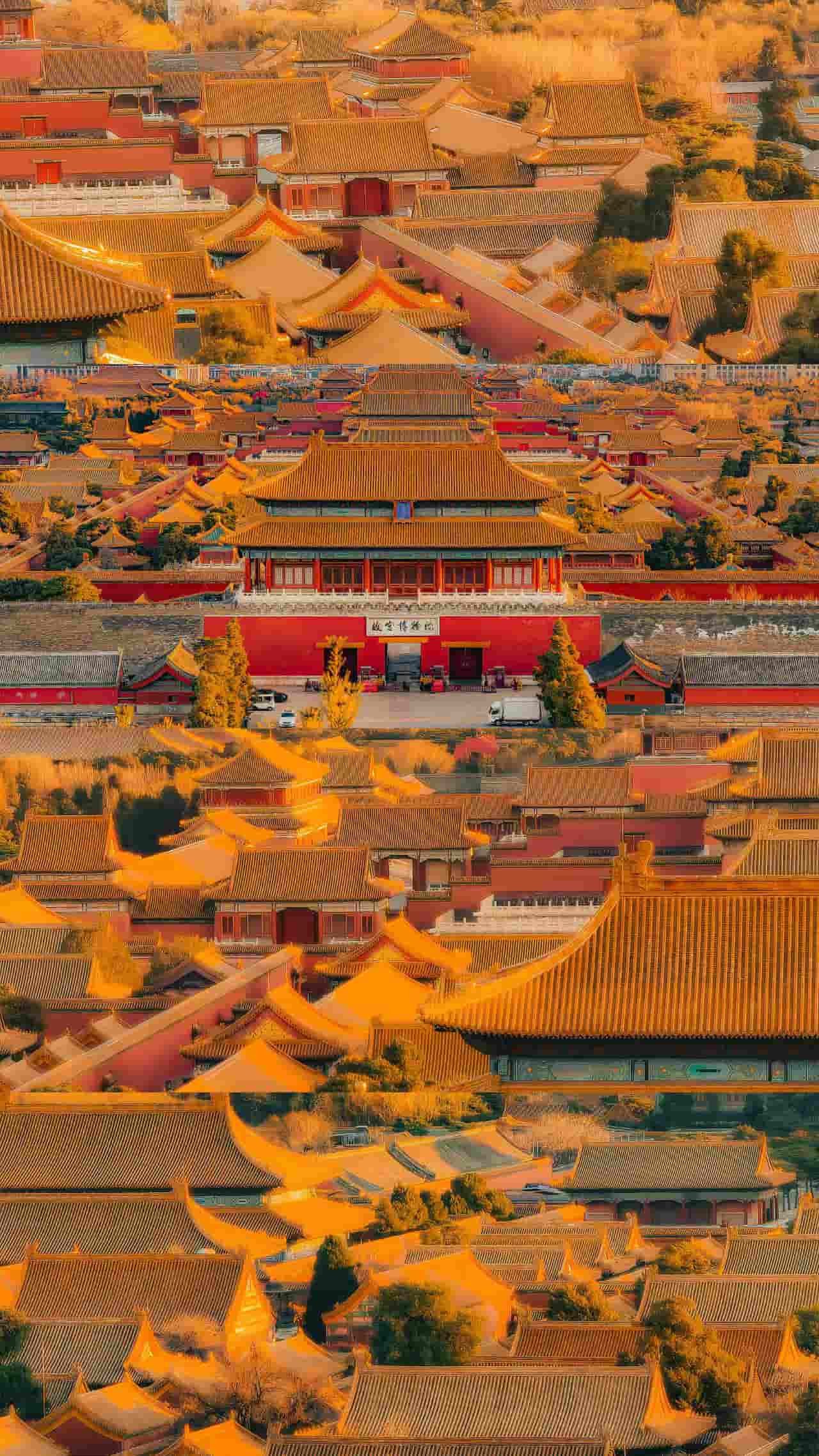
Qianmen sits directly south of Tiananmen Square. From most hotels here, you walk out the door and the Gate of Heavenly Peace is 800 meters ahead of you. The Forbidden City entrance is a 15-minute walk. The flag-raising ceremony at dawn? You roll out of bed 20 minutes before, not two hours.
Why it works for foreign tourists:
The neighborhood itself is half the reason to stay here. Dazhalan is one of Beijing's last surviving hutong commercial streets — not a sanitized replica, the real thing with dumpling shops that have been there since your grandparents were young. At night the whole street lights up with red lanterns, and the smell of lamb skewers drifts out of alleyways. It's the Beijing people imagine before they arrive.
Hotels that actually work:
MUJI Hotel Beijing — 800-1800 RMB/night. The top-floor rooms face the Forbidden City directly. Not "kind of" facing it — you open the curtains and there it is. Four floors up, the view clears the surrounding rooftops. Book a Type C or D room; the Type A and B face the inner courtyard instead. Trip.com 4.7/5. The catch: only 42 rooms, and the Forbidden City-facing ones disappear a month in advance.
Holiday Inn Express Qianmen — 500-700 RMB/night. Not charming, not boutique, but the front desk has seen enough foreign passports that your check-in won't take 20 minutes. Trip.com 4.5/5. Breakfast is included and has both congee and toast. Metro Line 2 Qianmen station is a four-minute walk.
Beijing Hotel NUO — 600-1000 RMB/night. This is the old wing of the Beijing Hotel, the one that hosted Nixon in 1972. The lobby alone is worth a look — French colonial architecture from 1917. Rooms are renovated but the bones are century-old. Walk to Tiananmen in six minutes. Booking.com 8.1/10 from 1,200+ reviews.
The trade-off: Some hotels in this area are in old hutong buildings with paper-thin walls and no elevator. Read the "building type" in Trip.com reviews before booking. If it says "renovated courtyard" and you see complaints about stairs, believe them.
District 2: Wangfujing / Dongdan — The Convenience Machine
Wangfujing is Beijing's Oxford Street — a pedestrian shopping strip two blocks east of the Forbidden City. It's more polished than Qianmen, more expensive, and way more predictable. You know exactly what you're getting.
Why it works for foreign tourists:
Three Metro lines converge here (1, 5, 8). You can be at the Forbidden City's east gate in eight minutes on foot, or take Line 1 two stops west to Tiananmen. The APM mall on Wangfujing Street has a food court with recognizable chains if you need a break from duck and dumplings. For families with kids who might revolt against three meals of Chinese food in a row, this is the safety net.
Hotels that actually work:
Park Plaza Wangfujing — 450-800 RMB/night. This is the value pick of the entire Wangfujing strip. Trip.com 9.4/10 from 3,675 reviews, TripAdvisor 4.5/5 from 3,449. That many reviews don't lie — the consistency makes it the safest bet in this price range. Five-minute walk to the Metro, English-speaking front desk confirmed. The breakfast buffet has an omelette station, which matters more than you'd think on day four of your trip.
Regent Beijing — 1,100-1,800 RMB/night. TripAdvisor 4.7/5 from 3,796 reviews. The indoor pool is heated year-round and rarely crowded before 10 AM. Rooms on the north side look directly at the Forbidden City roof line — request floors 12 and up. The concierge desk has English-speaking staff and can actually book tickets for you, not just point at a QR code.
Novotel Beijing Peace — 850-1,200 RMB/night. Booking.com 7.7/10 from over 11,000 reviews. That's an enormous sample size — the score reflects honesty, not enthusiasm. The location is the selling point: you're literally on the edge of Wangfujing Street. Rooms are standard Novotel (clean, functional, no personality). Book the Executive floor if you want a view that isn't a neighboring building's wall.
The trade-off: Wangfujing is expensive and crowded. The street itself is a tourist conveyor belt — souvenir shops selling the same panda hats and silk scarves. You're paying for location efficiency, not atmosphere.
District 3: Zhushikou / Chongwenmen — The Hidden Gem
This is the district Chinese travel forums recommend to each other but English-language guides never mention. It sits directly south of Qianmen, one Metro stop away, and everything costs about 30% less.
Why it works for foreign tourists:
Zhushikou station sits at the intersection of Lines 7 and 8. Line 8 north: Temple of Heaven (one stop), Qianmen (two stops), Wangfujing (four stops), Drum Tower (six stops), Olympic Park. Line 7 east: Universal Studios in 45 minutes. Line 7 west: Beijing West Railway Station. For a first-time visitor who wants to see the core sights without premium hotel prices, this is the answer.
Chongwenmen station (one stop further east) adds Lines 2 and 5 to the mix. From Chongwenmen, you can reach Beijing Railway Station in one stop on Line 2 — useful if you're arriving or departing by train.
Hotels that actually work:
Holiday Inn Express Temple of Heaven — 500-700 RMB/night. Trip.com 9.4/10 from 3,927 reviews. This is the highest-rated HI Express in central Beijing, and the reviews tell you why: consistently clean, consistently functional, consistently hassle-free for foreign guests. The "Temple of Heaven" in the name isn't misleading — the north gate is a nine-minute walk. Breakfast included.
JW Marriott Beijing Central — 1,000-1,600 RMB/night. Trip.com 4.8/5 from 2,064 reviews. This is the splurge option if you want Marriott points and a bathtub that could fit two people. It's near Xuanwumen station (Lines 2 and 4), which gives you the same access pattern as Zhushikou but with a proper five-star lobby.
The trade-off: There's nothing to do in Zhushikou itself. It's a transit hub surrounded by residential blocks. You're sleeping here, not exploring. For atmosphere, walk 15 minutes north to Qianmen at night.
District 4: Xidan / Financial Street — The Compromise That Works
Xidan sits west of the Forbidden City, at the intersection of Lines 1 and 4. Line 1 goes east-west through the core (Tiananmen, Wangfujing, CBD). Line 4 goes north-south through the university district (Summer Palace, Old Summer Palace, Peking University, Beijing Zoo, Beijing South Railway Station).
Why it works for foreign tourists:
Xidan is the only district that gives you efficient access to BOTH the central sights AND the northwest cluster (Summer Palace / Old Summer Palace). If you're doing a mixed trip — three days of central Beijing plus a day at the Summer Palace — splitting your hotel stay between two districts is more pain than it's worth. Xidan solves that.
Hotels that actually work:
Mercure Beijing Xidan — 450-650 RMB/night. Not to be confused with other Beijing Mercures — this specific one at Xidan is the one you want. Six-minute walk to Xidan station. The rooms are compact but the air conditioning actually works in August, which is not a given in this city. Front desk English is basic but functional.
Minzu Hotel (民族饭店) — 480-700 RMB/night. This is a state-owned hotel from 1959, which sounds like a drawback until you realize it means the rooms are twice the size of anything built after 2000. The building has Soviet-era bones — high ceilings, wide corridors, windows that actually open. Some rooms have been renovated, some haven't. Ask for a renovated room on the south side. Line 1 Xidan station is a four-minute walk.
The trade-off: Xidan has zero charm. It's a modern shopping district with department stores and office towers. You're not soaking in "old Beijing atmosphere" here — you're choosing logistics over vibes. If that trade-off works for you, this is the right district.
District 5: Guomao / CBD / Sanlitun — Best Hotels, Worst Location
This is where Beijing's best hotels live. The China World Summit Wing. The Rosewood. JEN by Shangri-La. The Kerry Hotel. If you want a swimming pool that belongs in a magazine, 24-hour room service, and a lobby bar where the cocktails cost more than your dinner — this is your district.
The problem: Every single major tourist attraction is 30-40 minutes away by Metro. The Forbidden City, Temple of Heaven, Summer Palace, Drum Tower — none of them are close. You're paying for a hotel experience at the expense of actually seeing Beijing.
Who should still consider it:
Business travelers who have meetings in the CBD anyway
Return visitors who've done the sights and want a luxury base
Anyone who values hotel quality above sightseeing efficiency
Nightlife-focused travelers (Sanlitun is Beijing's bar district)
Hotels that actually work:
JEN Beijing by Shangri-La — 800-1,200 RMB/night. Booking.com 9.2/10 from 854 reviews. The gym here is legitimately excellent — not "hotel excellent," actually excellent. 24-hour access, proper free weights, a boxing ring. Rooms are modern and quiet, which in Beijing is an achievement. Guomao station is 450 meters away. The breakfast buffet has a full Western spread alongside Chinese options.
Kerry Hotel Beijing — 1,200-1,800 RMB/night. Trip.com consistently 4.7+/5. The indoor pool is one of the best hotel pools in Beijing. If you're traveling with kids, the Kerry Adventure Zone (indoor playground) is a legitimate selling point — not a token corner with two soft blocks, but a multi-level play structure that'll exhaust a seven-year-old.
Swissotel Beijing Hong Kong Macau Center — 800-1,200 RMB/night. TripAdvisor 4.9/5 from 419 reviews. Tiny sample size but consistently glowing — the kind of reviews where people mention staff by name. The location is technically Dongcheng, on the eastern edge, which puts you closer to Sanlitun than the CBD. Line 2 Dongsishitiao station is nearby.
The trade-off: You already know it. Great hotel, long commute. Budget the Metro time into your day before you book.
District 6: Haidian / Zhongguancun / Xizhimen — The Wild Card
This is the university district in Beijing's northwest. It's close to the Summer Palace, Old Summer Palace, Peking University, Tsinghua University, and the Beijing Zoo. It's also where you catch the S2 train to the Badaling Great Wall from Xizhimen station.
Why it works for foreign tourists:
If your trip is heavily weighted toward the northwest cluster — or if you're a family with kids who need a zoo day and a Great Wall day — this district makes more sense than commuting from the city center each time. Xizhimen station gives you three Metro lines (2, 4, 13), the S2 train to the Great Wall, and walking access to the zoo and planetarium.
Hotels that actually work:
Atour Hotel Zhongguancun — 500-800 RMB/night. Trip.com 4.9/5. Atour is China's answer to a design-forward mid-range chain — think Ace Hotel meets Muji. Free laundry machines (you do it yourself, but they're there), free late checkout until 2 PM, and the lobby doubles as a bookstore. The catch for foreign tourists: front-desk English varies wildly by staff member. Some shifts have someone who speaks it, some don't. Have your booking confirmation ready on your phone.
Novotel Beijing Sanyuan — 550-800 RMB/night. Not in Haidian proper but at Sanyuanqiao on Line 10's northeast corner. I'm putting it here because it serves the same "not in the center but well-connected" role. Sanyuanqiao is one stop from the Airport Express and on the Line 10 ring line. If you're arriving late at Capital Airport and want zero hassle, this is the play. Front desk English is solid — it's a Novotel.
The trade-off: You're far from Tiananmen, the Forbidden City, Temple of Heaven, and Qianmen. Expect 40-minute Metro rides to the core. Only choose this district if the northwest attractions dominate your itinerary.
3. The Foreign Tourist Survival Kit — What Chinese Hotel Guides Won't Tell You
This section is why I wrote this guide. Skip it at your own risk.
Can your hotel legally check you in?
China requires hotels to register foreign guests with the local Public Security Bureau (PSB). Not all hotels have the license to do this. If you book a hotel that can't register foreign passports, the front desk will turn you away — even if you prepaid.
How this plays out in real life:
In 2024, a group of travel bloggers tested 52 hotels in Xi'an. Only 15 of them accepted foreign guests. Only two of those 15 were budget hotels. The rest either refused outright or spent 30 minutes making phone calls before saying no.
Beijing is better than Xi'an — but not by much. Here's what actually works:
International chains (IHG, Marriott, Accor, Hilton, Shangri-La): Safe. These are your Holiday Inn Expresses, Novotels, Mercures, Regents, JW Marriotts. They've processed thousands of foreign passports. Check-in takes five minutes.
High-end Chinese chains (Atour, Ji Hotel, Orange Crystal): Inconsistent. Some locations have the license, some don't. The front desk may not know the answer until they try to scan your passport. If you want to stay at an Atour, call ahead — or book through Trip.com, which labels hotels that accept foreign guests.
Budget Chinese chains (Hanting, Home Inn, 7 Days, Super 8): Assume no. Even if one location took foreigners last month, the license status can change. Not worth the gamble.
The only reliable filter: Trip.com has a "Welcomes Foreign Guests" tag on hotel listings. Booking.com and Agoda do not. If you're booking outside Trip.com, stick to international brands.
Your passport is not optional.
Every hotel in China scans your passport at check-in and transmits the data to the PSB. A driver's license, a photocopy, a photo on your phone — none of these work. You need the physical passport.
If your passport is at an embassy for a visa renewal, you're going to have a problem. Plan around it.
Can you pay with a foreign card?
Technically, yes. Since mid-2024, all three-star and above hotels in Beijing are required to have at least two POS terminals that accept foreign cards. In practice:
International chains: Visa and MasterCard work, no drama. AMEX is hit or miss.
Atour, Ji Hotel, Orange Crystal: They have the terminal. The front desk person may not know how to use it. It'll work eventually, but budget 10 extra minutes.
Budget hotels: Assume cash or Alipay only. If you don't have Alipay set up with a foreign card (which you absolutely should before arriving in China), you're in trouble.
The backup plan: Download Alipay and link your foreign Visa or MasterCard before you leave home. It takes 10 minutes and solves 80% of payment problems in China. You'll use it for the Metro, street food, taxis, and any hotel that can't figure out their card machine.
Which booking platform should you use?
Trip.com: The only platform with a foreign-guest filter. English interface, foreign cards accepted, 24-hour English customer service. This is your primary tool.
Booking.com: Works for international chains. Does NOT have a foreign-guest filter. If you book a non-chain hotel on Booking.com and it can't accept your passport, Booking.com's customer service will refund you — but they won't find you a replacement hotel at 11 PM.
Agoda: Same as Booking.com. Good for comparing prices on international chains, risky for anything else.
Meituan / Ctrip Chinese version: Don't bother. Requires a Chinese phone number and WeChat Pay. Foreign cards don't work. The interface is Chinese-only. The reviews reference platforms (Dianping, Xiaohongshu) you can't access.
My honest recommendation: Use Trip.com for everything. Check Booking.com and Agoda for price comparison on specific international hotels, but book through Trip.com. The foreign-guest filter alone is worth whatever small price difference exists.
PSB registration: the thing nobody tells you about.
Hotels handle PSB registration automatically at check-in. You don't need to do anything.
But — if you're staying at a friend's apartment, an Airbnb alternative, or any non-hotel accommodation, you are legally required to register at the local police station within 24 hours of arrival. This isn't a suggestion. If you're stopped for a random ID check (rare but not unheard of near Tiananmen and major tourist zones) and your registration isn't in the system, it's a problem.
The hotel solves this for you. Another reason to stay in one.
Breakfast: the silent dealbreaker.
Chinese hotel breakfasts are not Western hotel breakfasts. You will not find bacon and eggs at a domestic Chinese hotel unless it specifically advertises a "Western breakfast." What you will find: congee, pickled vegetables, steamed buns, boiled eggs, soy milk, and maybe some sliced fruit.
International chains (Holiday Inn Express, Novotel, Mercure, Marriott, Hilton) almost always include a mixed Chinese-Western breakfast. Atour and Ji Hotel are Chinese-only unless stated otherwise.
If breakfast matters to you — and by day four of a China trip, it will — filter for it when you book.
4. Airport and Train Station Survival
Capital Airport (PEK) — the main one
The Airport Express train leaves from Dongzhimen station (Line 2 / Line 13 / Airport Express). It's 25 RMB, takes 25 minutes to Terminal 3, and runs every 10 minutes from 6:00 AM to 10:30 PM.
The logistics move: If you have an early morning flight out of Capital Airport, stay near Dongzhimen or Sanyuanqiao the night before. Both are on the Airport Express line. Dongzhimen gives you the first departure — you're guaranteed a seat and you'll be at T3 in under half an hour. Book the Holiday Inn Express Dongzhimen (Trip.com 9.7/10 from 5,859 reviews, 550-700 RMB/night) and you're a six-minute walk from the Airport Express platform.
Sanyuanqiao is one stop later on the Airport Express and connects to Line 10 (the ring line). The CitiGO Hotel Sanyuanqiao is a three-minute walk to the station, around 400-600 RMB/night.
Daxing Airport (PKX) — the new one, way down south
The Daxing Airport Express leaves from Caoqiao station (Line 10 / Line 19 / Daxing Airport Express). It's 35 RMB, takes 19 minutes, and runs roughly every 8 minutes.
Daxing Airport is 46 kilometers south of Tiananmen Square. If your hotel is in the north of the city and your flight is out of Daxing, you're looking at 90+ minutes door to gate. Plan accordingly.
The logistics move: Stay near Caoqiao the night before an early Daxing departure. The Non-Fancheng Hotel (非繁城品) is 50 meters from Caoqiao station, around 300-400 RMB/night. It's not luxurious — think functional business hotel — but you can roll out of bed 40 minutes before your flight and still make it. Caoqiao also has an in-town check-in counter for some airlines, meaning you can drop your bags and get your boarding pass at the Metro station, then take the train to the airport hands-free.
Train stations — which one are you actually using?
Beijing has four major railway stations. They're all on different Metro lines. Check your ticket.
Beijing South Station (北京南站): Line 4 and Line 14. Serves high-speed trains to Shanghai, Tianjin, Nanjing, Hangzhou. Stay along Line 4 (Xidan, Caishikou) for direct access.
Beijing West Station (北京西站): Line 7 and Line 9. Serves trains to Xi'an, Chengdu, Kunming, Hong Kong (high-speed). Stay along Line 7 or Line 9.
Beijing Station (北京站): Line 2. Serves trains to Shenyang, Harbin, and some northeastern routes. Stay along Line 2 — Dongzhimen, Chongwenmen, Jianguomen all work.
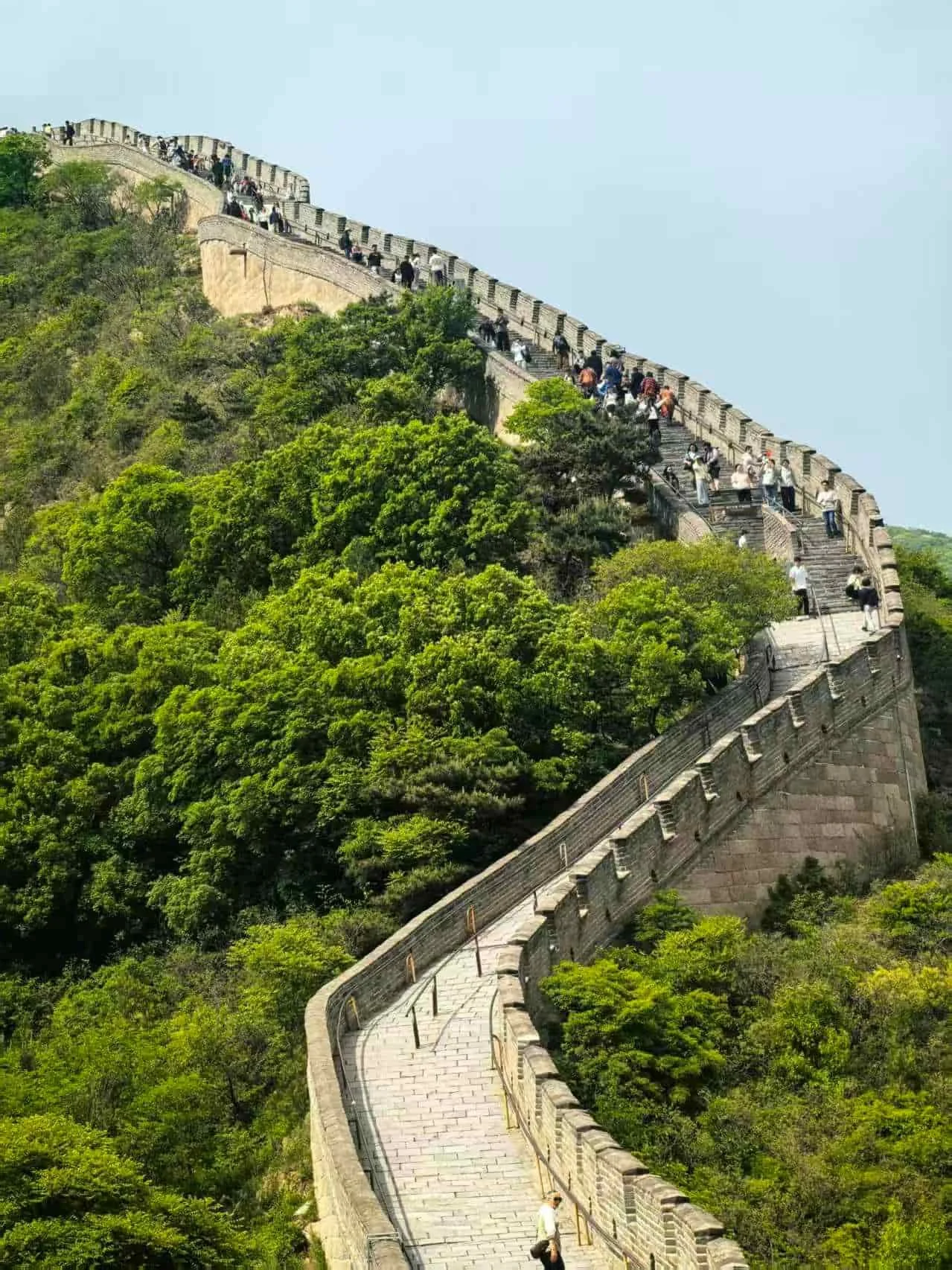
Beijing North Station (北京北站): Line 2, Line 4, Line 13 at Xizhimen. This is the one for the S2 train to Badaling Great Wall. If you're doing the Great Wall, stay near Xizhimen the night before — the S2 leaves early and seats fill up.
5. Eight Traps That Waste Your Money or Your Morning
Trap 1: "5-minute walk to the Metro" means 5 minutes by crow.
Always open Baidu Maps or Apple Maps and check the walking route. Beijing blocks are enormous. A hotel listed as "300 meters from Xidan station" might be 300 meters as the crow flies, but the pedestrian route loops around an elevated highway and takes 18 minutes. Check the actual walking path, not the straight-line distance.
Trap 2: "Beijing Hotel" in the name doesn't mean it's in Beijing.
Some hotels with "Beijing" in the name are in Yanjiao — a satellite town in Hebei Province, across the municipal border. From Yanjiao to Tiananmen Square takes roughly two hours by bus and Metro. Check the district name in the address: you want Dongcheng, Xicheng, Chaoyang, Haidian, or Fengtai. Anything else, look closer.
Trap 3: The Tiananmen-adjacent bargain room has no window.
If a hotel near Tiananmen or Qianmen is suspiciously cheap (under 300 RMB), the room is either underground, windowless, or a converted storage closet. Read the room type carefully — Chinese hotel listings are legally required to specify "no window" (无窗). If you see that phrase in a translated listing, believe it.
Trap 4: Beijing Railway Station area is loud and chaotic.
The hotels immediately around Beijing Railway Station are among the worst-reviewed in the city. The area is a crush of travelers, touts, and traffic at all hours. The rooms are old, the soundproofing is nonexistent, and the touts outside the station will follow you for blocks. Unless you're arriving at midnight and departing at 6 AM, stay one Metro stop away instead — Jianguomen or Chongwenmen are both one stop on Line 2 and infinitely better.
Trap 5: Hutong courtyard hotels are charming. They also have no elevator.
Many boutique hotels in the Nanluoguxiang and Shichahai areas are converted courtyard homes with steep stairs, no elevator, and walls thin enough to hear your neighbor's phone vibrate. If you're traveling with large luggage, a knee problem, or small children, skip the courtyard dream and book a regular hotel. The romance of a hutong courtyard disappears fast when you're hauling a 23-kilo suitcase up three flights of unlit stairs.
Trap 6: Booking last-minute during Golden Week turns a 600 RMB room into a 1,800 RMB room.
China's three major holiday periods — Chinese New Year (late January to mid-February), Labor Day (May 1-5), and National Day / Golden Week (October 1-7) — cause hotel prices to double or triple across Beijing. During Golden Week specifically, hotel occupancy in the city center runs above 95%. Book at least six weeks ahead for these periods. For summer (July-August), book three to four weeks ahead. For any other time, two weeks is fine.
Trap 7: Assuming your hotel has a Western breakfast because the photos showed toast.
Hotel listing photos in China are aspirational. They show the hotel at its best possible moment — often on opening day, often staged. The breakfast photo that shows a full English spread may be from a special promotion that ended two years ago. Filter reviews by keyword ("breakfast," "Western," "toast") and read what the last three foreign guests actually said.
Trap 8: Checking in after 10 PM without a booking confirmation in Chinese.
Late-night front desk shifts at non-international hotels are often staffed by the most junior employee — the one who drew the short straw. Their English will be minimal at best. If you're arriving late, have your Trip.com booking confirmation open on your phone, with the Chinese-language version displayed. Smile, hand over your passport, and point at the booking. It'll work. Just don't expect a conversation.
6. The One-Question Decision Guide
Skip the algorithm. Answer one question and you know where to stay.
First time in Beijing, want to see everything: Qianmen or Zhushikou. You're walking distance from Tiananmen, the Forbidden City, and Temple of Heaven. Line 8 connects everything else.
Need both central sights AND Summer Palace / Old Summer Palace: Xidan. Lines 1 and 4 at your doorstep.
Flying out of Capital Airport early morning: Dongzhimen or Sanyuanqiao. Airport Express at your doorstep.
Flying out of Daxing Airport early morning: Caoqiao. Daxing Airport Express at your doorstep.
Arriving/departing by high-speed train from Beijing South: Xidan or anywhere on Line 4.
Traveling with kids, zoo and Great Wall on the agenda: Xizhimen. Zoo is walking distance, S2 train to Badaling Great Wall leaves from here.
Hotel quality matters more than sightseeing efficiency: Guomao / CBD. Best hotels in the city, just accept the 30-minute Metro rides.
Want old Beijing atmosphere, don't want a generic hotel room: Qianmen / Dazhalan. The hutongs, the food stalls, the red lanterns at night.
On a tight budget but need a foreigner-safe hotel: Zhushikou. 30% cheaper than Qianmen, one Metro stop away.
Your Beijing Hotel — Let Us Sort It
I've been doing this since 2014 — matching foreign travelers with the right Beijing hotel for their specific trip, not whatever the algorithm pushes. If you'd rather spend your time planning what to see instead of cross-checking which hotels can actually take your passport, we handle it.
Drop us a message on WhatsApp. Tell me your dates, your budget range, and what kind of traveler you are (solo backpacker, couple, family with kids, first-timer who wants zero stress). I'll send back two or three hotels that actually work — confirmed foreign-guest registration, verified English-speaking front desk, and a location that makes geographic sense for your itinerary. Not a list of 50 options. Just the ones that fit.
We can also bundle your hotel with a private car and an English-speaking driver — useful if you're doing the Great Wall, the Summer Palace, or anything that requires getting out of the city center without wrestling with the Metro.
WhatsApp: +86 17267898631
Lynx Travel China. Since 2014. We book the hotels that actually let you check in.