Zhangjiajie Qixing Mountain Guide | The Complete "City in the Sky" Edition (Save This )
Contents
First, the Verdict: Is Qixing Mountain Right for You?
What Kind of Mountain Is Qixing Mountain?
Where Is Qixing Mountain?
How to Get Around Inside the Scenic Area
Recommended Routes
Getting There: How to Reach Qixing Mountain
Tickets and Costs (subject to the price posted on your booking channel that day)
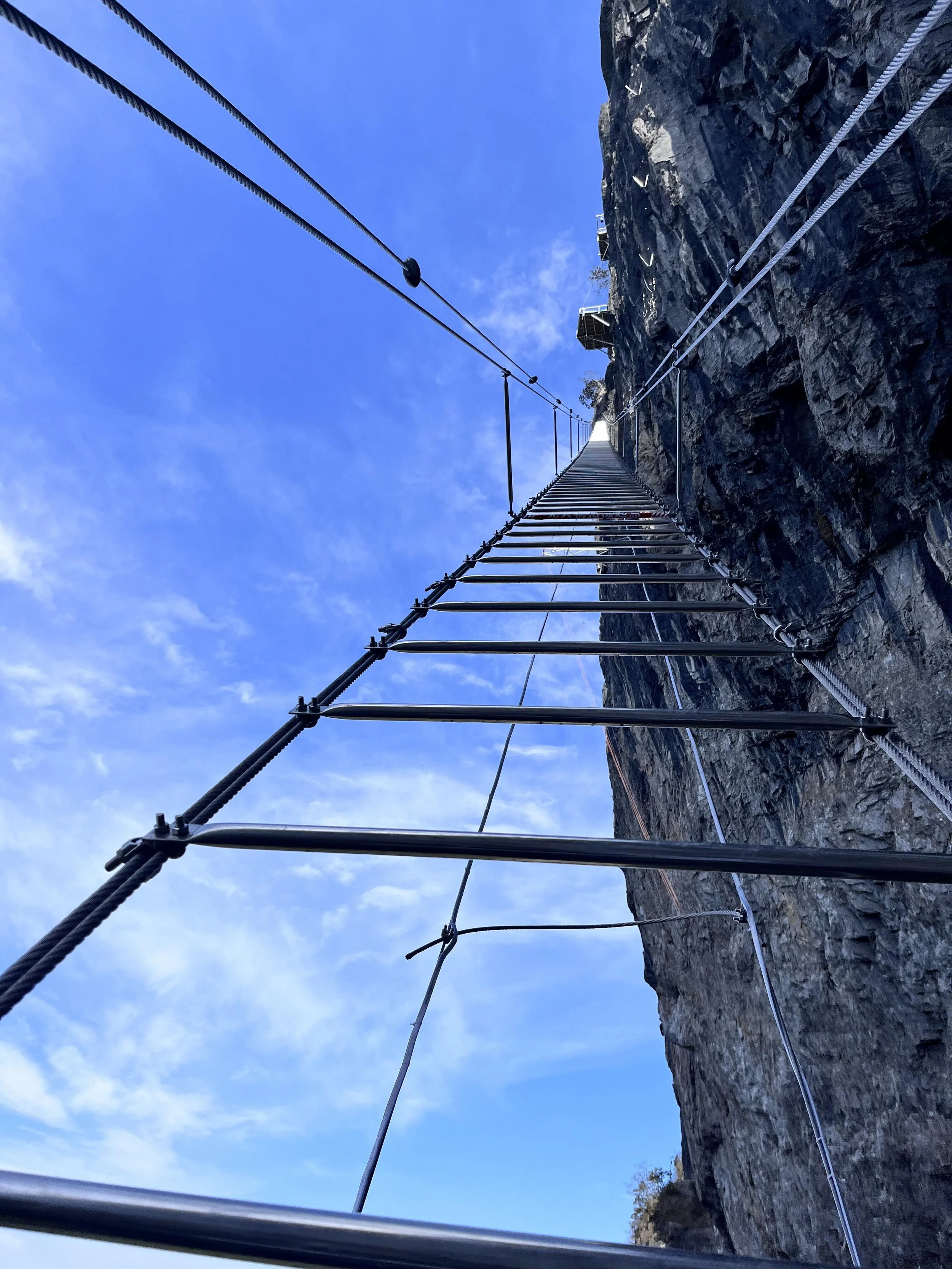
Via Ferrata in Detail (the Signature Adrenaline Activity)
What to Bring Before You Go Up (Checklist)
Accommodation: Stay on the Summit or Downtown?
Traps to Avoid and Safety
Frequently Asked Questions (FAQ)
Want It Handled for You? Leave It to Us
This guide covers Qixing Mountain end to end — how to get there, what it costs, how to move around the summit, which via ferrata route to pick, and whether staying on the summit is actually worth it. Save it first, then run through it before you set off. Don't start researching at the foot of the mountain.
1. First, the Verdict: Is Qixing Mountain Right for You?
Not everyone is a fit for Qixing Mountain. Read this list first so you don't waste your money.
Want to dodge the crowds and hate queuing — Highly recommended: The mountain really is quiet. It's not on the same scale as Tianmen Mountain or Wulingyuan at all.
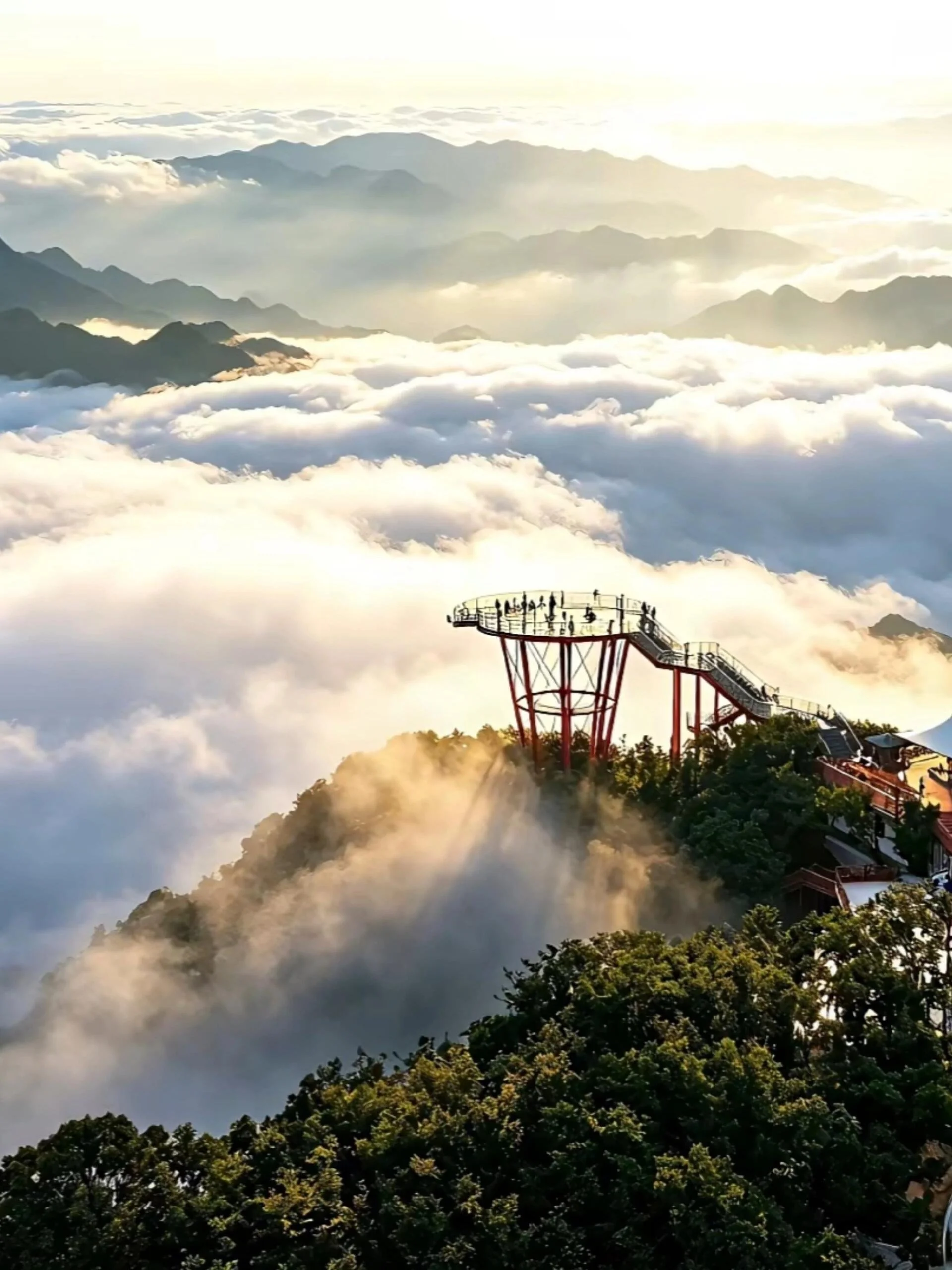
Chasing sea-of-clouds sunrises — Highly recommended: The sea of clouds is Qixing Mountain's signature. One night on the summit is the best money you'll spend.
Here for the adrenaline — Highly recommended: The via ferrata is top-tier in China, plus there's a rail slide and a cliff leap.
Couples and honeymoons — Recommended: Two romantic landmarks at 1,314 and 1,520, and the summit guesthouses turn the mood all the way up.
Families with kids (5 and up) — Recommended: The easy routes aren't tiring, but the via ferrata has a height requirement.
Limited mobility or wheelchair users — So-so: The walkways have steps and ups and downs, and you're on your feet the whole way.
Qixing Mountain's core draw is fewer people + sea of clouds + adrenaline. According to the scenic area's own introduction, it's also the only place in Zhangjiajie that packs the landscape features of China's three great mountains and five sacred peaks into a single mountain. Put it plainly: it's the underrated one. Drop this mountain anywhere else and it would have been a top draw years ago.
2. What Kind of Mountain Is Qixing Mountain?
Here's the hard data first.
Highest elevation — 1,528.6 m
Compared with Tianmen Mountain — About 10 m taller than Tianmen Mountain, and the two peaks are only about 2 km apart in a straight line.
Summit terrain — A giant high-mountain mesa (a rounded flat-top plateau). Seven taller peaks rise from the plateau and happen to sit in a "Big Dipper" pattern — hence the name Qixing (Seven Stars) Mountain.
Forest coverage — 87%
Old-growth forest — Nearly 2,000 mu preserved.
Average annual summit temperature — About 9°C, with no summer at all.
The summit really does average only around 9°C a year with no true summer — but on the hottest midsummer days it still reaches around 27°C up there in the daytime. A reporter measured it: during the dog days of August, the visitor center at the foot was 39°C, the cable car cabin was 33°C, and the Sky's Eye on the summit was 27°C — while downtown Changsha was already past 40°C. So don't assume you'll need a down jacket. A short-sleeve shirt is fine during the day, but add a windproof jacket for early mornings, evenings and rainy days.
There's an old local saying about this mountain: "Dayong has a Qixing Mountain, three feet and three taller than the sky." For years, because it was so high and had no road, it was a private playground for hikers, and it was also called "the hardest mountain to climb in Hunan." It only entered the public eye in January 2022, when the cable car opened.
Why it's worth a dedicated trip:
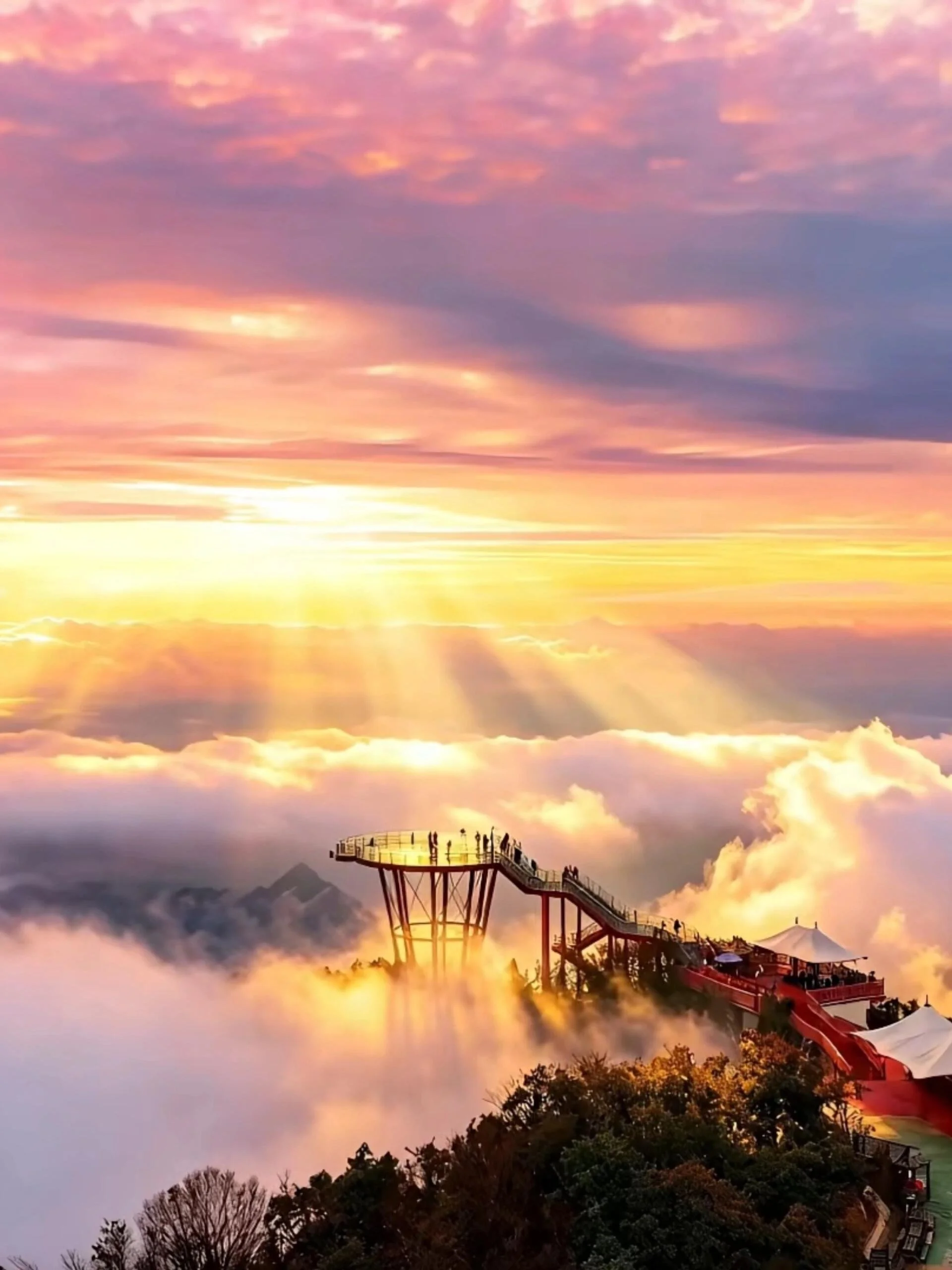
1520 Eye of the Sky: A circular glass viewing platform of 200 square meters — the most photogenic spot in the whole scenic area, with cliffs and a sea of clouds right under your feet.
Ruyi Bridge glass walkway: Built against the cliff at 1,314 m, 199.99 m long and 1.9 m wide — the longest and widest glass walkway in Zhangjiajie.
Horse-Hitching Post: A lone peak at exactly 1,314 m that "grows" straight out of the cliff face — the mountain's love landmark.
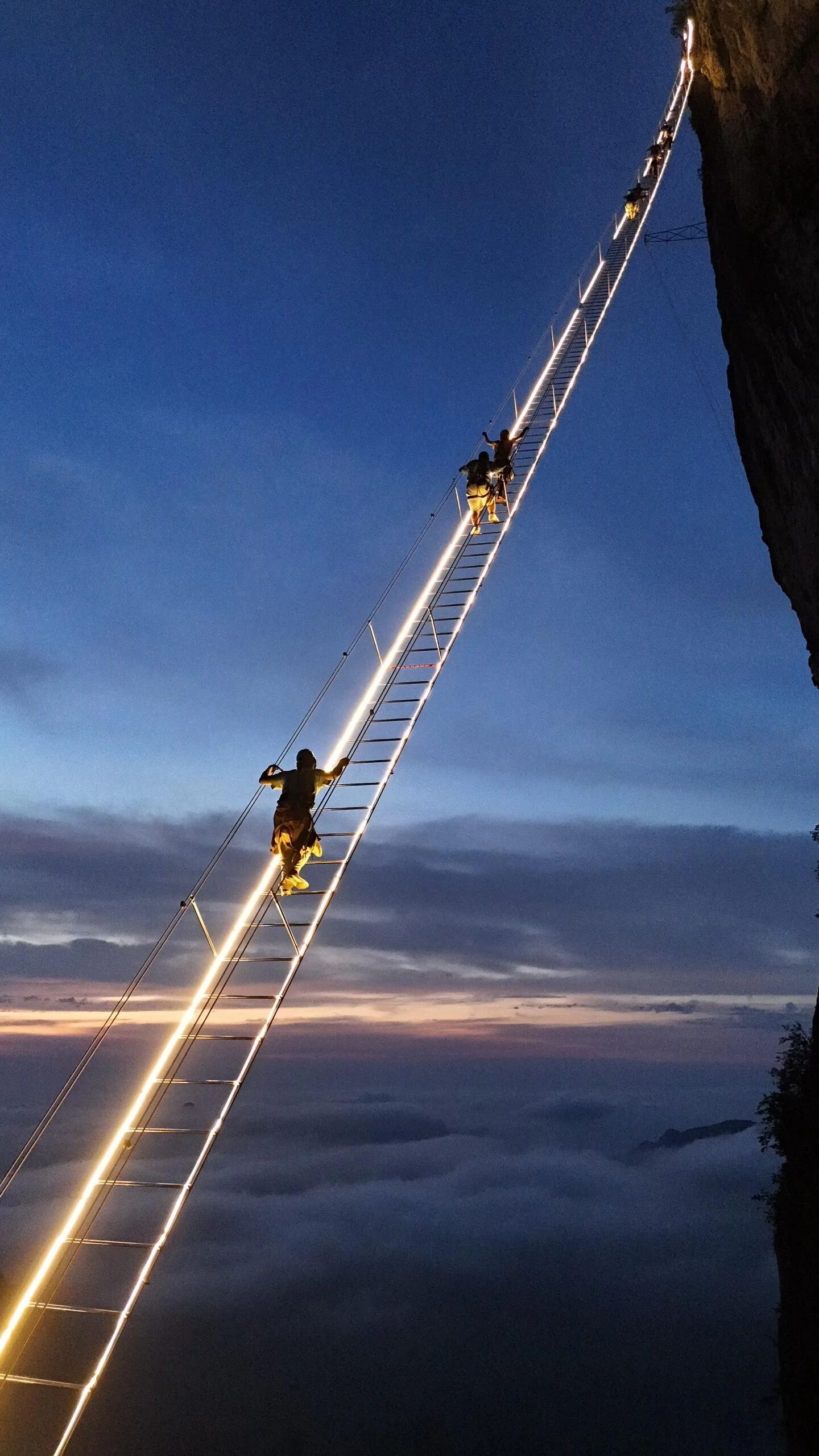
Via ferrata climbing: The longest Sky Ladder is 168 m, hung on the cliff at about 1,400 m, with a cliff drop of 1,480 m.
Seven Stars Ice & Snow Park: A rare high-mountain outdoor ski area for southern China — the only one in northwestern Hunan.
Few people: No elbowing through crowds. That's its single biggest value for money.
A special note for couples: 1314 ("one life, one lifetime") and 1520 ("I love you") are Chinese homophone puns. From its altitudes to its name, the whole mountain hides a message of "I love you." It's a great place to bring your partner — though families and solo travelers have just as good a time.
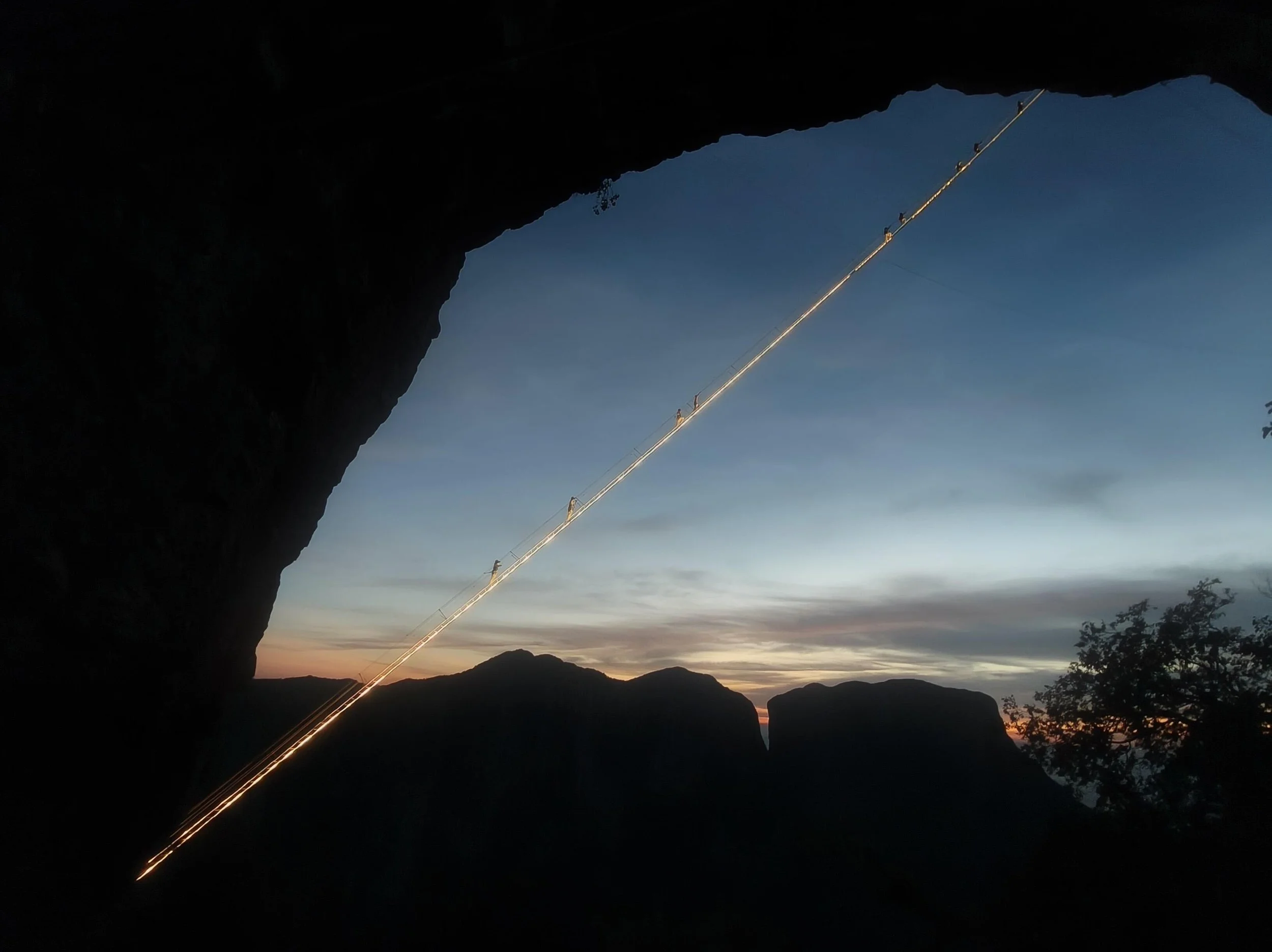
3. Where Is Qixing Mountain?
From downtown Zhangjiajie — About 13 km, 25 minutes by taxi
From Zhangjiajie Hehua Airport — About 8 km; the straight-line distance is very short, 30 minutes by taxi
From Tianmen Mountain — About 2 km in a straight line; you can look straight across to the Tianmen summit from the viewing platforms here
Administratively, Qixing Mountain sits in Tianmenshan Town, Yongding District, Zhangjiajie, Hunan Province. Both the visitor center and the lower cable car station are right in the town.
Because it's so close to the city, whether you're on a group tour or traveling independently, it slots in easily as a "one-day add-on" alongside a Wulingyuan itinerary, with zero hassle.
Want to see where that add-on day fits? The Zhangjiajie travel guide maps out the whole trip day by day.
And coming from another scenic area? Plenty of people only remember Qixing Mountain after they've finished Wulingyuan. Here are the distances and drive times, spelled out:
Wulingyuan (Biaozhimen gate) — About 55 km, about 1 hour by car or private transfer
Zhangjiajie National Forest Park ticket gate — About 45 km, about 55 minutes
Zhangjiajie Grand Canyon (Glass Bridge) — About 65 km, about 1 hour 15 minutes
Furong Town — About 110 km, about 2 hours 30 minutes
Key point: Coming from Wulingyuan takes at least an hour, and once you add 4–8 hours on the mountain, a same-day round trip gets rushed. Set aside a full day for Qixing Mountain, or simply spend a night downtown and head straight to the lower cable car station first thing the next morning.
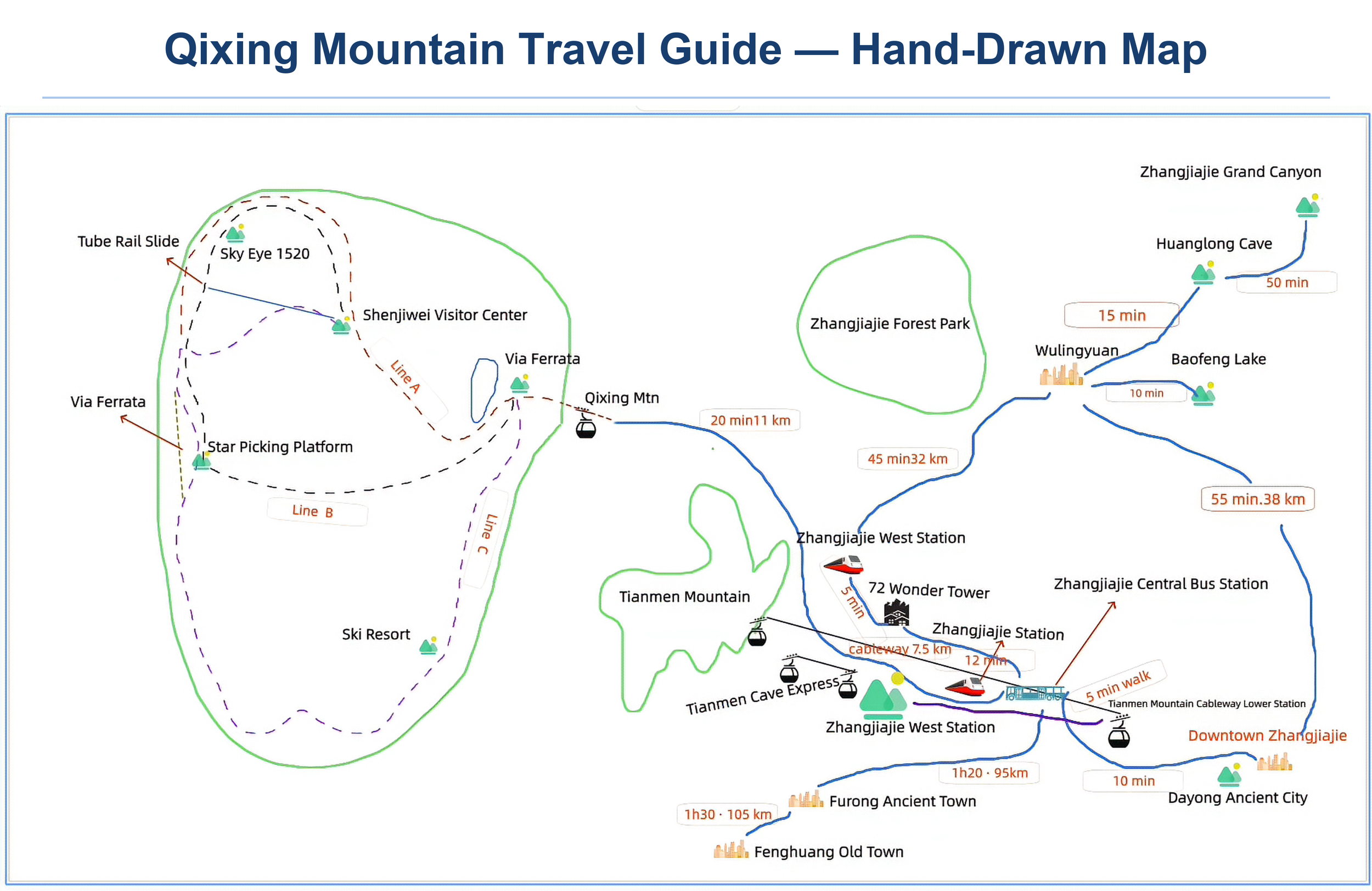
4. How to Get Around Inside the Scenic Area
Cable car up → shuttle to link the stops → walk the cliff walkways through the core sights. Both the cable car and the shuttle are included in the ticket package; the Ruyi Bridge glass walkway is a separate RMB 28.
Two ways to get around inside:
Cable car: From the lower station (Tianmenshan Town) to the upper station (summit) — 2,003 m of sloped length, 708 m of vertical drop, a maximum gradient of 42.79 degrees (close to 43), a top speed of 6 m/s, and 5.8 minutes at the fastest, usually 6–8 minutes to the top. Eight-person cabins, 50 cabins in total, moving 1,800–2,000 people an hour. You climb straight up through the clouds — that's a sight in itself.
Shuttle: Loops the main summit route and links every summit stop. Main stops: cable car upper station → Bajiaoting (Octagon Pavilion) → Star-Picking Terrace → 1520 Eye of the Sky → Shenjiwei → Qixing Grand Canyon Visitor Service Center. Included in the ticket package.
One thing to remember above all: the cable car is the only normal way up and down. The mountain is too steep for a road. There is a hiking trail, but it takes more than two hours one way and the path is rough — don't count on it to get you down during a normal visit. The cable car has no clearly defined last departure time, but it only shuts down after staff confirm no visitors are stranded on the mountain, so don't drag out your descent. It's worth saving the scenic area's official phone number: 0744-8556789. If you get stranded on the Qixing Mountain summit and don't have a Chinese phone number, contact the Zhangjiajie Travel China head office right away on WhatsApp: +8617267898631, tell us your exact location, and we'll contact the scenic area for you free of charge.
Main summit stops — follow this order and you won't get lost:
Tianjie Town: The summit's living area. The wooden guesthouses, the food street and Lanyue Lake are all here, and in the evening there are performances and a fountain stage by the lake. (You'll see it the moment you walk out of the summit cable car station.)
Horse-Hitching Post: 1,314 m, the mountain's love landmark. (It's the lone peak on your left as you ride the cable car up.)
1520 Eye of the Sky: Tianmen Mountain to the east, Xiongbing Rock to the west, and the whole of downtown Zhangjiajie straight ahead. Sea of clouds by day, city lights by night. (This was the core attraction in Qixing Mountain's early development.)
Ruyi Bridge: Built out over the cliff at 1,314 m — cliff face + glass + sea of clouds, every step a thrill. (This is the Qixing Mountain glass walkway. There's even a piano on it, and looking down you'll see the famous Qixing Mountain via ferrata.)
Star-Picking Terrace: 1,528.6 m, the true "rooftop" of Zhangjiajie. On a clear day the view stretches a long way; on a bad day you're just weaving through fog. (Look to your left from here and you'll see the cliff walkway that gathers China's three great mountains and five sacred peaks into one view, plus the Grand Canyon.)
Qixing Grand Canyon: A viewing belt along the canyon sightseeing road, with about 5.2 km of walkway in total.
Jiulong Ridge, Like Peak and Shenjiwei: viewpoints with their own strange rock formations.
Rail slide: A roughly 1,000 m gravity-powered mountain slide with over 80 m of vertical drop, about 3 minutes — a quick shot of speed.
What to eat on the mountain?
Tianjie Town food street: The summit's dining hub, with flavors from all over the country. Prices run higher than at the foot — a bowl of noodles can hit around RMB 30.
Other stops: Only simple stuff like grilled sausages, instant noodles and snacks. Few convenience stores, limited supplies.
My advice: Eat one meal up there for the experience and save your proper meals for after you come down. Bringing your own food and water up is better value — especially if you're doing the via ferrata, where you have to carry your own food for the middle section.
Best photo spots (ranked by how well they shoot):
Qixing Grand Canyon: The number-one camera position in the whole scenic area.
1520 Eye of the Sky: Sea of clouds, afterglow at sunset, and the whole of downtown Zhangjiajie. (A limited-edition view after rain clears.)
Ruyi Bridge glass walkway: Cliff face + glass + sea of clouds in one frame — don't forget the wide-angle lens.
Star-Picking Terrace: The highest panorama point on the mountain; on a clear day you can catch the layered ridges far off.
Horse-Hitching Post: A lone peak standing on its own — good for silhouettes and couple shots.
Lanyue Lake at Tianjie Town: The fountain stage at dusk plus reflections on the water — maximum atmosphere.
5. Recommended Routes
✅ The highlights in one day (short on time, want to fit it all in)
This route is laid out for you by the clock.
07:30–08:00 — Arrive at the lower cable car station, collect tickets / scan your ID to enter, and catch the first wave up (also the quietest).
08:00–08:20 — Ride the cable car to the summit; Tianjie Town is right outside the station.
08:20–09:10 — Explore Tianjie Town, Lanyue Lake and the wooden guesthouse area.
09:10–09:30 — Take the shuttle from Bajiaoting to Star-Picking Terrace.
09:30–11:30 — Walk the cliff walkway to the 1520 Eye of the Sky.
11:30–12:30 — A light lunch on the summit (or food you brought yourself).
12:30–13:00 — Take the shuttle from the Shenjiwei Visitor Center toward Star-Picking Terrace.
13:00–14:00 — Ruyi Bridge glass walkway.
14:00–15:00 — Shuttle back to Bajiaoting, then take the escalator up to the upper cable car station.
15:00–15:30 — Cable car down, back to the visitor center.
The whole thing covers the highlights in 7–8 hours.
✅ Two days (highly recommended — the sea-of-clouds sunrise is the soul of this mountain)
Day 1: Cable car up → Tianjie Town and Lanyue Lake → shuttle to Qixing Grand Canyon → walk the walkway past Star-Picking Terrace → 1520 Eye of the Sky → stay overnight in a summit guesthouse (open the window and there's the sea of clouds).
Day 2: Up early for the sea-of-clouds sunrise (Qixing Mountain's morning is widely regarded as the classic; watching the sun climb up out of the sea of clouds is a sight you won't forget in a lifetime) → walk the walkway to Shenjiwei → shuttle down.
If you're staying on the summit, your downward cable car ride still works the next day (the official rule: tickets and the up-and-down cable car are valid the same day; if you're staying on the mountain, the downward cable car can be used the next day) — so one ticket package covers two days. Confirm this in advance in the "Qixing Mountain Scenic Area" mini-program, or just book through us at Zhangjiajie Travel China.
✅ Via ferrata + highlights combo (for people with good stamina)
Be at the lower cable car station before 10 a.m. → head straight for the Big Cliff via ferrata → finish around midday → in the afternoon do the 1520 Eye of the Sky and Ruyi Bridge → cable car down. One day, both the adrenaline and the views.
Special warning: if you're doing the via ferrata, block out a full day. Don't believe the "three hours and you're done" line. Section 8 below explains in detail.
6. Getting There: How to Reach Qixing Mountain
Taxi / ride-hailing — Pick-up point: anywhere downtown | Price: about RMB 40–50 | Time: 20–25 minutes | Note: the best option for independent travelers; navigate directly to "Qixing Mountain Cable Car Visitor Center".
Taxi — Pick-up point: Zhangjiajie West Station (high-speed rail) | Price: about RMB 40 | Time: 30–40 minutes | Note: West Station is far from downtown — don't mix up your stations.
Intercity bus — Pick-up point: Zhangjiajie Central Bus Station | Price: RMB 4 | Time: 20–25 minutes | Note: 7:00–18:00, one every 40 minutes. The bus is at the station exit; the sign reads "Downtown — Tianmenshan Town".
Self-driving — Pick-up point: — | Price: parking capped at RMB 10 per day | Time: about 20 minutes from downtown | Note: navigate to "Qixing Mountain Cable Car Lower Station Official Parking". Private cars can't drive up the mountain.
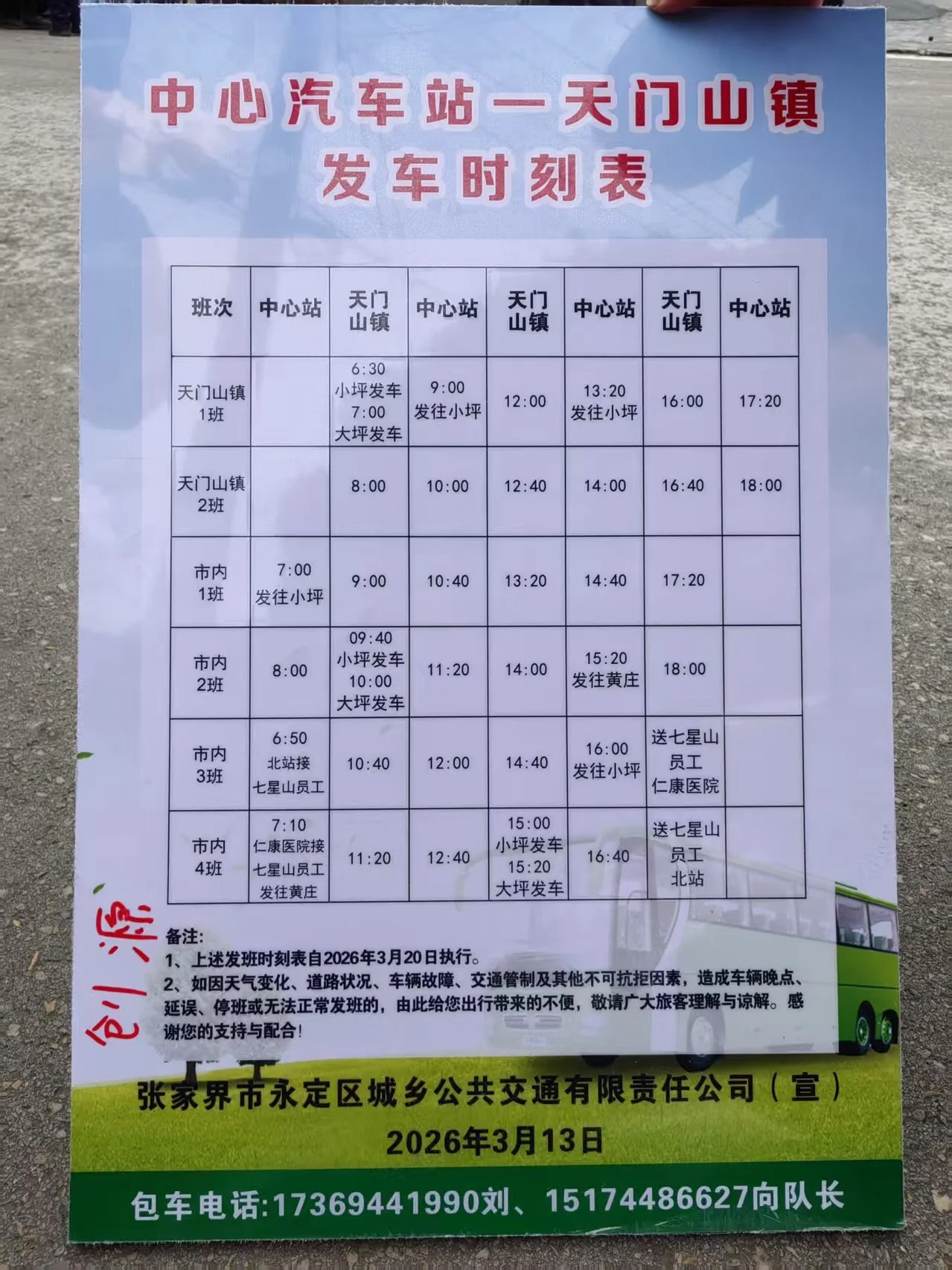
A few practical warnings, all learned the hard way:
Watch the last bus back. The last return bus is at 18:00, and it passes the parking lot around 18:05. If you miss it, contact the Zhangjiajie Travel China head office on WhatsApp: +8617267898631. For two people or more it's RMB 10 each to your hotel; a solo traveler needs a private car at RMB 50.
Don't trust "cheap guides" or "free transfers." Ignore everyone hawking at the station and the scenic area entrance.
Don't park in private lots along the road. Go straight into the official parking lot — RMB 10 a day, capped.
7. Tickets and Costs (subject to the price posted on your booking channel that day)
The standard sightseeing package (called the "Qixing Mountain Scenic Area Ticket Package" in the mini-program) includes the entrance ticket + round-trip cable car + summit shuttle + the 1520 Eye of the Sky platform + service fee + insurance. It does not include the Ruyi Bridge glass walkway (RMB 28 extra), and the RMB 5 shoe covers for the 1520 platform are also on you:
Adults — RMB 199 (mini-program price; gate price RMB 239)
Children under 1.2 m — Free
Minors under 18, seniors over 65, people with disabilities, active-duty military personnel, retired military cadres, and full-time university students (undergraduate and below) — Free entrance ticket (round-trip cable car and shuttle must be bought separately; bring a valid ID for verification)
Everyone else (including 18–24 year olds) — RMB 199, the same as adults
Two keys to saving money:
The official mini-program is cheaper than buying on site. In the "Qixing Mountain Scenic Area" mini-program it's RMB 199 straight up (gate price RMB 239) — RMB 40 cheaper than the window. Third-party platforms like Ctrip and Meituan sometimes list it lower, but that's a channel promotion price; the mini-program's official price is the benchmark. It supports booking for tomorrow, refunds anytime, and refunds after expiry.
For concession groups, it's the entrance ticket that's waived — the cable car and shuttle still have to be bought. Children under 1.2 m go free. Minors under 18 who are taller than 1.2 m, seniors over 65, people with disabilities, active-duty military personnel, retired military cadres, and full-time university students (undergraduate and below) get the entrance ticket waived with valid ID, but must buy the round-trip cable car and shuttle separately. Bring original ID documents for verification at the gate.
Experience activities (all prices below already include the scenic area entrance ticket):
Via ferrata · Big Cliff (Route 1 "Sky Ladder" / Route 2 "Ten Thousand Years Wall") — RMB 780 (generally does not include the entrance ticket; a "ticket + via ferrata" bundle is available)
Ticket + Tianshi Cave karst cave via ferrata / Ticket + sinkhole descent via ferrata — From RMB 380 each (ticket included)
Ticket + Big Cliff via ferrata + hiking tent — From RMB 938
Sky Ladder aerial photography ticket (drone follow-shoot) — From RMB 299 (a full-route climbing companion ticket is also available)
Rail slide — Up RMB 30 / Down RMB 60 / Round trip RMB 90 (requires height over 1.2 m and age under 60)
Ruyi Bridge glass walkway — RMB 28 (not included in the package)
1520 Eye of the Sky shoe covers — RMB 5
Booking channels: the WeChat mini-program "Qixing Mountain Scenic Area", Meituan, Ctrip and Qunar all sell online. It's real-name entry by scanning your ID card (international visitors should bring their passport original), which saves you the ticket-window queue. Via ferrata slots are tight — you must book a day ahead.
Refund and change rules: these differ by channel, so read them carefully before you book. If heavy rain or high wind shuts the cable car down, you can generally get a full refund, but follow your channel's specific rules. Check the weather forecast before you buy — it saves a hundred times the hassle of arguing about it afterwards.
Scenic area customer service phone: 0744-8556789
Budget per person:
One-day sightseeing tour
Ticket package: RMB 232 (including the RMB 28 glass walkway + RMB 5 shoe covers)
Round-trip transport: RMB 60–100
Food: RMB 50–80
Accommodation: —
Total: about RMB 340–410 per person
Via ferrata day
Ticket package: about RMB 840–940 (check whether the entrance ticket is included)
Round-trip transport: RMB 60–100
Food: RMB 50–80
Accommodation: —
Total: about RMB 950–1,120 per person
Two days (staying on the summit)
Ticket package: RMB 232
Round-trip transport: RMB 60–100
Food: RMB 100–150
Accommodation: RMB 1,400–1,700
Total: about RMB 1,800–2,100 per person
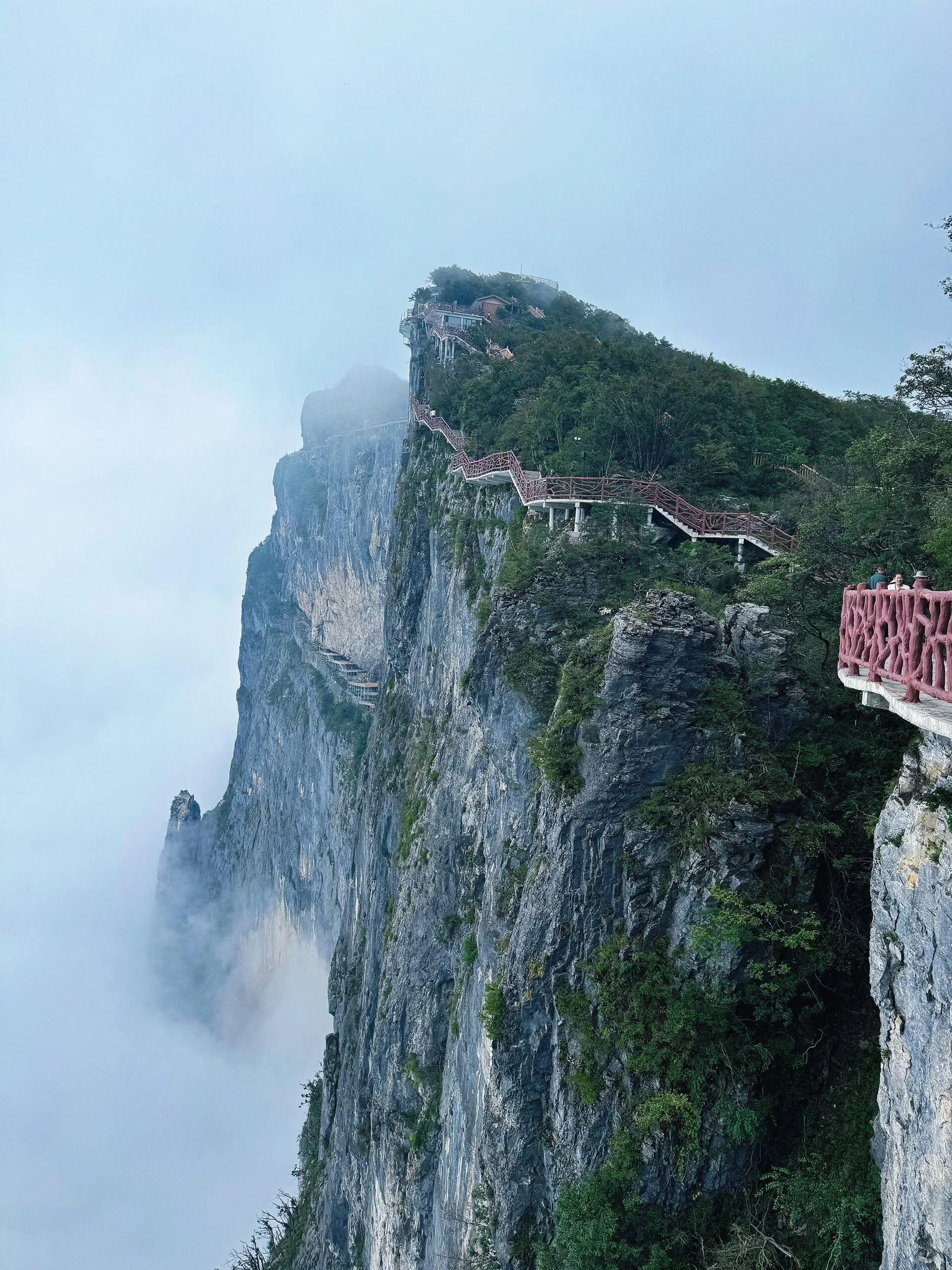
8. Via Ferrata in Detail (the Signature Adrenaline Activity)
Via ferrata (Italian for "iron path") means climbing along steel cables and iron ladders fixed to a steep rock face. It's far safer than free climbing and far more thrilling than an ordinary hike. Qixing Mountain's via ferrata has become a world-famous interactive scenic-area attraction — if you're young and you're in Zhangjiajie, definitely experience it once.
Which route to pick:
Big Cliff Route 1 · Sky Ladder — RMB 780 (generally excludes the entrance ticket; a bundle is available) | A 168 m Sky Ladder with about 1,000 m of suspended cliff route, 3–4 hours in total. The longest and most thrilling, with the most spectacular scenery.
Big Cliff Route 2 · Ten Thousand Years Wall — RMB 780 (generally excludes the entrance ticket; a bundle is available) | The other main Big Cliff line. Its length and thrill level are close to Route 1 — pick one of the two.
Tianshi Cave karst cave adventure — From RMB 380 (a bundle with the ticket is available in the mini-program) | A cave-and-cliff mixed route with a world of its own. Pick this one if you like caving and atmosphere.
Sinkhole descent exploration — From RMB 380 (a bundle with the ticket is available in the mini-program) | Descend into a natural karst sinkhole. All about exploration and the descent itself.
Ten key things to know about the via ferrata (important)
When buying a via ferrata ticket online, check first whether the entrance ticket is included. The RMB 780 listed on most channels is a Big Cliff single-activity ticket and does not include the scenic area entrance ticket. The mini-program has "ticket + via ferrata" bundles (ticket + Tianshi Cave karst cave from RMB 380, ticket + sinkhole descent from RMB 380, ticket + Big Cliff via ferrata + hiking tent from RMB 938). Read the ticket name before you order so you don't pay twice. Gear, coaches and insurance are generally already included — check the ticket description. If you want drone follow-shooting, there's a separate Sky Ladder aerial photography ticket (from RMB 299) and a full-route climbing companion ticket.
Call ahead a day in advance to book! Daily slots are limited (about 200 people), and walk-ups basically won't get a spot.
Qixing Mountain opens at 7:30 and the via ferrata starts at 8:30. Get there early — once you're inside, you still have to take a bus, transfer and ride the cable car to reach the via ferrata start point, and all of that takes time.
Bring gloves and a phone lanyard (the neck kind) in advance. You can bring other small items, but your own bag can't go onto the cliff face (you can store it at the via ferrata start). The scenic area gives you a small free bag that holds a snack and a bottle of water.
Buy water and filling snacks beforehand. Water along the via ferrata sells for RMB 10–15 and there's no food. There's a stretch in the middle where you rest and queue for the Sky Ladder — being hungry there is miserable.
Use the bathroom before you start. From start to finish it's about 3–4 hours, with no toilet at all along the way.
Block out a full day. This is the most important one. Some posts online say three hours — that's pure climbing time. From leaving your hotel, to the scenic area, the bus, the transfer, the cable car, queueing and registering at the via ferrata, the coach briefing and training, queueing to climb, queueing for the Sky Ladder, and all the way back afterwards — it can realistically eat 7 hours. People genuinely think 3 hours is enough, only leave 3 hours, then give up halfway and waste the whole trip.
Don't rush off when you finish. After you ride the cable car back down to the visitor center, you can collect a trophy and certificate in the building next door. Get staff to take a photo for you — maximum ceremony.
The Sky Ladder sways, and so do the steel cables. Be mentally ready. If you're afraid of heights, think carefully about it.
Don't wear white clothes or white shoes, and don't wear expensive clothes or shoes either. You rub against rock and rebar the whole way — white clothes are basically ruined after one run, and if something expensive gets torn, you're the one who'll feel it.
Physical requirements: over 140 cm tall, under 100 kg, aged 12–55. Not suitable for people with heart conditions, high blood pressure, high blood sugar or a serious fear of heights. Assess yourself honestly before you go — don't force it.
9. What to Bring Before You Go Up (Checklist)
A windproof jacket — essential. The summit averages only 9°C a year, and even in midsummer it's around 27°C in the daytime, noticeably colder in the early morning, evening and rainy weather. If you're catching the sunrise or staying on the summit, a light down jacket or shell jacket is genuinely useful.
Non-slip sneakers or hiking shoes. You'll need them on the glass platform, the cliff walkway and the via ferrata. Safety first — never wear heels or smooth-soled shoes.
Your passport. Ticketing and entry are both real-name, so you absolutely must bring it. No ID, no entry.
A light daypack. Mountain paths and walkways aren't suited to large luggage. Keep valuables on you.
Food and plenty of water. Supplies on the summit are limited, convenience stores are few and prices are high — a bowl of noodles can go for over RMB 30. Bringing your own is better value.
A little cash. Most shops take mobile payment, but some small stalls only take cash, so carrying a bit is safer.
A power bank plus a fully charged phone and camera. The scenery is too good — your battery genuinely won't keep up.
If you want the sunrise and you're staying on the summit: book the summit hotel in advance. The summit has Zone A tent rooms and Zone C wooden cabins. Most include breakfast for two but are non-cancellable; weekends and holidays are pricier and sell out easily. If you see a good price, lock it in early.
10. Accommodation: Stay on the Summit or Downtown?
Summit hotel (Zone A tent rooms / Zone C wooden cabins)
Price (reference): about RMB 1,400–1,700 per night (most include breakfast for two; non-cancellable)
Pros: open the window to the sea of clouds; no rushing anywhere for the sunrise; stars at night
Cons: expensive, pricier on weekends and holidays, and sells out easily
Hotel at the foot / downtown
Price (reference): about RMB 150–500 per night
Pros: plenty of choice, full amenities, good value
Cons: you have to set off early for the sunrise, and the sea of clouds is a matter of luck
My advice is blunt:
If you want the sea-of-clouds sunrise, stay on the summit. It's the one experience on this mountain that nothing else can replace. The cable car's operating hours make it impossible to come and go the same day and still catch the sunrise — you have to stay up there.
If you're skipping the sunrise, stay downtown. More hotel choice and easy transport. Don't stay in Tianmenshan Town — it's just a village, and without a car getting around is a real pain.
Treating Qixing Mountain as a "one-night add-on" alongside a Tianmen Mountain or Wulingyuan itinerary is the best way to use it. If you'd rather not stay over, compressing it into a day trip works perfectly well — here's our Zhangjiajie accommodation guide if you need it.
11. Traps to Avoid and Safety
Always check the weather before you go. The sea-of-clouds sunrise is weather-dependent. If visibility is poor or it's pouring, reschedule without hesitation. One thing to note: a blazing clear day may actually give you no sea of clouds at all — the early morning and late morning after rain clears are the best window.
Glass platform / glass walkway: wear non-slip shoes, don't run, don't crowd, and don't lie on the edge to take photos. If you're afraid of heights, hold the inner railing and walk — don't force yourself.
Not recommended for: pregnant women, wheelchair users, seniors over 95, and anyone with limited mobility (the walkways have steps and uneven terrain).
Avoid the peak times: skip the first week of National Day and the busiest stretch of the summer holidays. Early morning is the quietest, with the best light and the best chance of the sea of clouds.
Mountain weather changes fast: carry light rain gear. The cable car and walkways may close temporarily in high wind or heavy rain. Follow the scenic area's instructions and don't force your way onto the cliffs.
Drones: flying drones in the scenic area is prohibited without approval from the relevant authorities. Zhangjiajie as a whole controls drones fairly strictly. If you want aerial footage, apply to the scenic area in advance — don't quietly fly one yourself.
Protect the environment: don't litter along the way, and don't carve into the ruins or cliff faces.
Toilets: available at Tianjie Town on the summit, the cable car upper station and the main viewpoints. But there are none anywhere along the via ferrata — go before you start.
Medical care and rescue: there's a first-aid point on the mountain that can handle minor injuries. The scenic area's customer service number is not a rescue number. Once you're inside, note down the emergency contact details along the route; if you're doing the via ferrata, confirm emergency contact arrangements with your coach at the start point.
12. Frequently Asked Questions (FAQ)
Q: What's the best season to come?
A: It's more accurate to take it season by season.
Spring (March–May) — Highlights: lush green slopes and rhododendrons in bloom | Watch out: lots of fog, and sea-of-clouds visibility is inconsistent.
Summer (June–August) — Highlights: the heat-escape option, with the summit running 8–10°C cooler than downtown | Watch out: busiest season, with frequent afternoon thunderstorms.
Autumn (September–November) — Highlights: clear air and the highest probability of the sea of clouds — the most recommended season of the year | Watch out: big day-night temperature swings; bring a jacket.
Winter (December–February) — Highlights: fewest people, plus skiing (rare in the south) | Watch out: activities are heavily weather-dependent.
The genuinely best windows are autumn, September to November (highest odds of the sea of clouds), and summer, June to August (heat escape). Spring is foggy; winter is for snow.
Q: Qixing Mountain or Tianmen Mountain — which one?
A: Pick one of the two — don't try to cram both into a single day. Here's a decision list:
Elevation — Qixing Mountain: 1,528.6 m (slightly higher) | Tianmen Mountain: about 10 m lower than Qixing Mountain
Signature attractions — Qixing Mountain: via ferrata, Eye of the Sky, glass walkway | Tianmen Mountain: Tianmen Cave, the 999 steps, glass walkway
Crowds — Qixing Mountain: few, no squeezing | Tianmen Mountain: many, long queues in peak season
Queues — Qixing Mountain: almost none | Tianmen Mountain: queues for the cable car and the big escalator are the norm
Thrill level — Qixing Mountain: higher (the via ferrata is top-tier in China) | Tianmen Mountain: moderate
Best for — Qixing Mountain: people who want quiet plus a challenge | Tianmen Mountain: people who want to tick off the classic landmark
How to choose: if you want the classics, it's your first time in Zhangjiajie, and you need that "Tianmen Cave" photo → Tianmen Mountain. If you don't want crowds, want a thrill and want to watch the sea of clouds in peace → Qixing Mountain. Want both? Do both, but don't schedule them on the same day.
Q: Can I do it in the same day as Wulingyuan?
A: No. Qixing Mountain takes up a full day on its own, and once you add the round-trip drive to Wulingyuan, you end up doing neither properly. Give Wulingyuan (the Avatar filming location) 2–3 days of its own; and between Qixing Mountain and Tianmen Mountain, it's also best to pick one.
Q: If it rains or the fog rolls in and I want to reschedule, where do I go?
A: Don't force Qixing Mountain — you won't see the sea of clouds or much through the glass walkway, and the experience is cut in half. The alternatives are Yellow Dragon Cave and the Grand Canyon Glass Bridge — neither of these is in the same area as Qixing Mountain. Yellow Dragon Cave is a karst cave and is completely unaffected by weather; and the Grand Canyon in fog actually looks more like the Mirkwood of The Hobbit.
Q: Is it doable with kids?
A: Yes, but the via ferrata has thresholds (over 140 cm, aged 12–55). Kids over 1.2 m can do the rail slide (requires over 1.2 m and under 60 years old), plus the Ruyi Bridge glass walkway and a wander through Tianjie Town — just as much fun.
Q: Do I need a guide?
A: If you're not driving and you're going fully independent, the cable car + shuttle + walkway system is easy to use on its own, so it's not a must. But if you want the logistics handled — traveling with elderly parents or kids, booking summit accommodation, securing via ferrata slots — having a local team link up transport, tickets and accommodation in one go makes things far easier. Here's our Zhangjiajie guide service.
Q: Can you ski in winter?
A: Yes. Qixing Mountain has a high-mountain outdoor ski area (Seven Stars Ice & Snow Park) at 1,382 m, covering more than 50,000 square meters. It's the only high-mountain outdoor ski area in northwestern Hunan, and a rare large outdoor snow park for Hunan. There are two professional ski runs plus a fun snow-tube run, with gradients of 2°–20° averaging about 12°, a magic carpet lift and professional instructors. Skis, boots, poles and helmets are available for rental (snow suits and goggles are rented separately).
Operating period: November to March each year, roughly 9:00–18:00.
Reference prices: a weekday basic ticket is about RMB 120 per person; a two-hour ski package (including the scenic area entrance ticket) is about RMB 138.
A tip to save you trouble: the snow season is heavily weather-dependent, so call ahead to confirm it's open that day.
Q: Can I fly a drone?
A: No — it's prohibited without approval from the relevant authorities. Apply in advance if you want aerial footage.
13. Want It Handled for You? Leave It to Us
By now you can probably feel it: the traps at Qixing Mountain aren't on the mountain — they're all in the "connections." How to buy tickets for the best price, how to arrange transport without wasting trips, how to grab a via ferrata slot, how to book summit accommodation, and what time to get up on sunrise day.
You don't have to grind through all of that yourself. Here's what we do:
Ticket booking on your behalf: we get you the online discount price, with no ticket-window queue.
Hotel pickup + private car: from downtown, the airport or the high-speed rail station to the lower cable car station — you never have to find a car yourself. See our Zhangjiajie private transfer service.
Private custom small groups / private guides: traveling with elderly parents or kids, wanting the easy route, or wanting to go deep on the via ferrata — we build the itinerary around your pace. See custom itinerary planning.
Summit accommodation booking: you have to stay up there for the sunrise, and view rooms and couples' balcony rooms go fast — we watch for you.
Via ferrata slot reservation: daily quotas — lock it in early or you've wasted the trip.
Once you have your dates and group size, tap the WhatsApp icon on the page and I'll put together a custom itinerary and quote for you. You can also see everything we run on our private Zhangjiajie tours page.
One more thing before you go: reply "Qixing Mountain" on WhatsApp and I'll send you this guide as a PDF version you can flip through on your phone anytime.