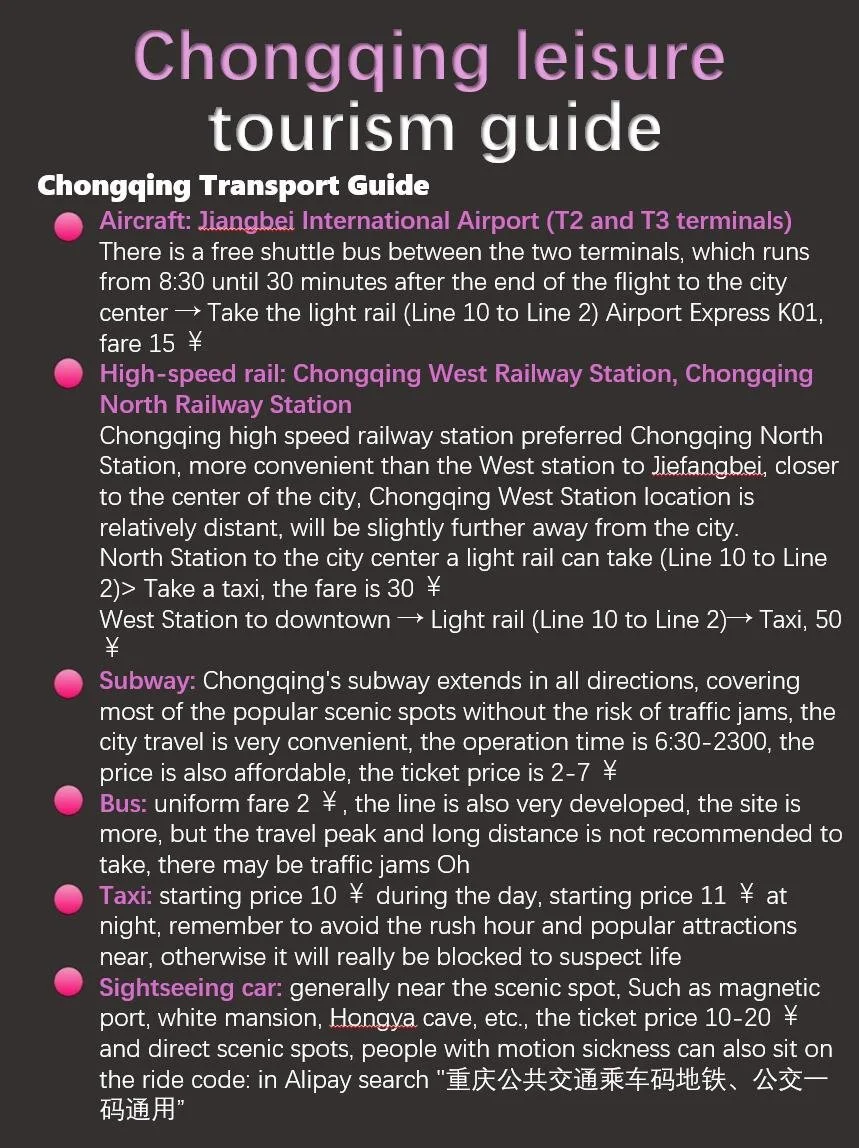
Chongqing Leisure Tourism Guide 2026By jing xiangyin | Published: Jun 22, 2026
Chongqing is not like anywhere else in China. Built into the hills where the Yangtze and Jialing rivers meet, it is a city of staircases, rooftop streets, monorails passing through apartment buildings, and hot pot restaurants on every floor. If you've seen the videos — the "cyberpunk" skyline, the 22-story building where the ground floor is the 11th floor depending on which side of the hill you enter, the drone light shows over the river — that's not exaggeration. That's just Chongqing. This guide walks you through a 4-day leisure itinerary that covers the essential Chongqing experiences, plus practical tips that will actually help you once you're on the ground.
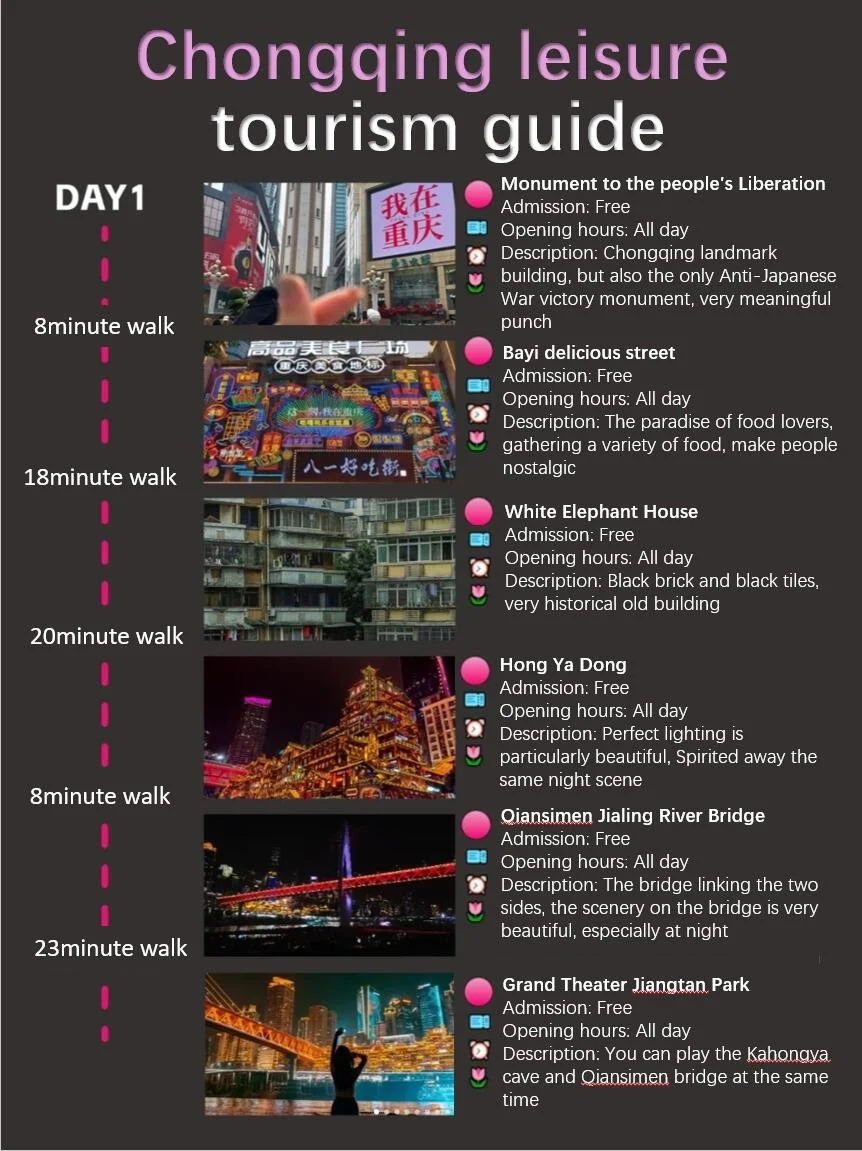
💥 DAY 1: Monument to the People's Liberation → Bayi Food Street → White Elephant House → Hongya Dong → Qiansimen Jialing River Bridge → Grand Theater Jiangtan Park
Morning: Monument to the People's Liberation (Jiefangbei)
Start your Chongqing trip at the Monument to the People's Liberation (Jiefangbei). The monument itself is a plain stone column — it won't take more than 5 minutes to look at — but the surrounding district is the heartbeat of modern Chongqing. This is where the city's shopping, dining, and commercial energy concentrates.
The monument was originally built in 1940 as the "Spirit of the Loyalty and Bravery Monument" during the War of Resistance against Japan, and was rebuilt in 1947. Today, it marks the zero point of Chongqing's city center.
What to do here: Walk around the pedestrian zone. There are malls (Chongqing Times Square, Metropolitan Oriental Plaza) if you want to escape the heat or rain. But the real value of starting here is orientation — once you've stood at Jiefangbei, you can always tell locals "I'm near the monument" and they'll know exactly where you are.
Late Morning: Bayi Food Street (Bayi Meishijie)
A 5-minute walk from Jiefangbei brings you to Bayi Food Street — a narrow pedestrian street packed with snack stalls and small restaurants. This is where you have your first Chongqing meal.
What to eat:
Chongqing xiaomian (重庆小面): Wheat noodles in a spicy, numbing sauce made with Sichuan peppercorns, chili oil, preserved vegetables, and scallions. ¥8–15. Every local eats this for breakfast. The spice level is real — order "weila" (a little spicy) if you're unsure.
Suanla fen (酸辣粉): Hot and sour glass noodles, chewy texture, tangy and spicy broth. ¥10–18.
Kaofu (烤麸): Grilled gluten skewers, street-snack style.
Bingfen (冰粉): Ice jelly with brown sugar syrup — order this after the spicy noodles to cool your mouth.
Most stalls here are cash-only. Very few accept foreign credit cards. ATMs are available on the side streets off Bayi Street — withdraw some cash before you eat.
Afternoon: White Elephant House (Bai Xiang Lou)
After lunch, take a taxi or walk 15 minutes southeast to White Elephant House (Bai Xiang Lou). This is one of Chongqing's lesser-known viewpoints. It's a building with a rooftop terrace that frames the Jialing River and the old town district. Locals come here to relax; tour groups usually don't include it.
There's no entrance fee. The best time to visit is mid-afternoon, when the light hits the river. You can see Hongya Dong across the water from here — it gives you a sense of the city's layout before you dive into the crowds.
Evening: Hongya Dong (Hongyadong)
Hongya Dong is the image that defines Chongqing on social media. It's a stilt-house complex (built in the traditional diaojiaolou style) constructed into the cliff face along the Jialing River. Eleven floors, each opening onto a different street level. At night, every floor is lit with golden lights, and the whole structure reflects on the river.
Practical info:
Free entry to the pedestrian areas. Individual restaurants and shops charge their own prices.
Best visited: 18:00–21:00, after the lights turn on. Arrive before 18:00 if you want photos without crowds.
What's inside: Restaurants (mostly hot pot and Sichuan cuisine), souvenir shops, coffee shops, and a hotel. The food is decent but tourist-priced. Eat elsewhere if you want better value.
The trick: The best view of Hongya Dong is not from inside it — it's from the opposite bank (more on that in the next stops).
Evening: Qiansimen Jialing River Bridge
After Hongya Dong, walk across the Qiansimen Bridge. This pedestrian-friendly cable-stayed bridge connects the Yuzhong district (where Hongya Dong is) to the Jiangbei district on the north bank. It takes about 15–20 minutes to walk across.
From the middle of the bridge, you get the classic Chongqing photo: Hongya Dong lit up on your left, the Jialing River below, and the city skyline behind. This is where every visitor takes their "I was in Chongqing" photo.
Evening: Grand Theater Jiangtan Park
After crossing the bridge, you're on the north bank. Walk west along the riverfront to Grand Theater Jiangtan Park (Juyuan Jiangtan Park). This is a riverside park where locals come in the evening to dance, fly kites, practice tai chi, or just sit and chat.
The park gives you a full view back toward the skyline you just crossed from. At night, the buildings along the riverfront put on a light show (usually starting around 20:30 or 21:00). It's free, and it's where you see the "real" Chongqing — not just the tourist sites, but how the city's people actually spend their evenings.
Dinner suggestion: After the park, eat dinner at one of the restaurants along the north bank riverside. They're slightly less touristy than Hongya Dong, and you can eat while looking back at the lights.
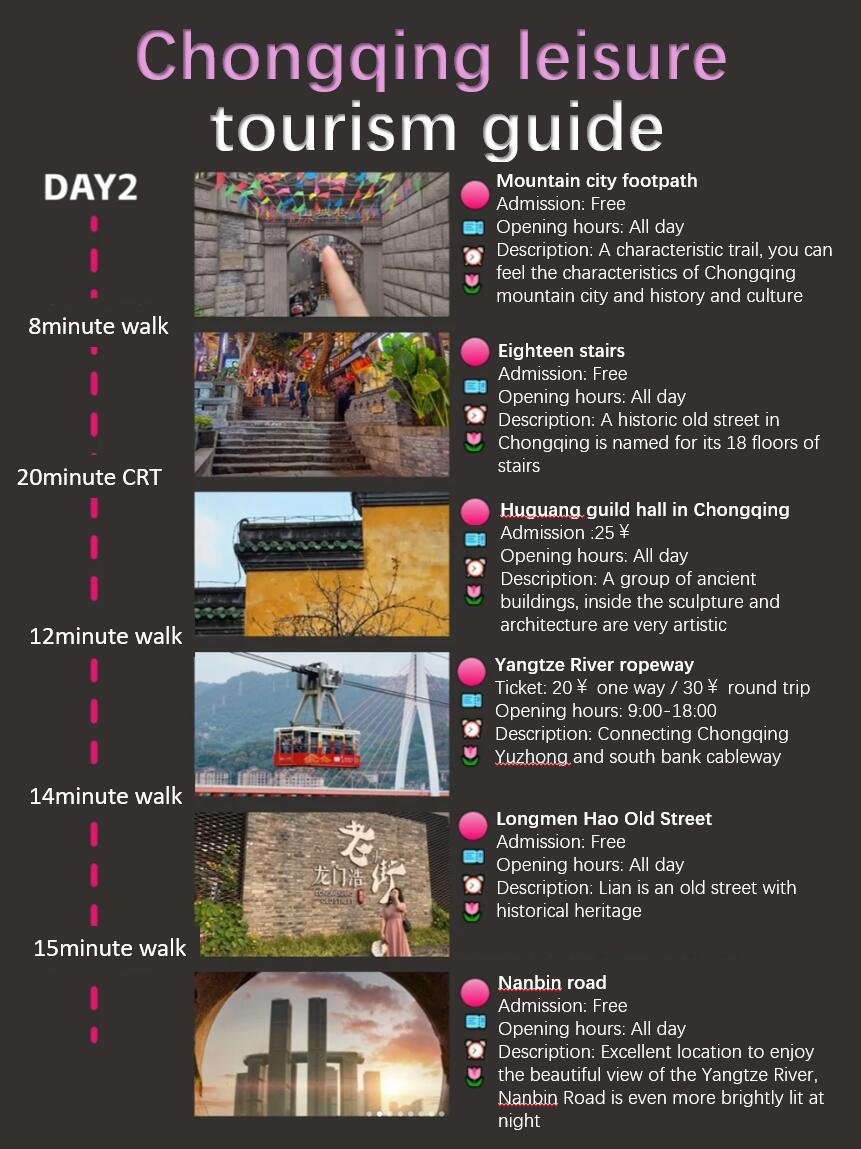
💥 DAY 2: Mountain City Footpath → Eighteen Stairs → Huguang Guild Hall → Yangtze River Ropeway → Longmen Hao Old Street → Nanbin Road
Morning: Mountain City Footpath (Shancheng Bujing)
Chongqing's defining physical feature is its terrain. The city is built on hills, which means "ground level" is a relative concept. The Mountain City Footpath is a network of pedestrian walkways, staircases, and alleys that connect different street levels. It's the best way to understand how the city actually works.
The route: Start from Changjiang Binjiang Road (near the river) and walk uphill. The full footpath is about 3 km, but you can walk sections of it. The most interesting part is the stretch from the riverside up to the Qiansimen Bridge area, which takes about 1.5 hours at a leisurely pace.
You'll pass through residential neighborhoods where old men play mahjong on the sidewalk, women carry groceries up 100-step staircases, and children run up and down alleys that double as stormwater drains in the rainy season. This is the Chongqing that doesn't make it into guidebooks.
Note: Wear good walking shoes. There are a lot of stairs. If you have mobility issues, this is not the activity for you.
Mid-Morning: Eighteen Stairs (Shiba Tiyu)
Continue to the Eighteen Stairs (Shiba Tiyu), a restored cultural tourism zone built around a famous set of stone staircases that historically connected the upper and lower parts of old Chongqing. The stairs themselves are now flanked by restored buildings housing teahouses, small museums, and craft shops.
It's a bit curated, but it's also one of the few places in central Chongqing where you can get a sense of what the old city looked like before the skyscrapers. Worth 45 minutes to an hour.
Lunch & Afternoon: Huguang Guild Hall (Huguang Huiguan)
Huguang Guild Hall is one of the best-preserved guild hall complexes in China, built in the Qing dynasty (1750s) by migrants from Hunan and Hubei provinces. The complex includes multiple courtyard buildings with intricate wood carvings, opera stages, and quiet gardens.
Practical info:
Entry: ¥30. Open 9:00–17:00.
Why visit: The architecture is the draw. The main hall has a decorated roof ridge with ceramic figurines — it's some of the finest Qing-dynasty craftsmanship in southwestern China. The complex is also built on a slope (this is Chongqing, after all), so the courtyards are at different levels connected by more staircases.
Time needed: 1–1.5 hours.
After visiting, eat lunch at one of the riverfront restaurants nearby. Yangtze River fish (changjiang yu) is the specialty here — fresh fish cooked in a spicy broth with pickled vegetables.
Afternoon: Yangtze River Ropeway (Changjiang Suodao)
After lunch, head to the Yangtze River Ropeway. This is a cable car that crosses the Yangtze River. It was originally built in 1987 as actual transport for locals (Chongqing didn't have as many bridges then). Today it's a tourist attraction, but it still has that slightly gritty, functioning-infrastructure feel that makes it more interesting than a purpose-built attraction.
Practical info:
Ticket: ¥30 one way, ¥50 round trip.
Ride time: About 4 minutes each way.
Best time: Late afternoon, when the light hits the river. The view of the city stacked on hills, with the river curving out of sight, is spectacular.
Tip: Go round-trip. The view is different in each direction, and the cable car interior has historical photos showing what the crossing looked like in the 1980s.
Evening: Longmen Hao Old Street & Nanbin Road
After the ropeway, cross to the south bank and walk to Longmen Hao Old Street (Longmenhao Laojie). This is a restored old street with traditional architecture, less commercial than Hongya Dong. It's a good place for dinner — there are riverside restaurants where you can eat hot pot while watching the river and the skyline on the opposite bank.
After dinner, walk Nanbin Road, the riverside promenade on the south bank. It's about 5 km of paved walkway. At night it's fully lit, and the skyline view from here is better than from Hongya Dong because you see the whole city, not just one building. Locals come here to walk, dance, and hang out. Join them.
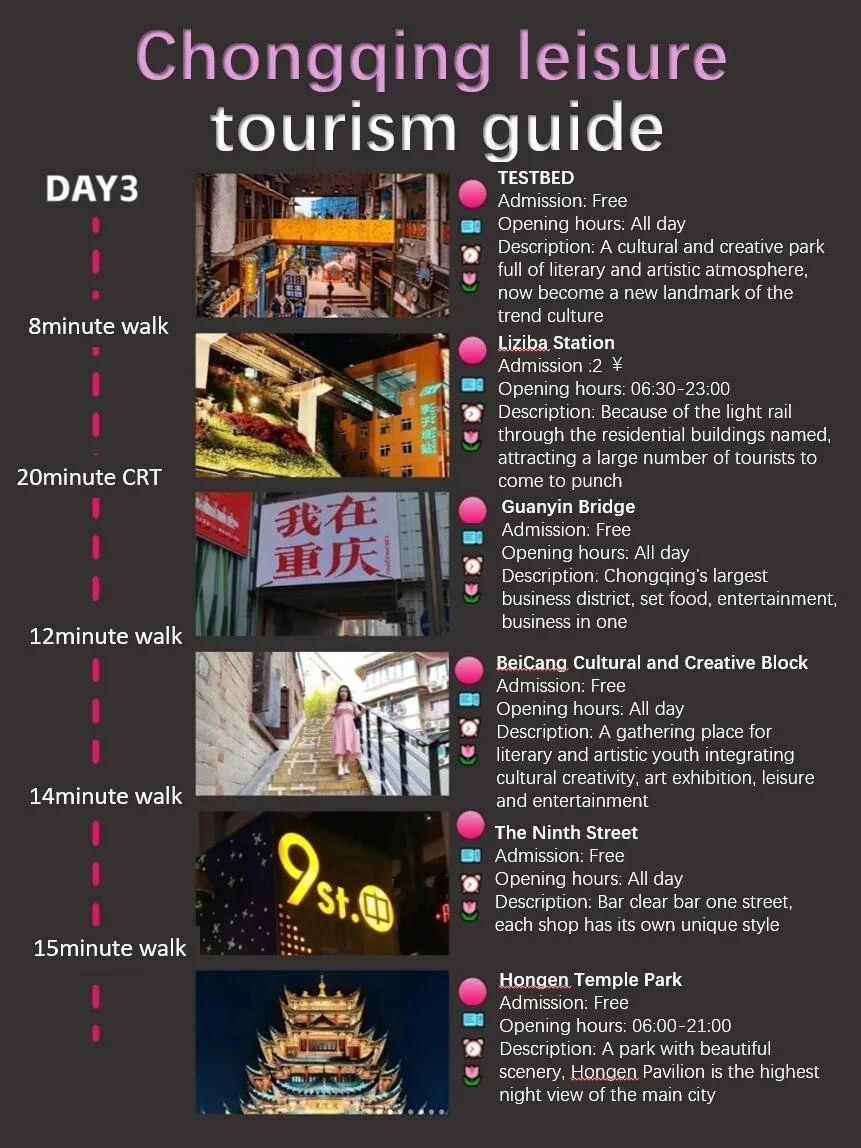
💥 DAY 3: Test Venue → Liziba Station → Guanyin Bridge → BeiCang Creative Block → The Ninth Street → Hong'en Temple Park
Morning: Test Venue (Cehsi Changdi)
(Note: If "测试场地" refers to a specific venue or activity that should be named differently, please let us know and we'll update this section.)
If you have time on the third morning before heading to Liziba, this is a good moment to visit one of Chongqing's emerging cultural venues or exhibition spaces. Chongqing has been developing a number of creative and cultural venues in recent years. Check locally for what's on during your visit — art exhibitions, design markets, and cultural events are increasingly common, especially on weekends.
Alternatively, if this time slot is open in your schedule, you can use the morning to sleep in, have a slow breakfast at your hotel, and then head to Liziba Station by metro (Line 2) in time for the late morning.
Late Morning: Liziba Station (Liziba Qinggui)
Liziba Station is the single most famous "8D Chongqing" image. It's a monorail station on Line 2 that passes directly through the 6th floor of a residential apartment building. The train enters one side of the building and exits the other. It's surreal, it's funny, and it's uniquely Chongqing.
How to see it:
Take Line 2 to Liziba Station and get off. Walk out to the viewing platform across the street from the station building.
The best photos are from the viewing platform on the opposite side of the track from the apartment building.
Best lighting: Mid-morning. The train passes every 3–5 minutes, so you won't miss it.
Free. No ticket needed — it's a functioning public transit station.
While you're in the Liziba area, walk through the neighborhood streets. This part of Chongqing retains more of its old residential character than the Jiefangbei district.
Lunch & Afternoon: Guanyin Bridge (Guanyinqiao)
Guanyin Bridge is a massive interchange and commercial district. The draw for visitors is the "I am Chongqing" (Wo shi Chongqing) neon sign on the pedestrian overpass — it's currently the most popular photo spot in the city. The characters "I am Chongqing" in English, in neon, on a pedestrian bridge, has become the city's unofficial welcome sign.
The Guanyin Bridge area is also a major shopping district. If shopping is your thing, this is where you do it. If not, take the photo and move on.
Afternoon: BeiCang Cultural and Creative Block (Beicang Wenchuang Yuan)
BeiCang is a renovated old textile mill turned creative district. It's where Chongqing's young creative crowd hangs out — design shops, small art galleries, cafes, and co-working spaces. It's quieter and less touristy than the main sites.
Why go: If you want a break from the intensity of the tourist circuit, BeiCang is where you spend 2–3 hours wandering, sitting in a cafe, and maybe buying something from a local designer. It's also one of the few places in Chongqing where the vibe feels genuinely local rather than performatively touristy.
Evening: The Ninth Street (Jiujie)
The Ninth Street (Jiujie) is Chongqing's nightlife strip. Bars, clubs, live music venues — it gets going after 21:00 and doesn't stop until late. If you want a drink and some late-night energy, this is where you go.
Note: Most venues here are Chinese-language environments. If you don't speak Chinese, going with a local or a guide will make the experience much more fun.
Alternative Evening: Hong'en Temple Park (Hong'en Si Gongyuan)
If nightlife isn't your thing, skip Jiujie and go to Hong'en Temple Park for sunset. It's one of the highest points in central Chongqing, with a panoramic view over the entire city. Free entry. Best visited one hour before sunset — you'll see the city transition from day to night, with all the lights coming on.
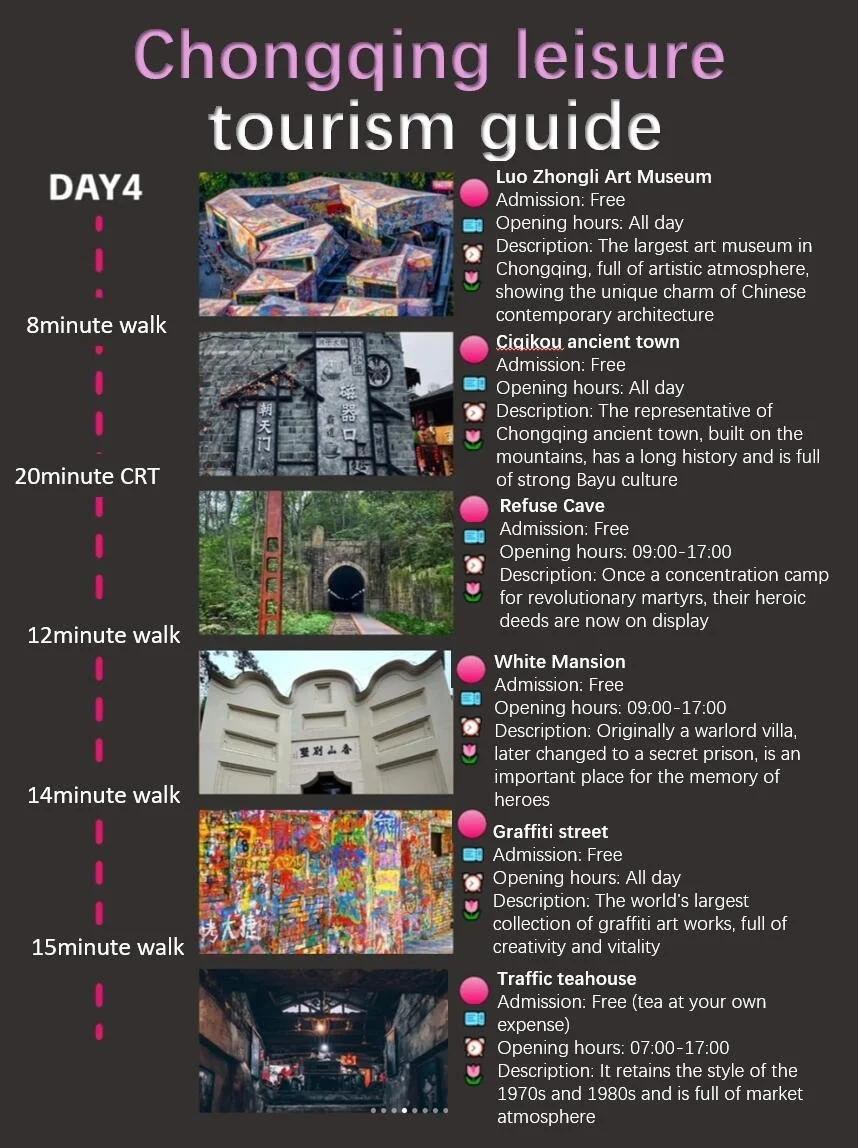
💥 DAY 4: Luo Zhongli Art Museum → Ciqikou Ancient Town → Refuse Cave → White Mansion → Graffiti Street → Traffic Teahouse
Morning: Luo Zhongli Art Museum (Luozhongli Meishuguan)
Start the final day at the Luo Zhongli Art Museum in the Shapingba district. Luo Zhongli is a contemporary Chinese artist known for his paintings of ordinary Chinese people — farmers, workers, children — in a realist style. The museum is small, and it's not a major destination, but if you're in the area for Ciqikou (next stop), it's nearby and worth a quick visit.
Check opening hours before you go — some sections close on Mondays, and hours can be irregular.
Late Morning & Lunch: Ciqikou Ancient Town (Ciqikou Guzhen)
Ciqikou is the most visited tourist site in Chongqing. It's a reconstructed (some say over-commercialized) ancient town from the Ming and Qing dynasties, built along the banks of the Jialing River. The main street is packed with souvenir shops, snack stalls, and teahouses.
Is it worth visiting? Yes — but manage your expectations. It's touristy, but it's also one of the few places where you can see traditional Sichuan architecture in one place. The side alleys are quieter than the main street and have better teahouses.
What to do:
Walk the main street for the atmosphere (and the people-watching).
Duck into the side alleys for teahouses and quieter courtyards.
Eat lunch here — Ciqikou chicken (Ciqikou ji) is a local dish worth trying. It's a whole chicken, poached and then served cold with a spicy dipping sauce.
Visit the Ciqikou Guinness Beer Museum if you're into that sort of thing (it's exactly what it sounds like).
Getting there: Take Metro Line 1 to Ciqikou Station. The ride from the city center takes about 30–40 minutes.
Afternoon: Refuse Cave (Feizhai Dong) & White Mansion (Bai Gongguan)
After Ciqikou, visit Refuse Cave (Feizhai Dong) and the White Mansion (Bai Gongguan). These are historical sites related to the Communist underground resistance during the Chinese Civil War (specifically, the 1940s, when Chongqing was the wartime capital). They're now museums and memorials.
Should you go? If you're interested in modern Chinese history, yes — they provide context for a chapter of Chinese history that most foreign visitors never learn about. If not, skip them and spend more time at Ciqikou or the next stop.
Note: These sites have a specific political perspective (they're state-run museums). Visit with that context in mind.
Late Afternoon: Graffiti Street (Huangjueping Tuhua Jie)
Huangjueping Graffiti Street is exactly what it sounds like — a normal street in the Jiulongpo district where every building surface has been painted with graffiti art. It was an initiative by the local government and art school (Sichuan Fine Arts Institute is nearby) to turn a run-down area into an open-air art gallery.
Why visit: It's popular with younger visitors and photographers. The graffiti is colorful and constantly being updated. It's also in a part of Chongqing that most tourists don't see — Jiulongpo is a working-class district, and the contrast between the graffiti art and the surrounding neighborhood is interesting.
Best time: Late afternoon for the light. The street faces west, so the golden hour works well for photos.
Getting there: About 30 minutes from Ciqikou by car/taxi.
Evening: Traffic Teahouse (Jiaotong Chating)
End your 4-day trip at the Traffic Teahouse. Established in 1989, it's one of the oldest continuously operating teahouses in Chongqing, located in the Eling Park area.
The atmosphere: Traditional decoration, locals playing mahjong at the tables, serving tea in classic gaiwan cups (a lidded bowl). It's deliberately old-fashioned. No Wi-Fi, no English menu, no Instagram-friendly signage — just a proper, functioning teahouse where people actually go to drink tea and play cards.
Why end here: After 4 days of Chongqing's intensity — the spice, the crowds, the hills, the neon — the Traffic Teahouse is where you slow down. Order a pot of jasmine tea (¥20–40 per person), sit for an hour, and watch how Chongqing's older generation spends an afternoon.
Entry: Free. You just pay for what you drink.
Tips for Visiting Chongqing
🔔 Tip 1: Popular scenic spots have large crowds — plan ahead
Chongqing's tourism boom (inbound visitors up 52.1% during the 2026 Spring Festival period alone) means that the most famous sites get very crowded, especially on weekends and holidays.
What to do:
Visit popular sites early (before 10:00 AM) or late (after 18:00 PM).
Avoid Chinese public holidays if you can — the National Day holiday (October 1–7) and Spring Festival (typically late January/early February) see the worst crowds.
Book hotels and transport in advance. Chongqing's hotel prices spike during peak periods.
Consider hiring a local guide for at least part of your trip. A guide can help you navigate crowds, skip lines where possible, and get you to less-known alternatives to the most crowded sites.
🔔 Tip 2: Don't rely too much on navigation apps — ask locals instead
Chongqing breaks navigation apps. Because the city is built on hills with multiple street levels, Google Maps frequently shows your location 1–2 levels above or below where you actually are. Locals joke that "in Chongqing, you're never sure if you're on the 1st floor or the 22nd floor" — and they mean it literally.
What actually works:
Ask locals. Chongqing people are famously friendly and proud of their city. If you look lost (which you will), someone will probably offer to help. Show them your destination in Chinese characters (have it saved on your phone).
Save Chinese addresses. Before you travel, save the Chinese names of your hotel, the sites you're visiting, and key landmarks. Show the characters to taxi drivers and locals.
Use Baidu Maps or Gaode Maps (in Chinese) if you can. They're more accurate in Chongqing than Google Maps — but you'll need to be able to read Chinese.
Walk with a guide for the first day at least, so you get a sense of the city's layout before trying to navigate it yourself.
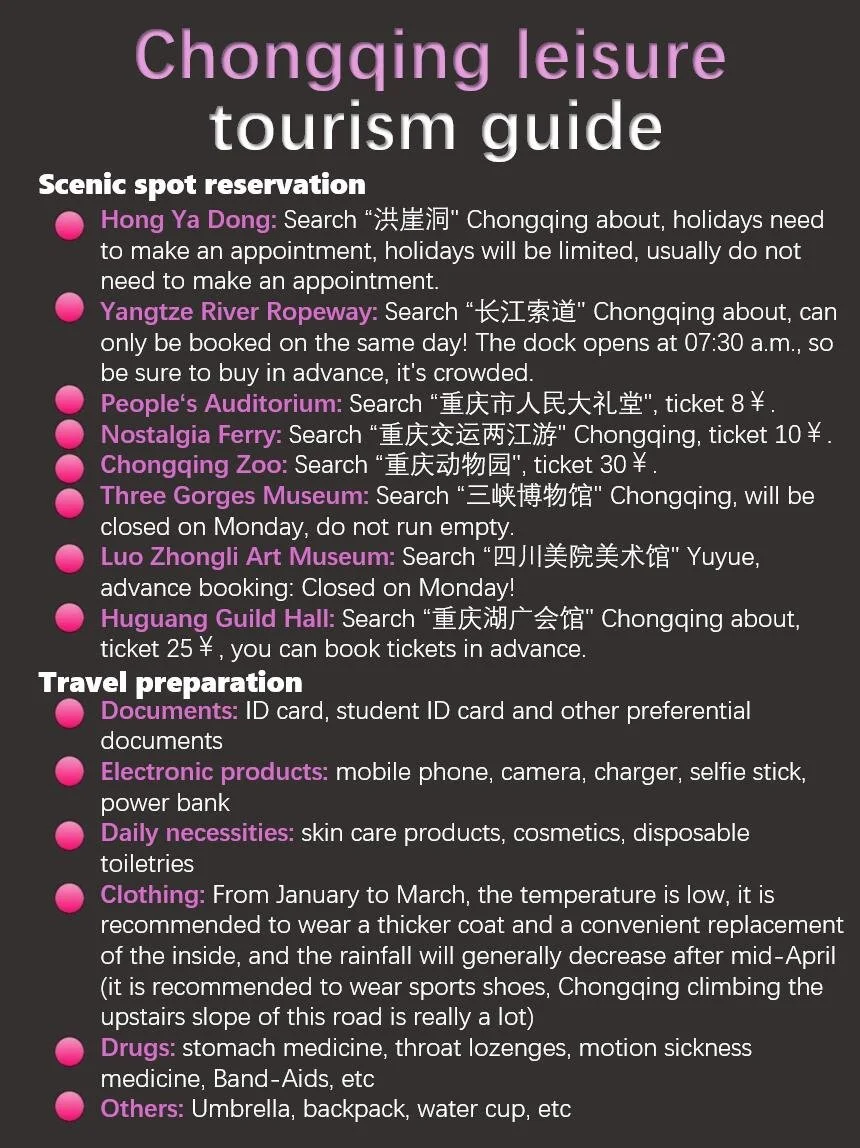
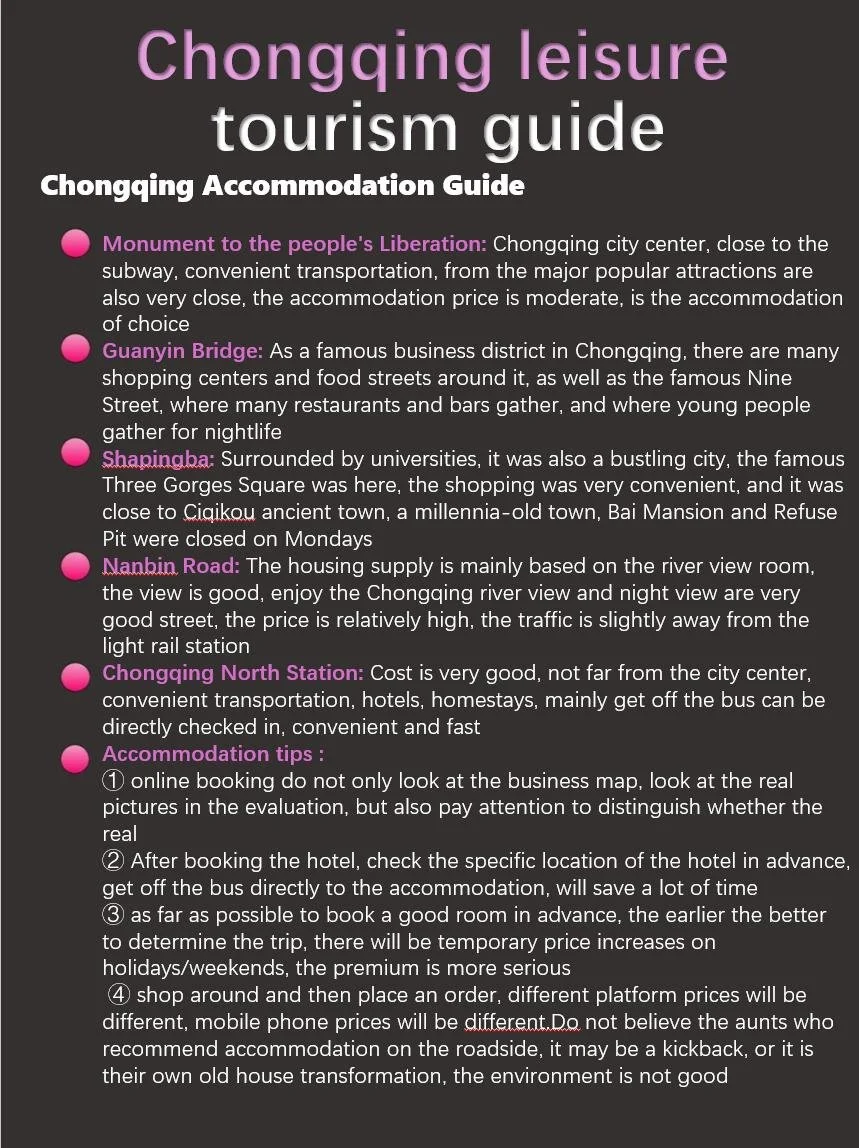
Planning Your Chongqing Trip
Chongqing is best experienced at a leisurely pace. The 4-day itinerary above covers the essentials without rushing, but there's much more to see if you have extra time:
Wulong Karst (2-day trip): UNESCO World Heritage site with natural bridges and caves. Featured in the movie Transformers: Age of Extinction.
Dazu Rock Carvings (1-day trip): 12th-century Buddhist rock carvings, another UNESCO site. Some of the finest religious sculpture in China.
Furong Cave (1-day trip): Massive limestone cave system with spectacular stalactite formations.
Jinfo Mountain (1-day trip): Alpine scenery, good for escaping the summer heat.
Need help planning? We're a licensed travel agency (License No: L-HUN-100749) specializing in private tours across Chongqing, Zhangjiajie, Tibet, and Xinjiang. We handle the logistics, the transport, the language, and the planning — you just show up.
Contact us:
📱 WhatsApp: +86-172-6789-8631
This guide was updated in June 2026. Prices, opening hours, and conditions may change — verify before travel.