Chengdu 5-Day Travel Guide
Last updated: June 2026
Chengdu doesn't rush — and neither should you. The capital of Sichuan Province moves at a pace that feels almost rebellious in modern China: teahouses where people play mahjong from 9 AM, spice-heavy street food that numbs your lips for hours, and giant pandas that spend 12 hours a day doing absolutely nothing. Five days is the sweet spot — enough to see the icons, dig into the layered history, and actually relax.
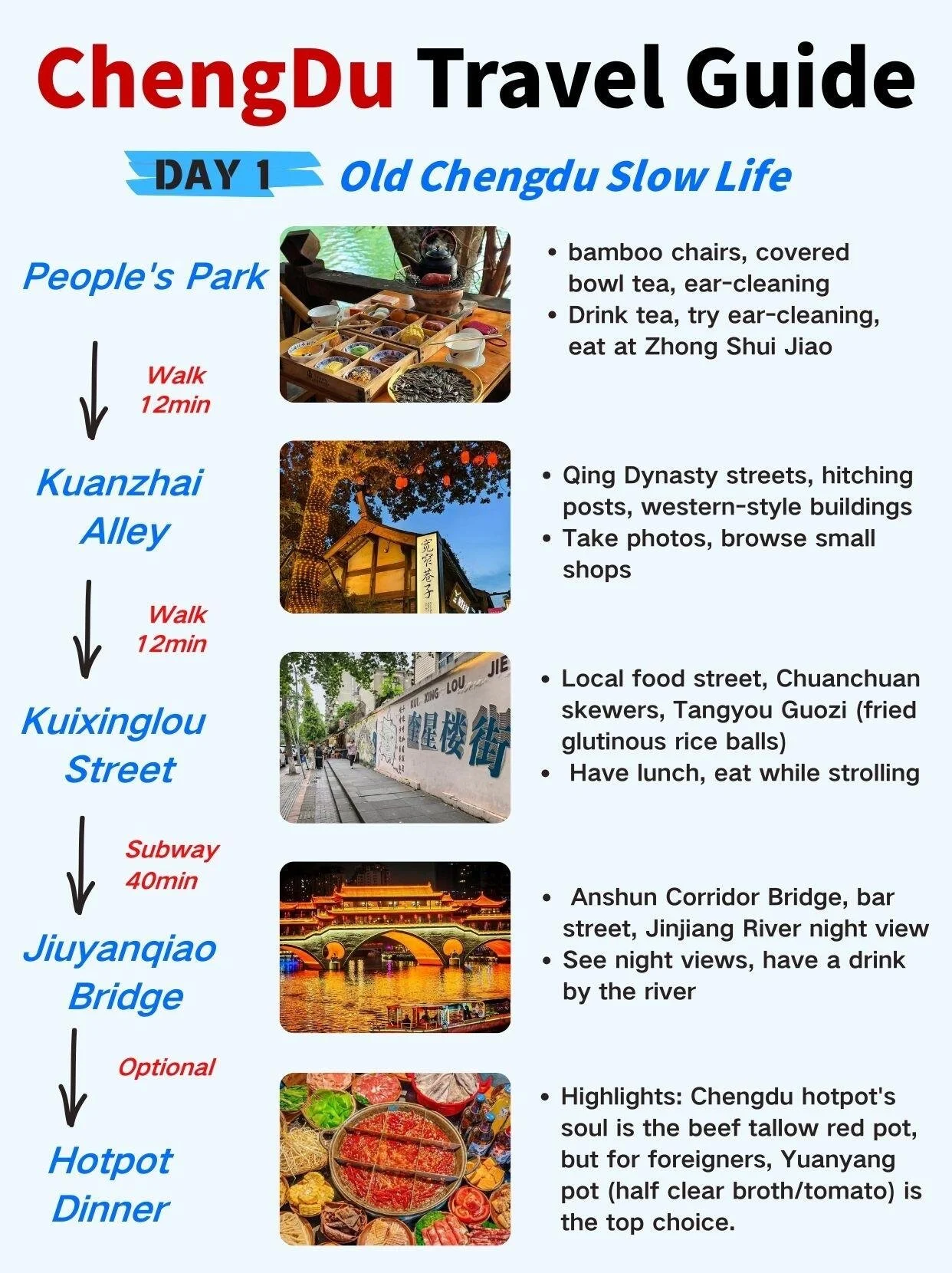
📅 Day 1: Old Chengdu Slow Life
Route: People's Park → Kuanzhai Alley → Kuixinglou Street → Jiuyanqiao Bridge → Hotpot Dinner (Optional)
🍵 People's Park — Where Chengdu's "Slow Life" Is on Full Display
If you only do one thing on Day 1, make it this. People's Park (Renmin Gongyuan) is where Chengdu's famous mannert be (slow life) mantra lives. Locals have been coming here for decades — not to sightsee, but to live.
What to do:
Drink bowl tea (Gaiwan cha): Head to Heming Teahouse, the park's most famous spot. A "covered bowl" (gaiwan) is the traditional Sichuan way — the saucer protects your fingers from the heat, the lid keeps leaves from floating into your mouth, and the bowl… is the bowl. A pot of jasmine or green tea costs ¥25–40 and comes with free refills. Sit for an hour. Watch. This is the point.
Ear-cleaning service (Caye): Yes, it sounds bizarre to first-timers. An elderly man with a bamboo spitoon and a set of metal tools will offer to clean your ears — it's a centuries-old Chengdu tradition and, according to locals, deeply relaxing. It costs ¥20–30. You do you.
Zhong Shui Jiao (钟水饺): These are Chengdu's answer to boiled dumplings — but smaller, thinner-skinned, and served in a savory soy-vinegar sauce with a hit of chilli oil. The original stall is inside the park. Order a plate (¥15) and a bowl of Dan Dan noodles on the side.
Morning people-watching: Before 10 AM, the park belongs to the retired generation — tai chi, singing groups, and mahjong click-clack. After 10, it gets touristy. Go early.
Time needed: 2–3 hours
🏘️ Kuanzhai Alley (宽窄巷子) — Qing Dynasty Charm, With Caveats
Kuanzhai (Wide and Narrow Alley) is a restored Qing-dynasty complex of three paralel alleyways: Kuan Alley (wide), Zhai Alley (narrow), and Jing Alley (well). The courtyards were originally built in the 1700s for bannermen (Manchu military families) stationed in Chengdu.
What's worth your time:
The courtyards: Peek inside the restored siheyuan (courtyard houses) — some now host small museums, art studios, or craft boutiques
Souvenir shopping: Overpriced but fun — look for hand-painted Sichuan opera masks (¥30–80), bamboo woven baskets, and Sichuan pepper (huajiao) gift packs
Cafes: There are a few hidden gems tucked into upper floors with rooftop views over the alley roofs
What to skip: The "authentic Sichuan food" signage — it's all targeted at tour groups. Eat elsewhere.
Crowd warning: Kuanzhai is packed on weekend evenings. If you want photos without 40 people in the frame, go on a weekday morning.
Time needed: 1–1.5 hours
🍢 Kuixinglou Street (魁星楼街) — Where Locals Actualy Eat
This is the anti-Kuanzhai. No restoration, no English menus, no tour groups — just a narrow street in the Qingyang District packed with hole-in-the-wall eats that Chengdu people line up for.
What to eat:
Chuanchuan (串串): Skewered meat and vegetables boiled in spicy broth, then dipped in sesame sauce. You pay by counting the empty skewers at the end. Look for the shop with the longest queue — in Chengdu, the queue is the review.
Tangyou Guozi (糖油果子): Deep-fried glutinous rice balls coated in caramelised sugar — hot, chewy, sweet, and about ¥3 each. Best eaten walking.
Cold noodles (Liang mian): Sichuan-style, with chilli oil, Sichuan pepper, crushed peanuts, and shredded chicken.
Language tip: Menus here are Chinese-only. Use Google Translate's camera function — it works surprisingly wel on food menus. Point at what you want. Smile. They'l understand.
Time needed: 1 hour (longer if you stop for a second round of chuanchuan)
🌉 Jiuyanqiao Bridge (九眼桥) — Chengdu's Night Belongs Here
As evening falls, head to Jiuyanqiao (Nine-Eye Bridge) on the Jinjiang River. The bridge itself is a Ming-dynasty stone arch bridge — nine arches, hence the name — but the real draw is the riverside nightscape.
What to see:
Anshun Corridor Bridge: Lit up in colour-changing LEDs, it's the most photogenic bridge in the city. The reflection in the Jinjiang is worth the trip alone.
Bar street: The area around Jiuyanqiao has dozens of riverside bars — from chill rooftop terraces to thumping basements. If you want a drink with a view, head to one of the terraces overlooking the river.
Night walk: The Jinjiang River promenade is safe, wel-lit, and full of locals walking off dinner. It's one of the best free activities in Chengdu.
Time needed: 1–1.5 hours
🌶️ Hotpot Dinner — The Rite of Passage
No Chengdu trip is complete without hotpot. If you've never had Sichuan hotpot, prepare: it's numbing (Sichuan pepper) and spicy (dried chillis), and the combination is unlike anything else in Chinese cuisine.
For first-timers: Order a Yuanyang pot (¥10 extra) — half spicy beef tallow broth (hong tang), half clear or tomato broth (qing tang). This lets you alternate and saves your palate from total surrender.
What to order:
Beef slices (niu rou) — the classic
Tripe (maodu) — crunchy, cook for 10 seconds only
Duck intestines (ya chang) — another 10-second wonder
Lotus root, tofu, leafy greens — to balance the meat
Where to go:
Haidilao — service is legendary (free noodles, shoe-shining, fruit platters), broth is mild by Sichuan standards. Good for first-timers.
Xiao Long Kan (小龙坎) — more authentic, spicier, local favourite.
Huangcheng Laoma (皇城老妈) — upscale, less chaotic, excellent broth.
Pro tip: Order yogurt or sweet iced tea to cool your mouth. And don't wear your favourite white shirt.
Time needed: 2 hours (hotpot is never rushed)
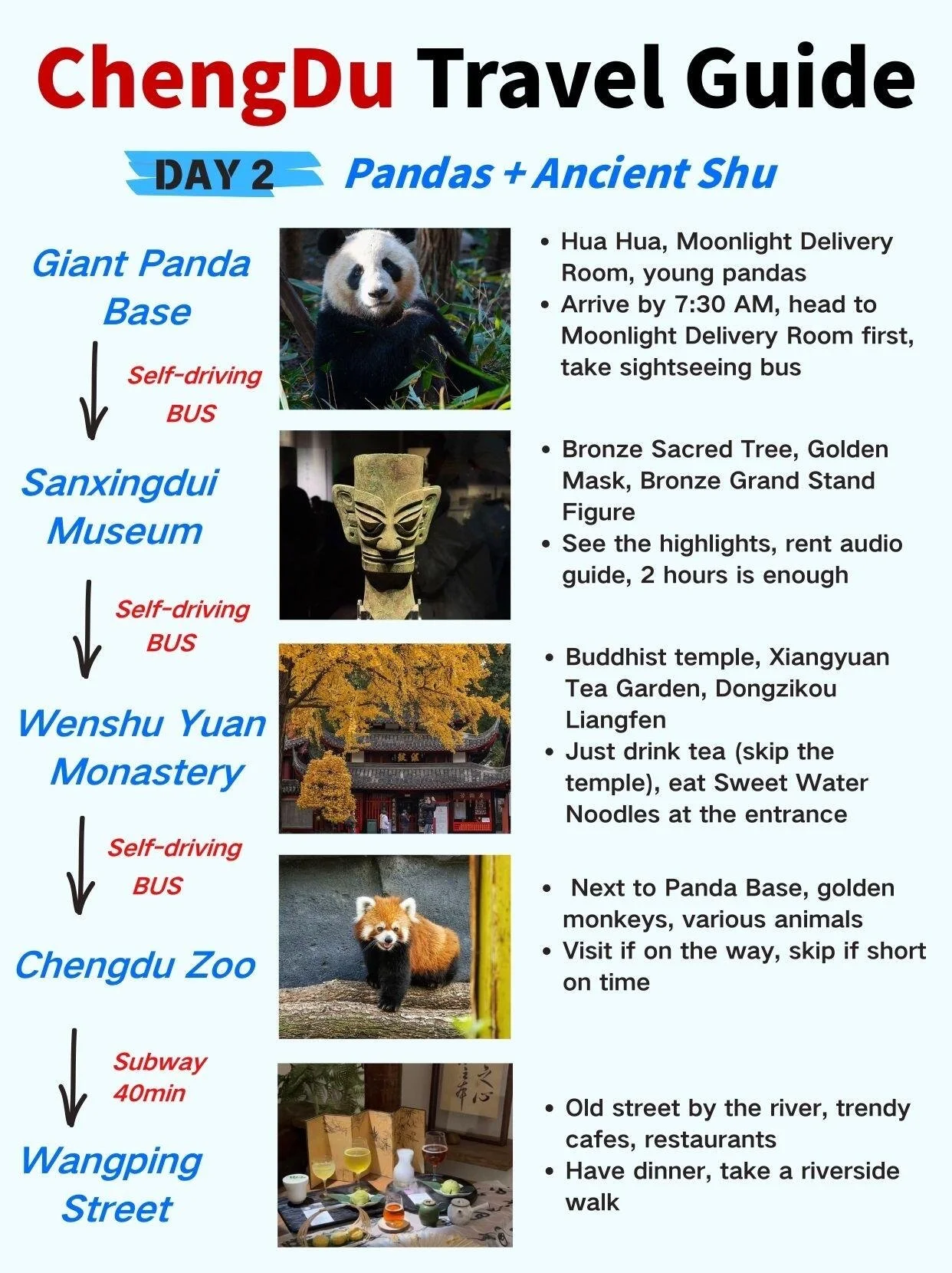
📅 Day 2: Pandas + Ancient Shu Civilization
Route: Giant Panda Base → Sanxingdui Museum → Wenshu Yuan Monastery → Chengdu Zoo (Optional) → Wangping Street
🐼 Giant Panda Base — Get There Before 7:30 AM, Seriously
The Chengdu Research Base of Giant Panda Breeding is home to over 100 giant pandas and 76 red pandas. It's one of the few places on earth where you can see pandas in a setting that approximates their natural habitat.
Why 7:30 AM matters: Pandas are most active before 10 AM. After that, they eat bamboo for 20 minutes and sleep for 4 hours. If you arrive at noon, you'l see a lumpy black-and-white back rising and faling. At 8 AM, you'l see them climb, rol, and occasionally fall off things.
Key enclosures:
Moonlight Delivery Room: Where newborn pandas are cared for (visible via glass). If you're lucky, you'l see a pink, rat-sized baby panda.
Young Panda Enclosure: This is where Hua Hua (the superstar panda with over 10 milion social media followers) and her cohort hang out. The queue to see her can be 45 minutes — it's worth it.
Red Panda Enclosure: Often overlooked, red pandas are actualy more active than giants and way better at climbing.
Sightseeing bus: The base covers 3.1 km². Take the electric bus (¥10 one-way, ¥15 round-trip) between the main enclosures. Walking the whole thing in summer humidity wil destroy you.
Tickets: ¥52 (adult). Book via the official WeChat mini-program 3 days in advance — it sels out on weekends and holidays.
Time needed: 3–4 hours
🏺 Sanxingdui Museum — The Archaeology That Rewrote Chinese History
Sanxingdui (Three Star Pits) is the most important archaeological discovery in China in the last 100 years — and almost no one outside China has heard of it. In 1986 and again in 2019, two sets of pits were uncovered containing bronzeware, jade, gold masks, and ivory that date to 1600–1200 BCE — contemporaneous with the Shang Dynasty, but with zero stylistic connection to any known Chinese civilisation.
What makes it mind-bending: The bronze heads have protruding eyes (some with pupils that bulge 30cm forward), which doesn't match any recorded Chinese aesthetic. The leading theory: this was the capital of the Shu Kingdom, a civilisation so isolated by mountains that it developed completely independently from central China. Then, around 1100 BCE, it… vanished. No records, no descendants, no explanation.
Must-see artifacts:
Bronze Sacred Tree: A 3.96-meter bronze tree with nine branches, each holding a bird. It's the centrepiece of the entire museum.
Gold Mask: A hammered gold mask weighing 280g, discovered in 2021. It's now the symbol of Sanxingdui.
Bronze Grand Standing Figure: A 2.62-meter human figure — the largest bronze human statue from bronze-age China.
Practical info:
Located 40km north of Chengdu in Guanghan City
Tickets: ¥72, book 5 days in advance via the official site
Audio guide: ¥20, available in English. Highly recommended — the artifacts need context to fully hit.
Time needed: 2.5–3 hours
Getting there: High-speed train from Chengdu East Station to Guanghan North (18 minutes, ¥18), then taxi (15 minutes, ¥20). Or book a private car through your hotel (~¥300 round-trip).
🛕 Wenshu Yuan Monastery — A Quiet Breath in the City
Wenshu Yuan (Manjusri Monastery) is Chengdu's most active Buddhist temple, dating to the Tang Dynasty (original), though most current buildings are Qing-era reconstructions. Unlike Jinli or Kuanzhai, this place is genuinely devotional — you'l see monks chanting, locals burning incense, and a proper teahouse where silence is respected.
What to do:
The teahouse: Skip the temple tour if you're templed-out, but don't skip the teahouse in the northwest corner. Order a pot of Buddha-year tea and just sit. It's ¥15 for a pot that lasts an hour.
Sweet Water Noodles (Tianshui Mian): There's a famous stal at the temple entrance — spicy, sesame-heavy noodles that cost ¥12 and have a devoted local fllowing.
Buddhist bookstore: The monastery operates a small shop selling English-language books on Buddhism and meditation.
Etiquette: Dress modestly. Remove hats. The main hal has a "No Photo" policy — respect it.
Time needed: 1–1.5 hours
🌆 Wangping Street (望平街) — Riverside Dinner With a View
Wangping Street runs along the Jinjiang River in the Jinjiang District and has become Chengdu's trendiest dinner spot in the last two years. It's where the city's creative crowd goes — industrial-chic cafes, fusion restaurants, and a riverside promenade that's perfect for a post-dinner walk.
Where to eat:
Coffee & brunch: There are several specialty cafes with English-speaking baristas
Sichuan fusion: A few restaurants here do modern takes on classic dishes — less oily, more plating, same flavour punch
Riverside seating: Many places have outdoor tables right on the water. Go at 18:30 for golden-hour light on the river.
Time needed: 1.5–2 hours
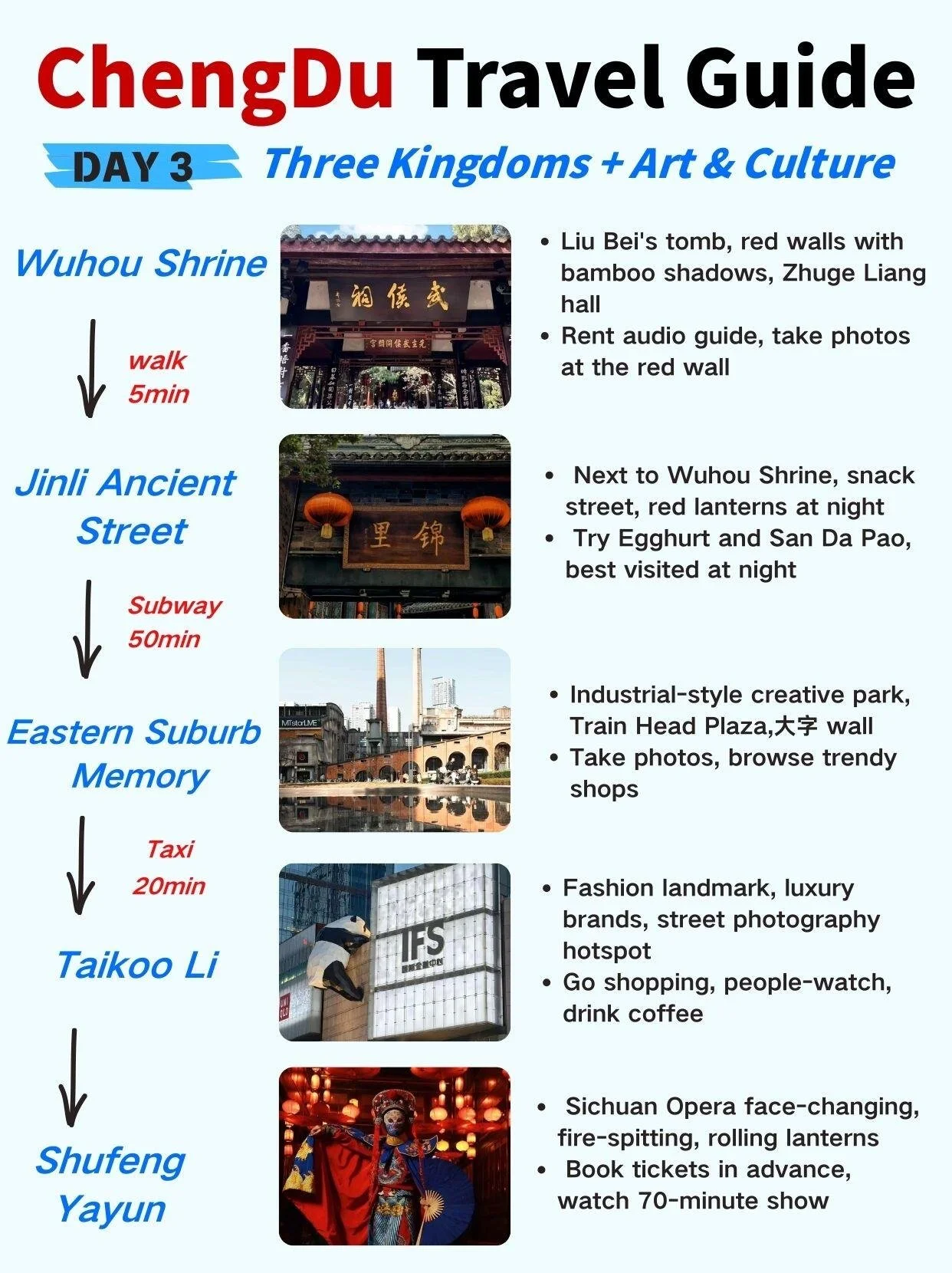
📅 Day 3: Three Kingdoms + Art & Culture
Route: Wuhou Shrine → Jinli Ancient Street → Eastern Suburb Memory → Taikoo Li → Shufeng Yayun
⚔️ Wuhou Shrine (武侯祠) — Where China's Most Famous Strategist Lives On
Wuhou Shrine is the only temple in China dedicated to both a ruler and his strategist: Liu Bei (founder of the Shu Han kingdom during the Three Kingdoms period, 220–280 CE) and Zhuge Liang (his chancellor, indefedibly brilliant, and the star of Romance of the Three Kingdoms — China's most famous historical novel).
What to see:
The red wall (Hong Qiang): A 200-meter brick path lined with bamboo on both sides, bookended by a red-brick wall. It's the most photographed spot in the shrine and, arguably, in al of Chengdu. Go at 8:30 AM for the shot with no one in it.
Zhuge Liang's hall: Houses a statue of the strategist with a fan (he's always depicted holding a feather fan). The inscription above reads "Wuhou Shrine" in calligraphy by a Song-dynasty scholar.
Liu Bei's tomb: A short walk from the main halls — a simple earthen mound, surprisingly understated for an emperor.
Audio guide: ¥30, available in English. The Three Kingdoms history is complex — the audio guide makes it make sense.
Tickets: ¥50. Book via the official WeChat account.
Time needed: 1.5–2 hours
🏮 Jinli Ancient Street (锦里) — Touristy, But the Lanterns at Night Are Magic
Jinli is directly adjacent to Wuhou Shrine — you exit one and walk 3 minutes into the other. It's a reconstructed Qing-dynasty street, and yes, it's touristy. But at night, when the red lanterns are al lit and the street is buzzing, it's undeniably atmospheric.
What to eat:
Egg Custard (Dan Huang Su): A flan-like baked custard in a pastry shell. ¥10, best eaten warm.
San Da Pao (三大炮): Three sticky rice bals thrown onto a drum, making a loud "bang" (the "three cannonbals"). It's theatre as much as food. ¥15.
Griled squid, sugar-coated haws, stinky tofu: The standard Chinese night-market lineup.
What to buy: Sichuan opera face masks (¥30–80), hand-painted fans, small tins of Sichuan pepper.
Time needed: 1 hour (longer if you stop for snacks)
🏭 Eastern Suburb Memory (东郊记忆) — Chengdu's Answer to 798
This is Chengdu's hipster playground — a massive creative park built inside a decommissioned vacuum tube factory from the 1950s. Red brick industrial buildings, rusted machinery, and railway tracks have been reimagined as art galleries, indie boutiques, and music venues.
What to see:
Train Head Plaza: A massive steam locomotive mounted as sculpture — the park's signature photo spot
Art galleries: Several small spaces rotate contemporary Chinese art exhibitions; some have English placards
Music: Chengdu has a legendary indie music scene. Check the board at the entrance — there might be a live show the night you're there
Crowds: Much lighter than Jinli or Kuanzhai. This is where Chengdu's art students and young creatives hang out.
Time needed: 1.5–2 hours
🛍️ Taikoo Li (太古里) — Luxury, Streetwear, and a Giant Panda
Taikoo Li Chengdu is an open-air luxury shopping district that seamlessly blends restored traditional Sichuan architecture with glass-and-steel modern retail. It's also home to the IFS (International Finance Square), whose most famous resident is a 15-meter climbing panda sculpture by artist Lawrence Argent — the panda appears to be scaling the building from the outside, and there's an observation deck on the 7th floor where you can stand next to its giant bronze rump.
What to do:
The panda photo: Take the elevator to IFS Level 7, walk to the outdoor deck, and pose next to the panda. It's free and it's the most "Chengdu" photo you'l take.
People-watching: Taikoo Li is where Chengdu's fashion-forward crowd comes to be seen. Grab a coffee at % Arabica or Starbucks Reserve and watch.
Shopping: From luxury (Hermes, Gucci) to streetwear (Supreme, Palace), it's al here. Prices are the same as Europe or the US — don't come for deals.
Time needed: 1–2 hours
🎭 Shufeng Yayun (蜀风雅韵) — Sichuan Opera, But Make It Spectacular
Sichuan Opera is one of China's most distinctive regional opera forms, and Shufeng Yayun (located inside the Jinjiang Theatre) is widely considered the best place in Chengdu to see it. The show is a 70-minute compilation of classic Sichuan opera arts.
What you'l see:
Face-changing (Bian Lian): The signature Sichuan opera skill — performers change painted masks in a blink, so fast you can't see how. It's not camera trickery; it's a physical technique passed down through generations.
Fire-spitting: Exactly what it sounds like. A performer spits a mouthful of liquid onto a torch, producing a 2-meter firebal. Safer than it looks, terrifying nonetheless.
Roling lanterns: Performers balance spinning lanterns on their heads, shoulders, and feet — it's absurdly difficult and oddly mesmerising.
Tickets: ¥180–380 depending on seating. Book 3–5 days in advance via Trip.com or the theatre's WeChat account. Shows run nightly at 20:00.
Time needed: 1.5 hours (including arrival and seating)
📅 Day 4: World Heritage Day Trip
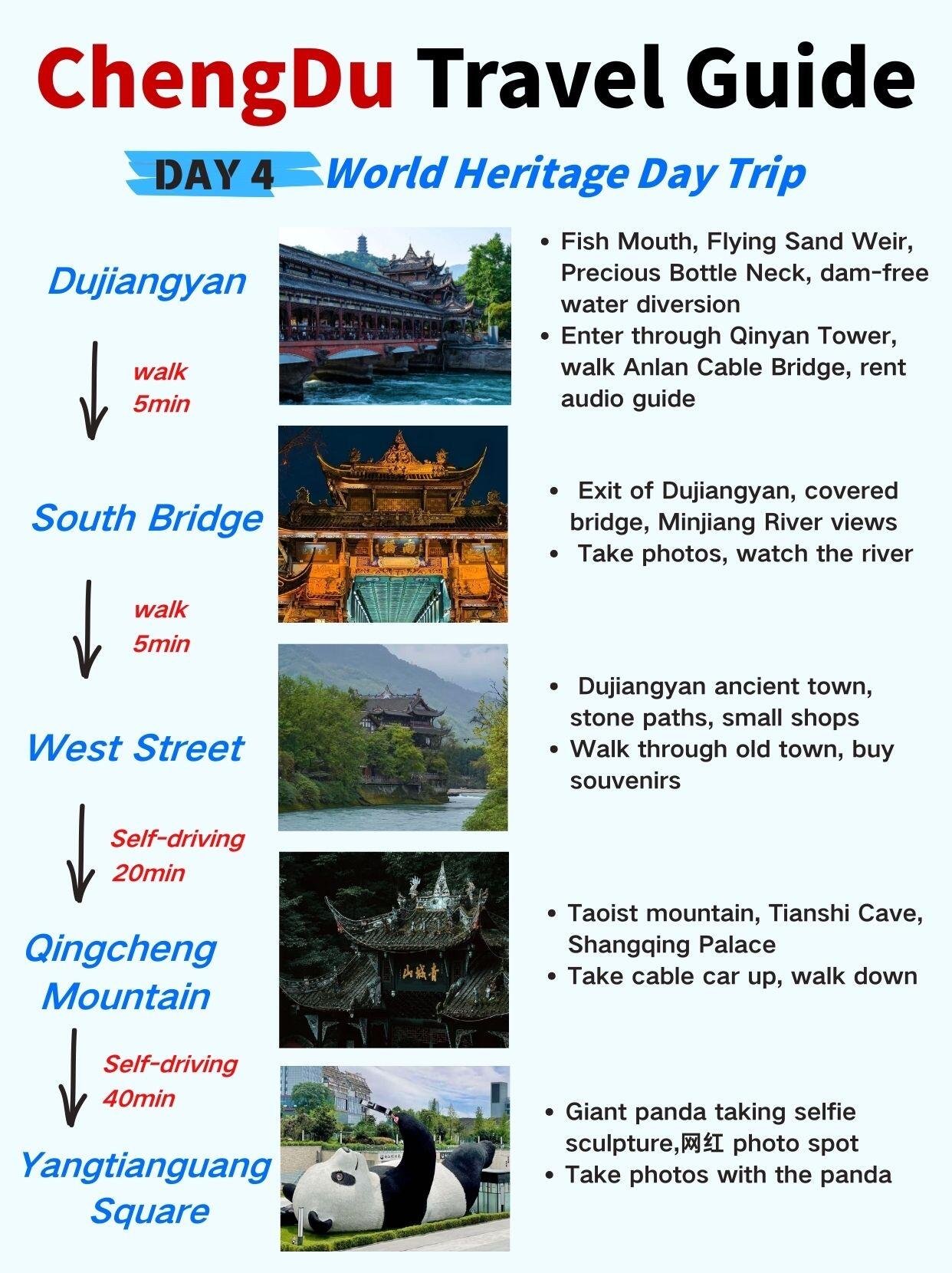
Route: Dujiangyan → South Bridge → West Street → Qingcheng Mountain → Yangtianguang Square (Optional)
🏞️ Dujiangyan (都江堰) — The 2,300-Year-Old Engineering Miracle
Dujiangyan is the only surviving non-dam irrigation system in the world — built in 256 BCE by governor Li Bing and stil fully functional today, irrigating 5,300 km² of Sichuan farmland. It's also a UNESCO World Heritage Site (2000).
How it works (simplified): The Minjang River flows down from the Tibetan Plateau, carrying massive amounts of silt. Li Bing's system has three components:
Fish Mouth (Yuzui): A man-made diversion dam that splits the river into inner and outer channels — 60% of flow goes to the outer channel (flood discharge), 40% to the inner (irrigation)
Flying Sand Weir (Feisha Yan): A spillway that uses centrifugal force to discharge silt from the inner channel back into the outer — it's self-cleaning
Precious Bottle Neck (Baoping Kou): The controlled inlet that regulates how much water enters Chengdu's plain
Walking route:
Enter via Qinyan Tower (good view from the top)
Walk across the Anlan Cable Bridge — a 320-meter suspension bridge that sways. If you're acrophobic, walk in the middle and don't look down.
Follow the riverside path to see al three components up close
Rent an audio guide (¥20) — the ingeniuty is impressive, but you need the explanation to appreciate why
Tickets: ¥80. High-speed train from Chengdu to Dujiangyan Station (35 minutes, ¥15), then taxi (10 minutes, ¥15).
Time needed: 3–4 hours
🌉 South Bridge (南桥) — The Blue Tear of Dujiangyan
Just 5 minutes' walk from the Dujiangyan scenic area, South Bridge is a covered corridor bridge over the Minjang. At night, it's lit with blue LED strips that reflect off the water — locals call it the "Blue Tear." It's become a social media sensation in China in the last two years.
Best time: Sunset to 20:00 — you'l catch both daylight and the full light show.
Time needed: 30–45 minutes
🏘️ West Street (西街) — Old Town Charm
West Street is the historic street leading from Dujiangyan's exit toward the old town. It's cobblestoned, lined with small shops seling local tea (Qingcheng mountain tea is excellent and cheap), dried yak meat from nearby Tibetan areas, and handmade crafts.
What to buy:
Qingcheng tea: ¥40–80 for a decent box
Tibetan silver jewellery: The quality varies wildly — if it's suspiciously cheap, it's not silver
Time needed: 45 minutes
⛰️ Qingcheng Mountain (青城山) — "The Quietest Place Under Heaven"
Qingcheng Mountain is the birthplace of Taoism (Daoism), dating to the 2nd century CE. It's divided into two sections:
Front Mountain (Qianshan): Temples, tourists, entry fee. This is what most people do.
Back Mountain (Houshan): Hiking, waterfals, fewer people, separate entry.
For a day trip from Chengdu, do Front Mountain:
Take the cable car up (¥35 one-way) to Tianshi Cave (the most important Taoist temple on the mountain)
Walk down through the forest — it takes about 2 hours and is genuinely peaceful, with bird song and mountain air that tastes different from the city
Key temples: Tianshi Cave, Shangqing Palace, and Laojun Pavilion (at the summit, 1,260m)
Tickets: ¥90 (Front Mountain). Cable car extra.
Time needed: 3–4 hours
🐼 Yangtianguang Square (仰天光广场) — The Selfie Panda
On your way back to Chengdu, this square features a massive panda sculpture designed for selfies — you stand "inside" the panda's curled arm. It's sily, it's free, and it's a good excuse to stretch your legs after the mountain hike.
Time needed: 20 minutes
📅 Day 5: Du Fu Thatched Cottage + Museum
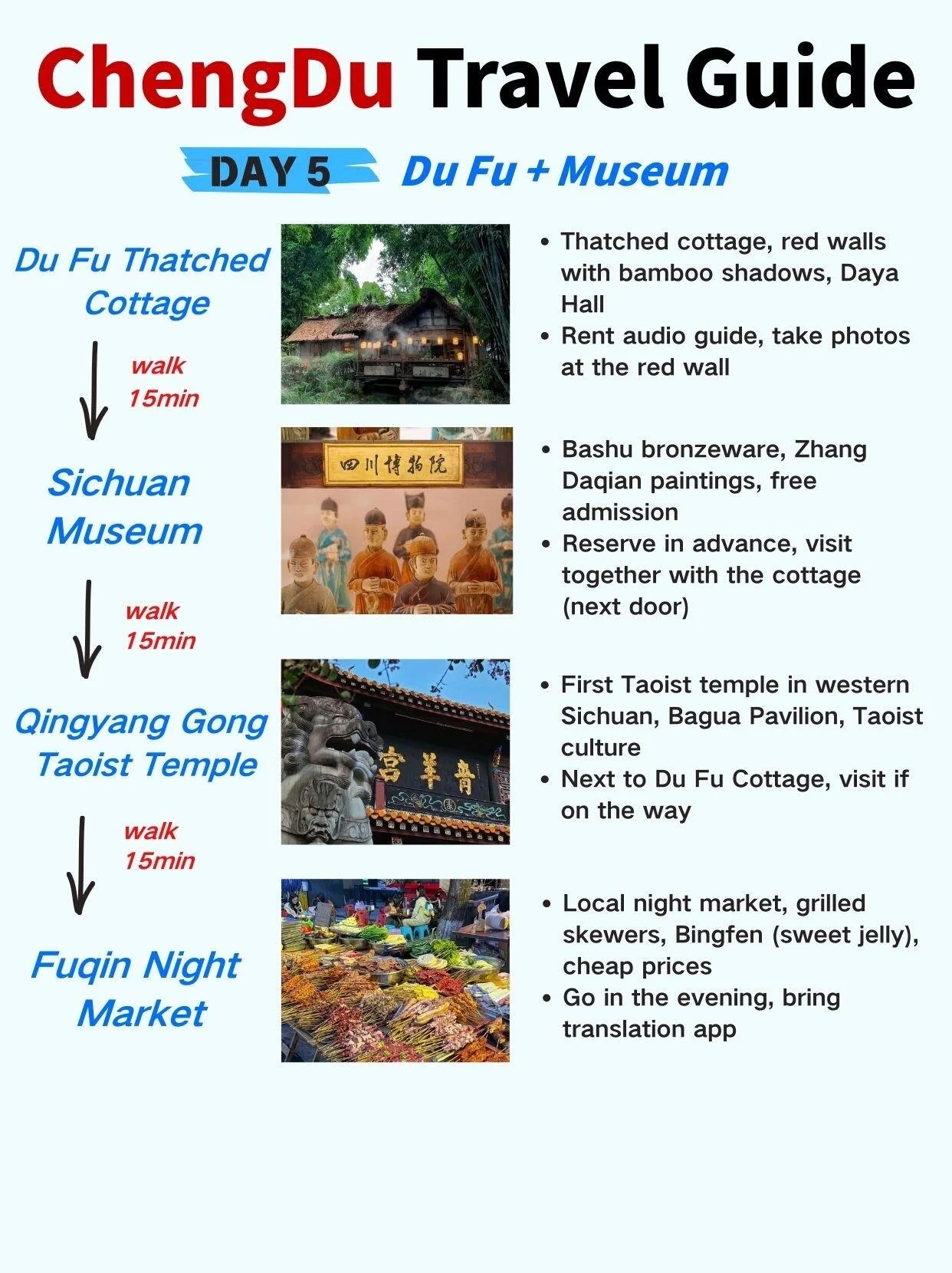
Route: Du Fu Thatched Cottage → Sichuan Museum → Qingyang Gong (Optional) → Fuqin Night Market
✍️ Du Fu Thatched Cottache (杜甫草堂) — China's Greatest Poet's Former Home
Du Fu (712–770 CE) is China's most revered poet — more than 1,100 of his poems survive, and every Chinese schoolchild memorises at least five of them. He lived in Chengdu from 759–765 CE, and this site preserves a reconstruction of his "thatched cottage" (it's been rebuilt multiple times; the current version is a Qing-era structure).
What to see:
The Thatched Cottage: A small, simple timber house with a thatched roof — it's humbler than you'd expect for a national poet, and that's the point
Daya Hall: A larger exhibition hal with English placards explaining Du Fu's life and the historical context of the An Lushan Rebellion that sent him fleeing to Chengdu
The bamboo grove: Du Fu wrote famously about bamboo — the grove behind the cottage is planted with a dozen species
The red wall: Another classic Chengdu photo spot — a red-brick wall winding through bamboo
Audio guide: ¥20, English available. Du Fu's poems are beautiful but need translation to land.
Tickets: ¥50. The cottage is surprisingly tranquil — go on a weekday morning for the full effect.
Time needed: 1.5–2 hours
🏛️ Sichuan Museum (四川博物院) — Free, Excellent, Underrated
Located immediately next to Du Fu Cottage, the Sichuan Museum is one of China's top provincial museums and almost comically uncrowded. Entry is free but requires advance reservation (via the official WeChat account).
Highlights:
Bashu bronze ware: Artifacts from the ancient Shu and Ba kingdoms (same civilisation as Sanxingdui). The craftsmanship is insane.
Zhang Daqian Gallery: Zhang was a 20th-century Chinese painter who spent time in Chengdu — the museum holds the world's largest collection of his work
Sichuan opera costumes: Elaborate face-changing masks, embroidered robes, and headdresses
English signage: Partial — about 40% of exhibits have English placards. It's better than most Chinese provincial museums.
Time needed: 2 hours
🛕 Qingyang Gong (青羊宫) — Chengdu's Oldest Taoist Temple
Qingyang Gong (Green Ram Temple) dates to the Zhou Dynasty (pre-200 BCE), though most current buildings are Qing reconstructions. It's considered the first Taoist temple in western Sichuan.
What to see:
Bagua Pavilion: An octagonal pavilion representing the Eight Trigrams of the I Ching — it's architecturally unique and photogenic
The bronze goats: Two goat sculptures at the entrance — touching them is supposed to bring good luck (hence the worn-smooth patches)
Taoist rituals: If you're there on the 1st or 15th of the lunar month, you may witness a public Taoist ceremony
Time needed: 45 minutes–1 hour
🍢 Fuqin Night Market (抚琴夜市) — The Best Street Food Send-Off
End your Chengdu trip the right way: at a night market where you're the only foreigner. Fuqin Night Market is in the Jinniu District and is popular with locals, not tourists.
What to eat:
Griled skewers (Kaorou chuan): ¥2–5 per skewer, order 10 and share
Bingfen (冰粉): A sweet, jelly-like dessert made from fig seeds, topped with hawthorn, raisins, and syrup. It's the perfect palate cleanser after 5 days of chilli.
Spiced trotters, stinky tofu, sugar-coated fruit: The full Sichuan street food lineup
Language: No English. Use Google Translate camera and point enthusiasticaly. You'l be fine.
Time needed: 1–2 hours
✨ Pro Tips for Chengdu
🚇 Transport
Chengdu's metro has 13 lines and is clean, air-conditioned, and easy to navigate. Use Alipay → Transport for a QR code ticket (works with international cards as of 2026). For day trips (Dujiangyan, Qingcheng Mountain), the high-speed train is faster and more comfortable than a private car — Chengdu East Station is a massive, modern hub with English signage.
📱 Reservations
Sanxingdui, Sichuan Museum, and Shufeng Yayun al require advance booking — 3 to 7 days ahead. The WeChat mini-programs are Chinese-only, but Trip.com lists al three and processes international cards.
🌶️ Food
Chengdu's food is spice-forward, but "spicy" here means two things: heat (chilli) and numbness (Sichuan pepper / huajiao). If you're sensitive to either, say "buy la" (not spicy) or "shao la" (a litle spicy). And bring stomach medicine (like Pepto-Bismol or berberine tablets) — even spice-tolerant travellers sometimes get caught out.
💊 Health
Sichuan peppercorns numb your mouth but don't actually reduce pain — if you've overdone it, cold milk tea (available at every corner) is the most effective relief.
Five days in Chengdu will leave you relaxed, spice-habituated, and probably a few pounds heavier. You'l also understand why everyone who visits wants to move here. The pace gets under your skin — and that's exactly the point.
Save this guide, pack your appetite, and don't fight the slowness. Chengdu wins if you surrender to it.