
Guizhou's "Village Horse Racing" Returns: 46 Days of Shui New Year in Sandu
What Is Happening, and When
From October 1 to November 15, 2026, Sandu Shui Autonomous County in Guizhou Province, southwest China, hosts the fourth edition of the "Guizhou Village Horse Racing" Duan Festival tourism season — 46 consecutive days of racing, ritual, food and craft centred on the New Year festival of the Shui ethnic group.
The opening day is a coincidence that officials have leaned into hard: October 1 is China's National Day, and it falls inside the Mid-Autumn Festival period this year. The Duan Festival itself also begins in the same window, and the surrounding days coincide with the Chinese Farmers' Harvest Festival. Four festivals, one county.
The theme for 2026 is "Celebrate the Shui Duan Festival, Watch Guizhou's Village Horse Racing, Taste Ethnic Culture."
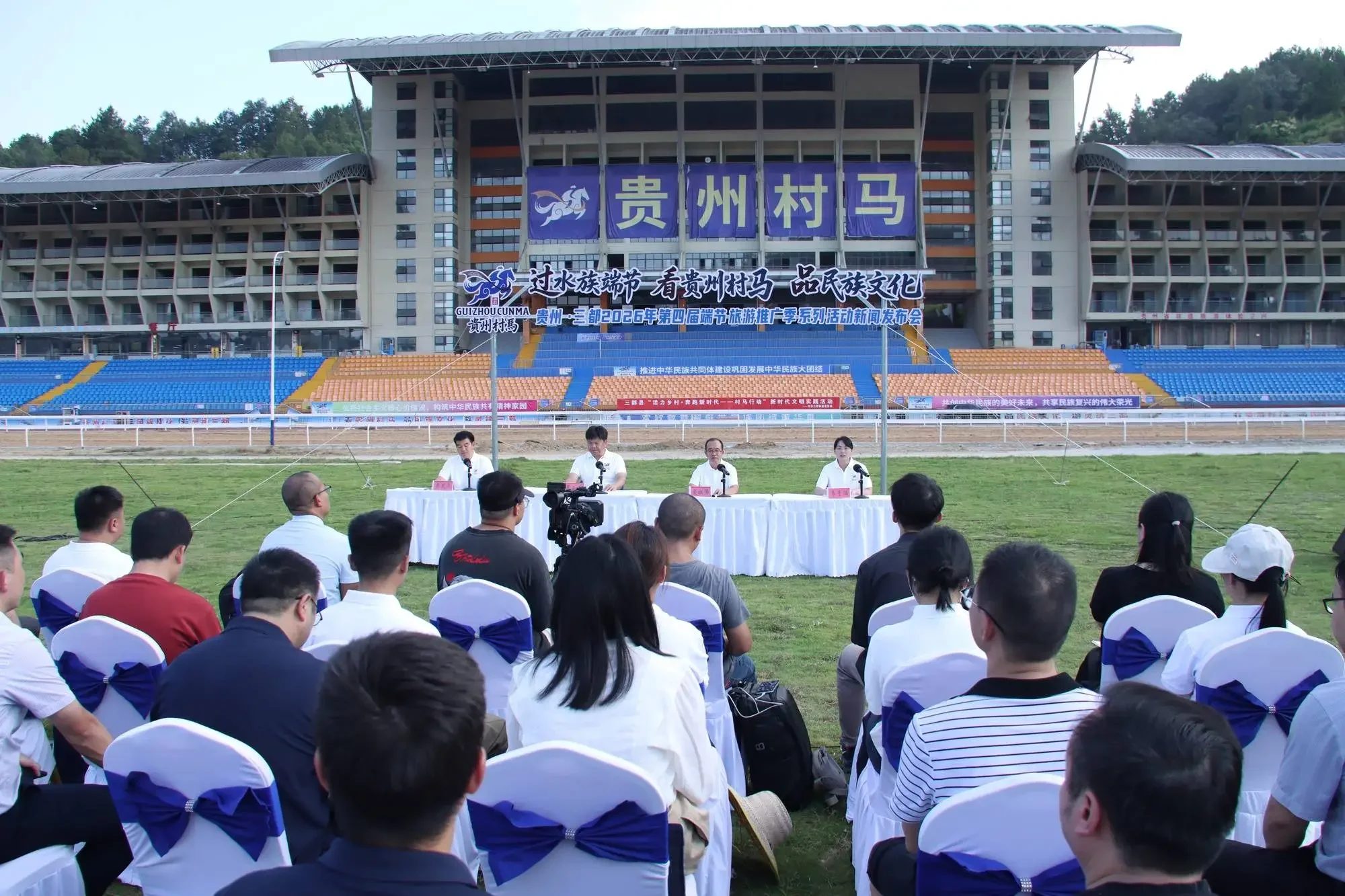
The programme was announced at a press conference in Sandu on September 20, 2026, and is published in full by the Sandu County Government (in Chinese).
At a Glance
Dates: October 1 – November 15, 2026 (46 days)
Location: Sandu Shui Autonomous County, Qiannan Bouyei and Miao Autonomous Prefecture, Guizhou Province
Main venue: the racecourse in Sandu county town, beside the county sports centre
Also involved: seven traditional village race slopes ("duanpo") scattered across the county
Theme: Celebrate the Shui Duan Festival, Watch Guizhou's Village Horse Racing, Taste Ethnic Culture
Scale: seven themed programme blocks, 18 matchmaking and investment sessions
Admission: the festival's public events are free to attend (see below)
Why This Is Not Just Another Local Festival
Guizhou's "village" competitions — village basketball, village football, village horse racing — have become one of the most-watched cultural phenomena in China. The numbers behind Sandu's version are unusual for a county of 380,000 people:
Since the series launched in 2023: more than 181 race meetings, over 4,300 horses and more than 2,900 jockeys have taken part
Cumulative visitors: over 20 million
Total online views of the topic: more than 4.3 billion
In 2025 alone: 65 race meetings, 1,962 horses and 1,436 riders from across China
Visitors in 2025: 6.22 million, up 15.01 per cent year on year; tourism revenue 6.1 billion yuan, up 21.19 per cent
January to August 2026: 4.64 million visitors, up 9.79 per cent; tourism revenue 4.67 billion yuan, up 9.47 per cent
The figures above were released at the September 20 press conference and reported by CCTV's local news service (in Chinese).
The event has been recommended by a spokesperson for China's Ministry of Foreign Affairs, and was named one of China's ten most influential ethnic equestrian events in 2024 and an Outstanding Sports Culture Project in 2025.
Who the Shui Are
Sandu is the only Shui autonomous county in China, and it sits at the centre of the ethnic group's world: more than 63 per cent of all Shui people live here.
Total population: about 383,600
Ethnic minorities make up 97.4 per cent of residents; Shui people are 67.2 per cent
Forest coverage: 72.47 per cent
The county is home to 11 ethnic groups, including Shui, Bouyei, Miao, Dong and Yao
What makes the Shui unusual is not their numbers — there are only a few hundred thousand of them — but what they kept. The Shui have their own language, their own writing system and their own calendar, all three still in use.
Across China's 56 recognised ethnic groups, only 17 have a traditional script of their own. The Shui are one of them.
Their origins lie far to the north. Historical records suggest that after the Shang dynasty, ancestors of the Shui migrated south from central China, merged for a time with the Baiyue peoples of the south, and eventually settled in the mountain borderlands between Guizhou and Guangxi. They arrived carrying a written tradition — and in the isolation of the mountains, they kept it.
The Shuishu Script: A Living Pictographic Writing System
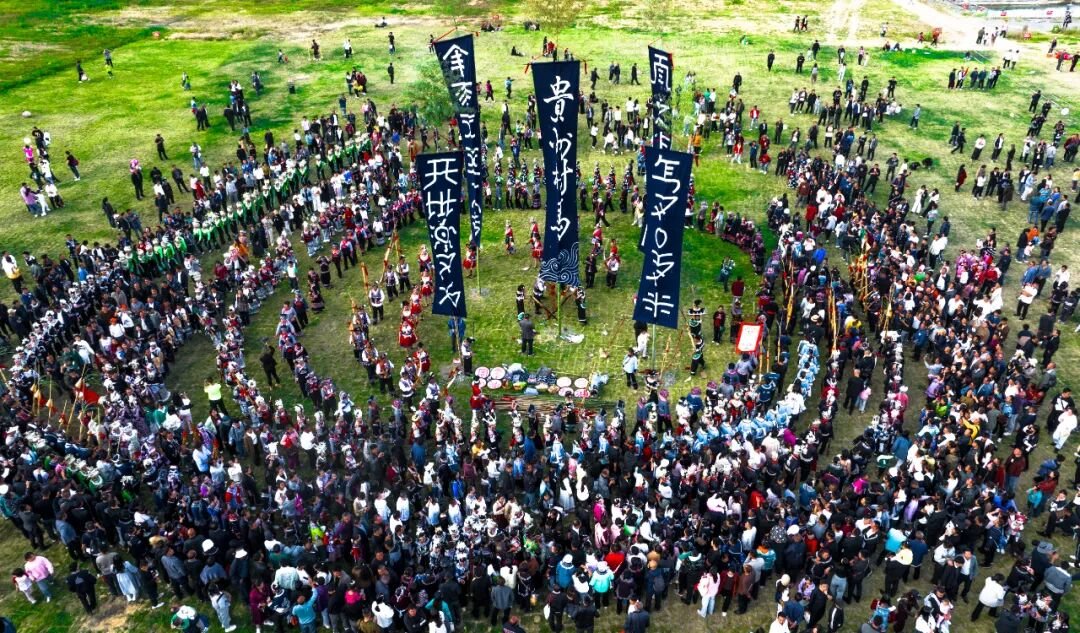
The Shui script, known as shuishu, is one of the last surviving pictographic writing systems still in practical use anywhere in the world — alongside the Dongba script of the Naxi people. Its characters resemble oracle-bone script and bronze inscriptions from China's Bronze Age.
In November 2022, the Shuishu documents of Guizhou Province were inscribed on UNESCO's Memory of the World Asia-Pacific Regional Register at the ninth session of the regional committee in Andong, South Korea — the first entry of its kind for Guizhou. The inscription is listed on the official register of the Memory of the World Committee for Asia and the Pacific, under the title Shui Character Documents, Guizhou Province.
The script works nothing like a modern alphabet:
It is hand-copied, not printed. There has never been a standard woodblock edition. Every volume is copied by hand by shuishu masters, a hereditary role held by men, who transmit the texts orally as well as in writing
The text cannot stand alone. A passage only carries meaning when a shuishu master interprets it together with the oral tradition attached to it
Colour changes meaning. The same character written in red and written in black can mean entirely different things — red for auspicious, black for inauspicious
It is still in daily use. Shuishu governs weddings, funerals, house-building and the timing of festivals. It is the Shui people's encyclopaedia of astronomy, geography, religion, medicine, agriculture and ethics
There are more than 17,000 original shuishu volumes held in archives across Qiannan Prefecture; 79 volumes have been entered in China's National Catalogue of Precious Ancient Books, and 466 shuishu masters have been formally documented in the prefecture. Guizhou has been digitising the corpus since 2002, recording the masters' oral readings before the generation that holds them passes.
A note on English: shuishu masters are best described as hereditary ritual specialists or keepers of the script. They are village scholars, not shamans — a distinction worth keeping in any translated material.
The Duan Festival: The World's Longest Annual Festival
Duan — jieduan in the Shui language — is the Shui New Year. It is the equivalent of Chinese Spring Festival: a time to close out the old year, celebrate the harvest, honour the ancestors and wish for good fortune ahead.
It is also, by some margin, the longest annual festival on earth.
It is calculated from the shuishu texts and the Shui calendar, falling from the twelfth month of the Shui year into the second month of the new year — roughly August to October by the Western calendar, at the point when the grain is in
The festival is celebrated in seven rounds, each lasting seven days, for a total of 49 days
In 2017 it was certified by the World Record Certification Agency (WRCA) as the world's longest annual festival and the world's longest traditional ethnic festival — the certification is public, record no. WRC20170111D
The seven rounds are the part that surprises people. They are not divided by geography. They are divided by kinship — by clan and bloodline. The Shui do not all celebrate at once; each lineage group takes its turn, in an inherited order, and the whole group takes the better part of two months to finish.
That single detail explains the festival's real structure. The 49 days are not 49 days of programme. They are the time it takes an entire ethnic group to take turns hosting its own New Year.
The customs that fill those days:
Ancestor offerings. On the eve, a table is set in the main hall with seven bowls, seven pairs of chopsticks and seven cups of home-brewed rice wine — always an odd number — with eight chairs placed around it for the returning ancestors. The first day is kept meat-free, but fish is never excluded
Fish stuffed with chives. The festival's signature dish, and the one dish no Duan table is complete without. It carries a migration memory: tradition holds that the ancestors, leaving their homeland, were given cooked fish stuffed with nine kinds of greens to sustain them on the road. The recipe was lost over time, and chives were substituted for the nine — the dish eaten today. As the Shui saying goes: no wine, no courtesy; no fish, no Duan
The long-table banquet. Every household cooks, and the tables are joined end to end so a guest can taste every family's cooking. Drink is passed from hand to hand as "rotating wine", with arms linked and shouts of xiu, xiu, xiu — "good, good, good" — before each cup is emptied. Custom requires visiting every single household; skipping one is a serious insult
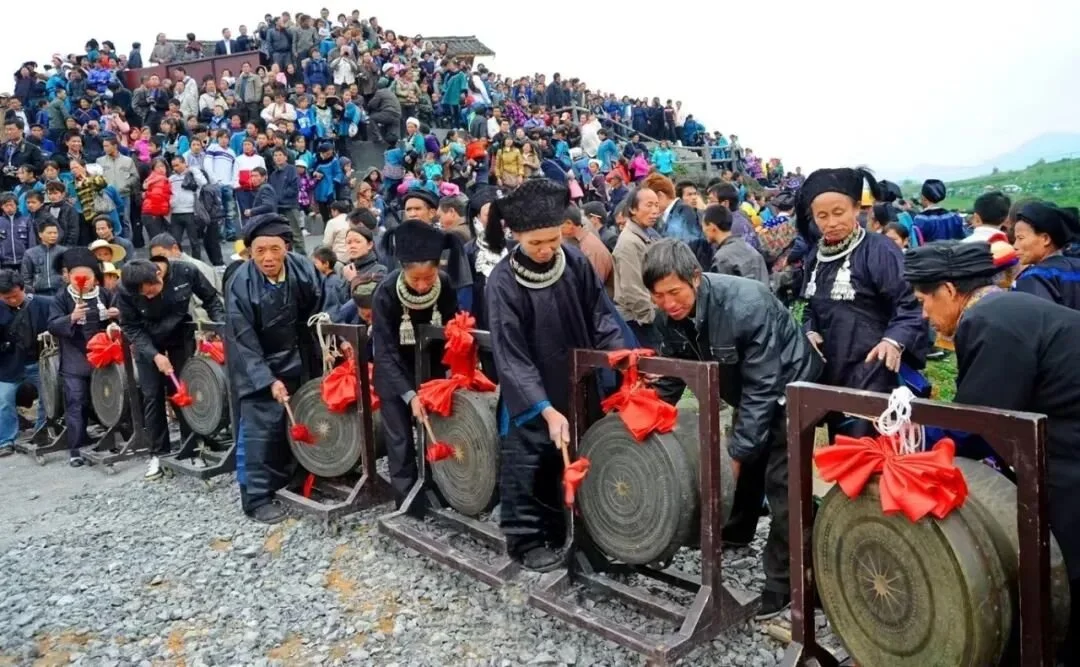
Bronze drums, struck until midnight. Drums hang in the main hall; the village takes turns beating them, and the sound carries from hamlet to hamlet for the entire season
Horse racing on the village slope. See below
Horse Racing That Begins With an Offering to the Ancestors
Sandu is described in Chinese state media as a "horse people of southern China" — an unexpected label for a mountain ethnic group in the subtropics, and the source of much of the event's appeal.
The Shui's ancestors came south on horseback. Horses carried them across rivers and over mountain passes, and the animal became something closer to a totem than a tool:
Sandu is home to more than 7,000 horses, of which over 3,000 are racing horses
There are 32 traditional village racecourses in the county, known as duanpo — the "Duan slopes"
Several local riders are ranked among the strongest in Chinese ethnic racing, and a Shui rider placed fourth in the equestrian events at China's first National Games in 1959
The racing itself is not what a European reader will expect:
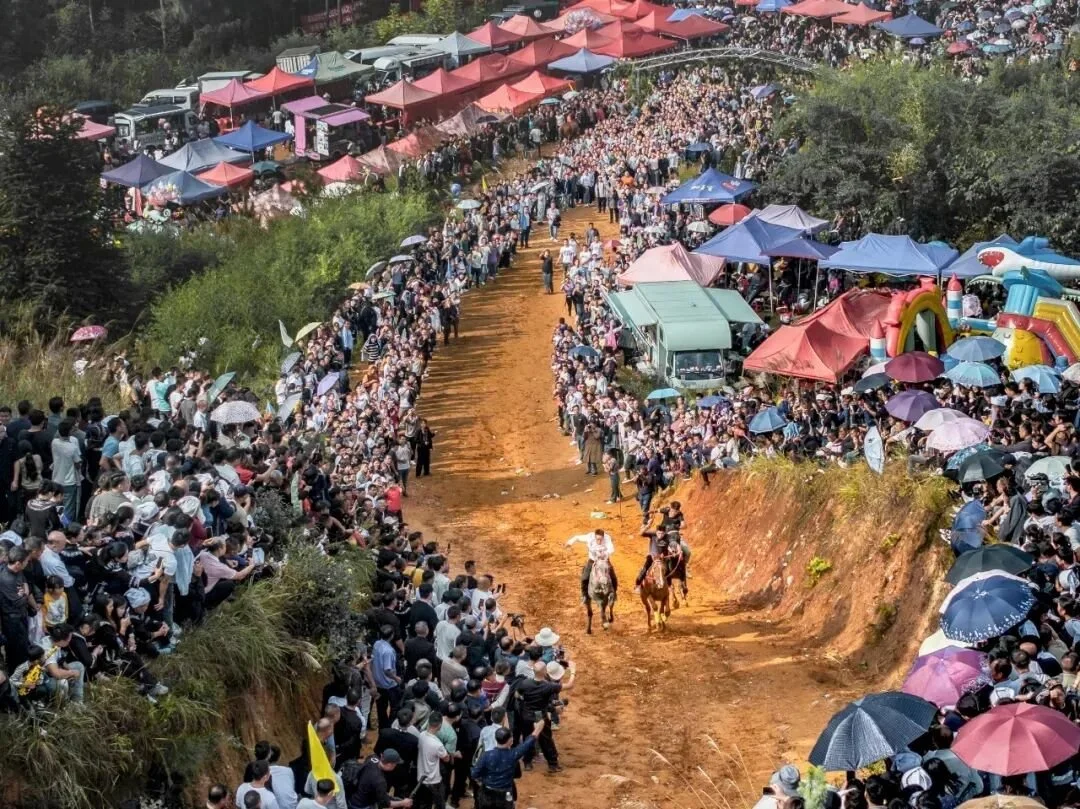
It opens with a sacrifice, not a starting gate. Before any horse runs, an offering table is set in the middle of the course with the village elder presiding. He recites words in memory of the ancestors. Only after he has ridden a slow circuit of the track himself are the races declared open
The race format is called "squeezing the horses." Riders do not run a clean straight. They surge into a valley together, jostling and crowding each other, and the first to force his way out of the pack and up the slope wins. It is a contest of position and nerve as much as speed
It is not a betting event. There is no wagering. The race is an offering to the ancestors and a communal celebration — which is why it is held on a hillside, not at a track
Duan slopes matter socially as well as ritually. The race draws crowds from every neighbouring village, and young people treat the gathering as the year's best opportunity to meet — with courtship songs continuing on the slope after dark.
What Happens Across the 46 Days
The programme runs in distinct phases:
October 1 — Opening day
Ethnic welcome ceremony and traditional Duan sacrifice
National Horse Racing Invitational opens
Shui long-table banquet
Horse-themed street procession
"Four Seasons Village Gala" evening performance
October 1–5 — The racing block
National Horse Racing Invitational in successive rounds
National Women's Mounted Archery Championship
Mass fun run
October 2–5 — Fire on the river
"Phoenix Feather Water Village" water-and-fire show on the Duliu River, including a water-screen film and drone light display
October 16 – November 14 — The village rounds
Seven traditional duanpo slopes hold community race meetings in succession, following the customary order of the festival's seven rounds
November 14 — Final of the Duan Slope Horse King championship
November 15 — Provincial Games marathon closes the season
What's Free
The county has attached a substantial list of free benefits to the season:
Free admission to key scenic areas across the county
Free shuttle buses on dedicated festival routes
More than 10,000 free parking spaces during the National Day holiday
A "Year of the Horse" guest programme — 2026 is the Year of the Horse in the Chinese zodiac. Visitors born in a horse year, visitors whose surname is Ma (马, the Chinese character for horse) or competing riders receive a free Shui long-table banquet on proof of eligibility; partner hotels and craft shops offer 30 per cent off year-round
Free experience vouchers for horse riding, river cruises and dragon boat trips
Updates are published through the county's official "Lingxiu Sandu" WeChat account.
Horsetail Embroidery: The Other Half of Sandu's Economy
Horse culture in Sandu is not confined to racing. The county's other national-level intangible heritage, horsetail embroidery, uses horsehair as its core material — the tail hair is wrapped tightly in silk thread to create a raised, almost sculptural texture, then embellished with coloured silk and coin-shaped bronze ornaments.
Listed as national intangible cultural heritage in 2006, in the first batch
Recognised as a Geographical Indication protected product
It has put more than 30,000 women to work, generating an annual output value above 80 million yuan
Products are exported to over 30 countries, including France and the United Arab Emirates
Alongside rice, horses and embroidery, the county has built what officials call a seven-link industry chain: racing, performance, sales, food, accommodation, travel and research. Village horse clubs, a jockey school, horse-farming subsidies and horsemeat restaurants have all grown out of the race meetings — and horse breeding, once a farming chore, is now a household income source. One breeder in Zhonghe township, whose horse won its fifth banner of the year, put it plainly: "Before, we kept horses because they helped with the farm work. Now a horse can earn me over 100,000 yuan a year."
From Poorest County to Tourism Engine
Sandu's festival is inseparable from its recent history. The county was formerly one of Guizhou's deepest-poverty counties. By the end of 2019, all 134,410 registered poor residents had been lifted out of poverty and all 146 poor villages had been delisted; the county exited China's poverty list in March 2020, a year ahead of schedule.
Economic indicators since:
Urban and rural per capita disposable income up 22.3 per cent and 31.7 per cent respectively between 2020 and 2024
County GDP reached 11.47 billion yuan in 2025, growing 5.3 per cent — faster than the national average
Forest coverage held above 72.47 per cent throughout
The county's own framing of the transition is that it "awakened a cultural gene" rather than inventing a tourist attraction.
What This Says About Rural China
Sandu is one node in a much larger story. Guizhou's "village" series — village basketball, village football, village horse racing, village fashion, village choirs — has become one of the country's most visible cultural exports of the past few years.
The village basketball, village football and village fashion events have accumulated over 280 billion online views combined
People's Daily ran a full-page feature decoding the phenomenon; Guangming Daily put it on its front page
The 2026 World Brand Moganshan Conference in Zhejiang devoted a forum to "decoding China's village cultural phenomenon", where a Sandu official presented the county's model
China's village basketball trademark has been registered in 48 countries
Chinese official commentary describes these events as having grown from "local viral moments" into "part of a national narrative" about grassroots China. For a visitor, the practical consequence is straightforward: this is not a tourist-board invention. It is a real festival in a real county, running to a calendar that has been kept for centuries — and in 2026 it is open for 46 days.
Quick Answers for Travellers
Is the festival free?
Yes. Public festival events, entry to key scenic areas, festival shuttle buses and holiday parking are free. Some activities, such as the horse-riding experience, require vouchers distributed by organisers rather than payment.
How long does the whole thing last?
Two different numbers apply. The Duan Festival itself lasts 49 days — seven rounds of seven days — because it is celebrated by clan groups in turns. The 2026 tourism season runs 46 days, from October 1 to November 15. The two are related but not identical.
When is the best time to see horse racing?
Racing happens in two distinct forms. The competitive invitational and national events run October 1–5 at the main racecourse in the county town. The traditional village races run October 16 to November 14 across seven duanpo slopes, one after another, and finish with the Horse King final on November 14. The village rounds are the more atmospheric of the two — smaller, older and closer to the festival's religious roots.
Do I need to book or reserve?
The county has not published ticketing or reservation rules for the racecourse, nor a day-by-day schedule for the seven village slopes. Only the date ranges are confirmed. Anyone planning around a specific village race day should check with the organisers closer to the date.
Is there any English-language service?
The county has not announced any English-language guiding, signage or interpretation for international visitors. All official information is published in Chinese. Travellers who do not read Chinese will need assistance arranging the visit.
How do I get to Sandu?
Sandu has its own stop on the Guiyang–Guangzhou high-speed railway — Sandu County Station (Sanduxian), between Duyun East and Rongjiang on the line to Guangzhou. Direct trains run from Guiyang in about an hour, and from Guangzhou in roughly four to five hours. One thing to plan around: the station is in Pu'an Township, about 15 km from the county town, so the last stretch needs a taxi or local shuttle. Check current timetables and shuttle times before you travel.
Do I need a Chinese visa?
Yes — standard Chinese visa requirements apply. Some parts of western China require additional permits; Guizhou does not.
Planning a Guizhou Trip Around It
Sandu sits in Qiannan Prefecture, about an hour from Guiyang by high-speed rail, and combines naturally with the wider region — the Miao and Dong villages of southeastern Guizhou, the waterfalls around Anshun, and the karst scenery of Libo.
If you would like to build a Guizhou itinerary around the Duan Festival, or combine it with a longer China trip, LynxTravel arranges private tours across China with licensed local partner agencies in each destination city. Our own agency licence is L-HUN-303839, and you can verify it on our licence page.